Opus 5.5 Built a Game From One Sentence: Cost and Results
We built two browser games with Opus 5.5 from single sentences: a 2D fox game and a 3D ball racer. Both worked first try for $0.67 total.

Update (9 Nov 2026): Claude Fable 5.2 and Mythos 5.2 are out - prices, access and benchmarks are in my Claude Fable 5.2 guide.
👁 135 reads
A browser game from one sentence in Opus 5.5 isn’t just something from X videos: we built two such games on September 26, 2026, each from a single sentence, and both ran without any console errors. We tested them in Polish (a useful proxy for non-English prompting). The first is a 2D skill game on canvas with a fox catching apples, the second a 3D game in three.js with a ball racing down a road. Below you’ll find exact prompts, times, tokens, costs in dollars, screenshots from automated gameplay, and one follow-up fix for a bug we found in the 3D game.
Summary
Both games worked on the first try: 0 console errors, arrow key controls, increasing speed, game over screen, and restart with spacebar. The 2D game took 103 seconds and cost $0.226, the 3D game 95 seconds and $0.185. In the 3D game, the corner counter showed 256 after collision while the end message showed 257, and neither game had mobile touch controls. One fix corrected both problems but cost more than the game itself: $0.255, because the model rewrote the entire file. Three queries total, $0.666.
Why We Tested This and How We Measured
Since the Opus 5.5 launch (September 22, 2026), X has been full of 3D games the model supposedly built “from one sentence.” We wanted to see how much truth there was to this with ordinary prompts, without a polished system prompt and without manual code fixes. We called the model through OpenRouter (anthropic/claude-opus-5.5) with default medium effort level and a 20,000 token output limit. We took costs from the billing field in the response, not from calculations. We described the model’s pricing and parameters in our Opus 5.5 guide, and the cost calculation method in our article about Opus 5.5 pricing.
We ran each game in Chromium through Playwright in a 1280 by 720 pixel window. The script clicked on the canvas, pressed space, then for several seconds pressed left or right arrow randomly 16 times for 200-600 ms and took three screenshots. Pixel comparison between screenshots shows whether anything is moving. Finally, the script stopped steering, waited for game over, took a screenshot, and checked restart with spacebar.
2D Game: Fox and Apples
The prompt, 39 words (translated from the Polish original):
Write in a single HTML file, without any external resources, a 2D skill game on canvas in which you control a fox with arrow keys catching falling apples and avoiding pinecones, with a score counter, three lives, increasing tempo, and a game over screen with spacebar restart.Opus 5.5 thought for 1,630 tokens and wrote the entire response in 103.4 seconds. It produced 11,271 output tokens and an HTML file of 16,942 bytes. All requirements from the prompt are there. The fox, apples, pinecones, clouds, sun, and pine trees are drawn in code, without a single image file. The model also added things we didn’t ask for: a golden apple worth 5 points, a high score saved in browser storage, temporary invincibility after getting hit by a pinecone, and screen shake.
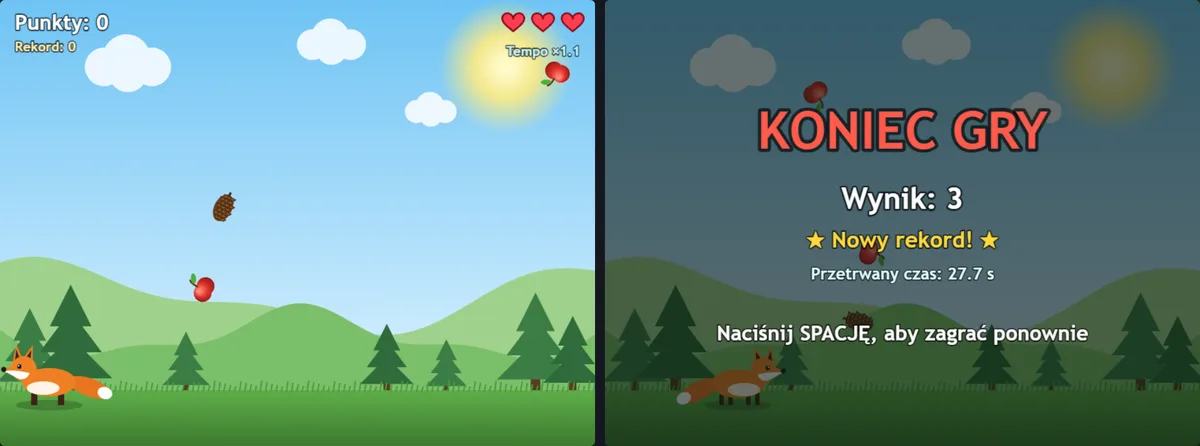
With random steering and waiting, the fox lost three lives after 27.7 seconds with a score of 3, and spacebar started a new game with the high score preserved. Between successive gameplay screenshots, 2.4% and 2.1% of pixels changed, which with small falling objects on a static background means the game is alive. The only stumbles are linguistic: the game over screen shows Polish text with awkward phrasing and a decimal point instead of a comma (grammatically incorrect in the original).
3D Game: Ball on an Endless Road
The second prompt, 46 words (translated from the Polish original):
Write in a single HTML file a 3D game in three.js loaded from CDN, in which you control a ball racing down an infinite road with left and right arrow keys, avoid obstacles, tempo increases over time, score is visible on screen, and after collision the game shows a message and restarts with spacebar.Here the response came after 94.6 seconds: 9,218 output tokens, including 2,084 thinking tokens, file 12,670 bytes, 393 lines. The three.js library version 0.160.0 loads from unpkg, so the game requires internet, which the model noted in its response. The scene has shadows, fog, pine trees, and posts along the road, and at higher speed the camera slightly widens the field of view. The score is distance traveled, with speed in km/h and high score alongside.
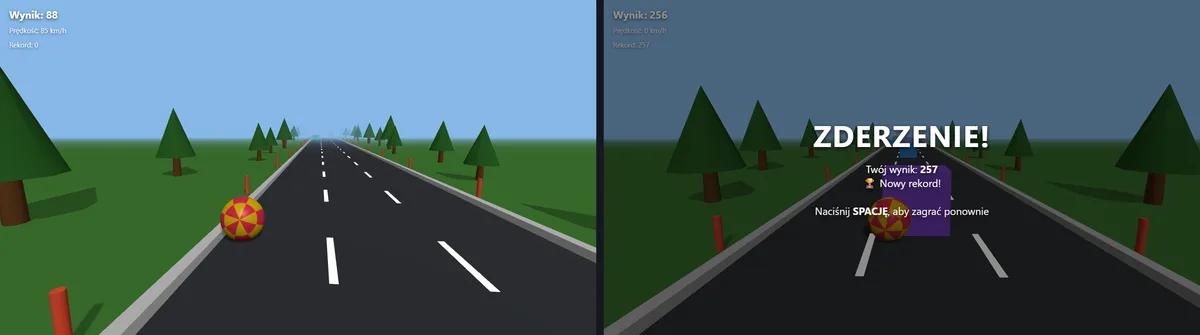
Between screenshots, 15.4% and 20.4% of pixels changed, because in 3D the entire scene shifts. The console was clean again. The bug only showed up in the screenshot after collision: in the corner “Wynik: 256” (Score: 256), but in the message “Twój wynik: 257” (Your score: 257). In the code we can see the cause: distance increases before collision checking, and the counter refreshes after it, so on collision the function ends before the counter gets the last value.
One Follow-up Fix and What It Cost
The second problem isn’t a code bug, but an omission: neither game responded to touch, so you can’t play them on a phone. We sent one sentence to the same conversation:
The game works, but I found two problems: after collision the counter in the corner shows 256 and the final message 257, and on mobile you can't play because there's no touch control. Fix both and return the entire file.Opus 5.5 accurately described the cause of the discrepancy, moved score calculation to a single function, and added controls: holding the left or right half of the screen steers, tapping starts the game, and on touchscreens two arrow buttons appear. Without being asked, it adjusted the camera angle for vertical screens and blocked page scrolling and zooming. We checked this in phone emulation at 390 by 844 pixels: holding the left side pushed the ball to the left edge of the road, right side to the right. The counter and message showed the same number after collision, 227.
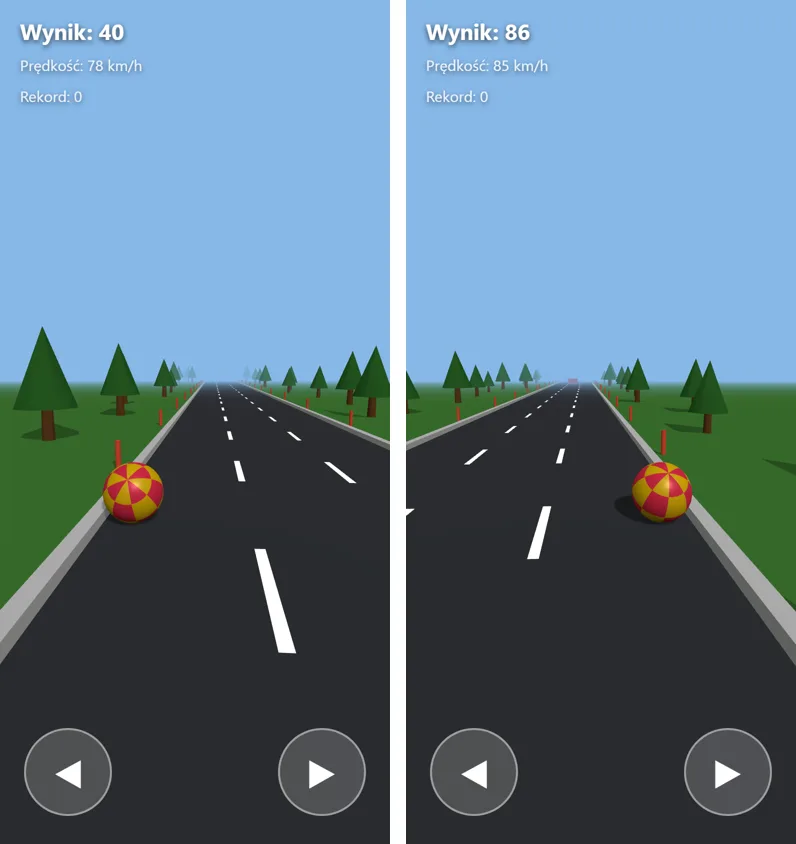
The price of this convenience: 93.2 seconds, 7,378 input tokens (previous conversation returns to the model), 11,295 output tokens, and $0.255. The fix cost 38% more than writing the game from scratch, because the model returned the entire file, which we did ask for. The file grew from 12,670 to 16,888 bytes.
Play Them Yourself
We put both games on the server exactly as Opus 5.5 delivered them (the 3D game after one fix), without any manual code changes. They work on computer and phone: fox and apples (2D) and ball on road (3D). The 3D game downloads the three.js library from the internet, so it needs a connection.
All Numbers in One Table
| Query | Time | Output tokens (thinking) | Cost | File | Result |
|---|---|---|---|---|---|
| 2D game, fox | 103.4 s | 11,271 (1,630) | $0.226 | 16,942 B | works, 0 errors |
| 3D game, ball | 94.6 s | 9,218 (2,084) | $0.185 | 12,670 B | works, score off by 1 |
| 3D game fix | 93.2 s | 11,295 (1,792) | $0.255 | 16,888 B | fixed, touch works |
| Total | 291.2 s | 31,784 | $0.666 |
No file fit in 12 KB. The closest was the first version of the 3D game, but only because the entire graphics engine comes from outside.
What This Means
- One sentence is enough for a playable prototype. The prompts had 39 and 46 words and produced games with no console errors, with elements we didn’t ask for.
- The model won’t think about mobile on its own. If the game is going on a website, add touch controls right in the first sentence. A fix after the fact cost more than the entire first version.
- Minor bugs only show up during play. We saw the score discrepancy of 1 in a screenshot, not in the console. Without automated play or a manual game, it would have gone unnoticed.
- Cost depends on file length, not game difficulty. The rate of $20 per million output tokens means that in our three queries, each 10 KB of finished file cost $0.13-0.15 including thinking. This is our opinion based on three queries, not a larger sample.
If you want to do this at larger scale, with fixes in a loop, it’s more convenient in Claude Code, where the model runs and reads files itself. About whether higher effort level helps, we wrote in our effort level test.
Frequently Asked Questions
How much does it cost to make a browser game in Opus 5.5?
In our measurement, a simple 2D game cost $0.226, and a 3D game in three.js $0.185, through the API on OpenRouter. One fix with rewriting the entire file was another $0.255.
Does a game from one sentence work right away?
In both our attempts, yes: zero console errors, working controls, game over, and restart. In the 3D game there was a score discrepancy of 1, and neither game supported touch.
How long does game generation take?
From 94.6 to 103.4 seconds per game at medium effort level. The model thought for 1,630 to 2,084 tokens.
Sources and Date Checked
- All times
- tokens
- costs
- and screenshots are our measurements from three queries to the anthropic/claude-opus-5.5 model on OpenRouter
- cost from the billing field in the response. Model pricing according to Anthropic’s announcement from September 22
- 2026. The 3D game uses three.js library 0.160.0. Checked September 26
- 2026


More on this from QUANTSLANT
 benchmarks·Z-Image Turbo vs Qwen-Image 2.1: my RTX 4090 testEight prompts, sixteen images and measured RTX 4090 timings. I separate Z-Image Turbo results from smaller-GPU assumptions and language claims.