Kling 4.0: Features, Pricing, API and Availability
Kling 4.0 generates videos up to 30 seconds in 4K. See what’s new, how pricing works, and what we found when checking API access.
👁 189 reads
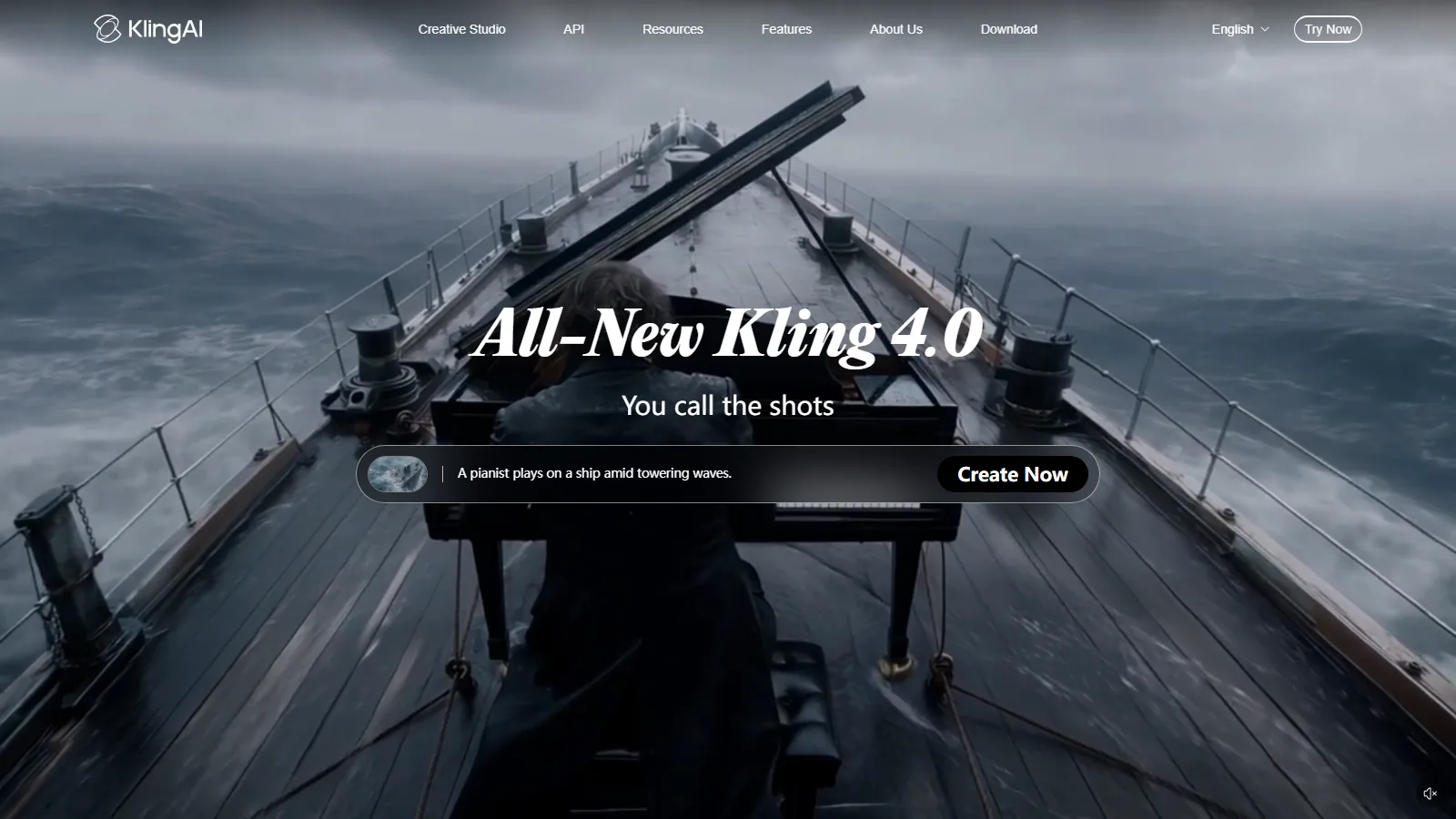
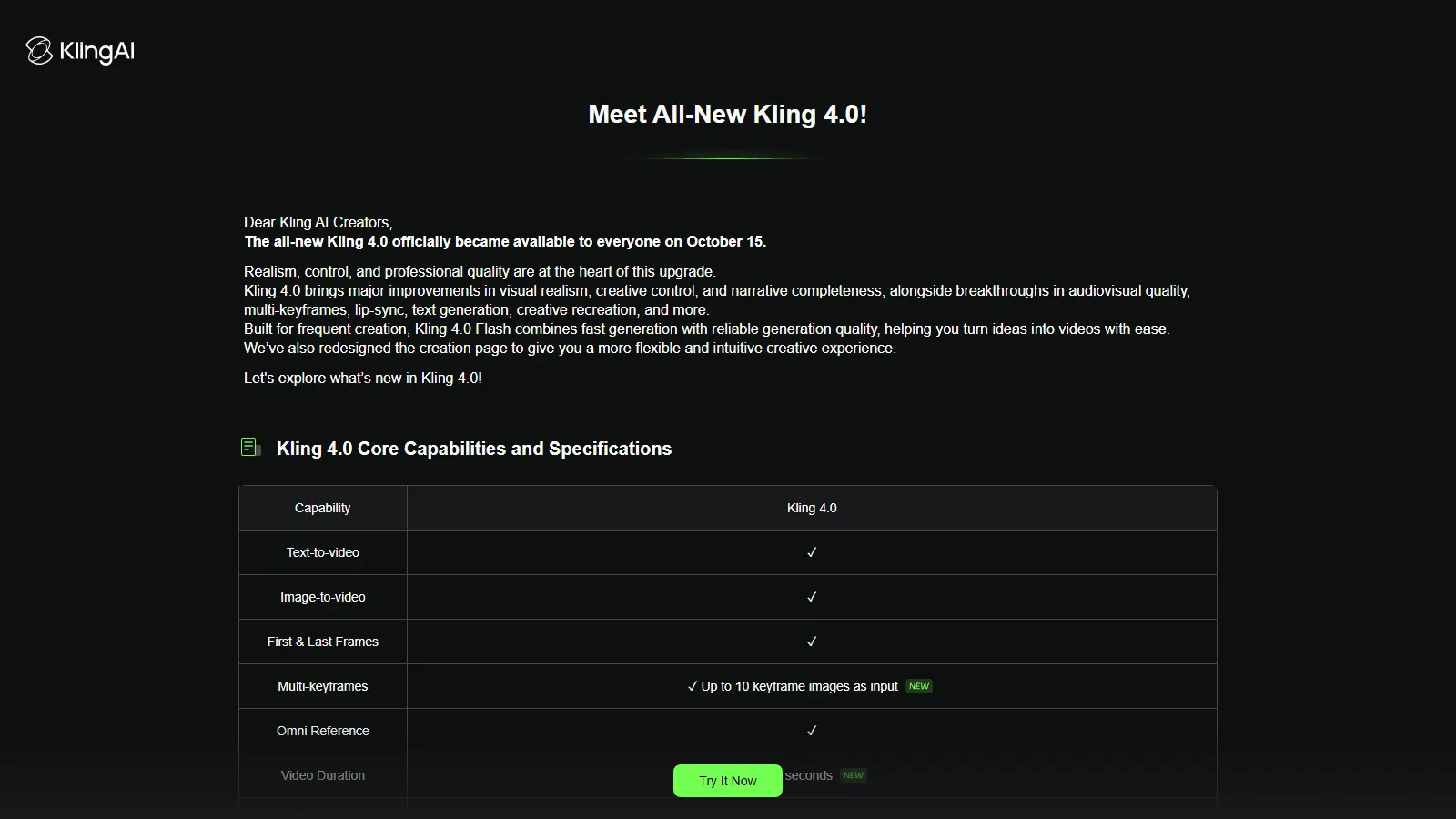
Kling 4.0, often called simply Kling 4 in search results, is the fourth generation of Kuaishou’s video model. Since October 15, 2026, it has been available to everyone on kling.ai, as well as through the official MCP server and CLI. It creates clips up to 30 seconds long in 720p, 1080p or 4K, accepts up to 10 keyframes and 15 references, and generates stereo audio. This guide covers what’s new compared with Kling 3.0, how to get started, pricing, API availability (I checked seven services that evening), comparisons with other models and answers to common questions. For earlier versions, the app and Kling’s history, see the Kling AI guide.
Update, October 20, 2026: FLUX 3 Max, the faster FLUX 3 Video variant post-trained by fal, delivered a 10-second clip in 20-25 seconds in my test. Details, prices and clips: FLUX 3 Max: 10 s of AI Video in 12 s? My Test, Prices, Clips.
For a broader comparison of AI video generators, with my test results, USD prices and free plans, see Best AI Video Generator 2026: Test Results and USD Prices.
Status: available to everyone since October 15, 2026 (as of October 15, 19:00)
- kling.ai and apps: available in the redesigned creator. The site and pricing page opened from Poland without a VPN. Kling 4.0 Flash (720p, up to 20 seconds) had previously been available only to selected users, starting September 28.
- Pricing: Standard plans start at $8.80 per month, and Pro costs $32.56. Kling 4.0 shows “Limited-Time 10% Off” from the Pro plan upward. I checked the creator: 15 credits per second at 1080p and 10 at 720p. Standard does not include Kling 4.0 as a plan benefit.
- MCP and CLI: available officially since October 15 (the kling.ai/mcp server and the @klingai/cli-global npm package, with OAuth sign-in).
- API: not yet. The official API says “Kling 4.0 API Coming Soon.” Kling 4.0 was unavailable on OpenRouter, reAPI, kie.ai and Higgsfield API. fal.ai already had endpoint addresses, but they returned a ready-made placeholder clip.
- Coming soon: 10-bit HDR in 1080p and 4K, video extension up to 2 minutes, and an API for businesses.
- Polish: not among the nine listed languages, but in my October 21 test Kling 4.0 spoke Polish without a single word error (3 of 3 lines in Whisper).
Kling 4.0 at a glance
| Detail | Status as of October 15, 2026 |
|---|---|
| Developer | Kuaishou (Kling AI); announcement and Flash release on September 28, 2026; full model available to everyone on October 15, 2026 |
| Clip length | 3-30 sec (Flash: 3-20 sec) |
| Resolution | 720p, 1080p, 4K (Flash: 720p) |
| Aspect ratios | 21:9, 16:9, 1:1, 9:16, Auto |
| Inputs | Text, image, first and last frames, up to 10 keyframes, up to 15 references |
| Audio | Stereo, two channels; speech in nine languages (not Polish) |
| Where it’s available | kling.ai, apps, MCP and CLI; API “coming soon” |
| Artificial Analysis ranking | Kling 4.0 is not listed yet; the highest-ranked Kling model (3.0 Omni) is 15th for text-to-video |
What’s new in Kling 4.0
The October 15 release notes describe six changes. Here’s what the developer says, along with what each change could mean in practice.
- Up to 30 seconds in one generation. Kling 3.0 topped out at 15 seconds. A longer clip can tell a scene with several turns without stitching together separate generations.
- Up to 10 keyframes. Upload images you want to appear at particular points, and the model fills in the motion between them. Kling 3.0 accepted only the first and last frames.
- Omni Reference with up to 15 items. You can use up to 10 images, five videos (up to 30 seconds total), seven elements (characters or objects, including three from video) and a voice sample. Reference videos can guide character and camera movement; the options also include “white model” video and depth maps.
- Edit existing videos. Add up to five input clips (up to 30 seconds total) and change facial expressions, movement, camera, style or background, or replace a character while keeping the rest of the scene unchanged.
- Stereo audio and better lip-sync. Speech is supported in nine listed languages - Chinese, English, Japanese, Korean, Spanish, Portuguese, German, French and Hindi - “and more,” with accents such as British English or Cantonese.
- On-screen text. The same nine languages are supported for readable text, as well as emoji and logos that should stay attached as the camera moves.
Two features in the release notes are marked “coming soon”: 10-bit HDR at 1080p and 4K, and video extension up to 2 minutes. Don’t assume they’re available at launch. Alongside the model, Kling redesigned its creator: one field for text, images, video and audio; grid or list views; a continuous timeline; a node-based canvas; and an Agent you can instruct by describing your goal.
Kling 4.0 vs Kling 3.0 and Kling 4.0 Flash
| Feature | Kling 3.0 | Kling 4.0 | 4.0 Flash |
|---|---|---|---|
| Length | 3-15 sec | 3-30 sec | 3-20 sec |
| Resolution | 720p, 1080p, 4K in Native 4K mode | 720p, 1080p, 4K | 720p |
| Frames | First and last | Up to 10 keyframes | First frame only |
| References | Elements (Omni version) | Up to 15 | Omni Reference |
| Speech languages | 5 | 9 “and more” | No details |
| Image | SDR | 10-bit HDR (coming soon) | 8-bit SDR |
| API | Yes (from $0.084/sec) | Coming soon | Coming soon |
For a detailed comparison, examples and advice on when to stick with 3.0, see Kling 4.0 vs Kling 3.0. I covered Flash at launch in Kling 4.0 Flash.
Official examples
I’ll run my own Kling 4.0 tests when the model becomes available through an API. For now, these are official materials: a trailer, a video from the Kling AI YouTube channel and an example from the release notes. These are demonstrations selected by Kuaishou, not generations of my own. Treat them as a showcase of the model’s potential, not an independent quality assessment.
How to use Kling 4.0
- Visit kling.ai (referral link) or download the Kling AI app (publisher: KLING AI PTE. LTD.). Watch out for similarly named imitations in app stores.
- Create an account using email, Google or Apple. The Basic plan does not require a card and provides free daily credits.
- In the creator (Generate), select Kling 4.0 or Kling 4.0 Flash. Flash is cheaper and faster, but limited to 720p and 20 seconds.
- Set the duration (3-30 seconds), aspect ratio and resolution. The creator shows the credit cost before you click: 15 credits per second at 1080p and 10 at 720p. 4K is currently marked “Coming Soon.”
- Add materials in one field: a starting image, keyframes, character references or a video showing movement. You can refer to each reference in your prompt.
- Write your prompt in English and describe movement, camera and lighting. Spoken dialogue can be in English or one of the nine listed languages; Polish is not listed, but it worked without errors in my October 21 test. See Kling 4.0 prompts for examples.
- Review the result at full size: hands, text and small objects are often most likely to look wrong when enlarged.
If you’d rather have an agent such as Claude, ChatGPT or Cursor request videos for you, Kling offers an MCP server and command-line tool. See Kling 4.0 MCP and CLI for setup instructions.
Kling 4.0 pricing: plans and costs
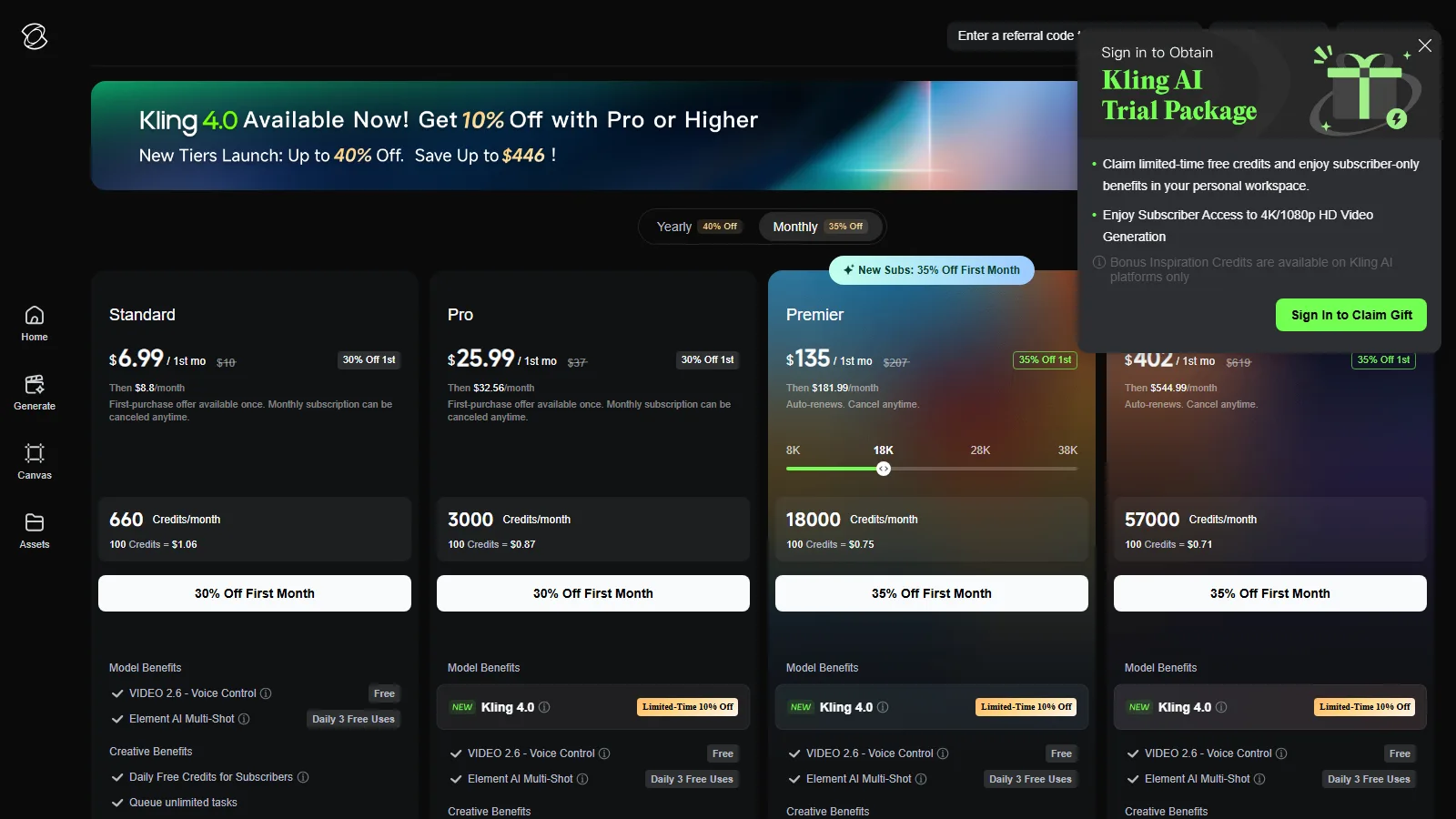
I checked prices on Kling AI’s official plans page on October 15, 2026, at about 18:20. Prices are listed in USD, with no VAT information. The page was accessed from Poland without signing in.
| Plan | Monthly price | Credits per month | Kling 4.0 |
|---|---|---|---|
| Basic | $0 | Free daily credits | No discount |
| Standard | $8.80 | 660 | Not included as a plan benefit |
| Pro | $32.56 | 3,000 | 10% off for a limited time |
| Premier 8K | $80.96 | 8,000 | 10% off |
| Premier 18K | $181.99 | 18,000 | 10% off |
| Ultra+ | $544.99 | 57,000 | 10% off |
The first month is 30-35% cheaper. For example, Pro costs $25.99. Pro costs $293.04 per year, or $24.42 per month. The $159.99 Ultra plan, which offered early access to Flash from September 28, has disappeared from the pricing page; it has been replaced by Ultra+ with 57,000 credits. See Kling 4.0 pricing and plans for all Premier options and annual prices.
Prepaid API access to Claude, GPT-6, Gemini, Veo and Kling with one key: see my Jantaris guide.
How many seconds of Kling 4.0 do plans include?
I checked the kling.ai creator on the evening of October 15, 2026: one Kling 4.0 result at 1080p, 30 seconds and 16:9 costs 450 credits, or 15 credits per second. The same clip at 720p costs 300 credits, or 10 credits per second. The creator states: “Billed per second. Input video duration is included in the total billed duration.” That means input video, such as a reference or a clip you want to edit, also counts toward the billable duration.
| Plan | First month | Credits | Seconds at 1080p / 720p | Cost per second at 1080p / 720p |
|---|---|---|---|---|
| Standard | $6.99 | 660 | Kling 4.0 is not included as a plan benefit | |
| Pro | $25.99 | 3,000 | 200 / 300 sec | $0.13 / $0.087 |
| Premier 18K | $135 | 18,000 | 1,200 / 1,800 sec | $0.11 / $0.075 |
| Ultra+ | $402 | 57,000 | 3,800 / 5,700 sec | $0.11 / $0.071 |
- After the first month (Pro $32.56, Premier 18K $181.99, Ultra+ $544.99), a second at 1080p costs $0.16 / $0.15 / $0.14, and at 720p it costs $0.11 / $0.10 / $0.096.
- A 30-second 1080p clip (450 credits) in the first month costs $3.90 on Pro, $3.38 on Premier 18K and $3.17 on Ultra+ (then $4.88 / $4.55 / $4.30).
- Premier 18K is the best fit for a music video: 1,200 seconds at 1080p gives you 40 shots of 30 seconds - enough for several versions of each shot in a three-minute clip. The per-second cost matches Ultra+ ($0.11), while the plan costs almost three times less ($135 in the first month).
- Standard ($6.99, then $8.80) does not include Kling 4.0 in its “Model Benefits.” Don’t buy it specifically for Kling 4.0.
- The 10% discount on Kling 4.0 from Pro upward may or may not reduce the credit rate, so these calculations exclude it. If the discount applies, you’ll get about 10% more seconds.
- 4K and HDR are marked “Coming Soon” in the creator, and the cost of 4K is not yet known.
My API availability check
I wanted to run Kling 4.0 through an API on the same five scenes I used to test six models in the Video Arena on October 8: a camera orbit, Polish speech, text on a sign, water and the same character in two shots. I also had a sixth scene with three shots over 15 seconds. That evening, I checked seven services that are often among the first to get new video models:
| Service | Kling 4.0 status at 18:30 on October 15 |
|---|---|
| Official Kling API | “Kling 4.0 API Coming Soon”; API packages “currently don’t support Kling 4.0” |
| fal.ai | kling-video/v4/... endpoints exist, but return a ready-made placeholder clip (0 billable units) |
| OpenRouter | Unavailable; the latest options are Kling 3.0 Pro and Standard |
| reAPI | Model page marked “coming soon” |
| kie.ai | “coming soon” |
| Higgsfield API | Unavailable; the latest options are Kling 3.0 and O3 |
| Kling MCP and CLI | Available, but require a Kling account and sign-in |
fal.ai was the most interesting case. Its new endpoint schemas were public and matched the release notes (3-30 seconds, 21:9, keyframes, multiple shots and voices), so I submitted two short requests for a rotating red cube on a table. Both returned after 2.5 seconds with the same 12-second clip of an astronaut, and neither used any billable units. This was a placeholder ahead of launch, not a generated result. I cover the details in Kling 4.0 API: where it’s available.

I’ll run the Video Arena quality test once the model can be called through an API. The script is ready and checks whether a provider is generating real results. Until then, I’m not assigning Kling 4.0 a score because I haven’t seen any of its clips apart from the developer’s examples.
Kling 4.0 compared with other video models
Kling 4.0 had not appeared in the Artificial Analysis Video Arena leaderboard as of October 15, around 18:20. New models usually appear there after a few days of voting. Below are leading models from the ranking and scores from my Video Arena (the same five scenes, scored from 0 to 10). The Kling model in my Arena was Kling 3.0 Standard, the only version available through an API on October 8.
| Model | Artificial Analysis Elo, text-to-video | My Arena (average) | Maximum clip length |
|---|---|---|---|
| Wan 3.0 | 1174 (1st) | 8.8 | 30 sec |
| FLUX 3 Video | 1147 (6th) | 8.9 | 20 sec |
| MiniMax H3 Max | 1155 (5th) | 8.4 | 15 sec |
| Seedance 2.5 | 1160 (3rd) | 5.6 | 30 sec |
| Kling 3.0 | 1000 (16th) | 6.6 | 15 sec |
| Veo 3.1 Lite | 950 (21st) | 4.8 | No details |
| Kling 4.0 | Not listed yet | To be tested after API launch | 30 sec |
Kling 3.0 struggled most with two scenes in my video arena: a Polish sentence (intelligibility: 5.5 out of 10) and the sign text “YELLOW BOAT” (4 out of 10). The English wording is a translation of the original Polish test text, “YELLOW BOAT” (translated from the Polish original); the actual test was in Polish, and the translated wording was not retested. Kling 4.0 promises better on-screen text in nine listed languages, without Polish. I checked it on October 21: the chalkboard text “ŻÓŁTA ŁÓDŹ” came out with every Polish diacritic correct (9/10). For a comparison of features and prices with Seedance 2.5 and Veo, see Kling 4.0 vs Seedance 2.5 vs Veo.
My Kling 4.0 test, October 21, 2026
On October 21, 2026 I generated 10 clips with Kling 4.0 in kling.ai: 720p, Omni reference mode, fictional characters only. The average score was 8.45/10. The biggest surprise was Polish speech: it is not on the official language list, yet all 3 Polish lines came out without a single word error in Whisper large-v3. English and French speech were not part of this test.
| # | Scene | Length | Score /10 |
|---|---|---|---|
| 1 | Camera orbit around a motorcycle | 5 s | 7.0 |
| 2 | Polish speech (tongue twister) | 5 s | 9.5 |
| 3 | Chalk lettering with Polish diacritics | 5 s | 9.0 |
| 4 | Water overflowing a glass | 5 s | 8.0 |
| 5 | Character after a hard cut | 5 s | 8.5 |
| 6 | Baker, 1 reference image | 5 s | 9.0 |
| 7 | Bakery, 3 reference images | 5 s | 8.5 |
| 8 | Bakery, 10 reference images | 5 s | 8.0 |
| 9 | Multi-shot baker, 3 shots | 15 s | 8.5 |
| 10 | Boxing coach and dachshund, 9:16 | 10 s | 8.5 |
The 10 clips cost 585 credits in total (9 credits per second at 720p after the 10% Kling 4.0 discount). Two weak spots: the motorcycle orbit stopped at about 90 degrees instead of 180, and the model carried props from reference images (a coach’s boxing gloves) into scenes where they did not belong.
- I tested Kling 4.0 on 10 clips - every score, the failures and what a small test can prove.
- How many references Kling 4.0 really holds (1, 3, 10) - what stays consistent and what drifts.
- Kling 4.0 on fal.ai: playground step by step - fields, the multi_prompt fix and the real cost.
Does Kling 4.0 support Polish?
Yes, in practice. Polish is not among the nine languages listed in the release notes (the list ends with “and more”), but in my October 21 test all three Polish lines came out with zero word errors in Whisper large-v3. In my September 28 test, Kling 3.0 mispronounced between 4 and 10 of the 12 words in a Polish sentence. The actual test was in Polish; any English rendering of its prompt would be a translation, not a retest. See Kling and Polish for results, videos and workarounds such as dubbing or recording a voice-over separately.
Who should use Kling 4.0?
- Worth considering: ads and product clips up to 30 seconds in one shot, storyboards with keyframes, recurring characters based on references, and 21:9 editing in 4K.
- Probably not the right fit: if you want to automate production through a standard API (not available yet), or only need five-second clips - leading models in the rankings may be cheaper for those.
That’s my assessment based on the release notes, pricing and Kling 3.0 results, not a test of Kling 4.0.
More Kling 4.0 guides
- Kling 4.0 is available to everyone: features and pricing (October 15)
- Kling 4.0 API: I checked seven services (October 15)
- Kling 4.0 pricing: plans, credits and discounts (October 15)
- Kling 4.0 vs Kling 3.0 (October 16)
- Kling 4.0 MCP and CLI: how to connect Claude and ChatGPT (October 16)
- Kling 4.0 vs Seedance 2.5 vs Veo (October 17)
- Kling 4.0 prompts: 20 examples (October 17)
- Kling 4.0 for small businesses: make an ad step by step (October 18)
- Kling 4.0 for music videos (October 18)
- Kling 4.0: common mistakes (October 19)
- Kling 4.0 for free: Basic plan and limits (October 19)
- Kling 4.0 in Poland: how to buy (October 20)
- Kling 4.0 keyframes (October 20)
- Kling 4.0 4K and HDR (October 21)
- Kling 4.0 in the Artificial Analysis ranking (October 21)
- Kling 4.0 audio and lip-sync (October 22)
- Kling 4.0 Flash, Kling 4.0 Omni Reference, Kling and Polish
Frequently asked questions
When did Kling 4.0 launch?
Kling 4.0 has been available to everyone since October 15, 2026. The announcement and early access to Kling 4.0 Flash for selected users began on September 28, 2026.
Is Kling 4.0 free?
The Basic plan provides free daily credits. Kling 4.0 costs 10 credits per second at 720p and 15 at 1080p, according to my check in the creator. Without a paid plan, 1080p is limited to three attempts. Free videos have a watermark and cannot be used commercially.
How much does Kling 4.0 cost?
Plans start at $8.80 per month for Standard; Pro costs $32.56. Standard does not include Kling 4.0 as a plan benefit, so the practical starting point is Pro. A second at 1080p costs 15 credits, or $0.11 on Premier 18K or Ultra+ to $0.16 on Pro after the first month.
How long can Kling 4.0 videos be?
One Kling 4.0 generation can be 3-30 seconds long; Kling 4.0 Flash supports 3-20 seconds. Extending videos to 2 minutes is listed as “coming soon.”
Is Kling 4.0 available through an API?
Not as of October 15, 2026. The official API is marked “Coming Soon,” and Kling 4.0 was unavailable on OpenRouter, reAPI, kie.ai and Higgsfield API. fal.ai has Kling 4.0 endpoint addresses, but they return a placeholder clip. The official MCP and CLI tools are available after you sign in with a Kling account.
What’s the difference between Kling 4 and Kling 4.0?
There is no difference: they’re two names for the same model. Kling’s official name is Kling 4.0, alongside the lighter Kling 4.0 Flash version.
Does Kling 4.0 speak Polish?
Yes. Polish is not on the official list of nine languages, but in my October 21 test all three Polish lines (a tongue twister, a baker’s line and a coach’s shouts) were transcribed by Whisper without a single word error. It is a small sample, so listen to every clip before publishing.
Sources
- Kling AI: Kling 4.0 release notes (checked October 15, 2026)
- Kling AI: plans and pricing (checked October 15, 2026, 18:20)
- Kling AI Developer Platform: Kling 4.0 API Coming Soon (October 15, 2026)
- Kling AI: API pricing (October 15, 2026)
- Kling AI on X: announcement of full Kling 4.0 availability (October 15, 2026)
- npm: @klingai/cli-global, official Kling CLI (version 0.2.1)
- Artificial Analysis: Video Arena (checked October 15, 2026)
- reAPI: Kling 4.0 (coming soon, October 15, 2026)
- My API checks on October 15, 2026, 17:45-18:40: fal.ai (two requests), OpenRouter, Higgsfield API, and the reAPI and kie.ai catalogs
- Kling AI on YouTube: official Kling 4.0 videos (September 28-October 15, 2026)
- Testing method: Quantslant Lab
 Kling 4.0 Is Now Available: Features, Pricing and APINews
 Kling 4.0 Pricing: Plans, Credits and 10% DiscountAI Tools
 Seedream 5.5: Features, Availability, API Pricing, and BenchmarksNews
The link to Higgsfield is a partner link: if you buy through it, QUANTSLANT earns a commission and you pay the same price. It has no influence on the content, including where the coverage is critical.
More on this from QUANTSLANT
 guides·Midjourney V8.2 Draft Mode: 24 Sketches at Half PriceDraft Mode in Midjourney V8.2 generates 24 small sketches for 0.4 GPU minutes. We tested whether it's worth using over standard generation.