25 Claude Opus 5.5 Prompts That Use Its Strengths
25 ready-to-use prompts for Claude Opus 5.5: code, long documents, contracts, SVG, games. Five tested with cost and a cheat sheet for effort levels.

Update (9 Nov 2026): Claude Fable 5.2 and Mythos 5.2 are out - prices, access and benchmarks are in my Claude Fable 5.2 guide.
👁 125 reads
Claude Opus 5.5 prompts deliver the most where the model has an edge: long context up to one million tokens, code, analysis, writing, and graphics from code. We collected 25 ready-to-use prompts, grouped by task. We ran five of them on September 26, 2026 through the API and show you a snippet of the result, timing, and exact cost. For each group, we added the effort level you should start with.
Summary
Five tested prompts cost a total of 0.18 USD. The cheapest (simplifying a paragraph on low effort) cost 0.003 USD and took 3.4 seconds without a single thinking token. Code with tax ID validation passed all 33 test cases on the first try. One mistake was ours: a project plan on low effort was cut off at the 3,000 token limit, because low effort doesn’t mean short output.
How to Match Effort to Task
Opus 5.5 always thinks, and the default effort level is medium. In the API you set it with a parameter, for example in OpenRouter "reasoning": {"effort": "low"}. In our test of effort levels on a medium-difficulty task, the level changed neither the result nor the cost, because the model adjusts the amount of thinking itself. The cheat sheet below is a starting point. This is our opinion.
| Task Type | Starting Effort | From Our Measurements |
|---|---|---|
| Editing, summaries, emails | low | 0 thinking tokens, 3.4 s |
| Code, SVG, contract analysis | medium | 407-889 thinking tokens, 16-24 s |
| Long documents, large repositories, games, difficult debugging | high | not measured, increase when medium fails |
Long Document (1 Million Token Context)
- “I’m pasting 14 project documents. Find all contradictions between them. For each, provide both quotes verbatim, file name, and section. If you’re not certain, mark it as ‘to verify’.”
- “Here’s the entire repository. Draw a dependency map between modules in Mermaid and list 5 places where a change in one file breaks three others.”
- “This is a transcript of 3 hours of meetings. List decisions, responsible persons, and deadlines. Support each point with a quote and timestamp. Don’t add decisions that no one stated.”
- “Compare two versions of terms and conditions. Table: paragraph, old text, new text, impact on customer in one sentence. Skip purely editorial changes.”
Writing
- Tested: simplifying a bureaucratic paragraph (low effort). We ran this test in Polish.
Rewrite the following paragraph into simple, natural language for an online store customer. Rules: maximum 3 sentences, sentences up to 15 words, zero jargon, active voice, most important information in the first sentence. Don't add facts that aren't in the text. Return only the new paragraph.

Text: "In connection with the need to adapt logistics processes to increased order volume during the pre-holiday period, we inform you that fulfillment of orders placed after December 15 may be extended to 5 business days, with prepaid orders being processed first."
Result in full (translated from the model’s Polish output): “If you order after December 15, you may wait up to 5 business days for your order. Before the holidays we have more orders than usual. We fulfill prepaid orders first.” All rules met, no added facts. 3.4 s, 96 output tokens, 0.003 USD. More about the model’s multilingual quality in our test Opus 5.5 in Polish.
- “Edit the text according to these rules: [rules]. Below, list changes in format: was, is, which rule.”
- “Write a refusal to cooperate with a client who is 45 days overdue on payment. Polite, without apologizing, 5 sentences, with a specific deadline.”
- “Give 10 titles for this text, each up to 60 characters, no rhetorical questions and no promises the text doesn’t fulfill.”
Code
- Tested: tax ID validation with tests (medium effort). We ran this test in Polish.
Write in Python 3 a function `waliduj_nip(nip: str) -> bool` for Polish tax ID (NIP). It should accept notation with dashes and spaces ("123-456-32-18"), reject anything other than 10 digits, and check the control sum (weights 6,5,7,2,3,4,5,6,7; sum mod 11; result 10 means invalid NIP). Include 5 pytest tests, including edge cases. No comments in code except docstring. Return only one code block.The model returned 79 lines: a function and 5 parameterized tests covering 33 cases, including Arabic-Indic digits, tabs, and a number instead of a string. We ran them: 33 of 33 passed. 21.3 s, 889 thinking tokens, 0.039 USD.
cyfry = nip.replace("-", "").replace(" ", "")
if not re.fullmatch(r"[0-9]{10}", cyfry):
return False- “Here’s a diff. Do a review: only bugs that will change program behavior, from most dangerous. For each, line number and a test that will expose it.”
- “I have an error and log below. Give 3 hypotheses in order of probability and for each one command that will confirm or refute it. Don’t write a fix yet.”
- “Rewrite this module from JavaScript to TypeScript without changing behavior. First write tests that will lock in current behavior.”
Analysis and Planning
- Tested: project plan (low effort). We ran this test in Polish.
I'm a one-person company and I want to launch a paid newsletter (quarterly $13) for accountants about AI tools in 4 weeks. I have 1,200 people on my free list. Break down a plan week by week: maximum 4 tasks per week, with a measurable outcome for each. At the end, 3 biggest risks and how to check them cheaply before launch. No intro, no summary.The plan was concrete: in week 1 a survey with goal “min. 120 responses (10% of list)”, in week 3 pre-sale with goal of 20 paid subscriptions. But the response was cut off mid-sentence because we set a 3,000 token limit. 37 s, 0.061 USD. Lesson: for plans, set output limit with margin, even on low.
- “Here’s a CSV with sales data. Find 3 anomalies. If you lack data for a conclusion, write what’s missing instead of assuming.” We checked this in our article about number hallucination.
- “Do a pre-mortem: it’s a year later and the project failed. Give 5 most likely causes and an early signal for each.”
- “Compare these 3 offers in a table: total price over 12 months, hidden costs, cancellation terms. At the end, which one is missing data.”
Contracts (Not Legal Advice)
- Tested: list of questions for a lawyer (medium effort). The clauses are fictional. We ran this test in Polish.
You are not a lawyer and you do not provide legal advice. Read a fragment of a B2B contract for software development services and prepare a list for discussion with a lawyer.

Format: Markdown table with columns: Point | What it says (1 sentence) | Why it may be risky for contractor | Question for lawyer. Maximum 5 rows, only things actually resulting from the text. At the end, one sentence about what's missing from this fragment.

§3 para. 2. Contractor transfers to Client copyright to works upon their delivery, for all known fields of exploitation.
§4 para. 1. Payment is due within 60 days from the date of invoice acceptance by Client.
§4 para. 3. Client may withhold payment until all reported defects are removed.
§6 para. 1. For each day of delay, Contractor will pay a contractual penalty of 1% of total remuneration.
§7. Contractor will not undertake cooperation with Client's customers for 24 months after contract termination.
The model connected two clauses: rights transfer upon code delivery, and payment can be withheld, so the client may have rights to code they haven’t paid for. It also calculated that the unlimited penalty after about 100 days exceeds the contract value. It added on its own that this is not legal advice. 24.1 s, 0.041 USD.
- “List from this contract all deadlines and amounts in a table: paragraph, what, how much, from when counted. Don’t interpret anything.”
Graphics and Video from Code
- Tested: chart in SVG (medium effort). We ran this test in Polish.
Draw in pure SVG (viewBox 0 0 800 450) a horizontal bar chart "Prompt Lab: score out of 100 pts" for five models: Claude Opus 5.5 - 90.1; Model B - 84.6; Model C - 81.2; Model D - 77.9; Model E - 72.4. Style: background #0e0d0c, bars without rounding, winner in color #c46a3c, rest #5a534c, text #f2ede6, font sans-serif, values at end of bars with decimal point, axis from 0 to 100. No scripts and external resources. Return only SVG code.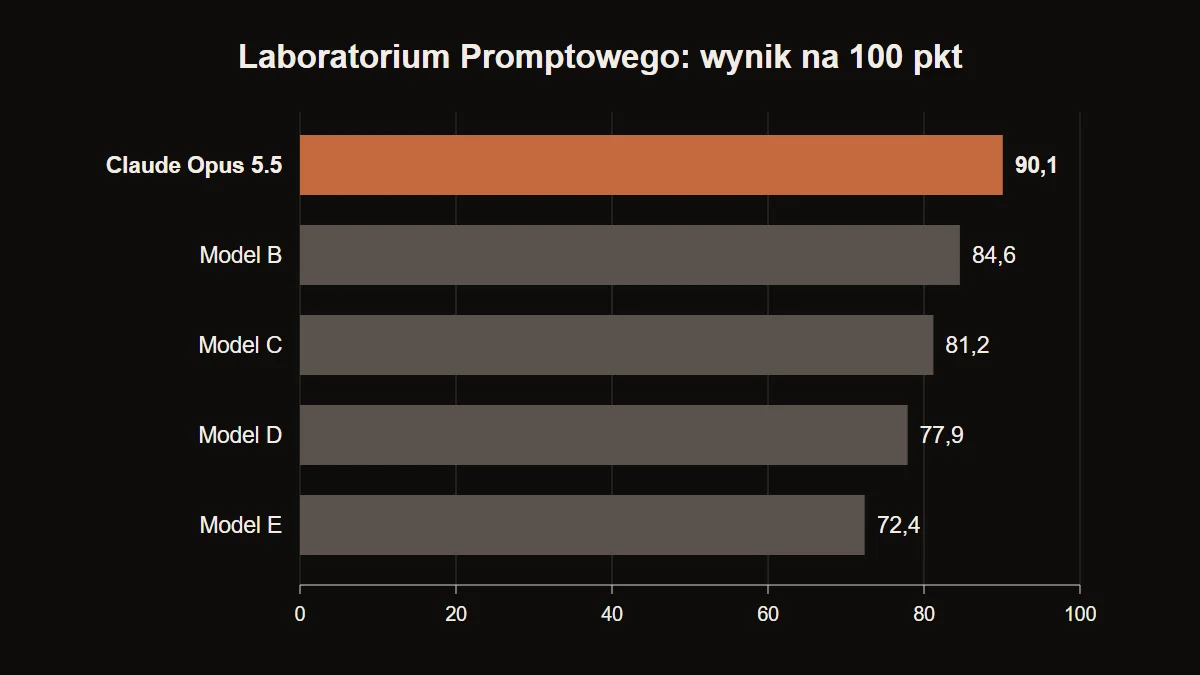
We checked bar lengths: they match the scale to the pixel. 16.1 s, 0.037 USD.
- “Make an animated SVG loading icon in 3 brand colors, only SMIL or CSS in file, 1.2 s loop, max 2 KB.”
- “Write a Remotion composition 1280×720, 30 fps, 9 s: [list of scenes, HEX colors, texts]. Only remotion package, animations with useCurrentFrame().”
- “From this data make an SVG infographic 1080×1350 for social media: 1 main number, 3 supporting ones, source in footer.”
Games and Pages
- “Make a game in one HTML file: [mechanics in 2 sentences]. Keyboard and touch controls, score saved in localStorage, no external libraries.”
- “Build a landing page in one HTML file for [product]: hero section, 3 benefits with numbers, pricing, FAQ. Mobile first, no images from the web.”
- “Make a clickable customer panel prototype with 3 screens, on fictional data, so I can show it before writing the backend.”
For games and pages, start with medium, and switch to high when the model loses logic between files. You can check token costs in the Opus 5.5 pricing, and full model description in the guide.
Frequently Asked Questions
Do Claude Opus 5.5 prompts have to be in English?
No. All five tests were in Polish and the texts in responses were written in correct Polish with all diacritical marks.
How much does one prompt cost?
In our tests from 0.003 to 0.061 USD. Output costs the most: 20 USD per million tokens.
What effort level should I choose?
Low for editing and short texts, medium for code and analysis, high for long documents and difficult bugs. At low effort level, our paragraph was generated without thinking tokens.
Will Opus 5.5 replace a lawyer for contracts?
No. It prepares a good list of questions and points out provisions to check, but leave contract evaluation to a lawyer.
Sources and Verification Date
Our own test
- 5 queries to Claude Opus 5.5 through OpenRouter (
anthropic/claude-opus-5.5) - cost from billing field of response. Model parameters (1 million token context
- up to 128k output
- default medium effort) from Anthropic model documentation
- prices from Anthropic announcement. Verified September 26
- 2026


More on this from QUANTSLANT



 news·Google Gemini 4 Argon: New Model for Complex Professional TasksGoogle DeepMind announces Gemini 4 Argon, a frontier-class model built for complex, long-running professional tasks with 1M token context window.