Liquid AI d1: Open Decision Model, AA Benchmark, and Performance
Liquid AI released d1: a decision model starting at $0.04/M input tokens with open d1-3B weights. We review benchmarks, pricing, and our classification tests.
👁 116 reads
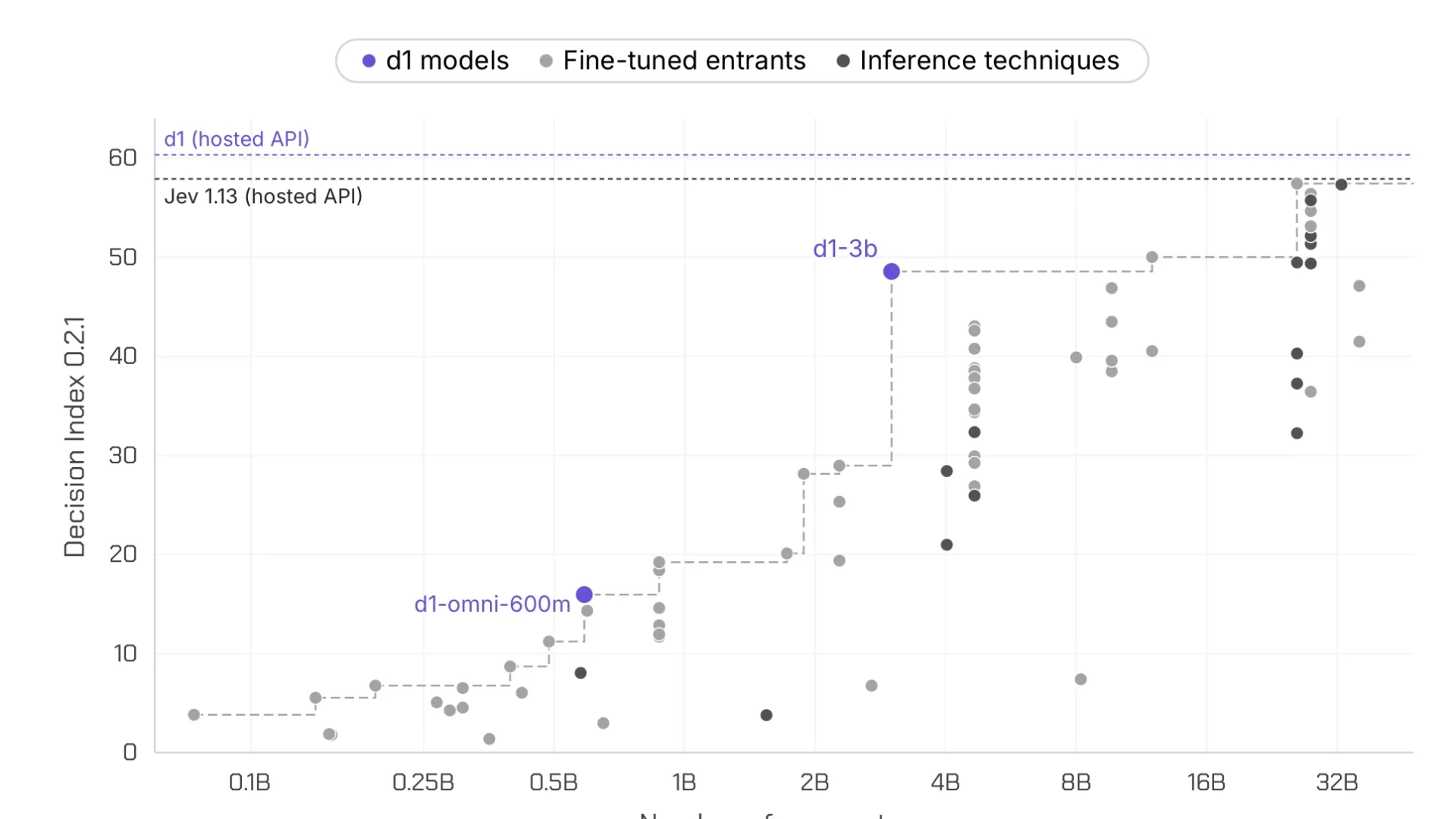
d1 is Liquid AI’s decision model: instead of generating open-ended text, it selects an answer from a provided list and outputs the probability for each option. The hosted version launched on September 29, 2026, at $0.04 per million input tokens, and on October 7, Liquid AI released open weights for d1-3B alongside the experimental d1-omni-600M, both designed to run on standard GPUs and edge hardware. In the Artificial Analysis Decision Index from October 13, 2026, d1 scores 50.3 points (7th place out of 11) and posts the highest knowledge accuracy among decision models - though it almost never admits when it does not know the answer.
Status as of October 13, 2026
- d1 (Hosted): Available via Liquid AI API and OpenRouter (
liquid/d1), priced at $0.04 per million input tokens, with no output token fees. - d1-3B (Open Weights): 3.1B parameters, based on LFM2.5-VL-3B, handles text and vision, released under the LFM Open License v1.0.
- d1-omni-600M: Experimental model, based on LFM2.5-Encoder-350M, handles text with vision or text with audio.
- Artificial Analysis Decision Index: 50.3 points, $30.30 per million tasks, 299 ms median latency per task.
- Our Polish-language test: Department routing 42/47, urgency scoring 43/50, tool selection 10/10.
What is Liquid AI d1?
d1 belongs to the emerging category of decision models, opened in September by TypeSafe’s Jev. It accepts an input state (such as a customer ticket or an image) along with explicit questions having predefined choices. Instead of autoregressively generating text, it computes probability distributions across all candidate options. It handles three core question types:
choice- select a single option from a specified list,noul- yes or no, accompanied by the probability of “yes”,score- evaluation along an ordered numeric scale.
We break down the entire model category, leaderboard rankings, and architectural trade-offs in our complete guide to AI decision models.
Three Versions of d1 Compared
| Version | Base Architecture | Input Modalities | Availability |
|---|---|---|---|
| d1 (hosted) | Unspecified | Text (vision supported in Liquid API since Oct 5) | Liquid AI API, OpenRouter |
| d1-3B | LFM2.5-VL-3B | Text and vision | Hugging Face |
| d1-omni-600M | LFM2.5-Encoder-350M | Text + vision or text + audio | Hugging Face |
Liquid AI has not confirmed whether the hosted d1 endpoint uses the exact weights found in d1-3B. The d1-3B Hugging Face model card lists 16 supported languages, including Polish. According to Liquid AI benchmarks, a single question takes d1-3B 8 ms on an RTX 4090, 26 ms on a Jetson AGX Orin, and 50 ms on a Jetson Orin Nano - these are vendor-provided figures that we have not verified independently on local edge hardware.
Artificial Analysis Decision Index Benchmark
| Benchmark Metric | d1 | Decision Model Category Leader |
|---|---|---|
| Decision Index | 50.3 | Jev 1.13 (57.5) |
| Knowledge Accuracy | 41.0 | d1 (41.0) |
| Refusal Rate (“I don’t know” vs. hallucination) | 1.7 | Microsoft-Decision-1 (39.8) |
| Reasoning (HLE) | 11.5 | Jev 1.13 (20.9) |
| Tool Selection (When2Call) | 77.4 | GLiDE and Celeris-1 (83.7) |
| Safety Classification (WildGuardTest) | 90.9 | GLiDE (95.1) |
| Cost per 1M Tasks | $30.30 | Decider v1.1 27B ($16.50) |
| Median Latency | 299 ms | Celeris-1 (63 ms) |
- Best knowledge accuracy in its class: Though top-ranked among dedicated decision architectures at 41%, it still trails general LLMs like Claude Haiku 5.5 (low effort) at 52%.
- Persistent guessing: A refusal score of 1.7 reveals that when d1 lacks the factual answer, it almost never selects “I don’t know.” In mission-critical workflows where false positives are costly, outputs must be filtered through calibrated confidence thresholds or verified by a fallback model.
- Mid-tier pricing: Hosted rates are on par with Microsoft-Decision-1 and Mercury Decide despite achieving lower composite benchmark scores.
Hands-On Evaluation (October 13, 2026)
We tested d1 via OpenRouter using the identical benchmark set we ran against 8 alternative decision models and 2 compact LLMs: 50 customer support inquiries tested in Polish (classifying departments across 7 options and evaluating urgency) alongside 10 agent dialogues where the model decides whether to trigger an external tool, ask clarifying follow-ups, reply directly, or decline.
| Model | Department (out of 47 unambiguous) | Urgency (out of 50) | Tool Selection (out of 10) |
|---|---|---|---|
| d1 | 42 | 43 | 10 |
| Best Decision Model | 44 | 48 | 10 |
| Claude Haiku 5.5 (low) | 45 | 46 | 10 |
- Latency: Median round-trip time was 340 ms connecting from Poland via OpenRouter - the second-fastest score in our evaluation run (Claude Haiku 5.5 required 1689 ms).
- Operating Cost: Running one million tasks formatted like this test suite amounts to approximately $12.90 on d1 (compared to $96.70 on Claude Haiku 5.5).
- Urgency Calibration: 43 out of 50 was among the lower scores in the cohort; deployment teams will need custom confidence thresholds tuned to their domain data.
How to Deploy and Run d1
- Cloud API (No Setup): Access through OpenRouter via the
POST https://openrouter.ai/api/alpha/decisionsendpoint, targetingliquid/d1withstateandquestionspayload blocks. See our implementation examples in Python in our decision models guide. - Liquid AI API: Direct calls to
https://api.liquid.ai/decisions/v1/systemoneusing your Liquid AI dashboard API key. The schema follows the Jev standard format. - Local Edge Hosting: Download the open weights from
LiquidAI/d1-3Bon Hugging Face. Liquid AI officially documents llama.cpp support across Apple Silicon, AMD, Qualcomm, and NVIDIA platforms.
LFM Open License: Commercial Use Rules
d1 model weights are published under the LFM Open License v1.0 rather than Apache-2.0. The primary stipulation: commercial deployment is royalty-free provided your organization (including affiliated entities) generates under $10 million in gross annual revenue. Surpassing that $10M threshold requires an enterprise agreement with Liquid AI. Academic research and non-commercial projects remain unrestricted without revenue barriers.
Who Should Choose d1?
- Strong Fit: Edge hardware operating without guaranteed internet access (smart cameras, retail kiosks, robotics), multimodal vision classification, and enterprises requiring on-premises data isolation that fit within the $10M license tier.
- Poor Fit: Decision workflows where the model must acknowledge ignorance rather than guess - Microsoft-Decision-1 and Jev handle unknown states far more reliably. For peak overall accuracy, Jev 1.13 remains superior; for rock-bottom cloud API pricing, Decider v1.1 27B takes the lead.
Frequently Asked Questions
How much does Liquid AI d1 cost?
Hosted d1 runs at $0.04 per million input tokens with zero output token fees via both Liquid AI API and OpenRouter (as of October 13, 2026). The open-weights d1-3B release is free to self-host for companies making under $10M in annual revenue.
Does d1 support multilingual input?
Yes. The d1-3B model documentation lists 16 supported languages. In our direct evaluation using Polish customer inquiries, d1 correctly routed 42 out of 47 unambiguous tickets.
How is d1 different from Liquid AI LFM2.5?
LFM2.5 is Liquid AI’s foundation family of generative language models that write text. d1 is derived from these architectures, but strips away text token generation to compute direct probability scores across pre-defined decision candidates.
Where does d1 rank on the Artificial Analysis leaderboard?
It ranks 7th out of 11 evaluated decision models, recording an overall 50.3 score on the Decision Index as of October 13, 2026. Jev 1.13 currently leads the index at 57.5 points.
Google · Your sourcesQuantslant higher in your Google - one clickAdd to preferred sources →Sources
- Liquid AI: Open d1 Models Announcement (October 7, 2026)
- Liquid AI: d1 Decision Model Architecture
- Hugging Face: LiquidAI/d1-3B Model Card and License (verified October 13, 2026)
- OpenRouter: liquid/d1 Model Listing
- Artificial Analysis Decision Index v1.0 (October 13, 2026)
- Direct benchmark evaluation: October 13, 2026, running 60 tasks via OpenRouter from Poland.

More on this from QUANTSLANT



 ai tools·Apple explains how new Audio Intelligence features process sound without storing raw audio