Nvidia RTX Spark and MXC: Jensen Huang & Microsoft Reinvent the PC
Nvidia and Microsoft unveil RTX Spark and MXC, bringing local AI agents to Windows with up to 128 GB unified memory and 1 petaflop of FP4 compute.
👁 117 reads
For thirty years, Nvidia built its fortune on a single platform. Jensen Huang put it bluntly during his meeting with Satya Nadella in San Francisco:
“If not for Windows there would be no GeForce.”
That line sounds like a casual quip, but it is much more than that - it is the key to understanding why the RTX Spark announcement is far more than just another generation of laptop graphics chips.
It is not about graphics
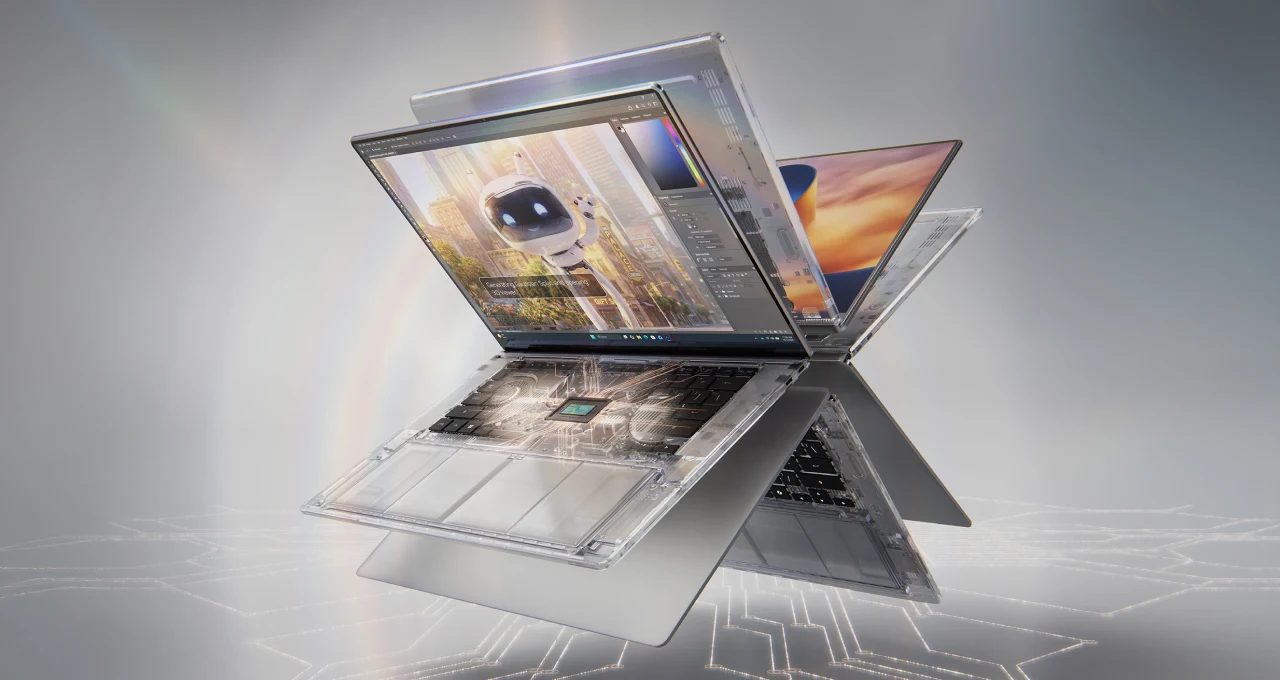
RTX Spark is hardware engineered from the ground up for local AI agents, running on your machine rather than in the cloud or a data center. In short: a Blackwell GPU with up to 6,144 CUDA cores paired with an up to 20-core Grace CPU delivering 600 GB/s of bandwidth and up to 128 GB of unified memory. The result is one petaflop of FP4 compute. That is enough to run models like Qwen 3 directly on a user workstation - models that, as Microsoft EVP of Windows and Devices Pavan Davuluri emphasized, “simply don’t fit on a traditional machine.”
The Surface Laptop Ultra, unveiled by Davuluri as the flagship RTX Spark machine, features these exact specifications - up to 128 GB of memory and a petaflop of AI compute. Pre-orders for RTX Spark laptops are already live, with shipments starting October 16. Compact desktops will arrive in retail channels in November. Hardware partners include Acer, ASUS, Dell, HP, Lenovo, Microsoft, MSI, and Gigabyte.
Why MXC matters more than the chipset
If we had to single out one announcement from the Dogpatch Studios event destined for the history books, we would pick Microsoft Execution Containers over RTX Spark itself. MXC is system-level infrastructure built directly into the Windows kernel - an OS-level layer that allows AI agents to persist in the background under operating system supervision, complete with enterprise-grade IT monitoring and governance.
Davuluri framed it clearly: “We are building these primitives directly into Windows, so agents can be secured, observed and governed.” Huang raised the stakes even higher, comparing MXC to DirectX - the API suite that standardized PC game development in the mid-1990s and effectively established Windows as the dominant platform for developers.
“Just as Windows and DirectX revolutionized how applications were built, MXC is going to revolutionize how agents are built and deployed.” - Jensen Huang
This is not keynote hyperbole. DirectX genuinely reshuffled the entire gaming industry. If MXC attains similar standing - and the technical rationale is sound, addressing process isolation and security at the OS level - the shift will transform every IT department managing a fleet of Windows workstations.
Personal assistants replace the personal computer
During his conversation with Nadella, Huang made a remark that might sound like standard marketing speak at first, but carries serious implications: “The personal computer is the ultimate tool - what happens in the era of agents, when the agent is on your computer? It is now your personal assistant.”
This is not speculative futurology; it is an architectural reality. Agent 365 running alongside MXC on RTX Spark hardware enables a persistent, isolated, and auditable AI assistant right on an enterprise laptop - without routing sensitive data through external APIs, without cloud latency, and without the risk of context leaking outside the workstation. For corporate security teams, this delivers a capability that simply did not exist before.
Nadella summed it up in a sentence worth remembering: “We needed to make the desktop the most secure place for agents to execute.” It sounds straightforward, but it dictates the underlying architecture: the OS controls the agent, never the other way around.
Google · Your sourcesQuantslant higher in your Google - one clickAdd to preferred sources →What this means for the PC market
Until now, the AI laptop category has largely been driven by marketing hype - NPUs posting impressive benchmark scores that offered little practical value in everyday workflows. RTX Spark presents a fundamentally different model: Nvidia’s full software stack (CUDA, TensorRT, and inference libraries) brought to a mobile form factor backed by real memory capacity and serious bandwidth.
For developers, the advantage is immediate: you can write and test code locally within the identical CUDA environment where end-user agents will eventually run. There is no longer a need to rewrite execution pipelines when moving from development setups to deployment.
Huang shared a sentiment during the event that should be taken quite literally: Nvidia grew into what it is today thanks to Windows. Now it aims to return the favor by providing the dedicated silicon foundation Microsoft needs for “Windows as an agentic platform” to actually succeed.


More on this from QUANTSLANT

 benchmarks·Best AI Translator: Google Translate vs DeepL vs 6 LLMsWe tested 70 tricky sentences across Google Translate, DeepL, and 6 LLMs. Here is how modern frontier models compare against dedicated translation tools.