GPT-6.1 Terra Technical Drawing Test: Scan vs. Photo
GPT-6.1 Terra scored 57/58 on a technical drawing test. It read a shaft drawing from a photo perfectly, but mistook Ø50 for Ø60 on a noisy scan.
👁 115 reads
OpenAI lists technical drawing interpretation as one of GPT-6.1 Terra’s main use cases. On launch day, Terra read two clean computer-generated drawings without errors. So, on October 26, 2026, I made the task harder: I tested the same flange as a noisy scan and as a photo of a print taken at an angle, plus a new shaft drawing with tolerances, a thread, and a keyway. Terra scored 57 out of 58 points - the same as GPT-6.1 Sol and Gemini 4 Argon. All four tested models made the same single error.
At a glance (test run October 26, 2026)
- 4 images, 58 points: Terra 57, GPT-6.1 Sol 57, Gemini 4 Argon 57, GPT-6 Luna 56.
- Shaft (16 fields): Every model got a perfect score, including from the photo - and calculated the mass to the nearest 0.1 g: 651.3 g.
- Scan: Every model read “Ø60” instead of Ø50. Luna also missed the conflicting thickness.
- Cost for 4 images: Terra $0.0186, Sol $0.0355, Argon $0.0344, Luna $0.0036.
- Reasoning level: 13/13 on the flange at all six of Terra’s reasoning levels, including no reasoning.
What I tested and how
I drew all the diagrams myself in Python using matplotlib, so they would not be in any model’s training data. The models received an image and an instruction to “read it carefully and return ONLY a JSON object” with a list of fields. I automatically compared each field with the answer key, allowing a 2 g tolerance for mass. One attempt per image, medium reasoning, via OpenRouter. The test prompt was in Polish; the English wording here is a translation of the tested Polish prompt, not a new English test.
- Flange - scan. A 150 x 90 mm flange drawing with chain dimensions, 6 holes of Ø6.6 on a Ø50 pitch circle, and R10 on two corners. It was converted to grayscale, rotated by 1.8°, reduced to 55%, then given noise, speckles, and JPEG compression at quality 30.
- Flange - photo. The same drawing, made to look like a photo of a printed page: perspective distortion, uneven lighting, blur, and JPEG quality 45.
- Shaft - clean and photo. A new drawing with 5 stepped sections (Ø20h6, Ø30, Ø36, Ø25k6, M20x1.5 thread), a 1 x 45° chamfer, a keyway marked “8P9, length 32, depth 4” located 6 mm from the edge, and surface roughness Ra 0.8 on the Ø25 journal and Ra 3.2 on the other surfaces.
The flange includes two traps. The side view gives a thickness of 8 mm, while the material label says “sheet thickness 10.” The model should report this discrepancy. The threaded section’s length is not dimensioned on the shaft drawing, so it must be calculated from the dimension chain: 155 - 30 - 45 - 15 - 40 = 25 mm.
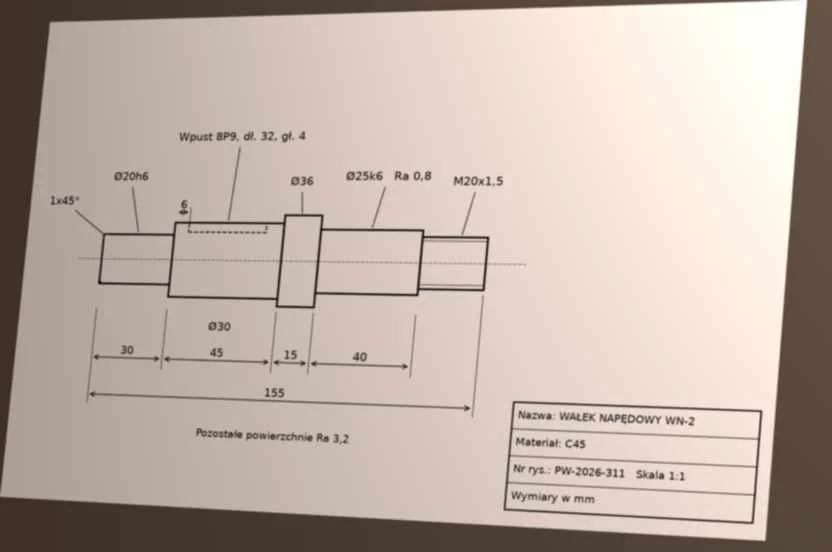
Shaft drawing: 16 fields read from a photo
The prompt listed 16 fields, from overall length to mass. The model had to calculate mass using a steel density of 7.85 g/cm³, treating the shaft sections as cylinders and subtracting the keyway as a rectangular prism:
V = π/4 x (20² x 30 + 30² x 45
         + 36² x 15 + 25² x 40
         + 20² x 25) - 8 x 32 x 4
  = 82,966 mm³
m = 82.966 cm³ x 7.85 g/cm³
  = 651.3 g
Terra’s response for the photo (excerpt; translated from the Polish test output):
"threaded_section_length_mm": 25,
"thread_specification": "M20x1.5",
"keyway_width_mm": 8,
"keyway_depth_mm": 4,
"keyway_distance_from_left
  _edge_of_diameter_30_section_mm": 6,
"surface_roughness_diameter_25_journal": "Ra 0.8",
"surface_roughness_other_surfaces": "Ra 3.2",
"material": "C45",
"mass_g": 651.3
All four models scored 16/16 on both shaft versions, including the calculated threaded-section length and mass to the nearest 0.1 g. The angled photo, dark border, and uneven lighting did not trip up any of them. Terra used 927 input tokens (image and prompt) and 522 output tokens for the photo, at a cost of $0.0035.
Flange scan: 5 mistaken for 6
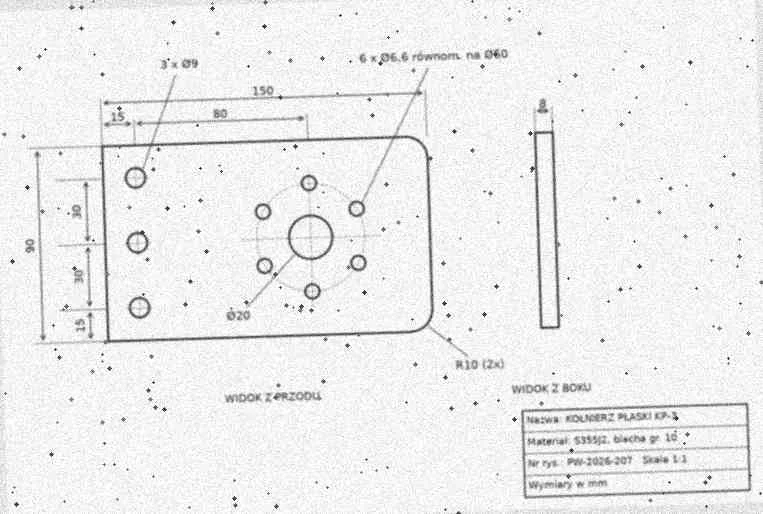
On the scan, all four models read “6 x Ø6.6 equally spaced on Ø60” instead of “on Ø50” and calculated a 30 mm distance between adjacent holes instead of 25 mm. With 6 holes, that distance is the pitch-circle radius, so the error carries through directly. After the noise and compression, the 5 really does look like a 6 - I can see it too. No model noticed that the holes in the drawing are clearly closer to the center than Ø60 would imply, and none flagged uncertainty about the reading.
Terra read the rest of the scan correctly, including the conflicting thicknesses: “The side view gives a thickness of 8 mm, while the material label specifies a sheet thickness of 10 mm.” It calculated the mass using 8 mm: 801.0 g, against the answer key’s 800.5 g. GPT-6 Luna did not notice the discrepancy on the same scan; it returned an empty list and calculated the mass using 10 mm.
| Model | Flange scan / photo (13 + 13) | Shaft clean / photo (16 + 16) | Cost for 4 images |
|---|---|---|---|
| GPT-6.1 Terra | 12 / 13 | 16 / 16 | $0.0186 |
| GPT-6.1 Sol | 12 / 13 | 16 / 16 | $0.0355 |
| Gemini 4 Argon | 12 / 13 | 16 / 16 | $0.0344 |
| GPT-6 Luna | 11 / 13 | 16 / 16 | $0.0036 |
Time per image: Terra 9-14 s, Sol 8-30 s, Argon 6-11 s, Luna 12-34 s. The scan took Sol and Luna the longest (30 and 34 s); Terra took 14 s.
Does a higher reasoning level help?
I gave Terra the clean flange drawing at all six reasoning levels, from none to max. It scored 13/13 every time, while the cost increased from $0.0036 (none, 242 output tokens) to $0.0113 (max, 1,770 tokens). For reading a drawing, visual perception matters more than how long the model reasons. See the GPT-6.1 Terra reasoning levels: low, medium, or max? test for details.
How to use this at work
- Ask for JSON with named fields. A list of fields prompts the model to read each dimension and makes it easier to compare results automatically.
- Ask for a list of discrepancies. The
drawing_discrepanciesfield prompted Terra, Sol, and Argon to flag the 8 mm versus 10 mm difference. Without such a field, a model may silently choose one value. - Add a field for uncertain readings. My prompt did not include one, and no model indicated that “Ø60” was hard to read on the scan. On poor scans, that is the most important information.
- Check critical dimensions against the drawing. One misread digit changed two fields at once - and every model made that mistake.
In ChatGPT, Terra is available only in Work mode and Codex; in the API, it is gpt-6.1-terra. The other results, including a test conducted in Polish, are in the GPT-6.1 Terra guide, and the per-token pricing is in the GPT-6.1 Terra pricing article.
Frequently asked questions
Can GPT-6.1 Terra read a technical drawing from a photo?
In my test, yes: it scored 16/16 on the shaft drawing photographed at an angle, including the h6 and k6 tolerances, thread, keyway, and mass calculated to the nearest 0.1 g.
What about a poor-quality scan?
Almost perfectly: 12/13. Terra misread one digit (Ø50 as Ø60), which also threw off the hole spacing. Sol, Argon, and Luna made the same mistake.
How much does it cost to read one drawing?
With Terra, $0.0035-$0.0059 per image with a JSON response. Sol and Argon cost roughly twice as much; Luna costs around five times less.
Google · Your sourcesQuantslant higher in your Google - one clickAdd to preferred sources →Sources and test date
- OpenAI: Introducing GPT-6.1 Terra - technical drawing interpretation listed as a use case (checked October 26, 2026)
- OpenAI API: GPT-6.1 Terra model - text and image input, pricing (checked October 26, 2026)
- My test: 4 drawings created in matplotlib, distortions added in OpenCV, OpenRouter, medium reasoning, October 26, 2026, at around 9 p.m.; total cost $0.092