Gemini Omni 1.2 vs Seedance, Kling, Veo and Wan Video Test
Six AI video models tested on identical camera rotation and dialogue prompts. See how Gemini Omni 1.2 compares to Seedance, Kling, Veo and Wan.
👁 119 reads
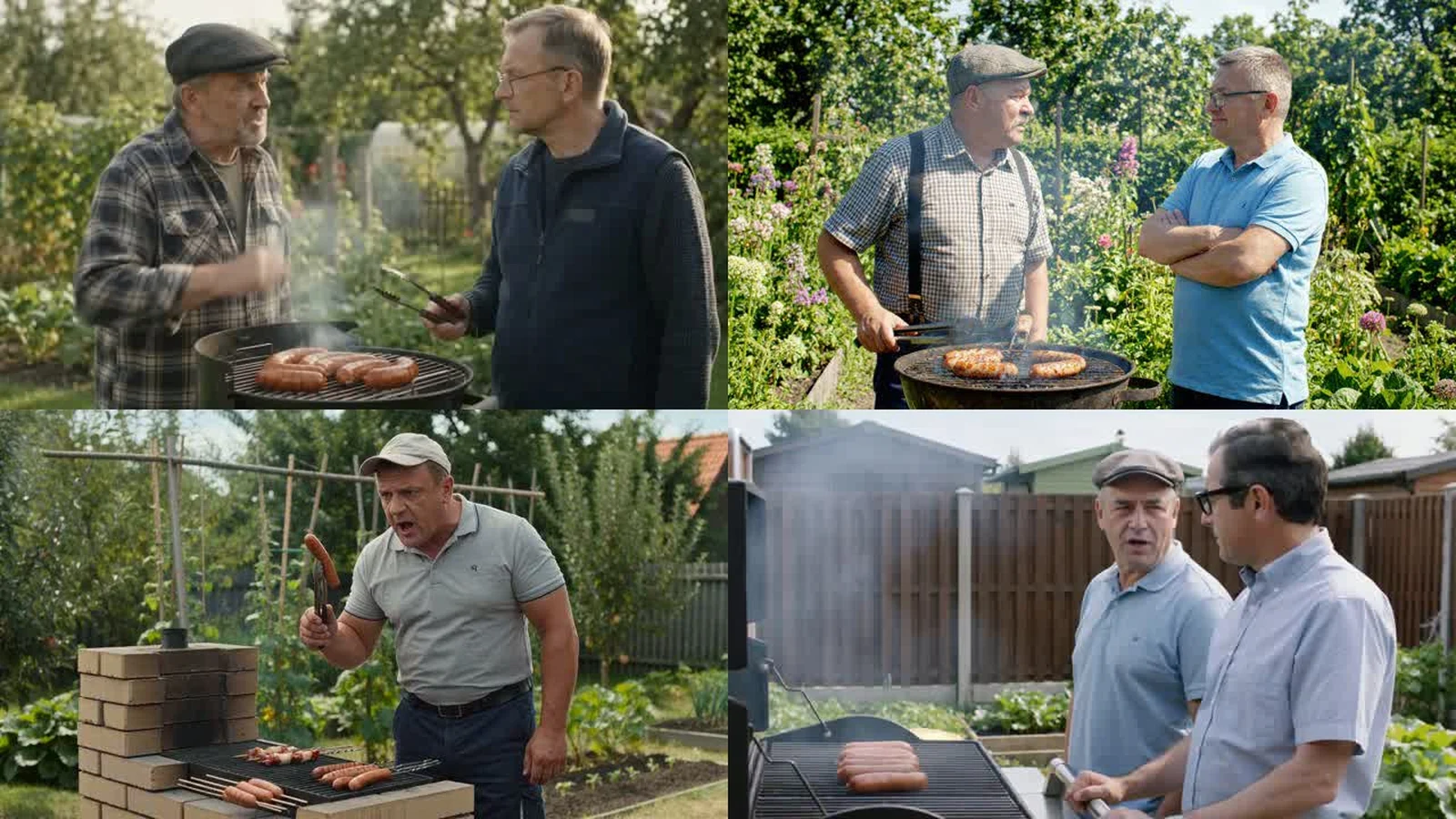
Six models, two scenes, and the exact same prompt down to every comma. In the first scene, the camera makes a continuous 360-degree rotation around an elderly woman selling apples at an outdoor market stall. In the second, two allotment gardeners argue over grilling sausages. Every clip was generated at 6 seconds, 720p, with audio enabled, ordered on the evening of November 5, 2026, the launch date of Gemini Omni 1.2 Flash.
For this comparison, I tested Omni 1.2 alongside its predecessor Omni 1.1, Google’s Veo 3.1 Lite, ByteDance’s Seedance 2.0 Fast, Alibaba’s Wan 3.0, and Kling 3.0 Standard. All of them were routed through the same OpenRouter API, ensuring generation times and costs remain directly comparable. Kling 4.0 and Seedance 2.5 were not included here because they either lack uniform availability or cost several times more, as discussed below.
Benchmark results at a glance
| Model | Cost (6s) | Wait time | Camera rotation | Dialogue quality |
|---|---|---|---|---|
| Gemini Omni 1.2 Flash | $0.42 | 48-49 s | Full rotation, single continuous shot | Clear, missed half of the first line |
| Gemini Omni 1.1 Flash | $0.61 | 45-46 s | Rotation attempted, less fluid | Full text, but 3 cuts and character morphing |
| Veo 3.1 Lite | $0.30 | 54-55 s | None, static camera | Full text, single continuous shot |
| Seedance 2.0 Fast | $0.55 | 88-115 s | Slight zoom-in | Garbled words, character swapped |
| Wan 3.0 | $0.51 | 159-185 s | None, static camera | Full text, single continuous shot |
| Kling 3.0 Standard | $0.76 | 133-176 s | Jump cuts instead of rotation | Dialogue altered and distorted |
To verify the spoken dialogue objectively rather than trusting my ears, I ran each generated audio track through OpenAI Whisper large-v3 speech recognition and checked it against the requested script.
Scene 1: 360-degree rotation around a market stall
The prompt (tested in Polish, translated here): smooth full 360-degree camera rotation around an elderly woman selling apples, constant subject scale, no cuts. This is an exceptionally demanding task because the model must infer what the subject looks like from behind and reconstruct the background accurately before returning to the original face seamlessly.
Omni 1.2 delivered exactly what was requested. The camera swings smoothly from front to side, passes behind her back while she adjusts her headscarf, and swings back around to her smiling face. Both her facial features and floral headscarf stay consistent from start to finish. Omni 1.1 also attempted the full circle and looked behind her back, but the camera movement was jerky.
None of the competing models managed the rotation. Veo 3.1 Lite and Wan 3.0 kept the camera fixed on a virtual tripod and simply had the woman wave her hands. Seedance executed a slight zoom-in. Kling segmented the clip into multiple cuts with mismatched backgrounds, which directly violated the “no cuts” constraint.
Scene 2: barbecue dialogue test
The prompt (tested in Polish, translated here): two men in their fifties standing by an allotment barbecue. First man, wearing a flat cap: “I told you the sausage had to come from Biedronka, not Lidl!” Second man, wearing glasses: “Just eat it and stop complaining.”
Omni 1.2 maintained a single steady shot. Both characters remained identical throughout the sequence, and lip synchronization matched the spoken audio. However, it truncated the end of the first sentence: instead of “from Biedronka, not Lidl”, it said only “from Biedronka”. Six seconds is tight for two separate dialogue lines, and the model opted to trim the sentence rather than speed up the delivery. When testing the same scene using an image prompt reference, Omni 1.2 recited the full line without omissions.
Omni 1.1 spoke all the lines, but cut the scene three times, and during the middle shot an entirely different man in a green shirt sat at the table. Veo 3.1 Lite and Wan 3.0 performed best in this specific test: full script delivered, both store names articulated accurately, and framed in a single take. Seedance 2.0 Fast replaced the second man with a bystander holding a beer, while garbling words into unintelligible phonetic fragments (“kielbana”, “biedynki”, “z lita”). Kling produced the strangest output: it paraphrased the lines into awkward grammar and distorted the second response into unrecognizable nonsense.
Which video model wins?
There is no universal winner across every category, as these two test cases illustrate:
- Camera motion and shot continuity: Omni 1.2 is the clear winner. It was the only model capable of executing an unbroken 360-degree orbit without cuts or face warping.
- Most cost-effective dialogue: Veo 3.1 Lite. At $0.05 per second, it delivered flawless non-English voice lines, though constrained to fixed camera positions and fixed clip lengths of 4, 6, or 8 seconds.
- Generation speed: Omni 1.1 and 1.2 both returned results in under 50 seconds. Wan and Kling required close to three minutes per generation.
- Models to avoid for non-English speech: Kling 3.0 Standard and Seedance 2.0 Fast struggled significantly with phonetic accuracy in this test.
A few caveats should be kept in mind regarding model tiers. Seedance 2.5, ByteDance’s flagship model, costs around $0.23 per second at 720p on OpenRouter, which is more than triple the price of Omni 1.2, so it was excluded from this budget-focused benchmark. Kling 4.0 is currently restricted to select API channels without standard transparent pricing. For a complete price breakdown, check our guide on Gemini Omni 1.2 pricing, and see earlier multi-scene tests in our AI video arena.
You can find our full suite of launch benchmarks in the Gemini Omni Flash hub.
More on this from QUANTSLANT



 guides·How to Get GPT-6 Cyber Access: Daybreak Red and Blue GuideLooking to access GPT-6 Cyber? OpenAI limits the model to approved Daybreak Red organizations. Here are the exact requirements and steps for Blue and Red.