One stick: why Ocarina of Time changed 3D games, and what the Switch 2 remake could not take away
Five inventions Nintendo made in 1998 because the pad had one stick. The 2026 remake got a second one and still threw almost nothing out.
👁 113 reads
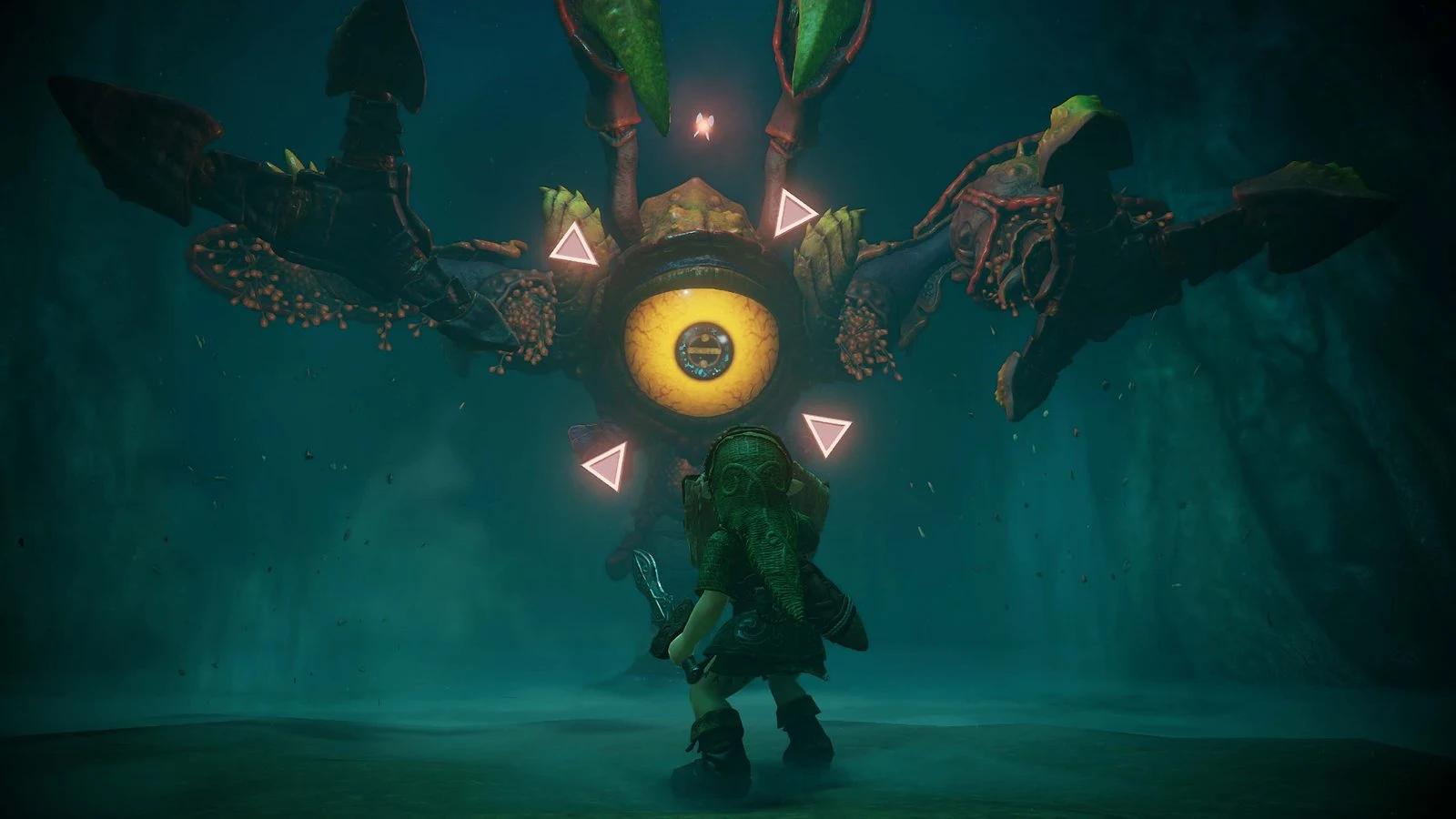
Four arrows around a monster’s eye, the hero seen from behind, the camera locked in place for as long as one button is held. That frame comes from a game released on 5 November 2026 for Nintendo Switch 2, but everything that works in it was invented 28 years earlier for a controller with a single analogue stick. My argument in this piece: The Legend of Zelda: Ocarina of Time did not change games because it showed a big world in 3D. It changed them because its makers had to fit the handling of that world under one thumb. The 2026 remake finally has a second stick, a jump button and a microphone, which makes it the best test this design has ever faced: once everything could be thrown out, what stayed?
Three dimensions, one thumb
In 1998 nobody had a ready answer to how sword fighting should work in 3D space. Shigeru Miyamoto later said the plan was modest: if the hardware could not cope, he would have been content with a game set inside a single building, Ganon’s Castle, as long as Link was in 3D.
“It was a huge project of making game in 3D polygon without knowing the final outcome from the beginning.”
Shigeru Miyamoto, Iwata Asks, 2011
The Nintendo 64 pad was the first Nintendo controller with an analogue stick. One of them. Eiji Aonuma, who designed dungeons and enemies on the original, explains the consequence in the 2026 interview: the stick moved the character, so the player could not freely turn the camera the way modern controllers allow. Five inventions grew out of that single limitation.
| Invention | 1998, Nintendo 64 | 2011, Nintendo 3DS | 2026, Switch 2 |
|---|---|---|---|
| Lock-on (Z-targeting) | The Z Button puts the camera behind Link and ties him to one target | Unchanged in principle | Unchanged |
| Camera | One stick, so the camera guides itself and is fixed at certain points | As in the original; aiming also by moving the console (gyro) | Free camera on the right stick; motion aiming |
| Context-sensitive button | One action button does what the screen suggests. No jump button: Link jumps by himself at an edge | Unchanged in principle; touch-based inventory | Jump on its own button, dash, quick item switching, two ways to do the Jump Attack |
| World clock | Day and night change in the open field | Unchanged in principle | Time passes everywhere, including towns |
| Ocarina | Melodies played with controller buttons open paths and change the time of day | Unchanged in principle | Buttons, humming into the console microphone, or a real ocarina |
The invisible chain: how Z-targeting was born
The most important of the five ideas was born at a theme park. One summer the team visited Toei Kyoto Studio Park, a set of film studios open to the public, looking for ideas for sword combat. Scriptwriter Toru Osawa recalled it was so hot that they ducked into a playhouse where a ninja show was on.
“A number of ninja were surrounding the main samurai and one lashed out with a kusarigama (sickle-and-chain). The lead samurai caught it with his left arm, the chain stretched tight, and the ninja moved in a circle around him.”
Toru Osawa, Iwata Asks, 2011
Osawa turned that directly into controls: once you lock on, something like a chain you cannot see exists between Link and the opponent. Push the stick forward and you close in; push it sideways and you circle around behind the enemy. Yoshiaki Koizumi took the other half of the idea from the same show: targeting flags one opponent and tells the others to wait their turn, so a fight against a group does not turn into a mess.
“The Z-targeting system has remained largely unchanged in subsequent 3D Legend of Zelda games. It’s stood the test of time and is still effective today.”
Hidemaro Fujibayashi, producer of the remake, Ask the Developer, 2026
A camera that knows where to look
Lock-on was, at heart, a camera trick. Because the player could not turn the view, the game did it for them. In many places the camera did not belong to the player at all: it stood at a fixed point and showed the room the way the designer wanted. Miyamoto went further and had cutscenes rendered in real time by the game engine rather than as pre-made movies, because a finished movie cannot be fixed later.
“But what’s more important to fans, the movies or how fun it is?”
Shigeru Miyamoto, Iwata Asks, 2011
The remake hands the camera to the player, and the developers say plainly that this was not a free change. Program director Hiroki Taguchi admits their worry: a player who can rotate the view loses their sense of direction. You beat an enemy in a sealed room, the door opens, and you no longer know which way you meant to go. So the team had to rebuild what the fixed camera used to give for free, placing objects in dungeons so that they point the way.
The Mario team gives up the jump button
The third invention sounds like heresy today. The people who had made Super Mario 64 two years earlier took the jump button away. Link leapt across a gap by himself when he reached the edge. Miyamoto thought of it on a day off.
“I gathered everyone on Monday morning and said, ‘We’re gonna do something called autojump!’ Everyone’s response was, ‘Say what?!’ The team that had made Mario games was going to give up the jump button.”
Shigeru Miyamoto, Iwata Asks, 2011
The remake gives the jump back. Director HokWai Ng explains it by generation: players used to recent games ask why Link could jump there but not here, so jumping now works anywhere with one button press. Aonuma adds that the old system was convenient for developers, because they knew exactly where a player could jump; removing the restriction meant anticipating every behaviour and adjusting the terrain. Young Link and Adult Link jump slightly different distances, so every gap had to be balanced for both. The Jump Attack shows how the argument ended: the new team built it the Breath of the Wild way (jump first, then attack), Aonuma could not get used to it, Fujibayashi preferred it, and the game shipped with both.
A world that does not wait, and an instrument instead of a menu
The fourth idea is about trust. In the open field the sun set without asking the player. Nintendo now describes the remake with a sentence that shows how far this went: time passes no matter where you are, and new characters and enemies appear after sunset. The world itself is still not seamless, and that is a decision, not a limitation. Ng says the team deliberately kept separate maps for separate areas, so that moving between them gives the player a moment to reflect and to anticipate the next part of the adventure.
The fifth idea gave the game its name. Fast travel, changing the time of day, opening a sealed path: in most games these sit in a menu. Here you had to take out an instrument and play a melody with the controller buttons. The remake adds a chapter that sounds like a joke but is consistent. About a year before release Aonuma walked up to Ng’s desk and announced that Switch 2 has a built-in microphone. Today you can hum a learned melody or play it on a real ocarina and Link repeats it in the game.
“It’s not even like voice recognition makes it any easier to progress through the game. But being able to interact with the world in such an intuitive way makes it feel much closer to you.”
Eiji Aonuma, series producer, Ask the Developer, 2026
What the remake fixed
The list of fixes is long but follows one rule: the team fixed what was a cost of the 1998 limitations, not their fruit. The best example is the Water Temple, a dungeon famous for getting people lost. Aonuma designed it and does not spare himself.
“I had some overdue homework: I wanted to do something about the Water Temple I created 28 years ago.”
Eiji Aonuma, Ask the Developer, 2026
The layout stays. What changed is what made people lose track: item toggling is now much easier, and some walls were replaced with lattice-style structures so you can see the rooms beyond. A smaller example is better still. Gohma, the first boss, can only be hurt at the right moment, which was hard to read in the original. Someone on the team noticed the two arms on top of its head; now Gohma guards its weak point with them whenever it is immune. Other changes: a dash by holding the roll button (rolling across Hyrule Field is still there), fully voiced cutscenes cast through blind auditions, more than 150 pieces of music recorded with an orchestra, and Threads of Time, a tapestry-style menu that recaps the story and shows the next objective.
What nobody was allowed to touch
The strongest evidence for my argument comes from the series producer himself. Aonuma decided modern players would not want to roll across the whole field and asked for warp points that did not exist in the original. The team built them. Then everyone played.
“So even though I was the one who proposed adding warp points, they just weren’t working for me in the end, so I got the team to take them all back out again.”
Eiji Aonuma, Ask the Developer, 2026
His reason: the moments of discovery, when you stop along the way and wonder what something is, were disappearing. The road across the field turned out to be structure, not filler. The same goes for lock-on, the separate maps and the dungeon mechanisms: the new team left all of them alone, although it had the hardware and the permission.
“The original really was so intricately crafted and so delicately balanced that I felt the whole thing might fall apart the moment you removed even a single piece.”
Hiroki Taguchi, program director, Ask the Developer, 2026
The limitation was the author
Having read both interviews, from 2011 and from 2026, this is how I see it. The five inventions were not crutches for weak hardware. If they had been, the remake would have thrown them out, because that is what remakes are for. Instead the second stick received only one of the five jobs, the camera, and even that required reworking dungeons so players would not get lost. The rest stayed because it had stopped being a workaround and become a language.
There is a less comfortable half to this argument. If the limitation was the author, a remake without limitations could not invent anything comparable. Humming into a microphone and a story tapestry are charming, but nobody will copy them for the next 28 years. Aonuma says openly why the game was made: so that developers who only know the recent Zelda games learn how the old one is built and carry something forward.
“It isn’t a question of whether the original or this game is better. The world simply feels so much richer.”
Eiji Aonuma, Ask the Developer, 2026
Critics gave it 95 out of 100 on Metacritic from 115 reviews (read on 15 November 2026); the 1998 original stands at 99 from 22 reviews. Nintendo says the remake sold over 5.2 million units worldwide in its first four days. For me the more interesting number is a different one: one. That is how many sticks it took to invent controls that nobody has managed to replace in 28 years.
Price, size and language in the US
For readers in the United States the practical part is short. I read the prices from Nintendo’s eShop price interface and the Nintendo US store on 15 November 2026. The game runs only on Nintendo Switch 2; there is no version for the first Switch.
| What | US |
|---|---|
| Release and platform | 5 November 2026, Nintendo Switch 2 only |
| Price | $59.99 digital, $69.99 physical |
| Download size | 24.9 GB, one player |
| Language | English, plus the other languages listed on Nintendo’s game page |
Sources
- Nintendo, Ask the Developer Vol. 24: The Legend of Zelda: Ocarina of Time, part 1
- Ask the Developer Vol. 24, part 3
- Ask the Developer Vol. 24, part 4
- Nintendo, Iwata Asks: Ocarina of Time 3D, original development staff
- Iwata Asks: Ocarina of Time 3D, Shigeru Miyamoto
- Nintendo UK, game page
- Nintendo, sales announcement, 11 November 2026
- Metacritic

More on this from QUANTSLANT


 news·From Dundee to GTA 6: the history of Rockstar Games in people, deals and scandalsHow a small Dundee studio became Rockstar Games: acquisitions, lawsuits and the bills for Hot Coffee, in numbers.