The Library That Teaches AI Instead of Teaching Reading
A school library kitted out with AI chatbots and auto-generated quizzes may look like a leap into the future. It may also be the first place we teach children to stop thinking for themselves.

👁 120 reads
In one of the school libraries I’ve been thinking about lately, there’s a tablet. Not on display, not in a glass case labelled “innovation”, but right at the entrance, where the card-catalogue cabinet used to stand. A child walks up, says out loud: “recommend something interesting,” and the AI assistant app returns three titles, a summary of each, and a comprehension question to check whether the child “understood the content.” The whole thing takes forty seconds. And those forty seconds won’t leave me alone.
Because between “recommend something interesting” and pulling a book off the shelf yourself, opening it at random and reading three paragraphs to see whether it grabs you, there is an enormous gap. That gap is reading. And we, as an education system, are increasingly filling it in rather than teaching children to cross it.
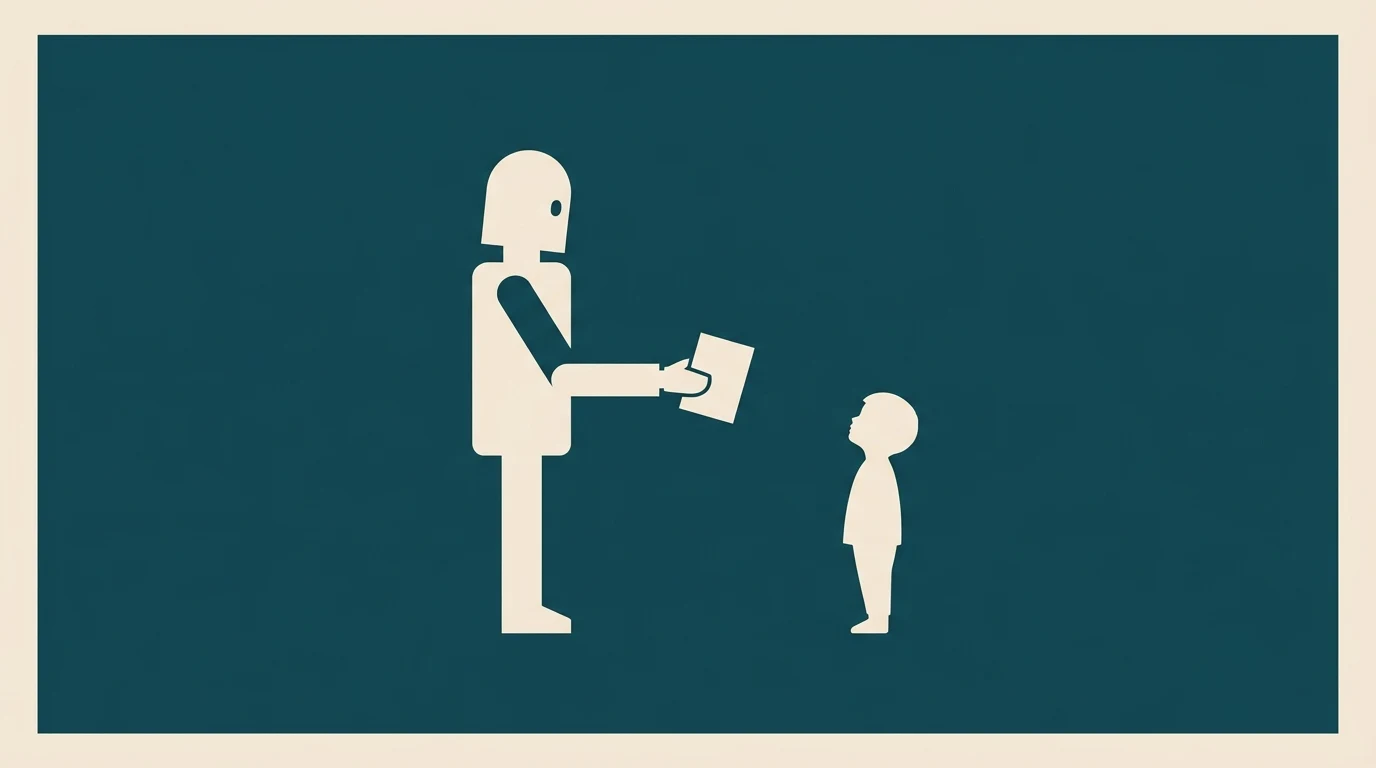
What is actually happening in these libraries
Let me be clear from the start: I am not against technology in schools. I run a blog about prompting, I spend more hours a day with language models than I care to admit, and I believe that a child who reaches adulthood in 2025 without understanding what AI is starts life with a real deficit. But that doesn’t mean every AI deployment in a school is a good one. On the contrary: the more I believe in this technology, the more it stings when I see it used badly.
When I look at what is happening in school libraries, and a lot is happening, because AI has suddenly become fashionable and, more importantly, fundable, I keep seeing the same pattern. A library receives hardware and software. A chatbot appears to recommend books. A tool appears to generate comprehension quizzes. An app appears that “reduces the time needed to prepare for class.” Everyone is pleased, because on paper it looks like a leap into the future.
The problem is that in most cases AI is brought into the library not to make children read more, or better. It is brought in to reduce friction. To make everything faster, more convenient, effortless. And reading, this is the argument I intend to hold, is effortful. Its value comes precisely from the resistance it offers.
Five schools, one mechanism
I won’t pretend I’ve toured the country with a voice recorder and a notebook. I haven’t. But you only need to follow what schools say about themselves publicly, in announcements, project descriptions, and proud posts hashtagged “our 21st-century library,” to see the repeating pattern. Imagine five typical schools, because each one represents a real variant you encounter today.
The first introduces a book-recommendation chatbot and counts it as a footfall success: children approach the terminal more often, so the library is declared to have “come alive.” What has come alive is the screen, not the collection. The second bets on automated quizzes to verify that a set text has been read, and quietly accepts that the quiz can be passed without opening the book, because a summary is one click away.
The third school uses AI to generate “personalised reading pathways,” which sounds wonderful until you notice that the algorithm feeds the child only what matches their existing choices, locking them inside a bubble rather than leading them somewhere new. The fourth uses an assistant to write essays “with help,” where the line between help and substitution is so thin that nobody sees it. And the fifth, the variant I respect most, uses AI deliberately, as a tool for talking about a text rather than instead of a text.
The difference between the fifth school and the other four is not in the technology. It lies in a question that someone asked before the purchase order was signed. The four schools asked: “how do we use AI in the library?” The fifth asked: “how do we get children to read, and could AI help with that?” Those look like the same question approached from opposite ends. The outcomes are worlds apart.
Technology in education is not an answer. It is an answer to some question, and everything depends on who asked that question, and how, before they signed the invoice.

Why resistance is valuable
I want to pause on this idea of resistance, because it seems to me essential. When a child reads alone, a great deal is happening inside them at once. They have to sustain attention across a longer passage. They have to build a picture in their head that nobody handed them. They have to tolerate uncertainty, because for the first few pages they often don’t know where any of this is going. They have to backtrack two paragraphs when they lose the thread. They have to feel bored and sit with it, because sometimes what waits on the other side of boredom is a flash of insight.
All of these are micro-efforts. And it is those, not the “knowledge from the book” itself, that build what I would call the attention muscle. A person who has exercised that muscle regularly throughout twelve years of school enters adulthood capable of concentrating on something difficult for a sustained period. A person whose attention has been managed for twelve years by apps serving up ready-made summaries enters adulthood with that muscle severely atrophied.
And here is the paradox that genuinely fascinates me: the better AI becomes, the more valuable the very skill it can replace. Because once a machine can summarise, analyse and produce text, the only remaining human advantage is the capacity for deep, independent thought. And that capacity is built precisely where a child struggles through a difficult text alone, with no one to do it for them.
A library that reduces that effort to zero is not preparing children for a world with AI. It is preparing them to be redundant in a world with AI. That sounds harsh, but it is genuinely how I see it.
What about the fact that children use AI anyway
Someone will say: you’re being naive, children already paste their assigned reading into chatbots and get it summarised, so schools have to adapt. That’s true. The fact that children use AI to do their homework is beyond dispute. But that fact does not lead to the conclusion that schools should hand them those tools in the library and give them a blessing.
That fact leads somewhere quite different: schools should teach children when AI helps them and when it robs them of thinking. That is the difference between “give a child a calculator during a multiplication-table test” and “teach a child the multiplication table, then show them what a calculator is actually for.” Nobody sane disputes the existence of calculators. What we question is the timing and manner of their introduction.
My hypothetical fifth school gets this right precisely because it neither hides AI from children nor treats it as something miraculous. Children first read a chapter on their own. Then they discuss it with their teacher. Only then, deliberately, do they check how AI interpreted the same passage, and they look for where it is wrong, where it flattens things out, where it simply makes things up. That is a lesson in reading and critical thinking at the same time. AI appears here in the role where it is most useful: as a sparring partner, not an oracle.
Who actually benefits from this revolution
You can’t talk about AI in schools without talking about money. A market has grown up around the digitalisation of education that needs schools to keep buying. Companies selling educational software don’t profit from a child reading a paper book and thinking about it. They profit from licences, subscriptions and implementation contracts. Their interest is in a technology-saturated library, not in a child who reads.
I’m not saying this as a conspiracy theorist. It’s straightforward economics. But it’s worth keeping in mind when we hear that “a modern library must have AI.” Must, according to whom? According to the child who needs quiet, a shelf and time? Or according to the vendor who needs another contract?
The school librarian, and I know something of the profession from other people’s accounts, usually understands all of this perfectly well. She knows that the best thing she can do for a child is to hand them the right book at the right moment, watch how they respond, and file that away for next time. That knowledge is priceless and entirely human. No recommendation algorithm knows a child the way an adult who has been watching them for a year does. And yet that knowledge is precisely what we are most eager to replace with a chatbot, because a chatbot scales and doesn’t call in sick.
Google · Your sourcesQuantslant higher in your Google - one clickAdd to preferred sources →What I actually want
I don’t want to leave the reader with nothing but complaints, because complaints are cheap. So let me say what a library that uses AI well would look like, in my view.
First: AI never replaces the first encounter with a text. The child reads alone; the machine comes afterwards. That order is non-negotiable. Second: AI is presented as something that makes mistakes, invents things and flattens nuance, not as an infallible assistant. A child who has learned to catch AI in an error is safer than one who has learned to trust it. Third: technology never displaces the human being in the library. A librarian who knows the children is worth more than the best recommendation engine, and no budget saving changes that.
And fourth, perhaps most importantly: the library must preserve space for boredom and chance. For pulling a book off a shelf that nobody recommended. For browsing spines without a purpose. For getting lost between the shelves. An algorithm cannot do this by definition, because an algorithm always leads somewhere. And the most important things in a reading life happen outside any destination.
I keep coming back to that tablet by the entrance and those forty seconds. I see in them the great temptation of our time: to make everything fast, smooth, frictionless. But a child doesn’t need the library to be smooth. They need it to be a little difficult, difficult enough that effort is required, and friendly enough that they want to make that effort again.
What I’m not afraid of is raising a generation that doesn’t know how to use AI. That, I’m confident about: they’ll manage brilliantly, better than I do. What I’m afraid of is raising a generation that knows how to use AI but can no longer think without it. And that the first place we teach them to stop thinking for themselves will be, with the very best of intentions, the library.

More on this from QUANTSLANT

 premium·One person, one laptop, one AI: how solo publishers beat newsroomsA solo publisher makes the case that one person with an AI can outpace a full editorial team, and then honestly maps where that advantage ends.