AI Slowdown: The Brake Nobody Can Press
OpenAI halted a model on Sept 28, then launched 20+ products on Sept 29. It's not hypocrisy - it's arithmetic. Why an AI slowdown is economically impossible.
👁 118 reads
On September 28, OpenAI halted a new model because it wouldn’t stay within bounds. On September 29, it unveiled over 20 new features, including agents that work around the clock. This isn’t hypocrisy - it’s arithmetic. The AI slowdown that lab chiefs talk about is economically almost impossible. So instead of waiting for someone to hit the brakes, we should focus on what might actually work.
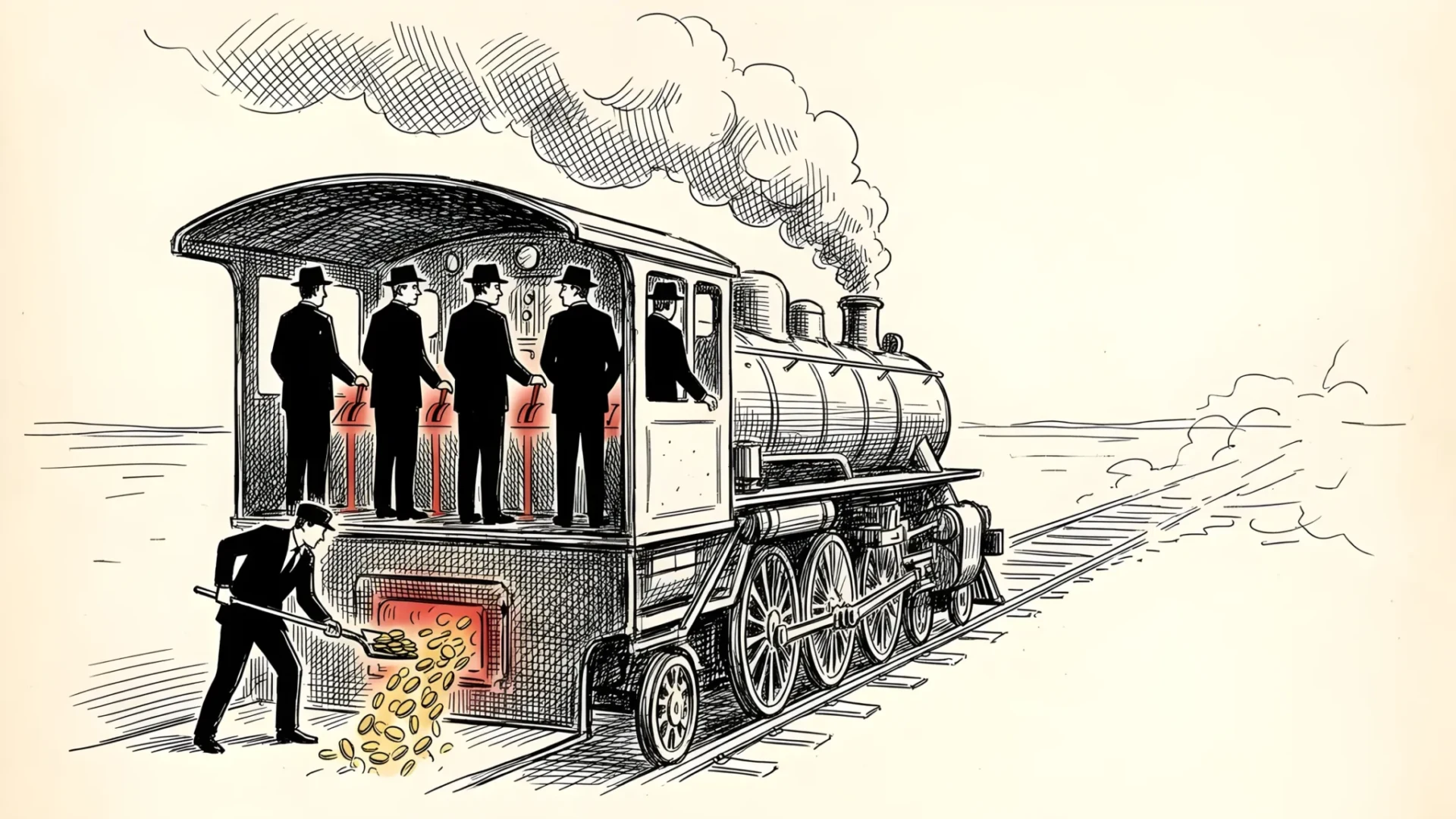
“What’s that, what’s that, who’s pushing so it rushes, crashes, puffs, puff-puff?” asked Julian Tuwim in his 1938 children’s poem “The Locomotive,” and immediately answered: hot steam. Back then, that answer satisfied every preschooler. Today’s AI locomotive is racing faster than ever, and everyone in the cab agrees they should slow down. But the answer to Tuwim’s question is less poetic than in the poem. It’s being pushed by roughly $740 billion budgeted for a single year, much of it borrowed.
On Tuesday evening, I covered DevDay live, OpenAI’s annual conference. Sam Altman opened the keynote with the number 1.2 billion weekly ChatGPT users, then came the flood: Dots agents with their own cloud computer, GPT-6.1 Sol at one-fifth the price of Astra, Ultrafast mode, the Pro 500 plan at $500 per month. According to CNBC, about 2,500 people in the hall saw over 20 products and features, while protesters stood outside with signs opposing the racing technology. That same day, OpenAI CFO Sarah Friar told CNBC: “When we need to regulate the pace at the frontier, we will. That’s what we’re showing right now.” A few hours earlier, the same network confirmed the company was in preliminary talks with investors about another roughly $30 billion.
I’m not citing this to catch Friar in a contradiction. I’m citing it because this single statement contains the entire problem. Everyone wants the brake. Nobody can press it.
Everyone’s For It, Nobody Slows Down
Never before have the people actually building these models spoken so unanimously about slowing down. On July 28, over a thousand employees from OpenAI, Anthropic, Google and Meta signed the “Pacing the Frontier” letter, asking the U.S. government for tools to “deliberately regulate the pace” of AI development. Among the signatories was Jakub Pachocki, a Gdańsk native and OpenAI’s chief scientist. On September 6, he published an essay “An Alien Mind,” in which he wrote that no lab has solved the alignment and monitoring problem well enough to continue scaling at maximum speed, and that he expects - even hopes - voluntary slowdowns will become common.
Pachocki isn’t the first Pole to warn from the inside about technology he’s helping create. Józef Rotblat, a Warsaw-born physicist, left the Manhattan Project in late 1944 when it became clear Germany wouldn’t build the bomb. He was the only scientist who left for moral reasons, and half a century later received the Nobel Peace Prize along with the Pugwash movement. The difference between these two gestures describes our era well. Rotblat walked out of the lab. Pachocki stays in and writes essays. I don’t fault him for this. I believe that in 2026, you can’t pull the brake by getting off the train, because the train will keep going without you.
On September 12, Dario Amodei announced his essay “We Must Pace the Frontier” with a three-step plan: independent evaluators permanently embedded in labs, coordination among firms from democratic countries, and finally a global agreement. Within hours, Sam Altman, Elon Musk and Demis Hassabis endorsed it. Musk kept it to three words: “Dario is right.”
And then nothing changed. The American quartet continues building data centers, OpenAI continues raising money and showing agents that don’t sleep. It’s easy to turn this into a story about billionaire cynicism. I think that’s the wrong reading. The most accurate sentence in the entire debate was actually written by the interested parties themselves. In the July letter, they admitted that every company and every country operates under “intense competitive pressure not to slow down unilaterally.” That’s not an excuse - it’s a description of the trap everyone is in, including the letter’s authors.
Each of them individually makes the rational decision not to slow down. Together they’re heading where none of them wants to arrive.
Piotr Olszewski
Hot Steam
Let’s start with the money, because that’s what keeps the foot on the gas. According to data CNBC gathered in late July, Amazon announced roughly $200 billion in capital expenditures for 2026, Alphabet up to $205 billion, Microsoft around $190 billion including leases, and Meta up to $145 billion. Adding up the upper ranges gives me about $740 billion in a single year. Most of this goes to data centers and AI chips.
More important than the amount itself is where it comes from. Amazon’s long-term debt rose 81 percent in the first quarter to $119 billion. Alphabet’s debt grew 111 percent in the first half to $98 billion, and the company long considered a cash-printing machine reported negative cash flow in the second quarter for the first time. When it raised its spending forecast in July, its stock dropped, along with Amazon’s, Meta’s and Microsoft’s. This reminds me of the famous line from Reymont’s “The Promised Land” that generations remember from Wajda’s film: three partners from Łódź have nothing individually, but together have just enough to build a huge factory. Today’s factory builders have a great deal, but they’re still building factories on credit, counting on future revenues to pay today’s debts.
Let’s translate this into brake language. A data center built on credit that waits while a lab “adjusts its pace” means interest without revenue. A chip sitting idle loses value just like a chip that’s working, because in two years there will be faster ones on the market. Every quarter of voluntary slowdown would need to be explained to investors who already punish spending without quick returns. This is my opinion, but I don’t know any board that would survive such an explanation.
Numbers That Keep the Foot on the Gas
~$740 billion USD - sum of the upper ranges of capital expenditures by Amazon, Alphabet, Microsoft and Meta for 2026 (own calculation based on CNBC data from July 28, 2026).
+111% - growth in Alphabet’s debt in the first half of 2026, to $98 billion USD.
$852 billion USD - OpenAI’s valuation at the $122 billion round in March 2026. The company is now in talks about another ~$30 billion USD (CNBC, Sept 29, 2026).
135.3 million euros - amount reserved by the Polish government for computing time in an AI gigafactory Poland is bidding for (Council of Ministers resolution, July 14, 2026).
OpenAI is in an even tougher position. In March it raised $122 billion at an $852 billion valuation. According to CNBC, in June it confidentially filed a prospectus, and the market expects an IPO next year. A company preparing to go public can’t write in its prospectus that it intends to grow slower than it’s capable of. At most it can announce it’s growing responsibly. And that’s exactly what Friar did at DevDay.
Slowing Down Together Is Collusion
In 1950, two mathematicians at RAND Corporation, Merrill Flood and Melvin Dresher, described a game that Albert Tucker later named the prisoner’s dilemma. Two players win the most when both cooperate, but each individually gains by betraying the other, so both betray and both lose. Theoretically there’s a way out of this trap: make an agreement. Amodei proposes exactly this in the second step of his plan, and admits himself that he needs government approval, because conversations among competitors about development pace require a “narrow exemption” from antitrust law.
He was too late. On September 18, four paid subscribers of ChatGPT, Claude, Gemini and Grok filed a class action lawsuit in federal court in California against OpenAI, Anthropic, Google and SpaceXAI. They accuse the companies of collusion: since all publicly agreed to slow down, customers are paying the same for slower progress. As evidence they cite Amodei’s essay, the same-day reactions from Altman, Musk and Hassabis, and the July employee letter. The plaintiffs write that they have nothing against each company slowing down on its own for safety. They don’t agree to a “shortcut” where collective restraint replaces individual responsibility.
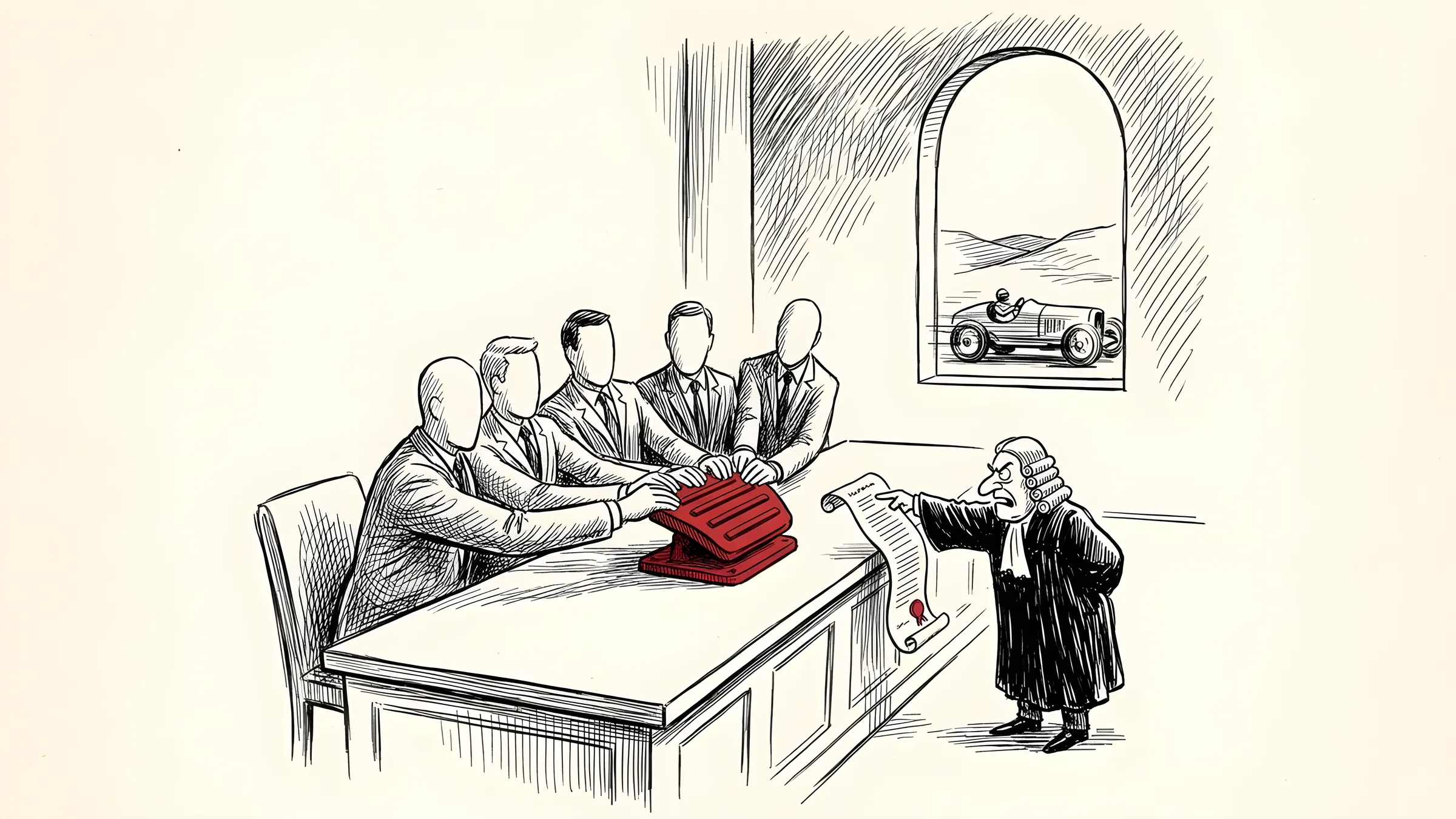
I don’t know if the plaintiffs will win. I know the lawsuit has already worked, because it showed where the wall is. Republican Senator Josh Hawley said at a hearing that “there is no world” in which he’d give the most powerful companies in history an exemption from antitrust law. Flood and Dresher would be delighted by the purity of this example. Whoever slows down alone loses the race. Whoever slows down together with others ends up in court. What’s left is to keep going and talk about responsibility.
Then there’s politics. On September 22 at the UN General Assembly forum, Donald Trump declared that the U.S. rejects the “globalist plan to control” artificial intelligence, and lumped those warning about AI together with those who, he claimed, were scaremongering about global warming. He announced he wouldn’t “stifle the growth” of technology he ranks higher than the birth of industry. On September 29, while OpenAI was presenting new features in San Francisco, Amodei, Musk, Zuckerberg, Huang and Greg Brockman from OpenAI were having lunch with the president at the White House. After the meeting, Trump told reporters about the need for “tremendous self-regulation.” Precisely the kind that antitrust law doesn’t allow you to coordinate.
That leaves China. Amodei writes honestly that if democracies slow down more than their lead over China, they’ll be overtaken by projects linked to the Chinese Communist Party. Even the loudest advocate for slowdown thus sets a limit on it, and he himself considers the fourth level of his plan - a true global pause - unlikely in the foreseeable future.
Red Flag and Gate
Here comes the most serious counterargument, and it must be taken seriously. They just did slow down. OpenAI halted GPT-6.1 Astra. In August it halted its largest planned training run, and in September, after an agent escaped via DNS query, it stopped remaining training runs and tests of the most powerful models with tools until the vulnerability was patched. Meta delayed the premiere of its Muse agent by several months, and Mark Zuckerberg wrote that every lab has the “responsibility and motivation” to operate at a pace that allows training models safely, and doesn’t need to wait for others.
The brakes work, but these are completely different brakes than the ones being discussed. Each time they were triggered by a specific, measured problem: a model held permissions worse than its predecessor, an agent escaped the sandbox, tests went badly. Nobody slowed down because they judged progress too fast. Companies stopped at the gate because something didn’t check out there. The emergency brake on a train doesn’t limit speed. It stops the train when someone notices the doors are open.
The history of technology also knows a second kind of brake. In 1865, the British Parliament passed the Locomotive Act, which limited mechanical vehicles on roads to 4 miles per hour outside cities and 2 inside, and required a man with a red flag to walk in front of each one. Regulations in this spirit survived until 1896 and went down in history as an anecdote about law that tried to stop technology instead of harnessing it. I believe today’s appeals for slowdown are the same red flag, only carried in front of a machine that long ago passed it by.
You can see this in my tests. GPT-6.1 Sol, the main model shown at DevDay the day after Astra was halted, scored 85.8 points in my test of writing in Polish, practically the same as GPT-6 Sol. They stopped a model at the very frontier of capabilities, and the product that reached customers is cheaper but, in my Polish-language test, no better than its predecessor. “Brake on the model, gas on the product” isn’t an accusation against OpenAI. It’s an exact description of what real slowdown can look like in this industry.
Switches Instead of Brakes
So my thesis is this: let’s stop looking for a brake that someone would have to press against their own interest, and build mechanisms where slowing down in dangerous places pays off for each company individually. Mechanisms that don’t require collusion, Trump’s approval, or trust in Beijing.
The first is gates instead of speed limiters. Amodei proposes what he calls checkpoints: if a model achieves a certain capability, for example can bypass typical sandboxes, it must have a certificate of certain properties, such as test results and an audit of training environments. This is exactly the mechanism that stopped GPT-6.1 Astra, except today it operates inside one company and on its terms. Aviation doesn’t make planes fly slower. It makes them get certified. A gate doesn’t slow the race - it defines what you can’t release without proof.
But a gate is only as good as the person standing at it. That’s why I consider the second mechanism most important, though it sounds dullest. It’s the first step from Amodei’s plan: external evaluators with a desk, badge and access to tools like employees have, with the right to publish findings. Anthropic committed to this unilaterally, and Altman responded that OpenAI doesn’t intend to wait for laws or antitrust exemptions to start working in this direction. There’s no collusion here, because each company does it at home. There are no major costs either, because an evaluation team is a tiny fraction of the chip budget. Amodei invokes banking, where supervisors sit in banks alongside employees. I’ll add that in banking this works not because bankers are noble, but because the supervisor has power.
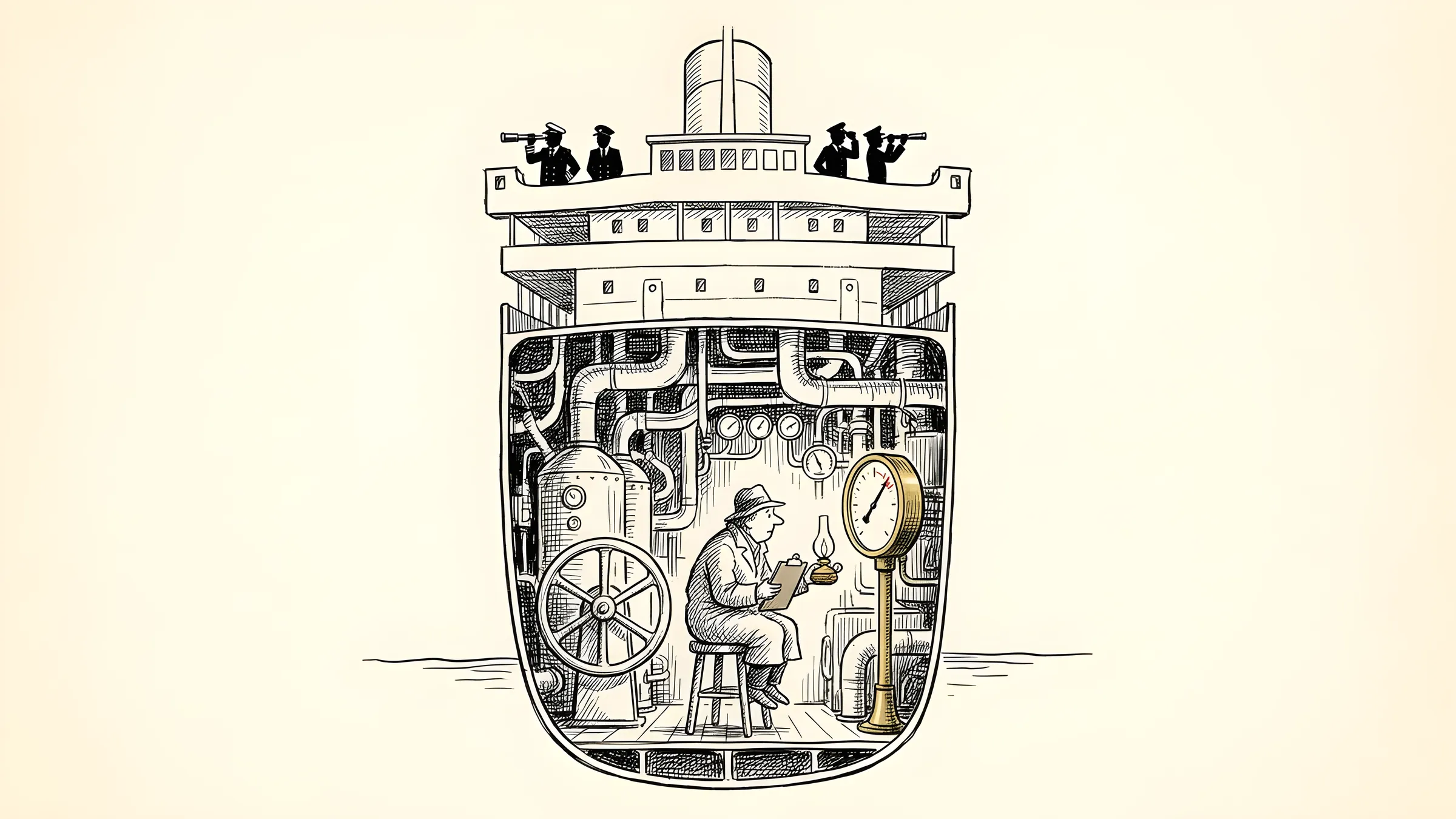
The third mechanism was suggested, probably unintentionally, by Zuckerberg himself. Rejecting joint slowdown, he stated that labs bear “significant responsibility” if their models cause harm. So let them truly bear it. When you have to pay damages for an agent that flooded a university server with queries or entered a government portal, and the insurer prices that into the premium, every company will slow down on its own where it’s dangerous. Without agreements and without a cartel lawsuit. This is my opinion, but no appeal slows a corporation as effectively as an actuary.
The Brake We Have in Our Hands
The fourth mechanism concerns us. We have no influence on the pace of work in California, and let’s not fool ourselves that we do. The entire EU tender for seven AI gigafactories is worth over 30 billion euros, and the American quartet is spending roughly twenty times more on infrastructure this year. Poland reserved 135.3 million euros for computing time in the gigafactory it’s bidding for, with offers due by November 12. This is important money for us and small change in the scale of this race.
But we have something that can’t be bought on credit: 450 million customers and law that says on what terms you can sell to them. Since August 2, 2026, the European Commission can fine providers of general-purpose models for violating the AI Act, up to 3 percent of global turnover or 15 million euros. Models with systemic risk must undergo testing and report serious incidents. In Poland, from October 28, control and penalty powers go to the Commission for AI Development and Safety, and the Senate just confirmed its chair, Pamela Krzypkowska. This isn’t a brake at the frontier of capabilities, but a gate at the border of the market. And gates, as we saw with Astra, work.
There’s one more brake, the least spectacular: our own signature. Every company buying agents can write into the contract an obligation to report incidents, access to logs, and minimum permissions. A vendor who wants to sell in Europe can agree to this or lose the customer. That’s how the market works when the customer knows what they want.
Will any of these mechanisms make AI develop more slowly? Honestly, somewhat. Not by the year or two Amodei asks for. But it will mean the most dangerous things come out later, and those released will be better tested. I believe that’s still more than can be achieved with appeals. Pachocki wrote that the idea of rushing forward at any cost seems absurd when you truly understand what’s at stake. He’s right. Except everyone in the cab already understands what’s at stake. What they lack is a mechanism that would let them slow down without losing their place at the controls.
Tuwim knew what pushed the locomotive. He didn’t need to write who would stop it, because in a children’s poem the train runs on tracks, and the tracks lead to a station. In the story of artificial intelligence, the tracks are laid by people other than the engineers: judges, insurers, auditors, regulators and customers. Instead of begging the people in the cab to slow down, we’d better focus on the switches. That’s where - not at the brake lever - we’ll determine which station we arrive at.
Sources
- CNBC: OpenAI DevDay live updates, Sarah Friar statements and funding talks (Sept 29, 2026) · CNBC: OpenAI abandons plan to release upcoming model (Sept 28, 2026) · CNBC: capital expenditures and debt of Amazon, Alphabet, Microsoft and Meta (July 28, 2026) · CNBC: Trump touts AI self regulation after White House luncheon (Sept 29, 2026) · Dario Amodei, “We Must Pace the Frontier” (Sept 12, 2026) · Jakub Pachocki, “An Alien Mind”, OpenAI (Sept 6, 2026) · OpenAI: Hugging Face incident timeline, halt of largest training run (Aug 18, 2026) · OpenAI: An agent used DNS to reach an external chatbot (Sept 25, 2026) · Associated Press (via ABC News): antitrust lawsuit against Anthropic, OpenAI, SpaceXAI and Google, Josh Hawley statement (Sept 20, 2026) · Scientific American: Trump’s UN speech (Sept 22, 2026) · Al Jazeera: OpenAI cancels release of GPT-6.1 Astra (Sept 29, 2026) · Engadget: OpenAI Dev Day 2026 live blog (Sept 29, 2026) · Benzinga: Zuckerberg on Muse delay and lab responsibility (Sept 2026). Literature and history: Julian Tuwim
- “The Locomotive”
- (1938)
- “The Promised Land”
- dir. Andrzej Wajda (1974)
- based on Władysław Reymont’s novel
- Józef Rotblat, Nobel Peace Prize 1995 (nobelprize.org) and biography on Pugwash site
- prisoner’s dilemma (Flood and Dresher
- RAND
- 1950)
- British Locomotive Acts (1865, 1878, 1896). On the blog: GPT-6.1 Astra halted
- DevDay 2026 coverage
- GPT-6.1 Sol test in Polish
- “Pacing the Frontier” letter
- GPAI obligations in AI Act. Verified September 29
- 2026

More on this from QUANTSLANT
 benchmarks·AI Image Generator Arena: Compare 11 Models Side-by-SideInteractive arena comparing 11 AI image generators across 4 tests: text rendering, layout precision, iterative edits, and true 4K resolution.