Decision Model vs LLM: Architecture and Performance
Compare decision models and traditional LLMs across routing tasks, latency profiles, calibration metrics, and cascading costs.
👁 115 reads
The emergence of dedicated decision models introduces an alternative to conventional large language models for production routing, moderation, and classification. A decision model takes an input context alongside predefined categorical questions and outputs calibrated probabilities for each option in a single network pass. In contrast, standard LLMs predict sequential tokens to generate prose or structured JSON objects, consuming compute across both input reading and output generation phases.
When Decision Models Surpass Generative LLMs
Decision models provide distinct advantages when tasks require fixed choices under strict operational budgets. Artificial Analysis data from October 13, 2026, illustrates that on Ai2’s WildGuardTest, GLiDE reached an F1 score of 95.1, surpassing Claude Haiku 5.5 low at 92.6 while running at 217 ms versus 1434 ms. Similarly, on NVIDIA’s When2Call tool-routing benchmark, GLiDE and Celeris-1 Decision both registered 83.7, whereas Claude Haiku 5.5 low scored 73 and GPT-6 Luna low scored 77.
Operational pricing reinforces this division. Decision model providers charge strictly for input tokens, making output tokens free. On the full Decision Index v1.0, Microsoft-Decision-1 processes one million benchmark tasks for $30.7 with a median latency of 207 ms, while Claude Haiku 5.5 low costs $184 across 1434 ms. For high-throughput classification, Decider v1.1 27B incurs $12.1 per million tasks on WildGuardTest, compared to $91.5 for Claude Haiku 5.5 low and $3,774 for Claude Opus 5.5 low.
Knowledge Boundaries and Generative Requirements
Generative LLMs remain essential whenever workflows require open-ended prose, unstructured document drafting, or deep general knowledge retrieval. On the AA-Omniscience-Decision test, decision model accuracy peaked between 28 and 41 percent, far behind GPT-6 Luna low at 66 percent. Liquid AI’s d1 attained the top decision model knowledge accuracy at 41.0 percent, yet its rate of selecting ‘I don’t know’ was only 1.7 percent, demonstrating significant overconfidence on unknown facts.
Hybrid Cascades in Production
Because decision models output numerical confidence distributions, systems can implement tiered cascades that route low-certainty cases to larger LLMs. A test conducted on 50 customer-support tickets in a non-English language (Polish) - a small sample designed to be indicative - evaluated this architecture by pairing Microsoft-Decision-1 with Claude Haiku 5.5.
- Claude Haiku 5.5 alone: 45/47 accurate department assignments at ~$101 per 1M tasks.
- Microsoft-Decision-1 alone: 44/47 accurate department assignments at $11.5 per 1M tasks.
- Confidence cascade: Microsoft-Decision-1 escalated tickets with confidence below 0.8 to Claude Haiku 5.5, achieving 45/47 accuracy at ~$18 per 1M tasks.
By delegating high-confidence classifications to the decision layer and reserving generative models for ambiguous inputs, teams can retain frontier model accuracy while reducing pipeline expenses.
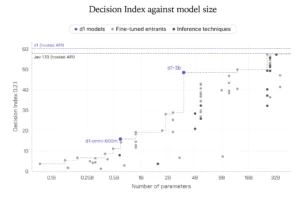
More: AI decision models - Decision Index ranking, prices and tests


More on this from QUANTSLANT
 news·Decision Index v1.0 Released by Artificial AnalysisArtificial Analysis has launched Decision Index v1.0 to benchmark decision models against traditional LLMs on structured evaluation tasks.