Gemini Agent: Google’s Universal Work Agent, Pricing & Features
Google unveiled Gemini agent: an autonomous work agent that runs in the background, coordinates tools, and collaborates as a teammate across Workspace.
👁 114 reads
Regularly updated. Current as of October 9, 2026.
Gemini agent is Google Cloud’s universal work agent, unveiled on October 8, 2026, at the Gemini at Work conference. You give it a high-level goal in a single prompt, and it drafts a plan, taps into your internal systems, works autonomously in the background for hours or days, and delivers a completed document, slide deck, email, or codebase. It operates across Gemini Enterprise and Google Workspace. For now, it remains in private preview with no standalone price tag - access is expected to be bundled into Gemini Enterprise, which starts at $21 per seat.
Status as of October 9, 2026
- Announcement: October 8, 2026, at Gemini at Work 2026, via Thomas Kurian’s post on the Google Cloud Blog.
- Status: Private preview for selected enterprise customers. Background processing, desktop/mobile apps, and third-party models are in early access.
- Pricing: According to VentureBeat, included at no extra cost for Gemini Enterprise subscribers (starting from $21 per seat monthly). Google has not announced standalone pricing for agent teammates.
- Availability: Google has not published a full country rollout schedule yet.
- Models: Gemini family today, with Anthropic’s Claude models officially announced.
What is Gemini agent?
Google previously offered multiple disconnected enterprise AI tools: Gemini in Gmail and Docs, the Gemini web app, the Gemini Enterprise agent platform (formerly Agentspace), and developer extensions. Gemini agent unifies them all. Google Cloud CEO Thomas Kurian described it as the “new, single, universal agent for work,” while Google rebranded the Gemini Enterprise product portal to “Gemini for Business: The Universal Work Agent.”
Unlike a traditional chatbot, you do not manage tasks step by step. Instead, you describe the end result - such as “prepare a Q4 pricing proposal deck using the project files and recent sales data” - and the agent autonomously locates files, analyzes numbers, writes copy, and outputs a finished presentation directly into Google Slides. You can close your laptop; the agent continues working in the cloud.
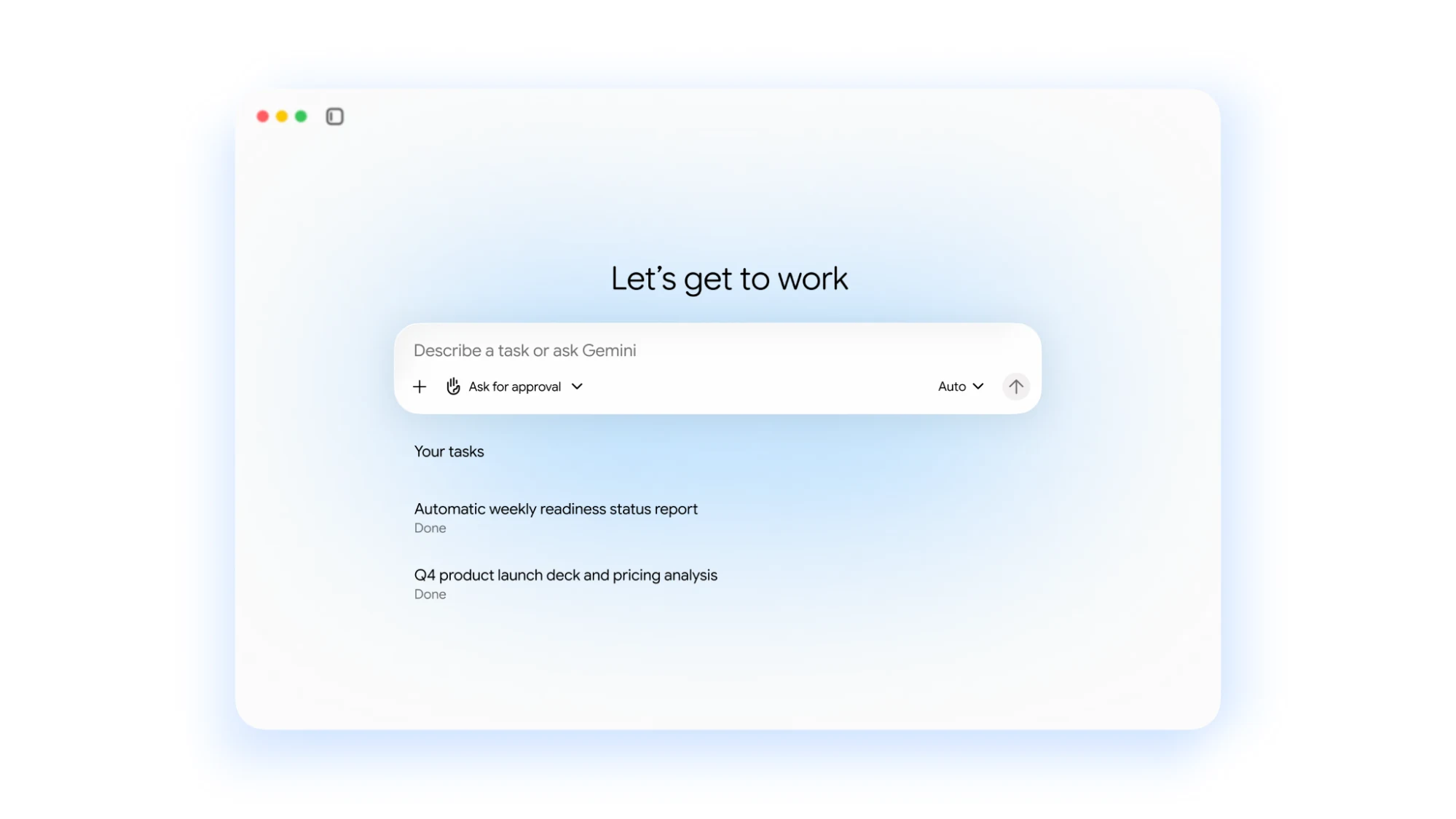
Key features and capabilities
- Retrieval and synthesis - searches across your company docs, emails, calendar events, and connected external software.
- Asset creation - generates complete documents, spreadsheets, slide presentations, graphics, and other media assets.
- Code execution - writes, tests, and executes scripts, operating inside terminal environments and IDEs.
- Planning and delegation - breaks complex projects into discrete steps, calls specialized skills and APIs, and spins up temporary sub-agents when required.
- Unified memory - leverages four distinct memory tiers (session, semantic, procedural, and episodic) so you do not have to re-explain team guidelines every time.
- Human-in-the-loop controls - includes an explicit approval toggle, allowing administrators to require human sign-off before critical external actions.
Where Gemini agent runs
| Environment | How it operates |
|---|---|
| Web browser, Windows, macOS, iOS, Android | Dedicated application interface with a single task prompt (desktop and mobile in early access) |
| Gmail, Drive, Docs, Sheets, Slides, Chat, Calendar | Directly mention via @Gemini within ongoing threads and files |
| Microsoft 365, Slack, and third-party tools | Pre-built connectors and integrations |
| Command line (CLI) and IDEs | Direct integration for software engineering workflows |
| Headless mode | Programmatic execution triggered by webhooks and external enterprise systems |
Agent teammates with their own Workspace accounts
The most consequential update centers on organizational structure. Google will allow teams to provision an agent as a full workspace colleague, complete with an email address on your domain (e.g., agents.yourcompany.com), dedicated Drive storage, a Google Calendar, and an entry in your company directory. It only accesses resources explicitly shared with it, operating just like a junior employee with scoped permissions. Google highlights three modes of deployment across Workspace:
- Personal assistant - assists an individual user with daily productivity;
- Proactive delegation - Workspace Intelligence surfaces workflows and suggests offloading them to an agent;
- Team coworker - an autonomous agent teammate with its own corporate identity.
Google has not yet published seat pricing for agent teammates. As VentureBeat noted, whether an autonomous teammate consumes a standard paid seat remains an open commercial question.
Underlying models and architecture
Google decouples the agent orchestration framework from the underlying foundation models. According to the Gemini at Work materials, the agent leverages both Google’s internal Gemini models and Anthropic’s Claude family, with support for additional proprietary and open-weights models planned. The Gemini roster includes:
- Argon - flagship reasoning engine (Gemini 4 Argon, as of October 9 still restricted to Fairwind program partners);
- Flash - optimized for ultra-fast, high-volume processing;
- Omni - native multimodal processing, including real-time video (Gemini Omni Flash);
- Gemma - lightweight open-weights family for specific edge or private tasks.
A built-in Smart Routing layer directs sub-tasks to the most cost-effective model suitable for each step. Google notes that third-party model selection is currently in early access, with Google models available natively today.
Gemini agent pricing
Gemini agent does not carry separate standalone pricing. According to VentureBeat, agent capabilities will be bundled into Gemini Enterprise subscriptions, while 9to5Google reports access will roll out to select Workspace Business and Enterprise tiers. Google’s enterprise tiers are billed in USD:
| Gemini Enterprise Edition | Pricing | Target audience |
|---|---|---|
| Business | From $21 per seat / month | Small and medium teams, up to 300 seats (documentation from Oct 7 indicates up to 500), 25 GiB per seat |
| Standard / Plus | From $30 per seat / month | No seat cap, up to 75 GiB, data residency controls, VPC Service Controls, customer-managed encryption keys |
| Pay-as-you-go | $0 seat fee, metered usage | Deployments starting at 20 seats, consumption-based billing |
Google provides a 30-day free trial for the Plus tier. If your company only requires inline generative writing inside Gmail and Docs rather than autonomous multi-step agents, standard Google Workspace plans with Gemini remain the straightforward path. See our comparison guide in Gemini agent vs ChatGPT vs Claude for business.
Security and administrative governance
- Each agent receives a cryptographically verifiable corporate identity operating under the principle of least privilege.
- Every action, API request, and data retrieval generates an immutable audit trail.
- An Agent Sandbox isolates all code execution, while the Agent Gateway acts as an enterprise firewall enforcing corporate policies.
- Strict spend caps can be enforced at the Google Cloud project billing level, pausing execution once thresholds are met.
- Per Google’s enterprise terms, your proprietary corporate data, prompts, and outputs are never used to train Google’s foundation models.
Release date and availability
Google has not provided a general public release date. As of October 9, 2026, the agent is restricted to a private preview with selected enterprise partners, with broader rollout slated for “coming months.” While global enterprise clients were featured at the event (including BNP Paribas, Commerzbank, Lloyds, Orange Spain, Ryanair, and Siemens), these represent existing Gemini Enterprise deployments rather than immediate agent rollouts. We will update this section as regional launch dates are confirmed.
Who should consider it?
- Organizations committed to Google Workspace that already rely on Gemini across their office suite and want deep native automation.
- Cross-functional teams managing complex tool stacks (such as CRM, Jira, and Microsoft 365), thanks to over 100 enterprise connectors.
- Not ideal for solo freelancers today: it is not available for retail purchase, and standard Gemini subscriptions or Gemini Advanced handle document drafting without enterprise overhead.
Frequently asked questions
Is Gemini agent free?
No. It is designed as an enterprise feature bundled with Gemini Enterprise (starting at $21 per seat monthly) and select Workspace business tiers. Google has announced no standalone free tier.
How does Gemini agent differ from the standard Gemini app?
The consumer Gemini web app is a conversational chatbot. Gemini agent is an enterprise orchestration platform: it connects to internal databases, executes multi-day jobs in the background, provisions dedicated agent email addresses, and operates under IT administrator policies.
Can Gemini agent use Anthropic’s Claude models?
Yes, Google confirmed that Claude models from Anthropic will be supported alongside Gemini. Third-party model selection is currently entering early access.
Does Gemini agent replace Google Agentspace?
Agentspace was rolled into the Gemini Enterprise umbrella in 2025. Gemini agent represents the unified conversational and execution layer on top of that infrastructure.
Does Google train its AI models on your company data?
No. Under Google Cloud’s enterprise terms, your prompts, uploaded files, search results, and agent actions are not used to train or fine-tune Google’s underlying models.
Does Gemini agent work alongside Microsoft 365?
Yes. Google Cloud provides connectors for Microsoft 365, Teams, Outlook, OneDrive, and Slack, allowing the agent to pull data and trigger workflows across mixed environments.
Related articles
- Gemini agent announced at Gemini at Work 2026
- Gemini agent vs ChatGPT vs Claude - Which is best for enterprise?
- Gemini 4 Argon: Architecture, capabilities, and availability
- How to build your own AI agent from scratch
Sources and review date
Official sources

More on this from QUANTSLANT



 guides·AI Ticket Routing in Python with Strands Decider 2BA decision model routes support tickets better than a chatbot. Here is a Python script using Strands Decider 2B with confidence scores and fallbacks.