IBM Research Method Cuts Agent Memory Tokens Without Dropping Lessons
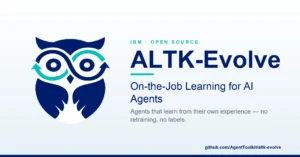
IBM Research published ALTK-Evolve on August 11, 2026, a system that reduces the token cost of agentic memory by delivering individual retrievable guidelines instead of a full evolving playbook.

👁 114 reads
IBM Research published ALTK-Evolve on August 11, 2026, presenting it as a lower-token alternative to ACE (Agentic Context Engineering) for agents that learn from their own past trajectories without weight updates or human labels.
- ALTK-Evolve clusters and merges near-duplicate lessons while preserving a support count that tracks how many independent episodes produced each guideline
- It extracts typed guidelines - strategy, recovery, and optimization - with causal attribution and subtask-level granularity, so lessons transfer across apps
- Both ALTK-Evolve and ACE reject compressing an agent's learned lessons into a short summary, but differ in how memory is built and how it reaches the model at inference
Both systems address a concrete failure pattern: an LLM agent given a realistic multi-step task - splitting a bill, finding a song, reconciling an order across nine simulated apps - tends to fail not from missing knowledge but from mis-using APIs it already knows. The fix is to turn the agent’s own history into reusable lessons and feed them back at inference time.
ACE organises those lessons into one comprehensive, evolving playbook, updated through a Generator - Reflector - Curator loop with per-bullet helpful/harmful counters and embedding-based de-duplication. ALTK-Evolve takes a different structural approach: it clusters near-duplicate lessons and merges within each cluster, with the surviving guideline inheriting the combined support count of every lesson that fed into it. That count - recording how many independent episodes produced a given guideline - is the system’s measure of reliability.
Where the two systems explicitly agree is on avoiding what ACE calls brevity bias and context collapse - the tendency for a model asked to rewrite its full context to summarise away hard-won detail. According to the IBM Research authors, “a lesson five different tasks discovered is a different object from one that appeared once, and both are worth keeping.”
ALTK-Evolve also extracts typed guidelines across three categories - strategy, recovery, and optimisation - with causal attribution and provenance traced back to the source trajectory at subtask granularity, meaning a lesson learned on one application can transfer to another.
For developers building tool-using agents, the practical implication is straightforward: the architecture of the memory store affects the token bill at every inference call. A system that delivers individually retrievable guidelines rather than a full evolving playbook can hold more distinct lessons without proportionally growing the context window - which matters whenever agent tasks span many steps or many tools.
Google · Your sourcesQuantslant higher in your Google - one clickAdd to preferred sources →

More on this from QUANTSLANT
 news·Zoom patches ‘Zoomsday’ flaw that let attackers hijack every device