Nvidia down 31%: how much is the Huang affair and how much is the market?
I compared Nvidia with the chip index session by session. Most of the drop from the record came before Huang wrote to staff; the affair shows in the last two sessions.
👁 111 reads
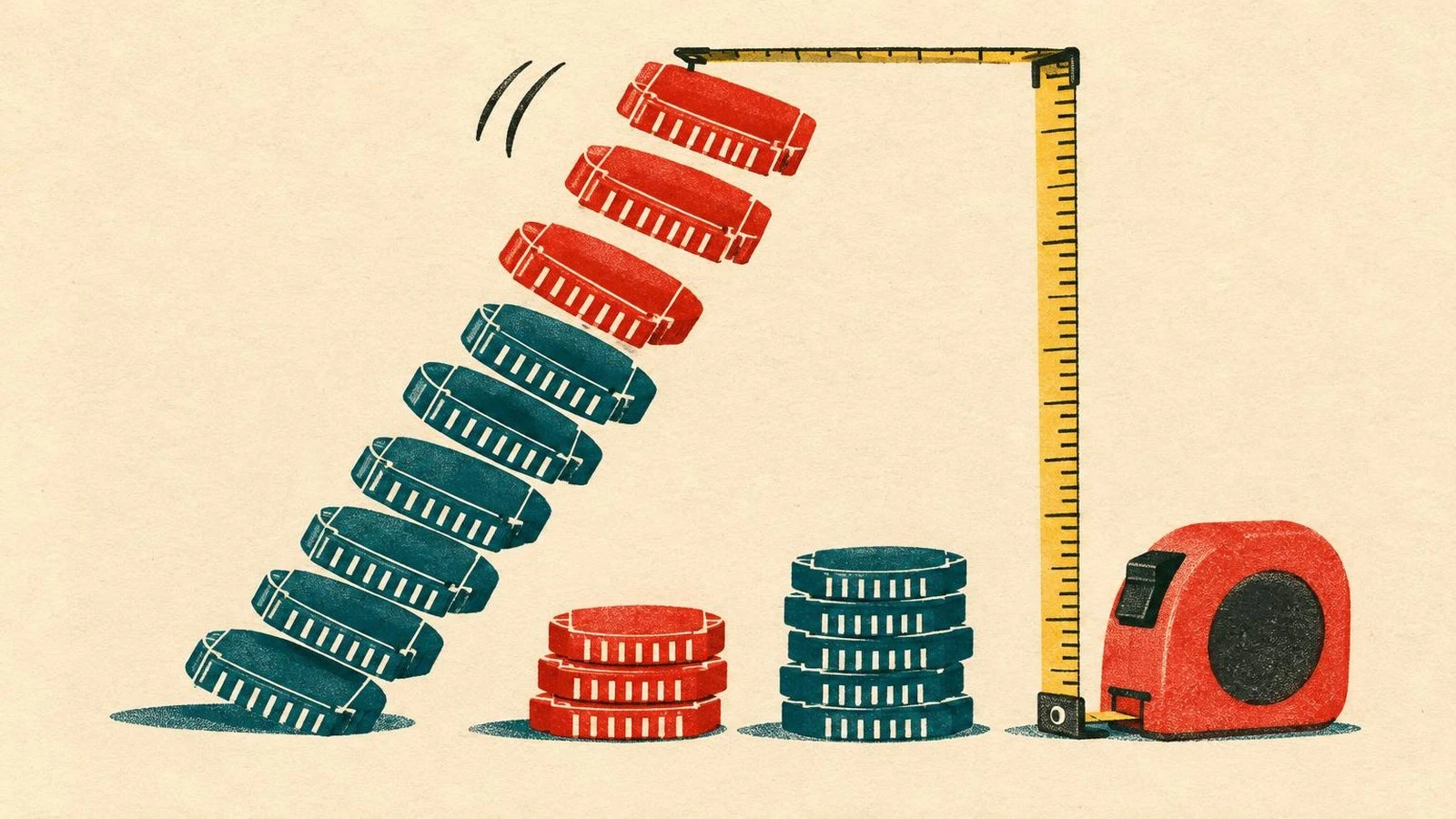
“Nvidia loses 31% over the Huang scandal” is roughly how many headlines summed up this week. I went through the closing prices session by session and compared them with the semiconductor index. The picture is different: about three quarters of the drop from the October record happened before Jensen Huang wrote to his employees, and during that period Nvidia actually held up better than the rest of the chip sector. A clear scandal effect shows up only in the last two sessions.
In short
- From the record close on 6 October ($239.24) to 10 November ($168.89): minus 29.4%. From the intraday high ($243.37): about minus 31%.
- Up to 6 November, before Huang’s memo: Nvidia minus 22.0%, the SOX semiconductor index minus 29.0%, the Nasdaq Composite minus 10.9%.
- 9-10 November, after the memo: Nvidia minus 9.5%, SOX plus 6.5%, Nasdaq plus 2.0%.
- Takeaway: most of the decline was a sector-wide AI sell-off. The affair started costing Nvidia clearly only from 9 November.
Before I start: this is not investment advice. I am not saying whether the stock is cheap or expensive, or what anyone should do with it. I only break down where the decline came from, using data anyone can check. All prices are New York closing prices from Yahoo Finance.
Where 31% comes from
On 6 October Nvidia traded as high as $243.37 during the session and closed at a record $239.24. On Tuesday, 10 November, the stock dipped to about $167 in the afternoon and closed at $168.89. From the intraday peak that is about 31%; from the record close, 29.4%. Both numbers are true; they just measure different things. I use closing prices from here on, because only those allow a fair comparison with an index.
Stage one: October without a scandal (6-28 October)
Between the record and the day before the first New York Times story, Nvidia fell 10.0%. The SOX fell 11.6% over the same period, the Nasdaq 3.8%. For three weeks Nvidia moved exactly like its sector, even slightly better.
What pulled the sector down? Sources point to several threads at once, and none can be measured separately. Yahoo Finance wrote in October about doubts over the return on AI spending. Some analysts, including Seaport’s Jay Goldberg, point to Nvidia increasingly financing its own customers. Then there is China: according to IDC data cited by Reuters, Nvidia’s share of China’s data center AI accelerator market fell to 34% in the first half of 2026, and Nvidia says in its quarterly filing that it has not yet generated revenue under the H200 licensing program. None of this is new or sudden. It is the backdrop against which investors started paying less for every dollar of the whole sector’s future earnings.
Stage two: the NYT report and a sector crash (29 October-6 November)
On 29 October The New York Times reported that, according to its sources, US intelligence regards Alice Huang of Megaspeed as a Chinese intelligence asset close to Nvidia’s CEO. If the market had seen that as a serious threat, it should show in the price. It does not. On 29 October Nvidia fell 0.8%, less than the Nasdaq (minus 1.4%). On 30 October it lost 4.2%, but the SOX fell 7.2% that day and the Nasdaq 2.9%.
The worst day of this stage was 5 November: Nvidia minus 9.3%. That sounds like the scandal, but the same day the SOX lost 12.2% and the Nasdaq 5.5%. FX Leaders linked the sell-off to cautious outlooks from Qualcomm and Arm and double-digit drops at AMD and Micron. I found no source tying that sector-wide sell-off to the Huang story.
From 28 October to Friday, 6 November: Nvidia minus 13.3%, SOX minus 19.6%, Nasdaq minus 7.4%. Counting from the record: Nvidia minus 22.0%, SOX minus 29.0%. Until Huang’s admission, his company was falling less than its own sector index.
Stage three: two sessions after the memo (9-10 November)
On Sunday, 8 November, Huang wrote to his employees and the board announced an independent investigation. From that point the paths split. On Monday Nvidia fell 4.27%, on Tuesday 5.47%, minus 9.5% in total. In the same two sessions the SOX gained 6.5%, the Nasdaq 2.0%, AMD almost 15% and Broadcom 13%.
The gap between Nvidia and its sector over those two days is therefore about 16 percentage points. That is the best available measure of what the Huang affair itself cost, although an imperfect one: some money may simply have rotated from Nvidia into rivals that had fallen further before.
What exactly are investors pricing in? Analysts say it openly. Dan Ives of Yorkville Ives estimates the chance of Huang leaving at about 15% and believes the company would be worth 25-30% less without him. Bank of America, in a note on 10 November, laid out three scenarios, from contained impact to “adverse findings, leadership disruption or tighter restrictions.” That last phrase is the key one: the market fears less a personal scandal than Washington tightening Nvidia’s exports and Huang losing the standing from which he negotiated with the administration for years.
How to count it fairly
If I had to give one proportion: of the 29.4% drop from the record, roughly 22 points came before Huang’s memo, while the whole sector was falling even harder. The remaining roughly 9.5% came in two sessions in which Nvidia swam against the market. Percentage declines compound, so the numbers do not add up exactly, but the proportion is clear: about three quarters of the drop came before the affair, about one quarter after it.
Two caveats. First, it cannot be ruled out that the 29 October NYT report started to weigh earlier and was simply drowned out by the broader sell-off. The data does not show it, but it does not exclude it either. Second, before the open on Wednesday, 11 November, the stock was up about 5%, which Investing.com linked to a stronger revenue outlook from CoreWeave, one of Nvidia’s big customers. The arithmetic can change at any moment, in either direction.
The next test is 17 November, when Nvidia reports results for a quarter it guided at $108 billion in revenue with no data center compute sales to China. A day later Congress wants to hear from Huang behind closed doors. What is confirmed and what is only reported is covered in my news article: Nvidia stock at its lowest since March: what is confirmed in the Huang probe.
Google · Your sourcesQuantslant higher in your Google - one clickAdd to preferred sources →FAQ
Did Nvidia lose 31% because of the Huang affair?
Not all of it. About 31% is the drop from the intraday high on 6 October. By 6 November, before Huang’s memo, the stock was already 22% lower and the SOX semiconductor index 29% lower. After the memo Nvidia lost another 9.5% while the SOX gained 6.5%.
When did Nvidia hit its record?
On 6 October 2026: a close of $239.24, with an intraday high of $243.37.
Is this a recommendation to buy or sell?
No. This is an analysis of past prices. I do not assess whether the stock is worth buying.
- Sources: NVDA
- PHLX Semiconductor Index (SOX)
- Nasdaq Composite
- AMD and Broadcom closing prices: Yahoo Finance (6 Oct-10 Nov 2026)
- 24/7 Wall St.
- heise
- FX Leaders (5 Nov)
- Yahoo Finance (October)
- Yahoo Finance / Reuters, IDC
- CNBC (11 Nov)
- Investing.com (11 Nov)
- The New York Times (29 Oct, syndicated)
- Nvidia board statement
More on this from QUANTSLANT



 news·Nvidia stock at its lowest since March: what is confirmed in the Huang probeNvidia shares hit their lowest close since March. I separate what Nvidia and Huang confirmed from media reports, and check where the 31% figure comes from.