Thélyson Orélien and the AI Detector: I Tested the Prize-Winning Novel. Same Paragraph Scored 100%, 85% and 0% AI
The Thélyson Orélien affair explained, plus my own test of the novel's excerpts in Pangram, AUTHORRA and ZeroGPT, with Zola and an AI text as controls.
👁 120 reads
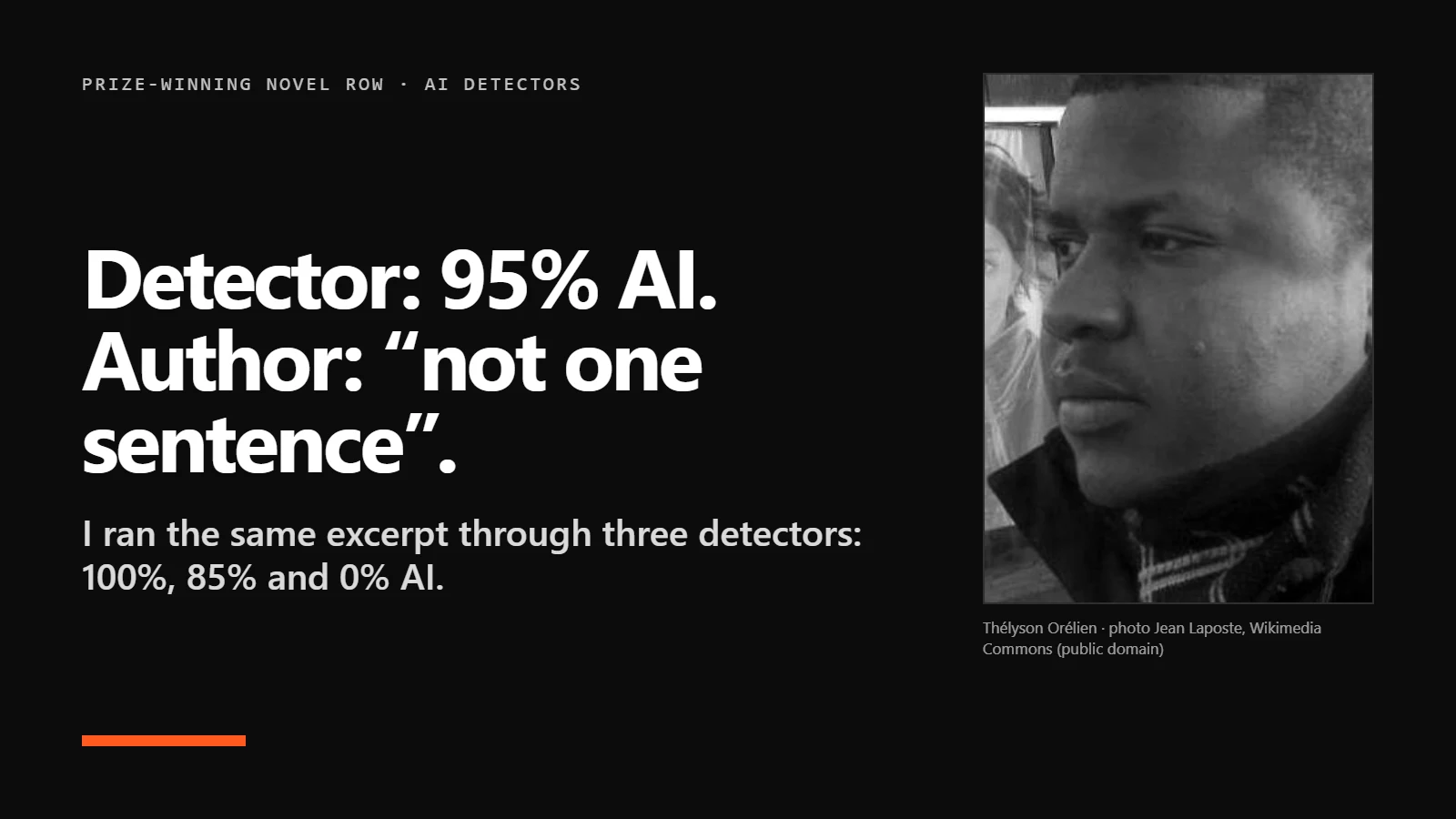
Thélyson Orélien’s debut novel “C’était ça ou mourir” won France’s Prix du roman Fnac, sold tens of thousands of copies and then was pulled from the Goncourt race after the AI detector Pangram flagged it as machine-written and the press dug up the author’s past plagiarism. Orélien denies using AI to write the book and says he is the target of a racist campaign. I took the publicly released excerpt of the novel and ran it through three detectors, alongside control texts. The same paragraph scored 100%, 85% and 0% AI.
Key points (as of 14 October 2026)
- The book: “C’était ça ou mourir” (“It Was Either That or Die”), published by Boréal in Canada and Grasset in France - the debut of a 38-year-old Haitian-born writer living in Quebec.
- The accusation: an X account called “Balance ton Claude”, then media tests. Le Monde: Pangram flagged more than 95% of the text as AI.
- The fallout: the Académie Goncourt dropped the novel on 25 September. The Renaudot jury kept it on its second list because, for most jurors, “it is not proven”.
- The author, 13 October: “not a single sentence in this book was created by a machine”. He also admitted to plagiarism in texts written years ago.
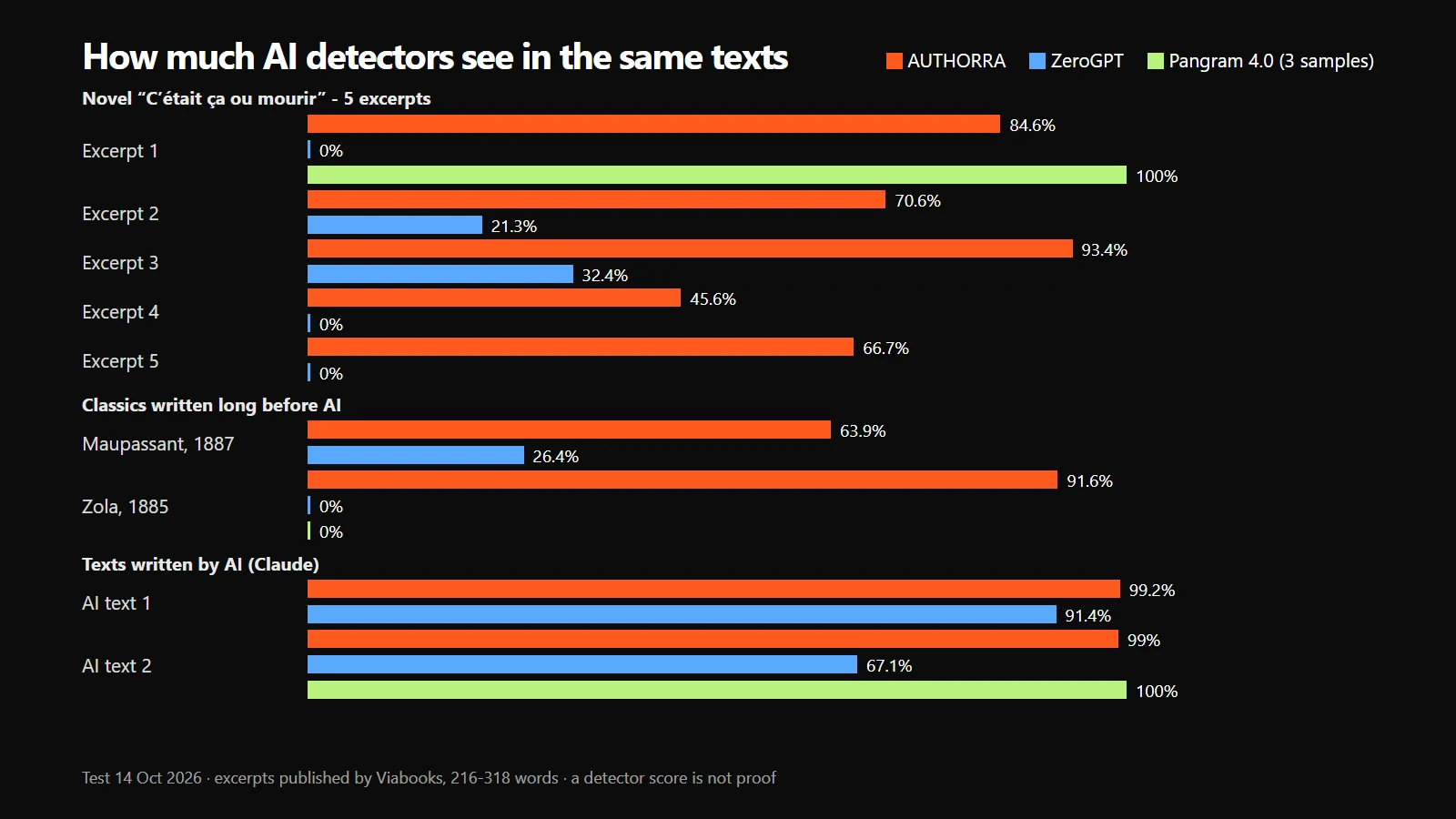
- My test: Pangram got both control texts right and scored the novel excerpt 100% AI. Two other detectors scored the same excerpt 84.6% and 0%. One of them labelled Zola as AI.
- A detector score is not proof. It is a probability estimate, not a record of how a text was written.

What happened: timeline
- March 2026 - the novel comes out in Quebec with Éditions du Boréal. The author says he started writing it in autumn 2017 and finished a first draft in 2019, before ChatGPT was public.
- 19 August 2026 - French edition by Grasset. The book makes the first lists of the Goncourt, Renaudot, Femina and Médicis prizes.
- 21 September - Prix du roman Fnac. The same evening, the anonymous X account “Balance ton Claude” posts Pangram screenshots: chapter 1 at 100% AI, chapter 2 at 91%. According to The Telegraph, the post drew almost 4 million views.
- 22-24 September - media tests. Le Monde runs more than half the novel through Pangram: more than 95% flagged as AI. Radio-Canada tests the full e-book: 94%. France 24 and France Inter report 92% and 95-100%.
- 25 September - the Académie Goncourt removes the book from its selection, citing the author’s plagiarism and “the convergent results of several analyses by trustworthy researchers and journalists”.
- 7-8 October - the book stays on the Renaudot’s second list. Femina and Prix Décembre leave it out.
- 13 October - the author publishes a statement titled “Ce roman que j’ai écrit” (This novel I wrote): no AI in the writing, an apology for old plagiarism, and a description of threats and racist harassment.
Who made the accusation, and with what
French essayist Samuel Fitoussi has said he is one of the people behind “Balance ton Claude”. The tool was Pangram, a commercial AI text detector. For version 4 the company reports a false positive rate of 0.0041%, and 0.0026% for French. An independent 2024 study by Marzena Karpinska (Simon Fraser University) found about 2% false positives, while noting that longer texts lower the risk.
The media also ran controls. Radio-Canada put six other Goncourt contenders, Bible chapters, nine French classics and eight books by authors of Haitian origin through Pangram. All came out human. Libération checked Orélien’s older writing: texts from the 2010s passed as human, while 2024 columns triggered alerts.
| Tested by | What | Pangram result |
|---|---|---|
| Balance ton Claude | chapters 1 and 2 | 100% and 91% AI |
| Le Monde | more than half the novel | over 95% AI |
| Radio-Canada | full e-book | 94% AI |
| France 24 / France Inter | excerpts | 92% / 95-100% AI |
| Radio-Canada (control) | 6 Goncourt novels, classics, Haitian authors | 100% human |
What the author and publishers say
Orélien has denied the accusation from day one. On 23 September he said he was “not sad, but angry” and was gathering evidence with his publishers. In his 13 October statement he wrote that no sentence of the novel was created by a machine and that he used tools only for research, such as foreign idioms. About the campaign against him:
“Les menaces, le lynchage médiatique et le harcèlement raciste que je subis depuis des semaines sont insoutenables.” (The threats, the media lynching and the racist harassment I have been subjected to for weeks are unbearable.)
In the same text he admitted something else: plagiarism years ago. La Presse reported that a 2012 short story contained passages from a book by Louis Pauwels and that a 2013 opinion piece was copied from The Philippine Star. He called these “unacceptable mistakes” and apologised. That is a separate issue from AI, but the Académie Goncourt bundled both into one decision. Grasset said it has “absolute confidence” in him, and Boréal said it stands by him.
My test: three detectors, novel excerpts and controls
The French literary site Viabooks published the first two chapters for free. I took five samples of 216-296 words from that excerpt, plus two kinds of controls whose origin is certain:
- Human text written long before AI: the opening of Zola’s “Germinal” (1885) and Maupassant’s “Le Horla” (1887), from Wikisource.
- AI text: two passages of about 255 words generated by Claude Opus 5.5 from the prompt “first-person prose, a teacher from Haiti flees gangs / a bus hold-up”. No edits.
Detectors:
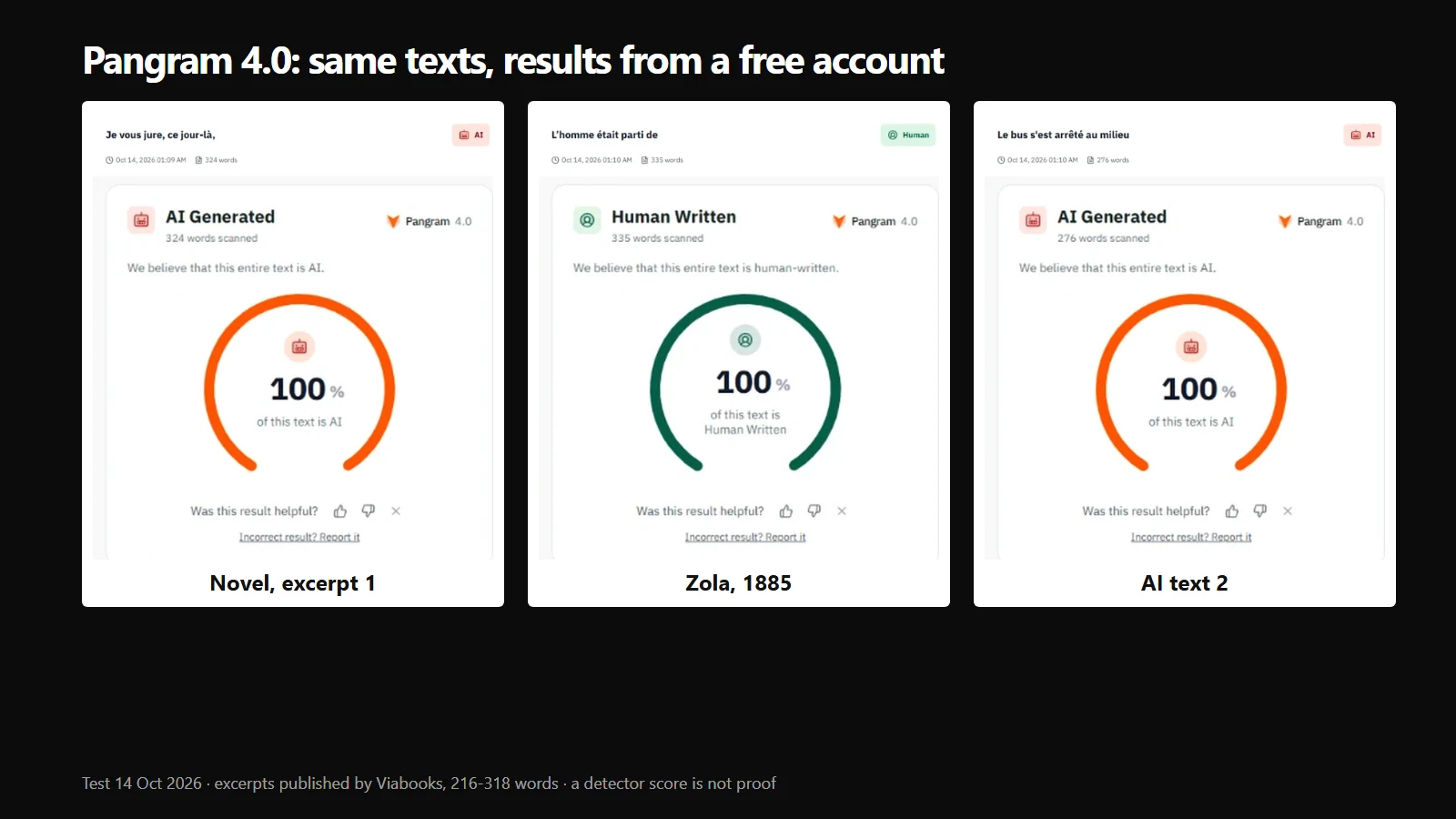
- Pangram 4.0 on a free account (3 scans a day). I checked three texts: excerpt 1, Zola and AI text 2.
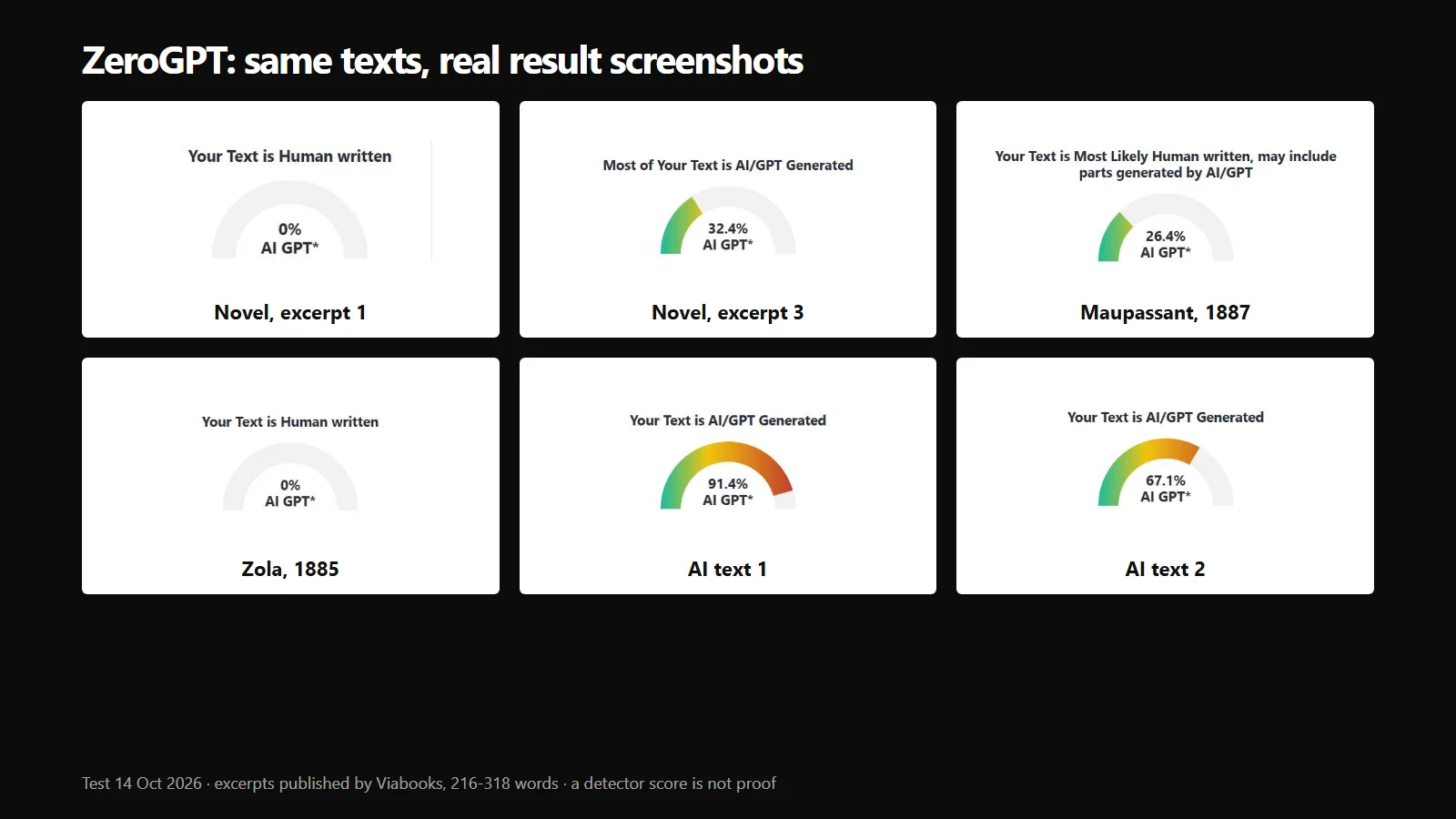
- ZeroGPT, the free box on its website, no login. All samples.
- AUTHORRA, a small stylometric detector with a public API (French model). All samples.
GPTZero’s free scan redirected to an app that requires an account, so I skipped it.
Results
| Sample | Pangram | AUTHORRA | ZeroGPT |
|---|---|---|---|
| Novel, excerpt 1 | 100% AI | 84.6% | 0% |
| Novel, excerpt 2 | - | 70.6% | 21.3% |
| Novel, excerpt 3 | - | 93.4% | 32.4% |
| Novel, excerpt 4 | - | 45.6% | 0% |
| Novel, excerpt 5 | - | 66.7% | 0% |
| Maupassant, 1887 (human) | - | 63.9% | 26.4% |
| Zola, 1885 (human) | 0% (human) | 91.6% - wrong | 0% |
| AI text 1 (Claude) | - | 99.2% | 91.4% |
| AI text 2 (Claude) | 100% AI | 99% | 67.1% |
Percentages are the AI share or probability reported by each tool. A dash means I did not run that text through Pangram (free account limit). For the full 3,546-word excerpt, AUTHORRA returned 83% (“mixed”).
What this shows
- Pangram behaved exactly as in the media tests. Novel excerpt 100% AI, Zola 100% human, Claude 100% AI. Both controls right, which adds to its credibility. Still, three samples are not a study.
- Same paragraph, three verdicts. Excerpt 1 got 100% from Pangram, 84.6% from AUTHORRA and 0% from ZeroGPT - a 100-point spread on identical text.
- Cheaper detectors stumble on classics. AUTHORRA rated Zola 91.6% AI, ZeroGPT gave Maupassant 26.4%. Both texts are more than 130 years old.
- All three caught the AI texts, although ZeroGPT gave the second one only 67.1%.
- My test settles nothing about this book. It shows that the score depends on the tool and that one screenshot is not enough to pass judgement on someone’s work.
Why a detector is not proof
A detector does not see how a text was written. It looks at the finished text and estimates which group its features resemble more: human writing or model output. More on the mechanics in my guide how AI detectors work and why they fail. In this case that matters because:
- Even a tiny false positive rate does not tell you whether a specific text is the exception.
- Editing, translation and style tools change a text. The author says he used tools for research. A detector cannot tell at which stage or how much a machine touched the text.
- Non-native writing gets flagged more often - a 2023 Stanford study (Liang et al.) showed this for English detectors. There is no independent research yet for Pangram on French literature, as Belgian outlet L-Post points out.
- Pangram co-founder Max Spero told The Atlantic in May that the tool should never be the final arbiter. In this case, however, he said the presence of AI in the novel leaves him in no doubt.
Stronger evidence than any percentage would be the history of the manuscript: drafts, emails with editors, dated files. The author said he was gathering such material; as of 14 October it has not been made public. If you are ever accused yourself, see falsely accused of using AI - what to do.
What next
The novel is still in the running for the Renaudot, and sales are growing - Paris Match Belgique reports more than 65,000 copies, with translations planned in more than 20 countries. For the book world this is the first case where a detector score visibly changed the fate of a major literary prize, and it will not be the last.
Sources
- My test, 14 October 2026: Pangram 4.0 (free account), ZeroGPT (website, no login), AUTHORRA (public API, French model); excerpts from Viabooks, controls from Wikisource and Claude Opus 5.5
- Viabooks: excerpt of “C’était ça ou mourir” - first two chapters
- The Telegraph (Henry Samuel): France’s literary sensation accused of using AI (23 Sep 2026)
- France 24: Novelist Thélyson Orélien rejects AI claims (13 Oct 2026)
- The Globe and Mail: Author Thélyson Orélien denies using AI, apologizes for past plagiarism (13 Oct 2026)
- Radio Canada International: Quebec author admits past plagiarism (13 Oct 2026)
- Radio-Canada, Les Décrypteurs: what to know about Pangram
- CP24 / The Canadian Press: publishers stand by author (23 Sep 2026)
- L-Post: Pangram, the software that shook the Goncourt (28 Sep 2026)
- ActuaLitté: the Prix Goncourt excludes Thélyson Orélien’s novel
- Paris Match Belgique (13 Oct 2026)
- Liang et al.: GPT detectors are biased against non-native English writers (2023)
- Wikimedia Commons: photo of Thélyson Orélien (Jean Laposte, public domain)