NVIDIA DGX Spark Now Available with 64 GB Memory
NVIDIA's new 64 GB DGX Spark configuration brings personal AI supercomputing to more developers with support for models up to 100B parameters.
👁 115 reads
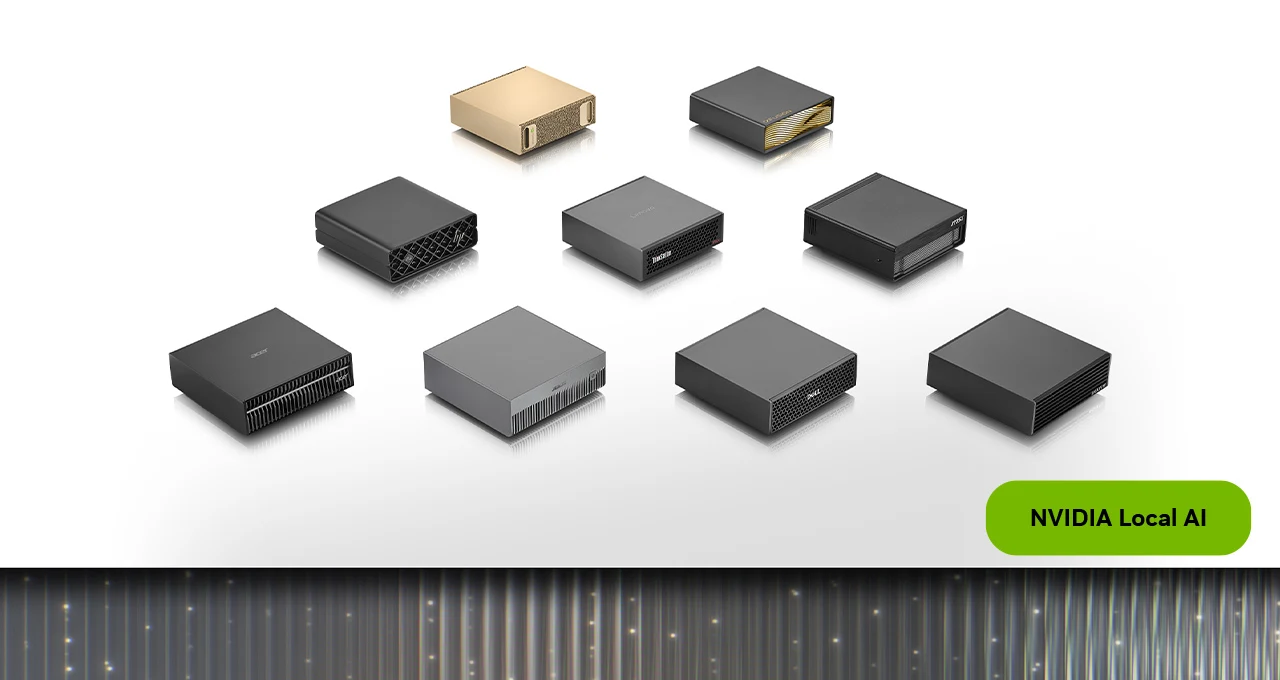
NVIDIA announced this month a new configuration of DGX Spark with 64 GB unified memory, available exclusively through manufacturing partners: Acer, ASUS, Dell, Gigabyte, HP and MSI. This is a direct response to growing demand for local AI infrastructure that doesn’t require constant cloud connectivity and allows you to work with sensitive data without leaving your own network.
What DGX Spark Is and Why the 64 GB Version Matters
DGX Spark is a compact personal computer based on the GB10 Grace Blackwell superchip - the same one that powers the more expensive 128 GB version. The new configuration retains the full ecosystem: DGX OS, CUDA-X AI libraries, NVIDIA Agent Toolkit, Nemotron models, and support for popular runtimes like Ollama, vLLM and PyTorch with CUDA. In other words, the difference between the two versions comes down solely to memory capacity - not software capabilities or chip quality.
This is an important distinction. 64 GB of unified memory is sufficient for running models up to 100 billion parameters, which covers the vast majority of open models available on the market today - from Llama to Qwen, Mistral and the Nemotron model family. For a developer, researcher or AI enthusiast who doesn’t need to simultaneously train large foundation models but wants a local, private and fast environment for agents, fine-tuning and data science, the 64 GB version becomes a realistic choice at a lower price than the 128 GB model.
Painless Clustering with Sync Cluster Assistant
The most interesting element of the new configuration isn’t the memory itself, but what you can do with two units. Each DGX Spark has a built-in NVIDIA ConnectX-7 NIC network card. Connecting two devices with a QSFP cable creates a cluster that combines memory to 128 GB, doubles memory bandwidth and extends model support to 200 billion parameters.
In NVIDIA’s tests with the Qwen3.8 27B model, two clustered 64 GB systems achieved up to 1.7x higher performance than a single unit - while maintaining the ability to scale further. Crucially: NVIDIA Sync Cluster Assistant automatically detects connected devices, validates the configuration and sets up the ConnectX-7 network. Each node uses the same NVIDIA software stack, so you don’t need to reconfigure anything when moving from one unit to two.
This is a philosophy NVIDIA has consistently applied in the enterprise segment for years - now it’s coming down to desktop level. A developer can start with one device, and when the project grows, add a second without rebuilding the environment. For small teams and independent researchers, this is a purchase and scaling model far more friendly than a one-time investment in more expensive hardware.
An Ecosystem Growing with the Platform
Since its launch, DGX Spark has been designed with AI agents in mind, not just inference. The platform supports NVIDIA Agent Toolkit and the full CUDA-X stack, allowing you to build multi-agent pipelines without going to the cloud. For companies processing medical, legal or financial data, locality is not so much a convenience as a compliance requirement.
Later this month, NVIDIA Sync Model Launcher will arrive - a tool designed to make launching a local model as simple as a few clicks. The launcher will download and run, for example, Qwen3.8 27B on a single system or cluster, automatically distributing the load between connected devices and making the model accessible from your laptop. What’s more, the launcher will also configure OpenCode - a browser-based coding environment - so it immediately uses the locally running model. A developer should be able to go from powering on the device to writing code with a local LLM in minutes, not hours.
Blender, as one of the first major creative applications, has announced a dedicated installer for DGX Spark, which should be available for download soon. This signals that the platform is starting to attract an ecosystem of partners from outside the traditional ML environment - toward 3D creators, graphic designers and artists for whom local AI-powered generation and editing of assets is becoming a practical work tool.
Google · Your sourcesQuantslant higher in your Google - one clickAdd to preferred sources →What This Changes in the Local AI Infrastructure Market
The market context is important here. For the past several years, AI developers have essentially had two options: cloud (expensive to operate, vendor-dependent, problematic for sensitive data) or building your own GPU cluster (expensive to purchase, complicated to maintain). The segment of so-called personal AI supercomputers - compact, integrated machines with GPUs and large unified memory - has filled the gap between these extremes.
Apple Silicon with unified memory up to 192 GB proved that an architecture without separate GPU memory can handle meaningful models locally. NVIDIA is following the same path, but with the full CUDA stack, which is the de facto industry standard for training and inference. Adding a cheaper 64 GB variant and a simple clustering mechanism is a clear signal that NVIDIA wants to make DGX Spark not a niche gadget for enthusiasts, but a real working platform for a broad group of professionals.
For developers, AI startups and research labs that don’t have budgets for full GPU clusters in data centers, DGX Spark 64 GB - especially in a two-unit clustered configuration - opens possibilities that just a year ago would have required either significantly larger expenditures or the compromise of depending on external provider APIs.
The local AI infrastructure market is just taking shape, but the pace at which NVIDIA is expanding the DGX Spark ecosystem - from software, through manufacturing partners, to tools for creators - suggests the company is taking this segment very seriously.



More on this from QUANTSLANT

 state of ai·International AI Safety Report 2026: Reasoning Models AdvanceLed by Turing Award winner Yoshua Bengio, the report shows AI capabilities are exploding while safety measures lag dangerously behind.