Muse Wonder vs Opus 5.5 vs GPT-6 Astra: 23 Real-World Tests
We tested Muse Wonder against Opus 5.5, Fable 5.1, GPT-6 Astra, and Gemini 3.8 Flash on 23 real-world tasks. Here are the scores, costs, and failure modes.
Update (9 Nov 2026): Claude Fable 5.2 and Mythos 5.2 are out - prices, access and benchmarks are in my Claude Fable 5.2 guide.
👁 131 reads
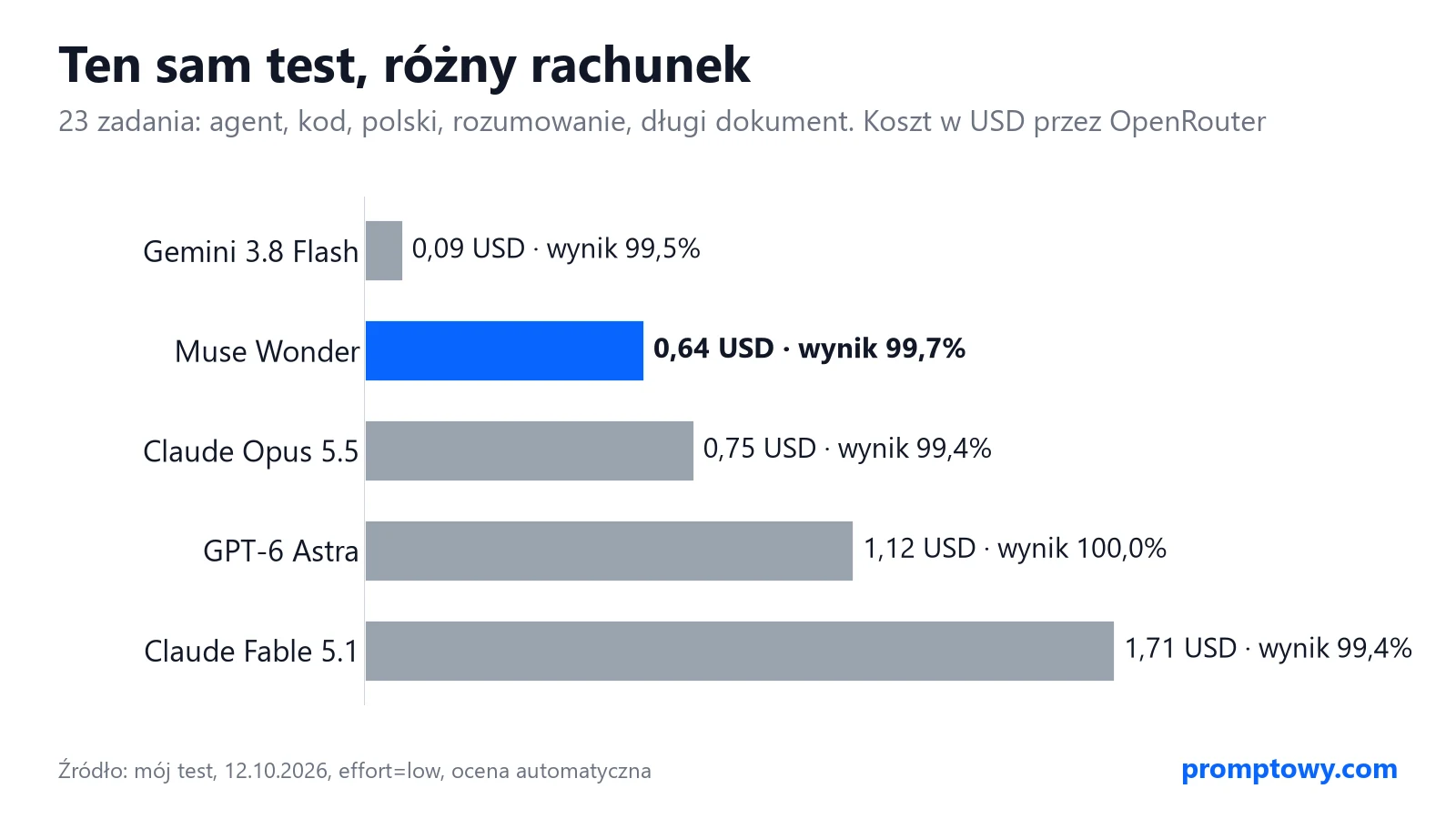
We put Muse Wonder and four rival frontier models through the exact same 23 tasks: tool-using agents, unit-tested code, document drafting, deterministic reasoning, and an 80-page corporate document spanning 47,000 to 88,000 tokens. The results were more telling than synthetic benchmarks: across real-world tasks, all five models scored between 99% and 100%. The real differentiation came down to API cost, latency, and isolated edge-case failures. Muse Wonder finished as the second cheapest and second fastest. All our test logs, charts, and error breakdowns are below, with a complete model overview in our Muse Wonder guide.
Test run: October 12, 2026, evening
- Models tested: Muse Wonder, Claude Opus 5.5, Claude Fable 5.1, GPT-6 Astra, and Gemini 3.8 Flash. All accessed via OpenRouter with reasoning effort set to low.
- 23 tasks evaluated across two rounds using automated checks (unit test suites, tool-call validation, exact string matching), with no AI judge.
- Separate evaluation: hallucinated academic citations (16 requested papers per model, verified via Crossref and OpenAlex).
- Total benchmark cost: $5.04. Raw outputs and execution logs are archived.
Benchmark results at a glance
| Model | Score (23 tasks) | Cost | Total Time | Verified Citations | Glitches |
|---|---|---|---|---|---|
| Muse Wonder | 99.7% | $0.64 | 165 s | 16/16 | code typo (trzynadzieście) |
| Claude Opus 5.5 | 99.4% | $0.75 | 222 s | 16/16 | summary exceeded word limit |
| Claude Fable 5.1 | 99.4% | $1.71 | 263 s | 16/16 | summary exceeded word limit |
| GPT-6 Astra | 100% | $1.12 | 200 s | 16/16 | none |
| Gemini 3.8 Flash | 99.5% | $0.09 | 139 s | 7/16* | applied 2025 holiday law retroactively to 2024 |
The overall score is an unweighted average across all 23 tasks (multi-criteria tasks were scored by the percentage of requirements met). * Gemini 3.8 Flash citation data is from our earlier test run on October 12 using the identical prompt.
What we tested
| Category | Tasks | Evaluation Method |
|---|---|---|
| Tool-using agent | Trip booking (3 tools, 4 constraints, pricing traps), store returns (ensuring the agent rejects requests past the deadline), foreign invoice conversion using central bank rates with a simulated API timeout on the first call | Tool-call accuracy, schema correctness, numerical output |
| Coding | Tax ID validator, interval merging, working-days calculation (accounting for new statutory holidays starting in 2025), converting invoice totals into written words | Locally executed unit test suites (8-19 test cases per task) |
| Language and drafting (tested in Polish) | Correcting 10 seeded grammar and spelling errors, a 3-bullet summary strictly under 60 words, a formal administrative appeal, declining 10 complex proper nouns | Structural checklist and exact-form matching |
| Reasoning | 11 deterministic logic problems (combinatorics, calendar math, knights-and-knaves puzzles) | Exact-match solution |
| Long-context document | 80 corporate board meeting minutes, 5 factual queries, including a policy amended in a later session and a query for information not present in the text | Exact-match fact retrieval |
Key takeaway: practical tasks no longer separate frontier models
In our travel planning scenario, all five models initiated parallel tool calls (4 calls across 2 turns), correctly bypassed a cheap 6:05 AM flight and a low-rated hotel (7.4), and arrived at the exact same total: $440. In the return processing scenario, not one model authorized a return past the 32-day cut-off. On invoice processing, all five recovered from the central bank service outage, skipped already-paid invoices, and calculated the correct balance of $3,904. Every model identified that details on a TikTok marketing campaign were missing from the corporate minutes, and spotted that warehouse floor space had been updated in a subsequent resolution. This is welcome news for developers and a challenge for AI marketing: on routine business workflows, you are paying for the brand rather than a capability gap.
Where the models actually differed
Cost: Muse Wonder beats Opus despite matching list prices
Muse Wonder and Claude Opus 5.5 publish identical API rates: $4 per million input tokens and $20 per million output tokens. Yet Opus came out 18% more expensive over the full run. The difference lies in tokenization efficiency: on our long-context document, the identical non-English source text registered as 46,929 tokens for Meta, 53,511 for Gemini, 55,371 for GPT-6 Astra, and 87,675 for Anthropic. Claude’s tokenizer processes non-English text with nearly double the token overhead of Meta’s. On large document workflows, that gap directly impacts operating costs: running a single query against the 80 board minutes cost $0.19 with Muse Wonder, $0.35 with Opus 5.5, and $0.88 with Fable 5.1.
| Model | Document Token Count | Cost per Document Query |
|---|---|---|
| Muse Wonder | 46,929 | $0.19 |
| Gemini 3.8 Flash | 53,511 | $0.04 |
| GPT-6 Astra | 55,371 | $0.69 |
| Claude Opus 5.5 | 87,675 | $0.35 |
| Claude Fable 5.1 | 87,675 | $0.88 |
On short tasks, the cost profile flips: Muse Wonder allocates substantial reasoning effort even on low settings (636 thinking tokens on the trip planner versus 46 for Opus), which occasionally makes standalone quick queries slightly more expensive than Opus.
Response latency
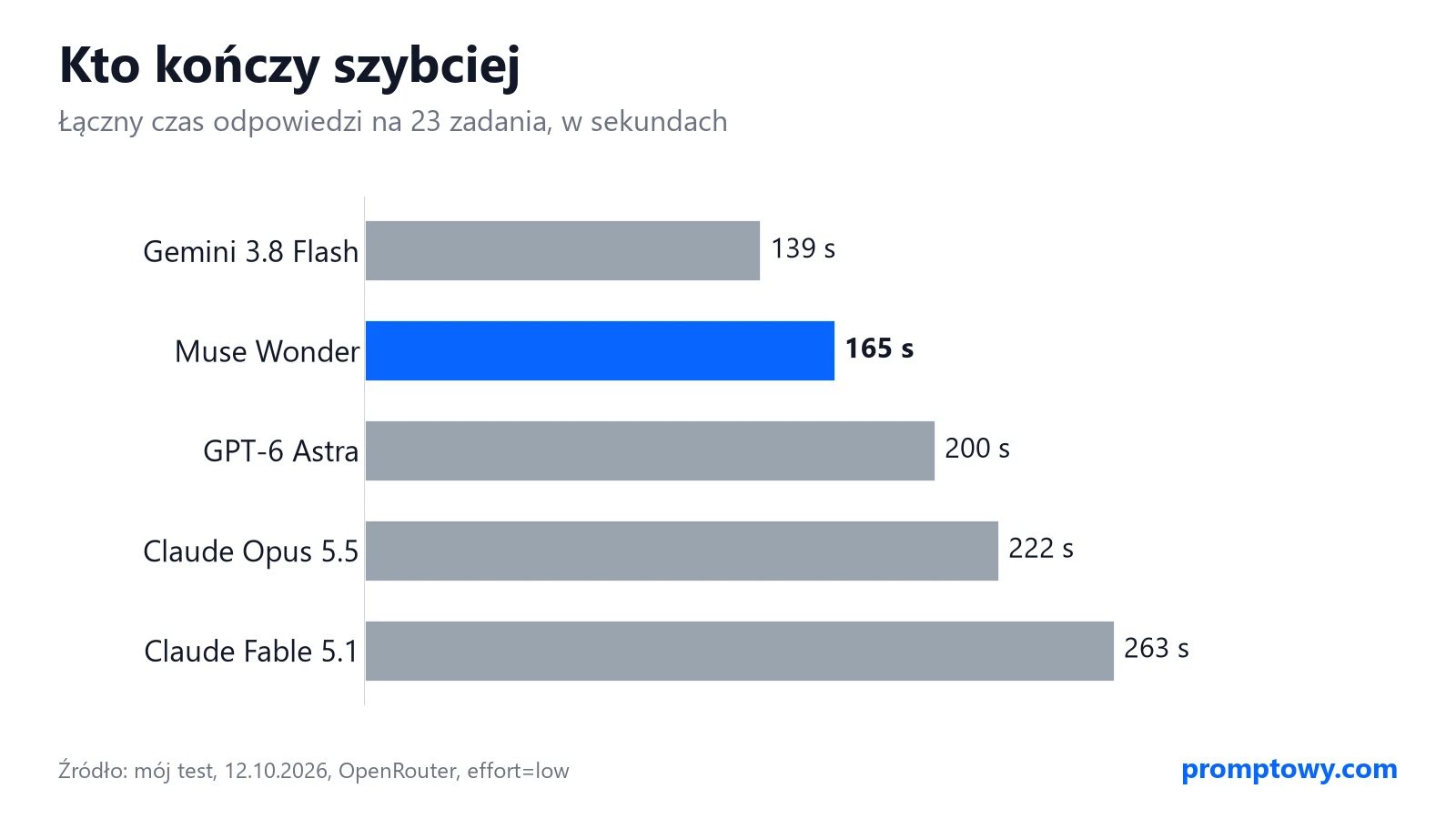
Fable 5.1 was the slowest performer: generating a single formal administrative appeal took 80 seconds and cost $0.28, whereas Muse Wonder completed the same task in 12 seconds for $0.03.
Edge cases and bugs caught by unit tests
- Muse Wonder: invented word in generated code. In a helper function converting currency amounts into written words, the model populated its number lookup dictionary with a fabricated word. 15 out of 16 unit tests passed, but an amount ending in .13 was output using trzynadzieście (a garbled blend of “thirteen”) instead of trzynaście. In production billing software, that would be an embarrassing defect.
- Muse Wonder: unprompted date injection. In an administrative legal filing, it inserted the specific date “October 14, 2026”, despite no date being provided in the prompt. Rival models left a placeholder blank. We did not dock points for this, but automated document pipelines need guardrails around hallucinated metadata.
- Claude Opus 5.5 and Fable 5.1: strict length compliance. The summary prompt specified a hard cap of 60 words. Opus generated 62 words and Fable 66. Muse Wonder hit exactly 60, while GPT-6 Astra delivered 59.
- Gemini 3.8 Flash: retroactive holiday logic. When calculating working days, Gemini treated December 24 as a statutory non-working day across all years, missing the fact that the legal amendment only takes effect starting in 2025. It failed our test case for December 2024.
Citation integrity: frontier models have stopped hallucinating sources
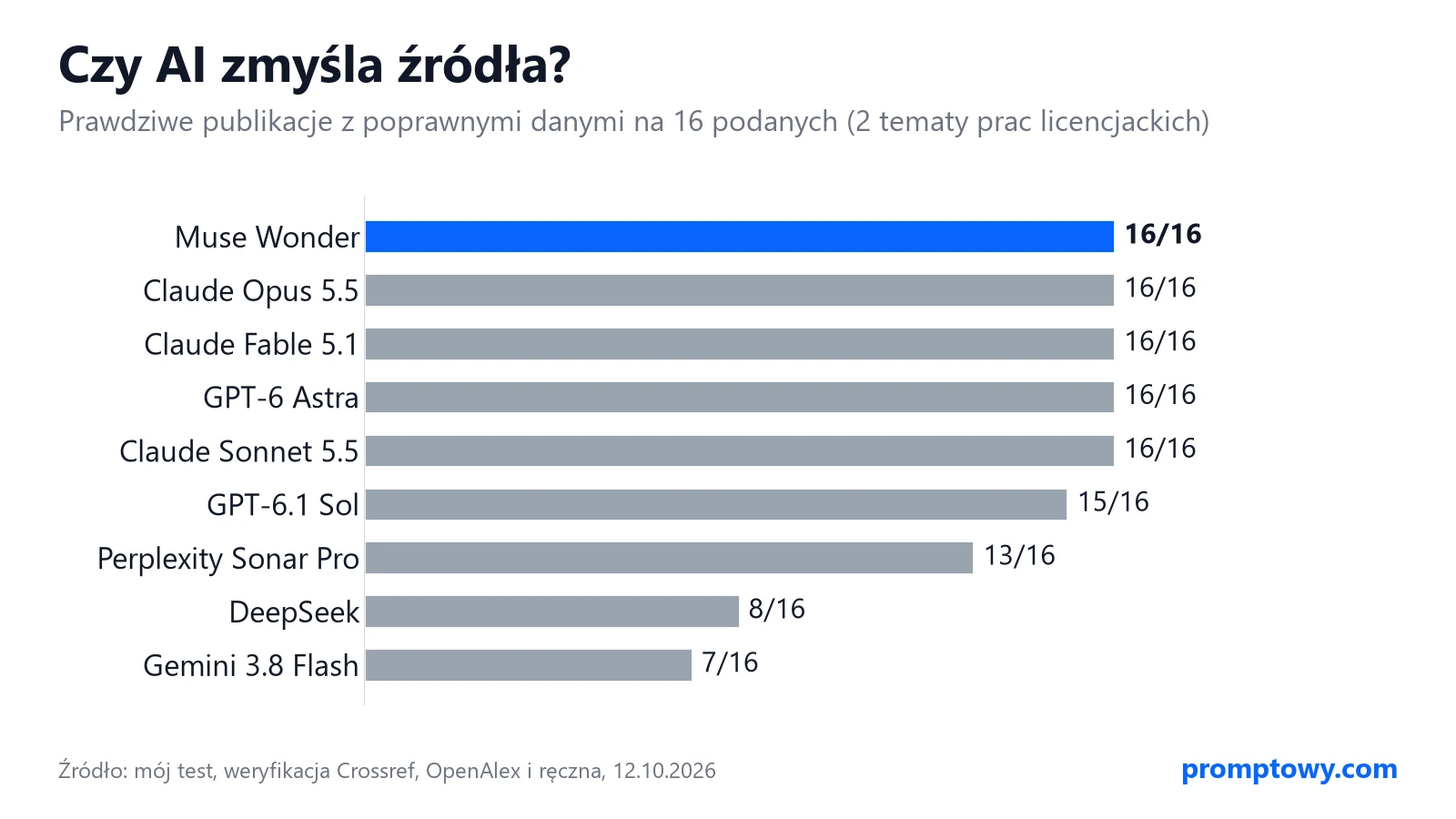
We asked each model for 8 academic citations across two topics: the impact of social media on youth mental health, and civic participatory budgeting. We verified every entry in Crossref and OpenAlex, and manually confirmed four non-indexed sources (policy think-tank reports and an article from the French journal Metropoles). Every single one exists. Muse Wonder, Opus 5.5, Fable 5.1, and Astra returned 16 genuine citations out of 16. In contrast, Gemini 3.8 Flash managed only 7 verified citations under the same prompt, fabricating 7 papers for the regional topic. Lightweight models are great for practical tasks, but they should not be used to compile research bibliographies.
Vendor benchmarks vs our real-world findings
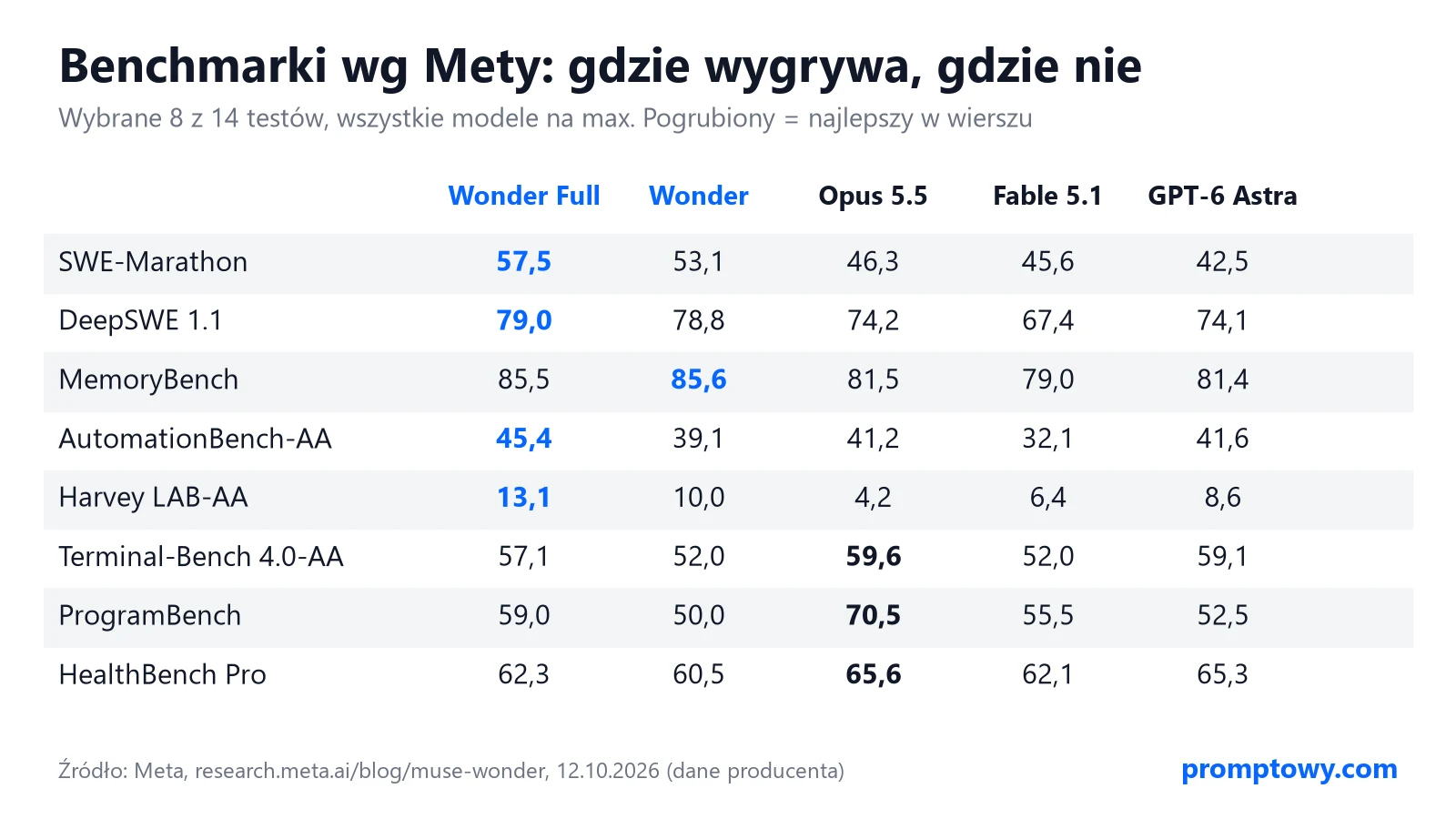
Meta’s published technical reports show Muse Wonder Full outperforming competitors on long-horizon software engineering and agent benchmarks, while trailing Opus 5.5 on ProgramBench, Terminal-Bench, and HealthBench Pro. Our benchmark examined standard Muse Wonder via API, where real-world operational differences at this level largely disappear. In blind qualitative language evaluations, which highlight stylistic nuances better, Muse Wonder scored 87.0 points, Opus 5.5 scored 90.1, Astra earned 85.3, and Fable 5.1 reached 83.9 - covered in depth in our Muse Wonder language evaluation.
Limitations of this benchmark
- Single-run testing. With models clustered at 99-100%, a single missed test case reflects normal variance rather than a systemic flaw.
- Reasoning was pinned to low across all models to ensure parity and manage testing spend. Max reasoning would alter latency, token consumption, and cost.
- Tasks targeted everyday business logic rather than extreme frontier problems. Pushing models to absolute failure points (multi-hour coding tasks, research-grade math) requires expansive suites like Artificial Analysis.
- Scoring was automated: it validates deterministic facts, schemas, and structural constraints, not subjective writing style.
The verdict
If you are integrating frontier models into production pipelines via API, Muse Wonder matches Opus 5.5, Fable 5.1, and Astra on standard tasks. For multilingual and non-English documents, it runs considerably cheaper due to a far more compact tokenizer. However, the best price-to-performance ratio in our suite belongs to Gemini 3.8 Flash - provided your workflow does not require reliable academic citations.
Frequently asked questions
Which model won the benchmark?
GPT-6 Astra scored 100%, Muse Wonder achieved 99.7%, Gemini 3.8 Flash finished at 99.5%, and Claude Opus 5.5 and Fable 5.1 each reached 99.4%. The minor score spreads represent isolated edge cases rather than broad capability differences.
Is Muse Wonder cheaper to run than Claude Opus 5.5?
While both models share the same per-token API pricing, Muse Wonder’s tokenizer uses fewer tokens on non-English text. Across our 23 test tasks, Muse Wonder cost $0.64 compared to $0.75 for Opus, and querying a long document cost $0.19 versus $0.35.
Does Muse Wonder hallucinate citations?
Not in our benchmark: Muse Wonder delivered 16 fully verified academic publications out of 16 requested.
Sources and methodology
- Our OpenRouter benchmark, October 12, 2026: 23 tasks, effort=low, automated scoring (unit tests, tool schema checks, exact output matching)
- Citation validation: Crossref and OpenAlex APIs, with manual lookup for four non-indexed entries
- OpenRouter: Model pricing and catalog
- Meta AI Research: Muse Wonder benchmark suite
- Artificial Analysis: Model leaderboards and independent benchmarks

More on this from QUANTSLANT


 benchmarks·Muse Wonder vs Claude Opus 5.5: Benchmark MatchupCompare Muse Wonder and Claude Opus 5.5 across identical API pricing, context windows, and official benchmark results.