Meta Muse Wonder: Benchmarks, API Pricing, and Full Test
Meta's Muse Wonder and Wonder Full hit 56 on Artificial Analysis. Full benchmarks, $4/$20 API pricing, tests, and comparison with Claude Opus 5.5.
👁 142 reads
Muse Wonder is a new model family from Meta, introduced on October 12, 2026: the standard Muse Wonder and the more capable Muse Wonder Full. In the independent Artificial Analysis index, Full scores 56 points, matching Claude Sonnet 5.5 and trailing Claude Opus 5.5 by just 2 points, while standard Wonder scores 52. The API is priced at $4 per million input tokens and $20 per million output tokens, matching Opus 5.5. In our testing conducted in Polish across 13 tasks, Muse Wonder scored 87.0 out of 100, securing 2nd place in the testing leaderboard. Below are Meta’s benchmarks alongside independent scores, pricing, a step-by-step setup guide, and complete test results.
Status as of October 12, 2026, evening
- Muse Wonder: Available in the Meta Model API (muse-wonder-1.0), in Muse Code, and on OpenRouter (meta/muse-wonder). Tested and functional internationally via OpenRouter.
- Muse Wonder Full: Only available in Muse Code on the Power Usage ($50/month) and Maximum Usage ($200/month) plans. Not available in the API.
- Muse App and Meta AI: Wonder is coming “soon”, initially to Muse subscribers. The standalone Muse app remains regionally restricted outside North America.
- Weights: Closed weights. Meta has not announced an open release.
- Independent tests: Artificial Analysis is live (56 and 52 points); LMArena has not posted scores yet.
Overview
Meta has delivered a top-tier frontier model. Muse Wonder Full ties for second place on the AA index, and in Meta’s published benchmarks it outperforms Opus 5.5, Fable 5.1, and GPT-6 Astra across 7 of 14 evaluations, primarily in long-horizon coding, agentic workflows, and memory retention. It falls behind in ProgramBench, HealthBench Pro, Terminal-Bench, and OSWorld. However, only the standard Muse Wonder (52 AA points) is available for API purchase, yet it carries the same price as Opus 5.5 (58 AA points). In our testing in Polish, it generated solid copy, scoring 87.0 points-ahead of GPT-6 Sol, Astra, and Fable 5.1. Weaknesses: repetitive phrasing in product descriptions and verbosity, which adds up at $20 per million output tokens.
What is Muse Wonder
Muse Wonder is a proprietary family of reasoning models from Meta Superintelligence Labs, an initiative built over the past 14 months following an overhaul of Meta’s AI division. The team’s first release was Muse Spark (April 2026, version 1.3 in September). Mark Zuckerberg described Wonder as a “significantly larger and more capable class of models” that elevates Meta into the frontier tier. According to Meta’s technical blog, the models were trained at the gigawatt Prometheus data center, combining large-scale pretraining with reinforcement learning.
Meta emphasizes two primary architectural capabilities:
- Active Memory - retains core user information across conversations and autonomously recalls it when relevant to the task;
- Active Focus - navigates complex assignments by exploring alternative paths, bypassing obstacles, and proactively clarifying critical decisions rather than halting.
The model card lists a 1-million-token context window with support for text, image, video, and audio inputs, alongside text-only output. Meta indicates the model was trained on multilingual data, though it omits a definitive list of supported languages and notes it has not been evaluated across every language. We evaluated its multilingual capabilities directly in Polish below.
Model Variants: Wonder vs Wonder Full
| Feature | Muse Wonder | Muse Wonder Full |
|---|---|---|
| Artificial Analysis Index 4.3 | 52 (10th position overall) | 56 (tied for 2nd) |
| Meta Model API | Yes, muse-wonder-1.0 | No |
| OpenRouter | Yes, meta/muse-wonder | No |
| Muse Code | Yes | Power Usage and Maximum Usage plans only |
| Muse App | “Soon”, subscribers first | No announcement |
| API Reasoning Levels | minimal, low, medium (default), high, xhigh, max | - |
| Context Window | 1M tokens | 1M tokens |
Reasoning cannot be disabled: on OpenRouter it is marked as mandatory, with the lowest setting being minimal. All of Meta’s reported benchmarks were measured at the max level.
Meta’s Published Benchmarks: Full Table
Meta evaluated both models against Claude Fable 5.1, GPT-6 Astra, and Claude Opus 5.5, with all models set to max reasoning effort. Several results come from third-party evaluators (Artificial Analysis, Vals AI, Surge, Datacurve, Abundant AI), alongside Meta’s internal suites (Personal Superintelligence Index, MemoryBench, FocusBench). The highest score in each row is shown in bold.
| Benchmark (per Meta) | Wonder Full | Wonder | Fable 5.1 | GPT-6 Astra | Opus 5.5 |
|---|---|---|---|---|---|
| Personal Superintelligence Index (Internal) | 59.1 | 54.3 | 49.9 | 54.5 | 55.2 |
| Harvey LAB-AA (Legal) | 13.1 | 10.0 | 6.4 | 8.6 | 4.2 |
| Vals Finance Agent V2 (Finance) | 59.1 | 56.6 | 58.9 | 53.5 | 58.6 |
| HealthBench Pro (Healthcare) | 62.3 | 60.5 | 62.1 | 65.3 | 65.6 |
| AutomationBench-AA (Enterprise Workflows) | 45.4 | 39.1 | 32.1 | 41.6 | 41.2 |
| GDP.pdf (Document Processing) | 33.2 | 30.8 | 27.6 | 34.2 | 30.6 |
| JobBench (Professional Tasks) | 75.3 | 70.5 | 73.1 | 66.1 | 75.4 |
| OSWorld V2.1 (Computer Use, partial) | 78.4 | 72.6 | 80.7 | 75.8 | 81.8 |
| MemoryBench (Memory, Internal) | 85.5 | 85.6 | 79.0 | 81.4 | 81.5 |
| Terminal-Bench 4.0-AA | 57.1 | 52.0 | 52.0 | 59.1 | 59.6 |
| DeepSWE 1.1 (Long-horizon Coding) | 79.0 | 78.8 | 67.4 | 74.1 | 74.2 |
| SWE-Marathon (Extended Projects) | 57.5* | 53.1 | 45.6 | 42.5 | 46.3 |
| ProgramBench (Code from Scratch) | 59.0 | 50.0 | 55.5 | 52.5 | 70.5 |
| Artificial Analysis Index | 56 | 52 | 53 | 53 | 58 |
* Full evaluated at xhigh effort. Source: Meta announcement table dated October 12, 2026. On OSWorld V2.1 binary completion (end-to-end task execution), Meta reports: Full 39.4, Wonder 34.3, Fable 5.1 43.1, Astra 34.3, with Opus 5.5 omitted.
Key caveats to consider when reviewing these figures:
- Personal Superintelligence Index and MemoryBench are proprietary benchmarks. PSI aggregates seven sub-evaluations, including Meta’s FocusBench and VBT. First-party benchmarks naturally favor the author’s architecture.
- SWE-Marathon does not reflect identical run environments. As noted in Meta’s model card, Astra and Fable results were pulled from Codex and Claude Code, while Wonder Full was tested on xhigh.
- Opus 5.5 leads ProgramBench by 11.5 points, and Meta trails both Opus and Astra on Terminal-Bench and HealthBench Pro-details absent from the headline announcements.
- Competitor baselines were executed partly by Meta, which notes prompts and tooling “may not have been tuned to optimal performance” for outside models.
Independent Results: Artificial Analysis
Artificial Analysis runs 10 automated evaluations (including GDPval-AA, Terminal-Bench 4.0, Humanity’s Last Exam, SciCode) combined into an aggregate score. Data as of October 12, 2026, evening:
| Model (Variant) | AA Index 4.3 | API Price USD (Input / Output) |
|---|---|---|
| Claude Opus 5.5 (max) | 58 | $4 / $20 |
| Claude Sonnet 5.5 (max) | 56 | $2 / $10 |
| Muse Wonder Full (max) | 56 | Not in API |
| Claude Fable 5.1 (max) | 53 | $10 / $50 |
| GPT-6 Astra (max) | 53 | $10 / $50 |
| Gemini 4 Argon (high) | 53 | $2 / $10 intro (Google announced) |
| Muse Wonder (max) | 52 | $4 / $20 |
| GPT-6.1 Sol (max) | 52 | $2 / $10 |
| Muse Spark 1.3 (max) | 48 | $1.25 / $4.25 |
Pricing sourced from OpenRouter and provider rate cards. Two key observations:
- Meta omitted Claude Sonnet 5.5 from its comparison chart. Sonnet matches Wonder Full’s 56 points on the AA index while costing half the price of the standard Wonder in the API ($2 / $10).
- Muse Wonder is verbose. During AA index testing, standard Wonder produced 130 million output tokens and Full produced 140 million, against an AA median of 88 million.
On LMArena, community blind evaluations are still pending. We will update the listing as data becomes available.
Pricing
| Platform | Price | Details |
|---|---|---|
| Meta Model API | $4 input, $20 output, $0.20 cached input (per 1M tokens) | Muse Wonder, rate limit 3,000 RPM and 4M TPM |
| OpenRouter | $4 / $20, $0.20 cache | Muse Wonder, unified API key across models |
| Muse Code Everyday / High Usage | $5 / $15 per month | Muse models, excluding Wonder Full |
| Muse Code Power / Maximum Usage | $50 / $200 per month | Includes Muse Wonder Full |
| Muse App (US, Canada) | $20 / $100 per month | Wonder coming soon, prioritized for subscribers |
Web search access via API carries an additional $2.50 per 1,000 queries. The low-cost Contributor tier available on Muse Spark ($0.10 / $0.20 in exchange for data training rights) is not offered for Wonder. Against competitors, Wonder matches Opus 5.5’s pricing, costs double GPT-6.1 Sol, and is 2.5x cheaper than GPT-6 Astra and Claude Fable 5.1. Our 13-task test suite cost $0.45 on Wonder, compared to $0.37 on Opus 5.5.
How to Use Muse Wonder
The simplest method to access Muse Wonder globally is via OpenRouter. This is how we conducted our tests:
- Create an account at openrouter.ai and fund your balance via credit card (minimum a few dollars). Meta models may require an 18+ age verification confirmation in your account settings.
- Generate an API key in the Keys tab.
- Select “Meta: Muse Wonder” in the OpenRouter playground or pass model ID
meta/muse-wonderin your API calls. - Adjust reasoning depth via the
reasoning.effortparameter (minimal to max). Note that medium and above will generate longer responses and consume more tokens.
Python snippet (using environment variable OPENROUTER_API_KEY; test prompt translated to English, original run was performed in Polish):
import os, requests
# Note: Prompt translated from the Polish original used during testing
r = requests.post("https://openrouter.ai/api/v1/chat/completions",
    headers={"Authorization": "Bearer " + os.environ["OPENROUTER_API_KEY"]},
    json={"model": "meta/muse-wonder",
          "reasoning": {"effort": "low"},
          "messages": [{"role": "user", "content": "Write a brief apology email for a delayed delivery."}]})
print(r.json()["choices"][0]["message"]["content"])
The second option is the Meta Model API (dev.meta.ai) using model identifier muse-wonder-1.0. Meta notes this API has expanded global access, though enterprise data processing agreements remain limited outside select jurisdictions. The third option is Muse Code, which provides Wonder Full on plans starting at $50/month.
Our Test in Polish: 87.0 Points and 2nd Place
We tested Muse Wonder across the same 13 tasks used on over 20 frontier models in our multilingual writing benchmark: 9 drafting assignments, two proofreading challenges, and two local knowledge quizzes. Note: we tested it in Polish. All parameters matched previous evaluations: OpenRouter, effort=low, identical token limits. Outputs were scored blindly by two independent LLM judges (Claude Opus 5.5 and GPT-6 Sol), calibrated alongside anchor baselines from round one. The anchors preserved their ranking order, and the scale shifted by 2.45 points, which was calibrated accordingly.
| Model | Score (Calibrated) | Judges (1-10) | Naturalness | Rule Adherence | Hard Proofreading | Hard Quiz |
|---|---|---|---|---|---|---|
| Claude Opus 5.5 | 90.1 | 8.70 | 8.00 | 25/26 | 30/30 | 48/48 |
| Muse Wonder | 87.0 | 8.15 | 7.22 | 26/26 | 29/30 | 48/48 |
| GPT-6 Sol | 86.4 | - | - | - | - | - |
| GPT-6 Astra | 85.3 | - | - | - | - | - |
| Claude Fable 5.1 | 83.9 | - | - | - | - | - |
| GPT-6 Luna | 82.8 | 7.63 | 6.67 | 24/26 | 29/30 | 48/48 |
| Muse Spark 1.3 | 75.3 | 6.78 | 5.63 | 25/26 | 29/30 | 48/48 |
Judges’ ratings, naturalness, and rule metrics for Opus 5.5 and Luna are from the same evaluation batch (October 12, 2026), and Muse Spark from September 27. Sol, Astra, and Fable scores represent round-one baselines. Muse Wonder adhered strictly to all 26 specified negative and positive constraints (word ceilings, bullet count, exact keyword placement), a feat missed by both Opus and Luna. Total execution cost across the 13 tasks was $0.45, with a cumulative generation time of 100 seconds (Opus 5.5: 133 seconds).
Performance breakdown:
- Summarization and translation were standout tasks. The evaluator model noted the summary concisely integrated all relevant details, while an English-to-Polish newsletter translation preserved natural idiom.
- Product description scored poorly (5.33). Wonder duplicated technical specs for an electric kettle twice across a single paragraph (temperature control, 30-minute hold, filter). Both evaluators penalized the redundancy and the tendency to output raw feature lists rather than benefit-led copy.
- Minor language quirks: a grammatical gender slip in a hashtag (corrupted lettering in the original Polish test), an overly formal closing phrasing in customer communications, and an unprompted gender assumption regarding the recipient.
- Proofreading and knowledge: 22/22 on the basic proofreading test, 29/30 on the complex proofreading test, and 100% on the factual knowledge tests.
By comparison, Muse Spark 1.3 previously scored 75.3 points, showing that Meta’s new generation makes meaningful gains in non-English natural language fluency. Comparative sample outputs can be viewed in our multilingual model arena.
Direct Comparison: 23 Automated Tasks across 5 Models
Beyond creative drafting, we subjected Muse Wonder, Opus 5.5, Fable 5.1, GPT-6 Astra, and Gemini 3.8 Flash to 23 standardized programmatic tasks: tool use/agent loops, code generation validated by unit test suites, structured documents, reasoning tasks, and long-context comprehension. All models achieved 99% to 100% functional accuracy; differences were driven by compute speed and API cost:
- Muse Wonder: 99.7%, $0.64, 165s - second lowest cost and second fastest, marred by a single typo in generated currency-to-words helper code;
- Claude Opus 5.5: 99.4%, $0.75, 222s - identical nominal token price, but Claude’s tokenizer handles Polish text at nearly double the token overhead (87,675 tokens vs 46,929 tokens for the same source document);
- GPT-6 Astra: 100%, $1.12, 200s;
- Claude Fable 5.1: 99.4%, $1.71, 263s;
- Gemini 3.8 Flash: 99.5%, $0.09, 139s - but returned only 7 valid real-world citations out of 16 in our literature lookup test (Muse Wonder achieved 16/16).
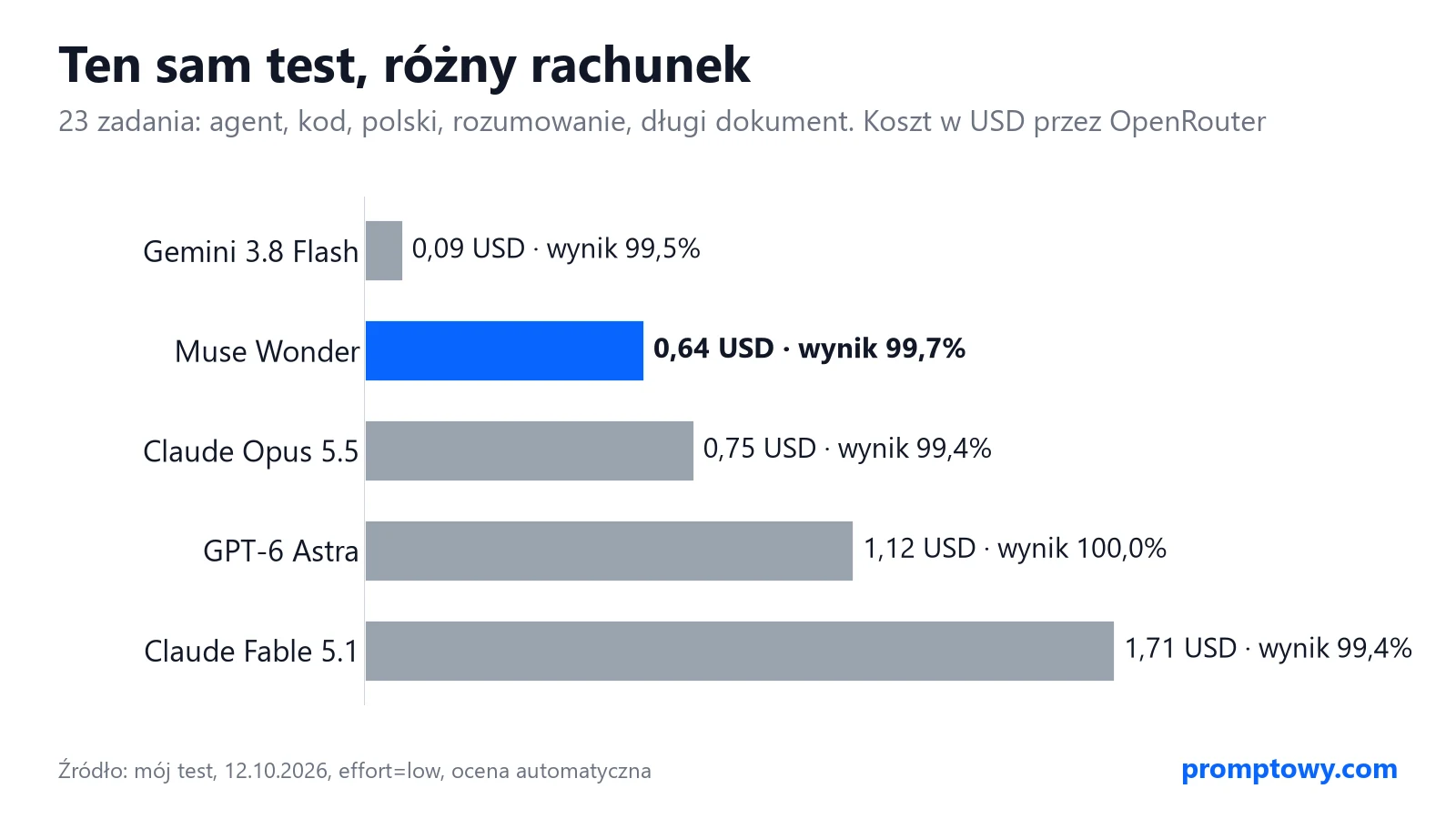
Read the comprehensive breakdown and error logs in our full test: Muse Wonder vs Opus 5.5 vs GPT-6 Astra: 23-task Head-to-Head.
High School Exam Benchmark: 215 out of 220 Points
We also ran Muse Wonder through standardized Polish high school leaving exams (Matura, May 2026 session) as part of our Matura AI benchmark series (tested in Polish):
| Subject | Muse Wonder | Claude Opus 5.5 | GPT-6.1 Sol | Claude Haiku 5.5 |
|---|---|---|---|---|
| Standard Mathematics | 50/50 | 50/50 | 50/50 | 50/50 |
| Advanced Mathematics | 49/50 | 50/50 | 50/50 | 50/50 |
| Native Language (Polish basic: text + essay) | 56/60 | 60/60 | 60/60 | 56/60 |
| English (Foreign language basic) | 60/60 | 60/60 | 60/60 | 59/60 |
| Total | 215/220 | 220/220 | 220/220 | 215/220 |
| Cost | $1.54 | $1.13 | $0.32 | $0.04 |
While the model comfortably passes, it does not lead the pack. All 4 lost points on the language paper stemmed from a synthesis note where it listed advantages and disadvantages of different media types rather than contrasting the two authors’ perspectives, violating the strict marking criteria (an error shared by 7 other models). It dropped one point on advanced mathematics, and ended up being the most expensive run in the cohort due to reasoning verbosity.
How Muse Wonder Compares with Rivals
| Model | AA Index | Multilingual Test Score | API Price (USD) | Availability |
|---|---|---|---|---|
| Muse Wonder | 52 | 87.0 | $4 / $20 | OpenRouter, Meta API, Muse Code |
| Muse Wonder Full | 56 | Not tested (no API) | - | Muse Code only (from $50/mo) |
| Claude Opus 5.5 | 58 | 90.1 | $4 / $20 | Claude.ai, API, OpenRouter |
| Claude Fable 5.1 | 53 | 83.9 | $10 / $50 | Claude.ai, API, OpenRouter |
| GPT-6 Astra | 53 | 85.3 | $10 / $50 | ChatGPT, API, OpenRouter |
| Gemini 4 Argon | 53 | Not tested | $2 / $10 intro (Google) | Restricted preview |
Key takeaways:
- Wonder vs Opus 5.5: Identical per-token API pricing, but Opus leads in independent benchmarks (58 vs 52 on AA) and our writing evaluation (90.1 vs 87.0). Wonder’s lead appears only in Meta’s internal suite, which was evaluated using Wonder Full.
- Wonder vs Fable 5.1 and Astra: Wonder is 2.5 times cheaper, scored higher in our multilingual writing assessment, and sits within 1 point on the AA index.
- Wonder Full is primarily compelling for software engineers already subscribed to Muse Code. It represents Meta’s most capable model, but cannot be bought on pay-as-you-go API terms.
Safety and Alignment
In its model card, Meta notes that absent safety mitigations, the base system risked crossing high-risk thresholds regarding chemical and biological threats, necessitating targeted safety alignment and output classifiers. Following post-training, Meta rates residual risk across evaluated domains as “moderate or lower.” On the Agentic Misalignment evaluation (testing whether an autonomous agent actively resists shutdown), Wonder Full scored 0%, while achieving 87.3% on the MASK honesty benchmark. Meta plans to publish a complete safety report later. The release follows earlier public concerns surrounding agentic safety, including a previous incident where a Muse agent revealed a user’s home address without consent.
Who Should Use Muse Wonder?
- Engineers building autonomous agents: If Meta’s long-horizon results (DeepSWE, SWE-Marathon, AutomationBench) match real-world workflows, Wonder is a serious candidate alongside Opus 5.5.
- Multilingual API pipelines: Scoring 87 points in our non-English evaluations, it outperforms Astra and Fable 5.1 while cutting API costs by more than half.
- Not ideal for casual end users: The model is not yet integrated into standard consumer products like WhatsApp or widely available consumer web apps.
- Not for cost-constrained tasks: GPT-6.1 Sol costs half as much with an identical AA rating of 52, while Claude Sonnet 5.5 matches Wonder Full’s 56 points at half the price of standard Wonder.
Further Reading
- Meta Announces Muse Wonder - Launch news and architectural details
- Muse Wonder Language Evaluation - Complete output samples and qualitative review
- Muse Wonder 23-Task Benchmark - Agents, code verification, costs, and hallucination rates
- How to Access Muse Wonder - Setup guide for OpenRouter, Meta API, and Muse Code
- Muse Wonder vs Claude Opus 5.5, Fable 5.1, and GPT-6 Astra - Full benchmark breakdown
Frequently Asked Questions
What is Muse Wonder?
Muse Wonder is a proprietary family of reasoning models released by Meta on October 12, 2026, comprising Muse Wonder and Muse Wonder Full. Serving as the successor to Muse Spark, it is tailored for autonomous agents, software engineering, and long-context conversational recall.
How much does Muse Wonder cost?
API access costs $4 per million input tokens and $20 per million output tokens ($0.20 per million cached input tokens). Muse Wonder Full is not available via standard API and requires a Muse Code plan priced at $50 or $200 per month.
Where is Muse Wonder accessible?
Muse Wonder can be accessed globally through OpenRouter (model ID meta/muse-wonder) and via the Meta Model API. Consumer interfaces like the standalone Muse app remain limited to select launch markets.
Is Muse Wonder better than Claude Opus 5.5?
Standard Wonder is not: it scores 52 on the Artificial Analysis index compared to 58 for Opus 5.5, and scored 87.0 versus 90.1 in our multilingual evaluation. Wonder Full outperforms Opus on several internal Meta benchmarks, but trails it by 2 points on the independent AA index (56 vs 58).
How does Muse Wonder handle languages other than English?
In our tests conducted in Polish across 13 diverse tasks, Muse Wonder achieved 87.0 out of 100 points, landing in second place overall. It demonstrated excellent reasoning and constraint following, with minor flaws in marketing copy redundancy.
Is Muse Wonder open source?
No. Muse Wonder has closed weights, and Meta has not announced an open release. Meta’s open-weights portfolio remains centered on the Llama series and Muse Glimmer.
Is Muse Wonder available in WhatsApp?
Not yet. Meta has stated the model will roll out gradually across ecosystem apps, prioritizing paid subscribers of the standalone Muse app in North America.
What is the difference between Muse Wonder and Muse Wonder Full?
Wonder Full is the higher-capacity flagship (scoring 56 vs 52 on the AA index and winning across most internal developer benchmarks), but it is restricted to Muse Code’s premium tiers. Standard Muse Wonder is accessible via API and OpenRouter.
Sources and Verification Date
Meta
- Meta AI Research: Muse Wonder (October 12, 2026)
- Muse Wonder Model Card (PDF)
- Meta Model API Pricing and Rate Limits
- Muse Code Pricing and Tiers
- Mark Zuckerberg on X: Muse Wonder Announcement
- Mark Zuckerberg on X: Product Availability
- AI at Meta on X: Release Details
Independent Sources
- Artificial Analysis: Muse Wonder Full Model Card
- Artificial Analysis: Muse Wonder Model Card
- Artificial Analysis: LLM Benchmark Leaderboard
- OpenRouter: meta/muse-wonder Specification
- CNBC: Meta Muse Wonder AI Launch and Subscriptions
Our Benchmarks
- 13-task test suite conducted via OpenRouter in Polish on October 12, 2026 (methodology: Testing Laboratory)
- Matura AI exam evaluation, official May 2026 exam papers, October 12, 2026
Verified on October 12, 2026, evening.