GPT-6 Astra vs Claude Opus 5.5: 9 Tests, Results and Costs
GPT-6 Astra vs Claude Opus 5.5 tested across 9 real-world tasks: code, front-end, data, reasoning, emails, JSON, and long docs with exact costs and runtimes.

Update (9 Nov 2026): Claude Fable 5.2 and Mythos 5.2 are out - prices, access and benchmarks are in my Claude Fable 5.2 guide.
👁 117 reads
GPT-6 Astra vs Claude Opus 5.5 is currently the most expensive showdown in AI: OpenAI’s top flagship against Anthropic’s most capable model, which lists at 2.5 times less per token. Instead of just copying spec sheets from the providers, I ran both models through the exact same 8 practical tasks via OpenRouter, followed by a tiebreaker involving complex mathematics. I executed the code, captured UI screenshots in headless Chrome, verified the math, and had blind evaluators score the prose. Below are the full results, runtimes, and costs for each task in USD.
Overview
Across eight practical tasks, neither model made a single factual or functional error: the code from both passed all 59 of my hidden test assertions, and both achieved perfect scores on data analysis, logic puzzles, JSON extraction, and long-document retrieval. The differences lie elsewhere. Claude Opus 5.5 drafted a significantly better email and designed a cleaner web interface (judged 4-0 by Gemini and Grok across both categories), costing $0.89 compared to $1.39 for Astra. However, Astra dominated the tiebreaker: solving 4 out of 4 hard math problems, while Opus failed to return an answer across five attempts after burning through its entire reasoning token budget. For software engineering, long documents, and front-end generation, Opus 5.5 takes the lead; for deep step-by-step math and heavy reasoning, pick Astra.
Which Model Should You Choose?
This table combines my hands-on evaluations with vendor-published benchmarks detailed below. Where both models performed flawlessly, API cost and generation speed serve as the tiebreakers.
| Use Case | Recommended | Why |
|---|---|---|
| Copywriting, emails, marketing (tested in Polish) | Claude Opus 5.5 | Judges rated it 9.1 vs 7.7; benchmark score 90.1 vs 85.3 |
| Python development, bug fixing | Claude Opus 5.5 | Identical test pass rate, 2.1x cheaper and 1.8x faster |
| Front-end prototyping, simple web apps | Claude Opus 5.5 | Both calculate correctly; visual design scored 9.3 vs 8.0 |
| Long document analysis | Claude Opus 5.5 | 6/6 on both, but $0.19 vs $0.37 with no surcharge above 272k tokens |
| Data extraction, JSON schema adherence | Tie | Flawless on both; Astra processed data faster (32.8s vs 50.3s) |
| Complex math, multi-step algorithmic reasoning | GPT-6 Astra | Tiebreaker score 4/4; Opus timed out with zero output |
| Autonomous scientific research workflows | GPT-6 Astra | +5.9 points on Terminal-Bench-Science (vendor data) |
| Existing OpenAI enterprise stack | GPT-6 Astra | Provider switching costs outweigh marginal savings |
Opus 5.5 vs GPT-6 Astra: Scores, Latency, and Cost per Task
Both models received identical instructions configured with medium reasoning effort. Costs reflect the exact usage.cost metric returned by OpenRouter in USD. Latency represents full end-to-end generation time on a single run.
| Task | Result: Opus vs Astra | Time: Opus vs Astra | Cost: Opus 5.5 | Cost: GPT-6 Astra |
|---|---|---|---|---|
| Code: module with unit tests | 38/38 vs 38/38 tests passed | 48.4s vs 94.3s | $0.120 | $0.277 |
| Code: bug fixing existing file | 21/21 vs 21/21 tests passed | 32.4s vs 51.5s | $0.072 | $0.127 |
| Front-end: loan calculator | 5/5 vs 5/5, design 9.3 vs 8.0 | 99.7s vs 104.6s | $0.255 | $0.361 |
| Data analysis (CSV) | 10/10 vs 10/10 | 50.3s vs 32.8s | $0.122 | $0.140 |
| Reasoning: 3 logic puzzles | 3/3 vs 3/3 | 28.6s vs 29.1s | $0.053 | $0.065 |
| Copywriting: customer email | 9.1 vs 7.7 pts | 23.2s vs 14.4s | $0.053 | $0.026 |
| Strict JSON extraction | 18/18 vs 18/18 fields | 11.0s vs 8.6s | $0.022 | $0.032 |
| Long context retrieval | 6/6 vs 6/6 | 9.2s vs 4.1s | $0.193 | $0.367 |
| Total (8 core tasks) | Zero errors on both | 302.8s vs 339.4s | $0.891 | $1.394 |
| Tiebreaker: 4 hard math tasks | 0/4 vs 4/4 | 182-321s vs 266.9s | $1.930 (5 attempts) | $0.697 |
Why Opus Isn’t Always 2.5x Cheaper
Official pricing puts Opus at $4 / $20 per million tokens (input / output) and Astra at $10 / $50, which looks like a clean 2.5x discount. In our real-world test, Astra ended up only 1.56x more expensive overall. Tokenizer efficiency explains the gap: on an identical Polish text document (91.8k characters), Opus registered 45,735 tokens, whereas Astra consumed just 28,853. Across all eight prompts, Opus averaged a 1.55x input token penalty, and on HTML generation of roughly similar length (24-25 kB), Opus produced 11.2k completion tokens versus Astra’s 6.9k.
For short prompts, Opus can even end up costing more. When asked to draft a 134-word email, Opus spent 2,049 tokens reasoning, compared to Astra’s 149 tokens, resulting in a $0.053 invoice versus Astra’s $0.026. For a deeper look at reasoning behavior, see our breakdown of Opus reasoning effort levels.
Code Generation: Module with Unit Tests
The assignment: implement a warehouse stock module (magazyn.py) handling FIFO inventory with Decimal precision, alongside a utility function parsing durations like “1h 30m” into seconds. The prompt introduced deliberate edge cases: boolean values passed as quantities, floats as prices, comma decimals, and requiring rounding only at the final sum. Each model was instructed to supply its own pytest suite. I then executed both their test suites and my 38 private hidden test cases.
Result: 38/38 hidden tests passed on both models. Both self-generated suites also passed completely: Opus generated 15 test functions (44 assertions), while Astra generated 23 test functions (90 assertions). Astra tested more edge cases, but took twice as long (94.3s vs 48.4s) and cost 2.3x more. Opus solved time string parsing using a single regular expression with named groups, whereas Astra iterated character by character enforcing unit order via a loop. Here is an excerpt from Opus’s solution:
r"(?:(?P<d>[0-9]+)\s*d\s*)?"
r"(?:(?P<h>[0-9]+)\s*h\s*)?"
Code Refactoring: Fixing Bugs in Legacy Code
Both models were given a reporting script with five functions containing deliberate bugs: an off-by-one error dropping the last rolling average window, unstable sort orders on ties, an omitted end date, multiplying strings by 100 instead of amounts, and strict tax ID validation failing on whitespace or country prefixes. The unfixed file failed 13 of my 21 test assertions.
After patching, both solutions scored a flawless 21/21. Opus flagged 10 issues, including an unprompted catch: “str.isdigit() accepts non-ASCII numeric characters (such as Arabic numerals).” Astra identified 9 issues and also found an edge case involving holiday dates supplied as iterators. Opus finished in 32.4s for $0.072; Astra took 51.5s and cost $0.127.
Front-End Engineering: Loan Payment Calculator
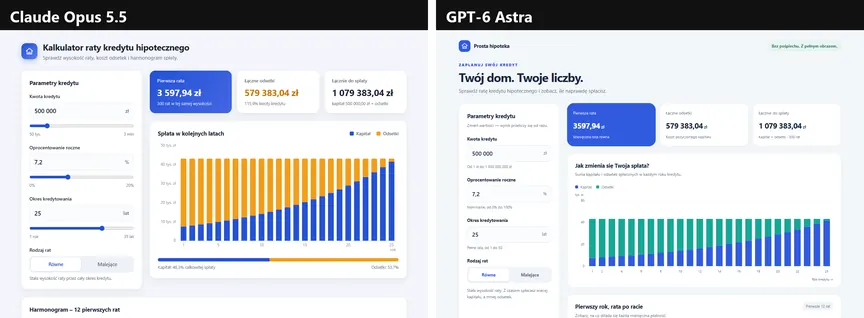
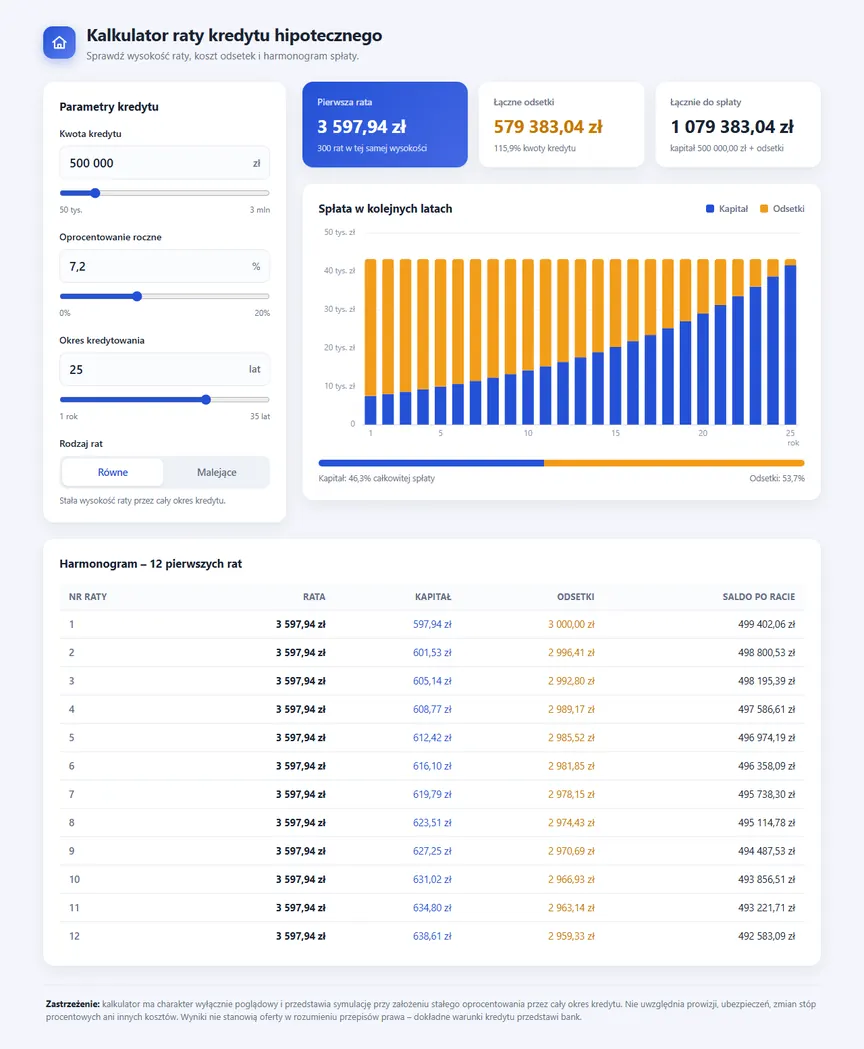
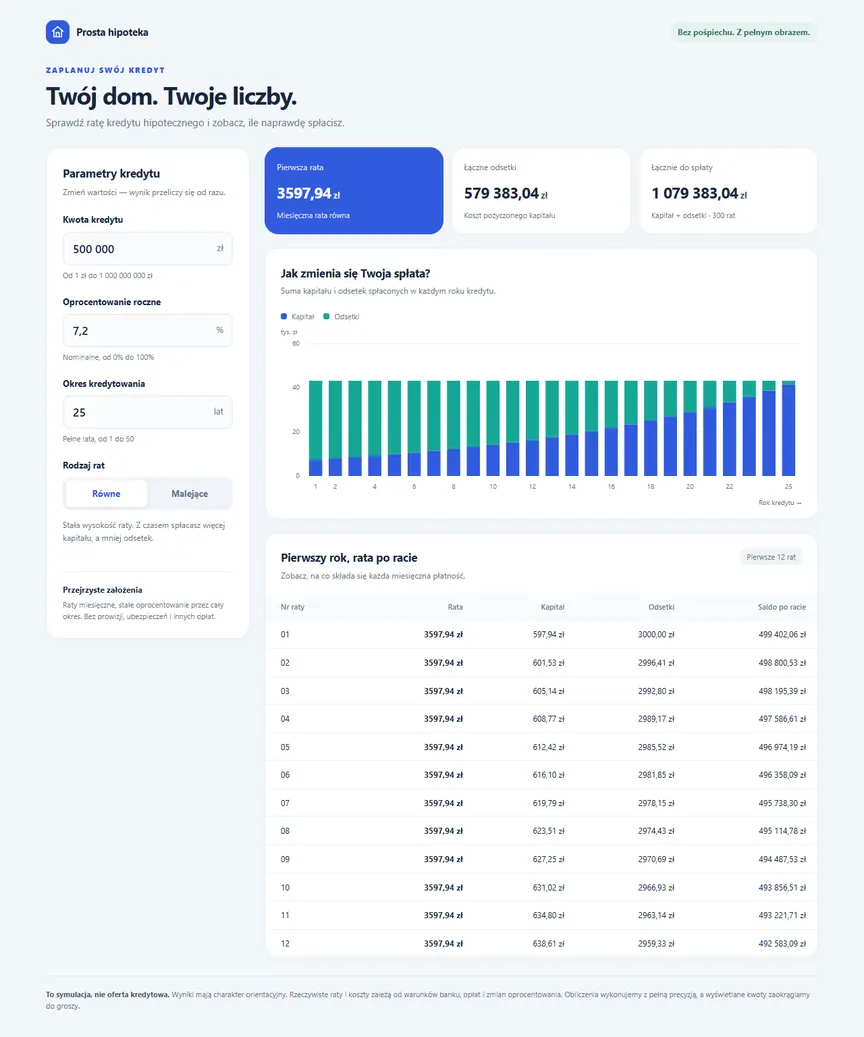
The prompt: generate a self-contained, single-file HTML/JS loan payment calculator with interactive HTML5 canvas charts, a 12-month schedule table, and support for both fixed and reducing installment calculations. We rendered each output in headless Chrome, took screenshots, and evaluated the numeric outputs across both payment modes.
Both calculators computed the exact correct numbers: monthly installments of 3,597.94 with 579,383.04 in total interest, shifting to an initial 4,666.67 installment and 451,500.00 interest under reducing schedules. The differentiation came down to UI quality. Opus added responsive sliders and an interactive principal-versus-interest breakdown bar. Astra omitted thousand separators and used low-contrast chart colors. Blind evaluators rated Opus at 9.3 and Astra at 8.0, awarding Opus a clean 4-0 sweep across all rounds.
Data Analysis: 73-Row Sales Dataset
The test dataset represented coffee retail sales: 73 line items across 45 orders, formatted with semicolon separators, comma decimals, and percentage discounts. The models were queried on net revenue, top-performing region and its revenue share, best-selling item by unit volume, largest month-over-month growth spike, average order value, and median order value for a specific region. Results were validated against a Python Decimal script.
Both models completed the calculations purely via generation (without code interpreter tools), achieving 10/10 correct metrics, including net revenue of 56,081.60 and a 67.5% September increase. Opus output formatted markdown tables for regional breakdowns, aiding manual verification, but consumed 4,533 reasoning tokens and took 50.3s. Astra delivered an executive summary and JSON output in 32.8s.
Logical Reasoning: Three Complex Puzzles
The puzzle suite included: counting five-digit numbers divisible by 11 whose digits sum to 20 (answer: 486), a 5-person knights-and-knaves logic problem, and a conditional probability problem involving three dice (5/18). Verified via Python brute-force scripts, both models scored 3/3 in near-identical durations (28.6s vs 29.1s). However, Opus generated double the tokens (2,550 vs 1,220) due to highly verbose internal derivations.
The Tiebreaker: Four Hard Math Problems
Because the core test suite ended in a draw, I presented a significantly more difficult problem set: counting permutations of {1..8} with no fixed points and no consecutive integers adjacent (answer: 1,695), finding the smallest integer satisfying modular conditions modulo 1105 (answer: 1,347), calculating the day of the week for October 13, 2173 (Wednesday), and determining the probability that a cumulative sum of fair dice rolls lands exactly on 10 (0.2893). Neither model had access to code execution.
Astra solved all four correctly in 266.9 seconds, spending 12,896 reasoning tokens at a cost of $0.697. Opus failed to deliver an answer on every single attempt. With a 16k token limit, Opus exhausted its entire context purely on chain-of-thought scratchpads three times. Increasing the limit to 32k tokens and switching to low reasoning effort produced the same failure. Reasoning traces revealed that Opus solved questions 2 through 4 quickly, then got trapped in brute-force permutation calculations until it hit the hard token ceiling. Five failed attempts cost $1.93 with zero output. I previously documented this phenomenon in our guide on why reasoning models get trapped in infinite loops. When calling Opus via API for open-ended math, always configure maximum token buffers and handle truncation flags.
Copywriting: Price Increase Customer Notice
We tested copy generation (conducted in Polish) for a coffee subscription brand announcing a 12% price increase, grandfathering existing subscribers, offering a coupon, and adhering to a 120-170 word count with a warm tone and zero emoji. Both outputs met all constraints. Gemini 3.1 Pro and Grok 4.7 evaluated the outputs in a double-blind, order-swapped review. Opus scored 9.1 points against Astra’s 7.7, winning all four blind matchups.
Evaluators praised Opus for natural phrasing, while Astra included awkward, generic marketing clichés and wrapped plain email text in markdown asterisks that fail to render in plain-text email clients. This aligns with our independent lab benchmarks, where Opus 5.5 scores 90.1 on writing compared to Astra’s 85.3.
Structured Data Extraction: Strict JSON Schema
An unstructured purchase order email with deliberate traps: an updated quantity buried in a postscript, gross prices needing net calculation, phone numbers requiring E.164 normalization, and written date deadlines. The model was required to return raw JSON with no markdown wrapping. I verified outputs using jsonschema across 18 target fields.
Both models produced valid JSON passing all 18 schema assertions, including tax calculations and custom discount deductions. Astra processed the output faster (8.6s vs 11.0s), while Opus proved slightly cheaper ($0.022 vs $0.032).
Long Context Needle Retrieval
We loaded a 91.8k-character legislative document. Roughly 60% into the context window, I inserted a synthetic control annotation containing a fabricated name and verification ID. Questions tested retrieval of the fabricated entry, specific statutory clause exceptions, statutory cancellation windows, and an intentional trick query regarding a non-existent regulatory fine.
Both models went 6/6, correctly confirming that the penalty was absent from the text. Opus explicitly cited the relevant surrounding paragraph, while Astra replied in 4.1s without needing reasoning tokens (Opus took 9.2s). Due to OpenAI’s long-context pricing structure, Astra cost $0.367 versus $0.193 for Opus, despite Opus processing 59% more input tokens.
Official Provider Benchmarks
The numbers below reflect Anthropic’s official launch metrics for Opus 5.5, with Astra’s comparative data compiled by Anthropic. Opus 5.5 wins in four of the six directly comparable benchmarks.
| Benchmark | Opus 5.5 | GPT-6 Astra | Winner |
|---|---|---|---|
| Terminal-Bench 4.0 | 66.4% | 57.9% | Opus (+8.5 pts) |
| FrontierCode v1.1 | 54.4% | 53.3% | Opus (+1.1 pts) |
| GDPval-AA v2.1 (Elo) | 1846 | 1542 | Opus (+304) |
| Humanity’s Last Exam | 67.7% | 57.2% | Opus (+10.5 pts) |
| AutomationBench | 40.0% | 41.4% | Astra (+1.4 pts) |
| Terminal-Bench-Science | 58.7% | 64.6% | Astra (+5.9 pts) |
| CursorBench, OSWorld, Chartography | Astra score unavailable (unreleased by OpenAI) | ||
Three caveats apply here. Opus was evaluated on maximum effort settings (and xhigh on Terminal-Bench), while Astra ran on high. Zapier’s AutomationBench ran without fallback routing, counting every model refusal as an automated task failure. Finally, this comparison was published directly by Anthropic.
Anthropic also claims that Opus at default medium reasoning outperforms Astra on FrontierCode at roughly 20% of Astra’s task cost, matches Astra on Terminal-Bench at 40% of the cost, and defeats Astra-max on GDPval-AA at a fifth of the cost. In our empirical testing across practical workflows, Opus ran at 64% of Astra’s total cost.
On Artificial Analysis leaderboards (as of September 24): Opus 5.5 Max scored 58 pts, xhigh 56, Astra Max 53, xhigh 52, while Opus Medium and Astra High tied at 51. In short: Opus at default medium matches Astra on high reasoning.
API Pricing and Long-Context Surcharges
| Pricing Tier (per million tokens) | Claude Opus 5.5 | GPT-6 Astra |
|---|---|---|
| Input tokens | $4.00 | $10.00 |
| Output tokens | $20.00 | $50.00 |
| Prompt cache read | $0.20 | $1.00 |
| Requests over 272k input tokens | Standard pricing | $20 input / $75 output surcharge across entire request |
| Context window / Max output | 1M / 128k | 1.05M / 128k |
| Reasoning effort tiers | low to max (default: medium) | low to max (default unlisted) |
| Knowledge cutoff | June 2026 | April 30, 2026 |
Anthropic maintains flat rate pricing across its entire 1-million token context window. In contrast, OpenAI applies a sharp pricing surge once a prompt exceeds 272,000 input tokens: doubling input rates to $20 and boosting output rates to $75 per million tokens for the full request. For an in-depth breakdown of Anthropic’s pricing tiers, see our analysis of Claude Opus 5.5 pricing.
Subscription Plans: Claude Pro and Max vs ChatGPT Plus, Pro, and Pro 500
| Subscription Plan | USD / Month | Model Availability |
|---|---|---|
| Claude Pro | $20 ($17 billed annually) | Full Opus 5.5 access |
| Claude Max 5x | $100 | Opus 5.5 with 5x Pro message caps |
| Claude Max 20x | $200 | Opus 5.5 with 20x Pro message caps |
| ChatGPT Plus | $20 | Astra restricted to ChatGPT Work and Codex (5-45 msgs / 5h) |
| ChatGPT Pro 100 | $100 | GPT-6 Pro (Astra) in standard chat |
| ChatGPT Pro 200 | $200 | GPT-6 Pro in chat; 10x Plus message limits |
| ChatGPT Pro 500 | $500 | 25x Plus message limits with Ultrafast compute |
At the $20 tier, Claude Pro provides direct access to Opus 5.5. Conversely, ChatGPT Plus limits Astra to specialized Work and Codex workspaces; getting Astra in standard consumer chat (branded as GPT-6 Pro) requires upgrading to ChatGPT Pro starting at $100 per month. Read our full breakdown of the ChatGPT Pro 500 subscription plan for enterprise details.
GPT-6.1 Astra Halted, GPT-6.1 Sol as an Affordable Alternative
A successor to Astra won’t arrive immediately. OpenAI paused GPT-6.1 Astra deployments after benchmark runs revealed permission scoping failures, giving no revised timeline. At DevDay 2026, OpenAI introduced GPT-6.1 Sol priced at $2 input and $10 output per million tokens - one-fifth the cost of Astra. In our text benchmarks, Sol scored 85.8 points, nearly matching Astra’s 85.3. For general text generation and lightweight scripts, Sol is the more sensible OpenAI model. For direct head-to-head metrics, check out our comparison of GPT-6 Sol vs Claude Opus 5.5.
Methodology and Test Setup
- API Access: Routed via OpenRouter using
anthropic/claude-opus-5.5(Claude Platform on AWS) andopenai/gpt-6-astra(OpenAI direct) on September 29, 2026. - Parameters: Identical prompts, reasoning effort set to medium, default temperatures, output token caps at 16k tokens (24k for code and web UI). Single-pass evaluation; network latencies may vary based on cluster load. Note: prompt copywriting and long-context legal tests were conducted in Polish.
- Verification: Code verified via automated pytest suites; UI evaluated using headless Chrome rendering; data, logic, and JSON validated via Python schemas; copywriting and design scored double-blind by Gemini 3.1 Pro and Grok 4.7.
- Total Test Cost: $4.91 across model responses (including $1.93 on Opus math timeouts) plus $0.35 in automated judge calls, totaling $5.26.
This benchmark did not cover autonomous multi-hour agentic workflows. For an example of extended execution, read our Remotion testing with Opus 5.5. For full model specs, see our Claude Opus 5.5 guide and GPT-6 Astra overview.
Frequently Asked Questions
Which model is better: Claude Opus 5.5 or GPT-6 Astra?
Across eight core practical tasks, both models completed all requirements without errors. However, Opus 5.5 produced superior prose, cleaner front-end code, and was 1.56x cheaper overall. Astra was the clear winner in multi-step mathematics, finishing 4/4 where Opus timed out.
Which model is cheaper in real-world use?
Claude Opus 5.5 cost $0.89 compared to $1.39 for Astra across the same 8 tasks. The real-world difference is smaller than the 2.5x listed in price tables because Opus tokenizes certain languages and code structures with a 50-60% token overhead. For short, high-reasoning prompts, Astra can occasionally cost less.
Which model handles copywriting better?
Opus 5.5. Independent evaluators Gemini 3.1 Pro and Grok 4.7 scored Opus’s copy at 9.1 out of 10 versus 7.7 for Astra, noting more natural syntax and tone control.
Is GPT-6 Astra included in ChatGPT Plus?
Only within specialized Work and Codex coding environments, subject to limits of 5 to 45 messages every 5 hours. Unrestricted chat access to GPT-6 Pro (Astra) requires the $100/month ChatGPT Pro tier.
Sources and Verification
- Direct testing conducted via OpenRouter (model directory and rates) on September 29
- 2026. Benchmark scores and operational cost comparisons referenced from the Claude Opus 5.5 launch announcement
- technical specifications drawn from the Anthropic Model Documentation and Anthropic API Pricing. Astra 272k token thresholds cited from OpenAI Developer Documentation. Subscription tier details verified via claude.com/pricing
- Anthropic Max Plan Support
- chatgpt.com/pricing
- OpenAI Pro Tiers Help
- and Astra Usage in Work and Codex. Legislative text retrieved from the Polish ELI Sejm API. Artificial Analysis index retrieved September 24
- 2026. All data verified September 29
- 2026
Reader Questions
Claude Opus 5.5 pricing: How does it compare to competing models?
Claude Opus 5.5 is priced at $4.00 per million input tokens and $20.00 per million output tokens, making it 2.5 times cheaper on paper than GPT-6 Astra ($10.00 / $50.00). In practical testing, the realized savings are around 1.56x because Opus generates more internal reasoning tokens and exhibits higher token overhead on non-English text. For short tasks requiring deep deliberation, Opus can sometimes equal or exceed Astra’s cost.
What are Claude Opus 5.5’s main strengths?
Opus 5.5 excels at creative and business writing, Python architecture, refactoring, and single-page front-end development. Blind judges rated its prose and web styling higher than Astra’s, and its code passed all hidden unit tests at lower cost and faster latencies. Its primary weakness is pure multi-step math without code execution tools, where it risks exhausting reasoning budgets.
Opus 5.5 vs GPT-6 Astra: Which should you deploy in production?
For code generation, document analysis, and natural copy, choose Claude Opus 5.5-it offers better value and higher conversational polish. For algorithmic research, intense numerical modeling, or agentic frameworks already built into OpenAI tooling, GPT-6 Astra remains the stronger choice.
Google · Your sourcesQuantslant higher in your Google - one clickAdd to preferred sources →The StarSkirmish rollback and the scope of a model comparison
The StarSkirmish Hillclimb asked the competing models to produce their own StarCraft bots. The organiser lists Stardust among the human-written opponents and describes graded submissions on fresh seeds. In his public update on 2 October 2026, organiser Kai McPheeters said he was rolling back GPT-6 Astra’s code and would allow it to continue. That date identifies the update. It does not establish the time of every match or the outcome of an individual submission.
For our comparison, this matters whenever a model can draw on tools or pre-existing material. Record which inputs and external resources each task permits, identify the submitted artefact and keep any rerun separate. A score from an excluded run should not quietly contribute to an average of valid tasks.