Gemini 4 Argon Pricing: API Rates, Hidden Token Traps, and Costs
Gemini 4 Argon costs $2/$10 per million tokens until November 30, before rates double. Here is how much real tasks cost and how it compares to Opus 5.5 and Astra.
👁 118 reads
Gemini 4 Argon costs $2 per million input tokens and $10 per million output tokens on the API, but only until November 30, 2026. Starting December 1, pricing doubles to $4 / $20. I calculated the actual running costs across my October 13 benchmarks to see when API usage makes sense. For a broader overview of the architecture, see our guide to Gemini 4.
Gemini 4 Argon API pricing: Launch promo vs. December 1
Official Gemini API rates per 1M tokens, verified on October 13, 2026:
| Tier | Until Nov 30, 2026 | From Dec 1, 2026 |
|---|---|---|
| Input | $2 | $4 |
| Output (includes thinking tokens) | $10 | $20 |
| Cached input | $0.10 | $0.20 |
| Batch & Flex: input / output | $1 / $5 | $2 / $10 |
Three critical details from the official rate card are easy to overlook:
- Thinking tokens count as output, billed at $10 per million (rising to $20 on December 1).
- Context caching is implicit only. You cannot manually force a cache; you receive the 95% discount only when Google automatically identifies a repeated prompt prefix.
- There is no free API tier. Argon is marked “Not available” on unpaid API tiers, and consumer app subscriptions do not include API access.
The same initial rate applies on OpenRouter (google/gemini-4-argon), which I used for my own benchmarking.
The 1M unified token limit: Impact on billing
Google specifies that Argon features a “1M unified input-output token limit”-a single, combined budget of one million tokens shared across both input and output. Following the September 30 announcement, some earlier coverage described a one-million token output capacity, which was imprecise. Here is how it behaves in practice:
- Submitting a document spanning 900,000 tokens leaves 1,000,000 - 900,000 = 100,000 tokens available for the generated response.
- Generating a maximum-length response to a tiny prompt: nearly 1M tokens × $10 / 1M = roughly $10 per call (rising to around $20 on December 1).
- Feeding a maximum-length input context: 1M × $2 / 1M = $2 ($4 starting December 1), plus the token cost of the generated response.
Real benchmark costs: What my tests actually spent
All benchmarks were conducted on October 13, 2026, via OpenRouter at a low reasoning level (effort=low). Note that original benchmark tasks, documents, and prompts were executed in Polish.
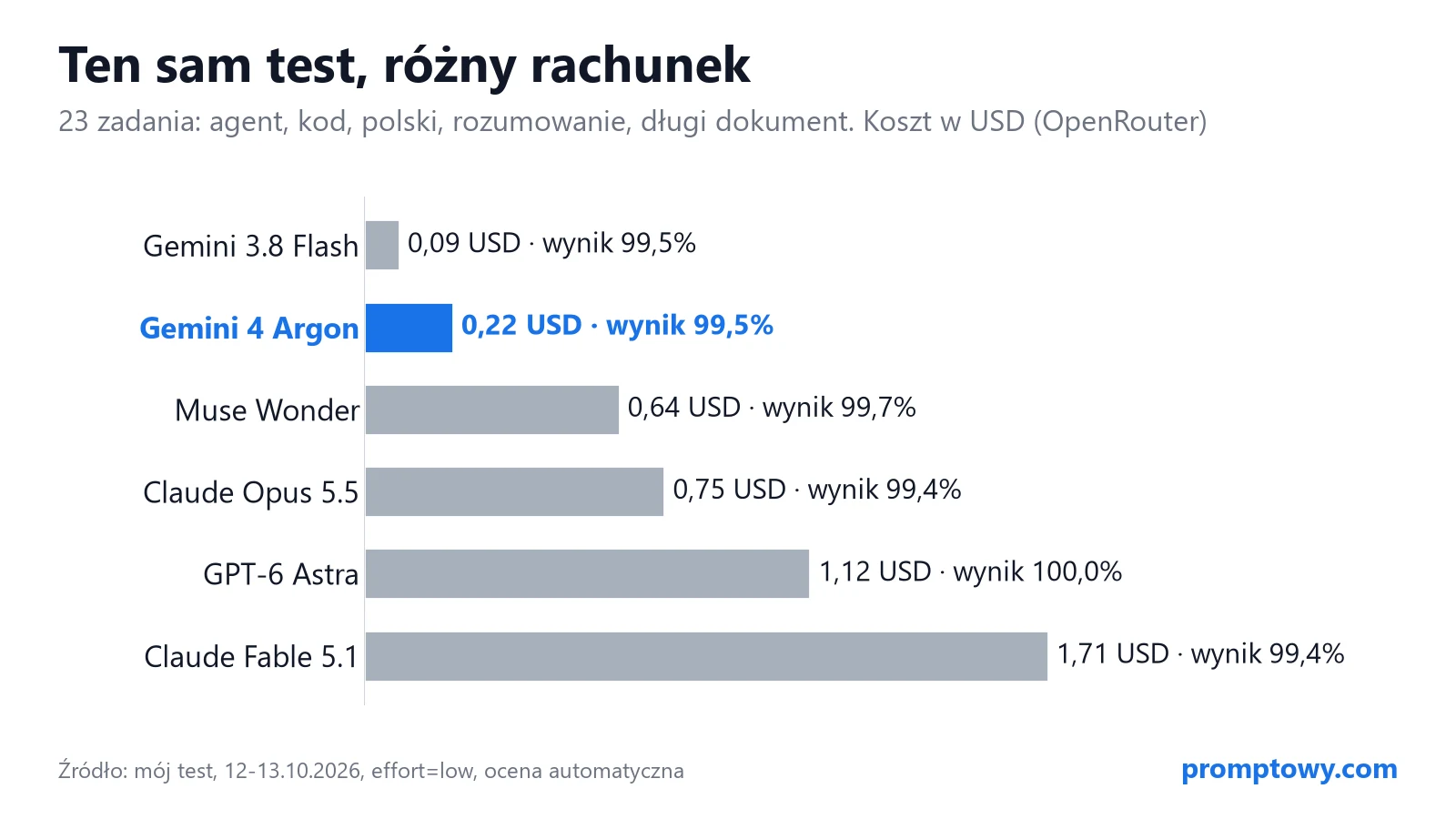
| Model | Cost (23 tasks) | Accuracy | Total runtime |
|---|---|---|---|
| Gemini 4 Argon | $0.22 | 99.5% | 135 s |
| Muse Wonder | $0.64 | 99.7% | 165 s |
| Claude Opus 5.5 | $0.75 | 99.4% | 222 s |
| GPT-6 Astra | $1.12 | 100% | 200 s |
| Claude Fable 5.1 | $1.71 | 99.4% | 263 s |
| Gemini 3.8 Flash | $0.09 | 99.5% | 139 s |
Per-task unit economics from these measurements:
- Single benchmark evaluation: $0.22 / 23 = roughly $0.0096. When prices double on December 1, this full test suite will cost approximately $0.44-still notably cheaper than Opus 5.5 ($0.75).
- Long document evaluation (158,111 characters, tested in Polish, 5 queries): Argon tokenized this document into 51,482 tokens. Calculating 51,482 × $2 / 1,000,000 yields $0.103, with an actual billed total of $0.10 (input accounted for nearly all of it). From December 1: 51,482 × $4 / 1,000,000 = $0.21. In contrast, Claude Opus 5.5 encoded the exact same source text into 87,675 tokens, costing $0.35 (87,675 × $4 / 1,000,000).
- Subsequent document query hitting the cache: 51,482 × $0.10 / 1,000,000 = around $0.005 for input processing, provided Google hits the implicit cache.
- Long-form text generation (Laboratory benchmark, 13 outputs tested in Polish): $0.062 / 13 = around $0.0048 per output. Producing 1,000 equivalent pieces would run roughly $4.77 at launch rates ($9.54 from December 1). In the same scenario, Claude Opus 5.5 cost $0.37 / 13 × 1,000 = approximately $28.46.
- Four Polish high school matriculation exam papers: $0.57, rising to roughly $1.14 on December 1.
For in-depth accuracy metrics, see our full Gemini 4 Argon review.
Argon vs. competing frontier models
Official API token pricing per 1M tokens (input / output):
| Model | Input | Output | Notes |
|---|---|---|---|
| Gemini 4 Argon | $2 | $10 | Until Nov 30; then $4 / $20 |
| GPT-6.1 Sol | $2 | $10 | - |
| Gemini 3.1 Pro | $2 | $12 | Above 200k tokens: $4 / $18 |
| Claude Opus 5.5 | $4 | $20 | - |
| Muse Wonder | $4 | $20 | - |
| GPT-6 Astra | $10 | $50 | - |
| Claude Fable 5.1 | $10 | $50 | - |
On December 1, Argon’s list price matches Opus 5.5 and Muse Wonder. However, token efficiency alters the real expenditure: in our testing, Claude’s tokenizer generated up to 70% more tokens than Argon on identical non-English input text, keeping Argon’s effective cost lower even at identical nominal rates.
The reasoning trap: High thinking effort consumes budgets fast
My tests used a low reasoning tier, and OpenRouter reported zero auxiliary reasoning tokens under that configuration. Turning the reasoning dial up changes things substantially. Artificial Analysis found that Argon consumed 110 million tokens across their benchmark index, compared to an industry median of 82 million tokens. That represents 110 / 82 = 1.34-a 34% heavier token footprint than typical models. Average cost per index problem evaluated:
- Gemini 4 Argon (introductory rate): $1.99
- Gemini 4 Argon (from Dec 1): $3.98
- GPT-6 Astra: $3.26
Until November 30, Argon is roughly 39% cheaper than Astra on this heavy workload (1 - 1.99 / 3.26). Starting in December, it becomes 22% more expensive (3.98 / 3.26 = 1.22). The lesson: lower base token fees will not protect your bill if your pipeline defaults to maximum reasoning depth. For everyday production workloads, lower reasoning settings proved more than capable.
Which setup is most cost-effective?
- A few dozen queries daily: 20 typical analytical tasks per day over 30 days totals 600 queries × $0.0048 = roughly $2.86 per month at introductory rates ($5.72 starting in December). If you only require API access without enterprise workspace bundles, pay-as-you-go via the API remains dramatically cheaper than fixed monthly enterprise subscriptions.
- Automated pipelines and heavy document ingestion: Use the API, ideally utilizing Batch processing. At introductory rates of $1 / $5 per million tokens, you cut baseline costs by 50%.
- Autonomous coding agents: If running agentic developer frameworks with Argon at elevated reasoning settings, expect task costs aligned with the Artificial Analysis benchmark: $1.99 per complex problem through November 30, shifting to $3.98 per task starting in December.
Sources
- Gemini API: Pricing schedule (verified October 13, 2026)
- Google: Gemini subscription tiers (verified October 13, 2026)
- Google: Gemini 4 Argon - Built to solve your hardest problems (October 13, 2026)
- OpenRouter: google/gemini-4-argon
- Artificial Analysis: Gemini 4 Argon - Google is back as one of the top three labs (September 30, 2026)
- Tests conducted October 13, 2026 by Piotr Olszewski: 23-task benchmark, long document test, Laboratory set (13 tasks), CKE exam papers - evaluated via OpenRouter, effort=low (tested in Polish)

More on this from QUANTSLANT



 guides·Company AI Policy: 10-Point Template and Common MistakesA ready-to-use 10-point internal AI acceptable use policy template, common implementation errors, and EU AI Act compliance essentials.