Space Mirror Test Satellite Could Brighten Night Sky 80km
A new study finds that a single Reflect Orbital satellite would appear about 40 times brighter than the full moon within its target area, with light scattering visible up to 80 kilometres away.

👁 117 reads
A new study calculates that Reflect Orbital’s planned constellation of light-beaming satellites would alter the night sky for people as far as 80 kilometres from the intended target area - far beyond the five-kilometre circular patch the US company plans to illuminate on demand.
- Reflect Orbital plans to launch a test satellite with an 18-by-18-metre mirror later this year, with eventual plans for up to 50,000 satellites measuring 54 by 54 metres
- A study accepted by Astrophysical Journal Letters calculates that 400 combined satellite beams would produce light as bright as 10,000 full moons, or 2.4% as bright as the sun, within a five-kilometre target area
- Astronomer Olivier Hainaut had separately modelled that Reflect Orbital's beams would brighten the sky up to 300% worldwide
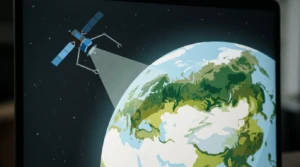
Reflect Orbital, based in the United States, is preparing to launch a test satellite called Eärendil-1 later this year. The satellite will extend an 18-by-18-metre mirror in orbit to test the feasibility of the company’s larger ambitions: a constellation of up to 50,000 satellites, each measuring 54 by 54 metres, designed to reflect sunlight to Earth for uses including solar panel charging, emergency response, and military activities. The launch was approved by the Federal Communications Commission in July.
Miroslav Kocifaj, an astronomer at the Slovak Academy of Sciences, and colleagues modelled how far the light from those satellites would scatter. Their paper has been accepted for publication in Astrophysical Journal Letters. Within the five-kilometre target zone, a single satellite would appear roughly 40 times brighter than the full moon. At 14 kilometres from the centre of the beam, brightness would still match that of a full moon. Combining the beams of 400 satellites - part of Reflect Orbital’s operational plan - would generate light equivalent to 10,000 full moons, or 2.4% as bright as the sun, inside the target area. Even at 80 kilometres from the beam’s centre, the researchers calculated, the effect would register as “a glow above the horizon.”
Google · Your sourcesQuantslant higher in your Google - one clickAdd to preferred sources →Astronomers alarmed, company pushes back
Samantha Lawler, an astronomer at the University of Regina in Canada, was direct: “This is incompatible with astronomy. There is no way you can do this and preserve dark skies.” Kocifaj was equally blunt: “Deploying these mirrors would be seriously damaging for astronomy and for the nighttime environment. The damage extends far beyond the target area.”
Olivier Hainaut of the European Southern Observatory in Germany, who separately modelled Reflect Orbital’s beams and found they would brighten the sky up to 300% worldwide, called the new work credible. “These guys are really good at that kind of modeling,” he said. “These two papers really cover most of it.”
Reflect Orbital CEO Ben Nowack disputed the findings. “Some assumptions are simply inaccurate,” he said, adding that the company’s safeguards - including exclusion zones - account for scattering, and that astronomer feedback has “informed our technology and operational plans.” Kocifaj responded that the company has provided no numbers or technical description to support those claims.


More on this from QUANTSLANT



 ai tools·Harvard Business School’s $699 startup bootcamp uses HeyGen AI avatars