A Billion Dollars for a Promise: AI Startup That Never Sold
The AI market keeps valuing promises over revenue. Here's why everyone at the table knows how the story ends, and why they keep playing anyway.

👁 121 reads
Picture a company that has existed for eighteen months, employs forty people, has never issued a single commercial invoice, and has just been valued at a billion dollars. You don’t need much imagination, because dozens of companies fitting that description have appeared in the last two years alone. This isn’t an anomaly. It’s a species. It has its own courtship rituals, its natural habitat in San Francisco, and its natural predators in the form of venture capital funds that hunt it with an enthusiasm I haven’t seen since the dot-com bubble.
The most interesting thing about this story is that everyone involved knows exactly how it usually ends. And yet they keep playing. That’s the puzzle I want to take apart here.
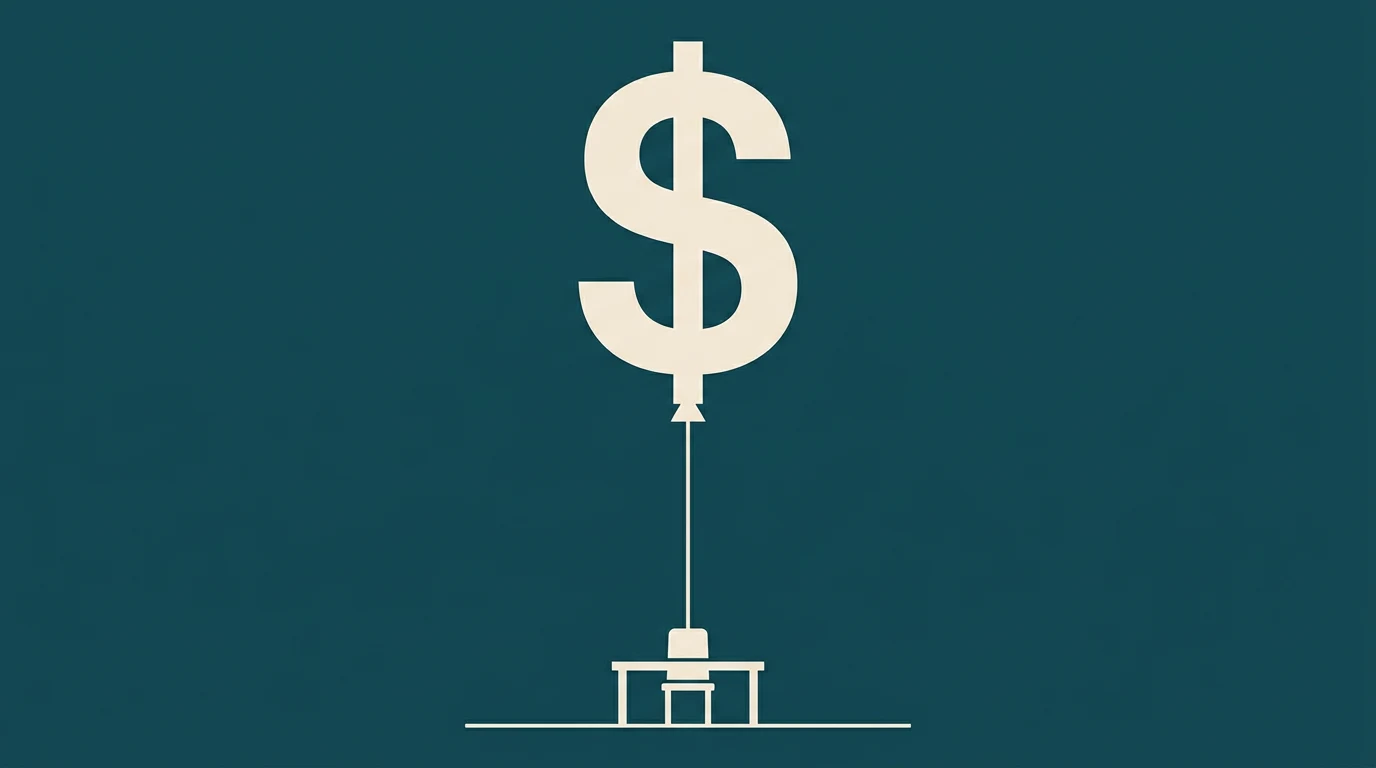
Why revenue stopped being an argument
For most of capitalism’s history, a company’s valuation was more or less tethered to what it earned, or could realistically expect to earn. Multiples could be aggressive, forecasts optimistic, but somewhere in the background there was always a number: revenue. In the world of AI, that anchor has been hauled up and thrown overboard.
The reason is simple and, I’ll admit, not entirely crazy on its own terms. Large language models and generative AI arrived as a technology compared in potential to electricity or the internet. If you genuinely believe you’re standing at the threshold of a civilisational shift, then asking “how much did this company make last quarter” seems about as useful as asking for Edison’s quarterly revenue in 1880. The investor isn’t buying revenue. They’re buying a position in a race whose prize is supposed to be control over the world’s new infrastructure.
The problem is that this narrative is simultaneously true and conveniently unverifiable. True, because the transformation is real. Convenient, because it justifies any valuation for any company that can say “agent”, “foundation model” and “reasoning” in the same sentence. When belief becomes the metric, every number is defensible, because none of them can be disproved.
Who’s really sitting at this table
To understand why this story repeats itself so stubbornly, you have to look at what each player actually wants. A billion-dollar valuation with no revenue isn’t a system error. It’s a system output. Everyone at the table gets exactly what they came for.
Start with the venture capital funds. A fund doesn’t make money because its portfolio company builds a sustainable business over a decade. It makes money because the valuation grows between one round and the next, and because it can exit before anyone asks to see a profit-and-loss statement. The VC model runs on what’s called the power law: out of ten investments, nine can go to zero if one returns a hundredfold. In that setup, caution is punished and recklessness rewarded. A fund that sits out the expensive, risky AI rounds risks something worse than a loss: missing that one winner and falling out of the game for the next decade.
Then there are the founders themselves. For them, a funding round at a billion-dollar valuation isn’t just capital. It’s a status signal, a magnet for talent, a shield against competition. In a world where the best researchers are fought over in bidding wars, a company with a fat account and a loud valuation can simply buy people that a smaller rival can’t reach. The valuation becomes a weapon, not just a mirror of worth.
And then there are the later-stage investors: pension funds, sovereign wealth funds, large institutions that need to deploy enormous pools of capital somewhere. For them, AI is the only category promising returns that justify the scale of their money. They don’t have the luxury of placing small, sensible bets. They have to go big. And big money pumped into a narrow sector drives valuations up mechanically, regardless of what’s happening in the product.
A billion-dollar valuation with no revenue isn’t an assessment of a company. It’s the price of a ticket into a game where everyone is more afraid of not playing than of losing.
Put those interests together and you get a self-propelling machine. Nobody needs to be naive. Nobody needs to secretly believe that a company with no revenue is worth a billion dollars. It’s enough that each party is rationally responding to the incentives in front of them. And that’s what I find most unsettling: this isn’t collective madness, it’s collective rationality producing an irrational result.

What that valuation actually doesn’t measure
To be fair: not every revenue-free AI company is an empty shell. Some are building things that are genuinely difficult, capital-intensive and valuable. Training a foundation model costs hundreds of millions before there’s anything to sell. In that sense, the absence of early revenue can be natural, the same way it was natural for a factory to earn nothing before production started.
But the valuations I’m talking about don’t measure the difficulty of the problem. They measure something else entirely, and this is the core of my argument. They measure, above all, how close a company is to the latest narrative fashion. Two years ago, having a chatbot was enough. Then you needed your own model. Then agents. Then “reasoning”. Each time, the buzzword changed faster than any of these things had a chance to prove their economic value.
Valuations also measure the quality of CVs. A team of ex-employees from the most celebrated AI labs will get a billion-dollar valuation on a slide deck containing a logo and a mission statement, while a more modest team with a working product and real customers will beg for a fraction of that figure. This isn’t an assessment of a company. It’s a trade in prestige, dressed up as an investment in technology.
And finally, valuations measure fear. A fund’s fear of being embarrassed for missing the round everyone will talk about later. A founder’s fear that a competitor will raise more. A large investor’s fear that capital sitting idle is losing value. Add up all those anxieties and express them in dollars, and you get a number with nine zeros next to revenue of zero.
What happens when the music stops
Every story like this has a third act, though the industry prefers not to discuss it at conferences. A valuation without revenue is a promise that someone will eventually come to collect. For a while, the next round confirms the previous one and the question of actual money stays off the table. But at some point there are no larger rounds left to escape into.
That’s when what we’ve seen repeatedly in the history of technology begins, just wearing different clothes. Some companies will be quietly acquired by larger players, not for their product but for their team and patents, in transactions that disguise failure as success. Some will lay off half the staff and claim it was always the plan. Some will spend years as zombies: alive on cash reserves, dead as businesses, too big to disappear quietly and too helpless to grow.
What’s most striking, though, is that the bursting of such a bubble rarely sounds like a bang. It usually sounds like a gradual silence. The company everyone was talking about stops being talked about. The round that was supposed to come doesn’t come. The valuation from the last round stays on paper like an epitaph, because nobody wants to officially acknowledge it was inflated: that would hurt everyone who signed off on it. As a result, failures in this world aren’t announced. They’re left unspoken.
And that’s the cost that bothers me most personally. Capital that went into ten fashion-driven shells didn’t go into companies solving dull, specific, less photogenic problems, companies that might have built something lasting. A bubble doesn’t just waste money. It warps the priorities of an entire generation of the most talented engineers, pulling them toward the highest valuations rather than toward the greatest value.
Google · Your sourcesQuantslant higher in your Google - one clickAdd to preferred sources →Is this time different
I have to ask this question honestly, because in every bubble someone says “this time it’s different”, and in every bubble that statement is half true. Railways really did change the world, even though railway stocks crashed. The internet really did eat the economy, even though vast amounts of capital evaporated in 2000. A technology can be revolutionary and the valuations around it can still be absurd. One doesn’t rule out the other. That’s the most common mistake in thinking about bubbles: assuming that because the technology is real, the valuations must be justified.
AI is real. This isn’t cryptocurrency without applications or a metaverse without users. People genuinely use these tools every day, pay for them, save time and money with them. But the fact that the technology is real doesn’t mean that this particular company, valued at a billion with no revenue, is its winner. The revolution can be genuine and a specific ticket on it can still be worthless.
So my conclusion isn’t “it’s all a scam” or “this is a new era where the old rules don’t apply”. Both of those positions are for people who don’t want to think hard. My conclusion is sharper and, I hope, more useful.
An AI startup valued at a billion dollars with no revenue isn’t a valuation of a company. It’s a valuation of our collective impatience. Impatience not to miss the next big thing. To get there before the competition. To deploy money that’s burning a hole in the portfolio. And as long as that impatience is stronger than the patience required to ask “right, but who pays for this and when”, the same story will repeat itself. The founders’ names will change, the buzzwords on the slides will change, the fund logos will change. The mechanism won’t.
Because the real product of these companies was never the technology. The real product was a story good enough that for a moment nobody felt like asking for the bill. And the best stories, as everyone knows, always cost exactly as much as we’re willing to pay for them, regardless of what they’re actually worth.


More on this from QUANTSLANT



 magazine·Google Spends $180 Billion and Its Stock Falls: The AI Capex ParadoxAlphabet committed a record $180 billion to AI infrastructure in 2025 and Gemini 3 reached 750 million monthly active users.