Oak Ridge opens Lux to researchers, bringing AI and simulation into one system
Lux opened to scientific users at Oak Ridge National Laboratory on 16 November, the same day it entered the TOP500 ranking in fourteenth place. For a...
👁 112 reads
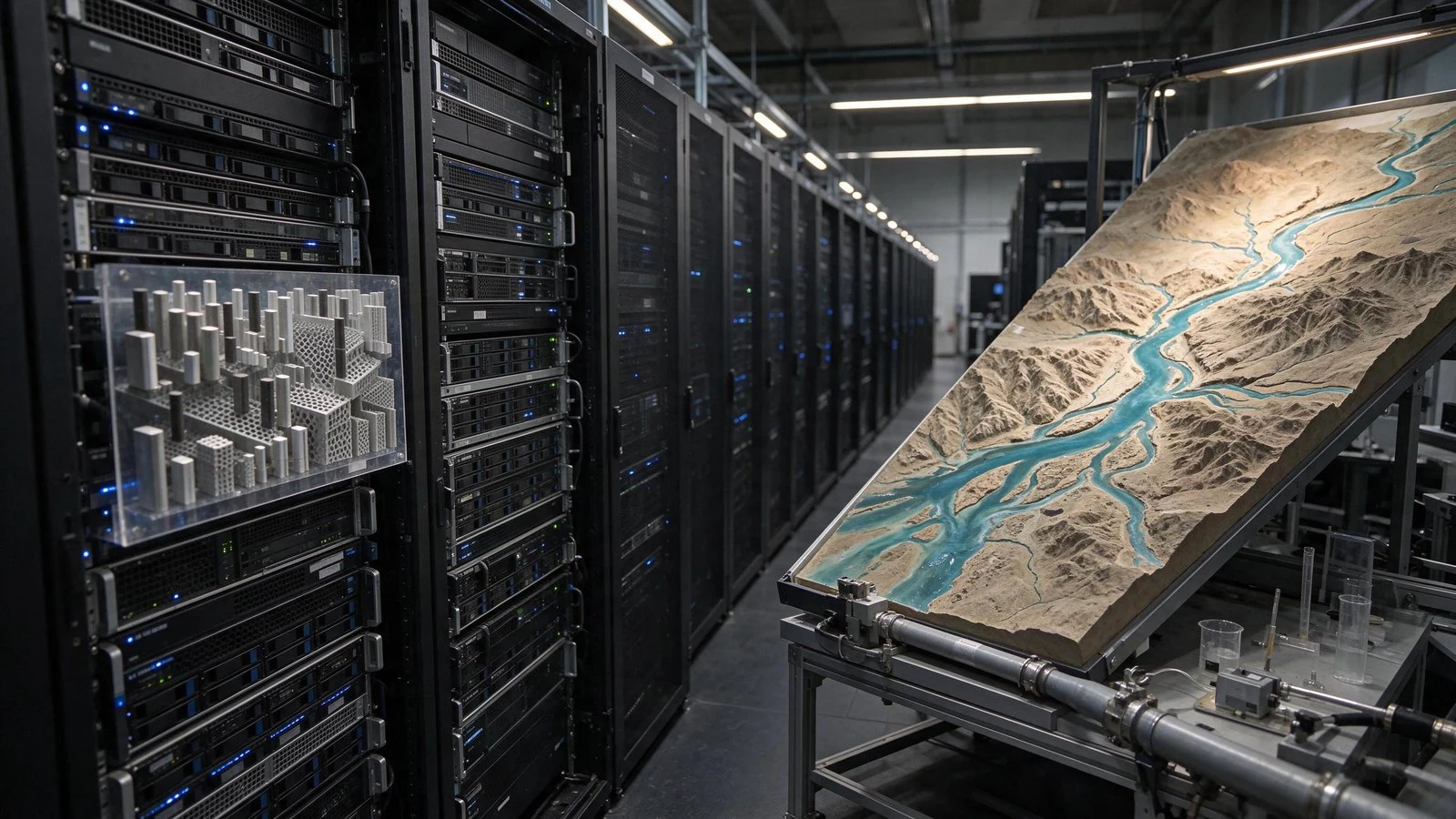
Lux opened to scientific users at Oak Ridge National Laboratory on 16 November, the same day it entered the TOP500 ranking in fourteenth place. For a US research team, the more useful part of that announcement is what the machine is meant to connect: scientific simulations, AI models and experimental data. Buying access to more processors is only one part of making those activities work together.
Oak Ridge reports 220.79 petaflops in the ranking and identifies AMD Instinct MI355X GPUs, EPYC processors and an HPE-built system. I would treat that benchmark as a description of a specific computing result, not as a prediction that every scientific project will run faster by the same amount. Training a model, moving a dataset and solving a simulation are different workloads.
The queue matters as much as the chip
Lux supports both Slurm and Kubernetes for scheduling resources. The distinction sounds administrative, but it points to a real meeting of computing cultures. Scientific teams often submit scheduled jobs, while cloud-oriented software may be organised around services and containers. Bringing the two together can reduce the gap between developing a model and putting it inside a research workflow.
Imagine a materials project that first runs simulations, then trains a model on their results and finally uses the model to select the next simulations. The scientific value comes from the complete loop. If the training stage finishes quickly but researchers spend days transferring results or rebuilding software environments, a faster accelerator has not solved the bottleneck.
That example is a way to assess the new infrastructure, not a claim about a measured Lux result. I would want a project to record time spent on the entire workflow, including preparation, queueing and validation. A headline hardware score cannot show whether a research group can reproduce a result next month with the same inputs and software.
Research capacity has an allocation model
The laboratory says roughly half of Lux’s annual 3.5 million node-hours will support the Genesis Mission, with the remainder available to AMD. That split describes access to computing resources. It should not be read as an equivalent split of publications, discoveries or financial returns.
The announced work includes fusion design, materials development and Earth-system prediction. The local example I find most concrete concerns forecasting water availability and river conditions for the Tennessee Valley Authority region. Here, the test of an AI-assisted workflow is whether its predictions remain useful under changing conditions, not whether its output sounds convincing.
A hypothetical forecasting team would need to separate training data from evaluation periods, compare against an existing method and examine errors when conditions change. Those are scientific requirements rather than features supplied automatically by a supercomputer. More capacity makes larger experiments possible; it also makes it possible to generate unreliable results at greater scale if evaluation is weak.
An opening, not a completed scientific result
For US university and industry teams, I would start with a well-defined computing question: which part of the proposed experiment cannot run adequately on existing resources? The answer could involve memory, parallel execution, a large training dataset or a sequence of simulations. Naming that constraint makes an access discussion more useful than asking for “AI compute” in the abstract.
I would also prepare a small reproducible version of the workload before seeking a larger allocation. It should include the data requirements, software environment, expected outputs and a way to check correctness. That is an editorial recommendation for using shared infrastructure, not a published Lux admission rule.
The opening gives scientists a new place to run those experiments. The next evidence worth watching is whether teams can connect the stages of their research reliably and publish results that others can examine. Lux’s ranking establishes computing capability; the experiments will establish what researchers can do with it.
FAQ
Is Lux available to scientific users now?
Oak Ridge’s 16 November announcement marks the opening to scientific users. Access remains a matter for the facility and its allocation arrangements.
Does fourteenth place measure AI model quality?
No. A supercomputer ranking measures a defined computing benchmark. It does not grade the accuracy of models or research conclusions.
Does Lux replace scientific simulations with AI?
The stated direction is to combine AI with modelling, simulation and scientific data. The announcement does not describe abandoning established scientific methods.
Google · Your sourcesQuantslant higher in your Google - one clickAdd to preferred sources →Sources
- https://www.olcf.ornl.gov/2026/11/16/lux-genesis-mission/ - accessed: 2026-11-17.
More on this from QUANTSLANT


 ai tools·LSE will use AI to turn 1.2 million handwritten wills into research dataA name, a bequest and a difficult line of handwriting can be enough to send a historian back to an archive.