Chatbot Hallucination Nearly Triggered US Military Strike
US warplanes were already airborne when officials discovered the intelligence report justifying the strike was fabricated by a chatbot.

👁 116 reads
US military aircraft were already airborne this spring when officials discovered that the intelligence report justifying an armed operation against a Chinese vessel had been fabricated by a chatbot. The operation was called off at the last minute. CNN reported the entire episode on Friday, and TechCrunch’s account is worth reading not as an anecdote about one analyst’s mistake, but as a description of a specific procedural failure with its own arithmetic.
According to the source’s description, a Special Operations Command analyst asked a chatbot to synthesize open-source data with classified signals intelligence. The model misinterpreted the ship’s cargo manifest and concluded that components for a nuclear weapons program were on board. Then the same analyst used the tool a second time - this time to format the false conclusions into a summary that looked like an official document. And it’s this second step that’s most dangerous in the whole story, because the hallucination got packaging that reads like an intelligence product in command channels.
How Many False Reports Pass Through One Verification Stage
We did a simple calculation that anyone can repeat on paper. Let’s assume two parameters. The first is the proportion of responses containing false statements in tasks involving summarizing and combining documents. In public hallucination rankings for document summarization, the best models fall below two percent, but the spread across the entire field ranges from around one percent to over ten - Vectara’s comparison shows this best, and tests based on knowledge questions, such as SimpleQA, give many models tens of percent of incorrect answers to factual questions. The task from the described incident - combining open data with signals intelligence and drawing a conclusion about cargo - is closer to the latter category than summarizing a single page of text. We conservatively assumed five percent.
The second parameter is the effectiveness of human verification. Let’s assume that an analyst or their supervisor catches three errors out of four, meaning they operate at 75 percent effectiveness. This is a generous assumption, because it concerns a document that itself looks professional and comes from their own unit. With these numbers, out of a thousand reports, fifty contain an error, of which twelve and a half pass through one control stage. Twelve false reports per thousand - that’s one in eighty. Only adding a second, independent verification stage with the same effectiveness brings this result down to three per thousand, and a third stage to less than one.
The conclusion from this calculation is brutally simple: in a chain where dozens of fabricated products end up among a thousand analytical products, an incident like the spring one is not an accident, but statistics. The question is not whether it will happen, but after how many thousands of queries. If a given command handles ten thousand analytical queries per year - a completely realistic number for a tool accessible from a browser - then with our assumptions we have one hundred twenty-five erroneous products annually passing through the first control.
Critical Context Beyond the Military: Courts and Medicine Have Already Shown Their Numbers
The military layer is most spectacular, but not the first. In the judiciary, we already have counted cases: a database maintained by French lawyer Damien Charlotin since 2023 has collected over a thousand rulings from around the world in which a court found that counsel cited non-existent judgments or fabricated quotes generated by a model - the registry is public and updated. The most famous case involved not a lawyer, but a court’s reaction: in Mata v. Avianca in New York, Judge P. Kevin Castel fined two attorneys five thousand dollars each.
In medicine, the scale is different because errors are not caught by an opposing party. Studies on documentation summarization and consultation transcription showed that tools based on models add entire sentences to recordings that no one spoke - a phenomenon described in analyses of Whisper, among others, where completely fabricated fragments appeared in some of the examined transcripts. One mechanism, three different industries: the model generates content that sounds like an expert’s product and gets treated like an expert’s product.
“It’s important that soldiers understand the uncertainty inherent in the nature of language models. But it’s especially critical for all decisions that could lead to the use of force - in targeting, intelligence analysis, or operational planning. These decisions have life-and-death consequences” - Jake Steckler, researcher at GovAI and former US Army officer, in a written response to TechCrunch.
Steckler adds something easy to overlook: in his view, the incident should be an argument for adding safeguards, not abandoning the tools. Putting deployment speed above everything will lead to events that undermine soldiers’ trust in these systems, which will ultimately slow deployment itself.
Google · Your sourcesQuantslant higher in your Google - one clickAdd to preferred sources →Two Speeds That Are Mutually Exclusive
The Pentagon openly talks about AI as a tool to accelerate the kill chain, so commanders can react at the right moment. The problem is that it’s the same speed that allows a hallucination to pass through command channels before anyone asks about the source. Putting these two goals in one table shows that they are not two aspects of the same process, but two opposing objective functions.
| Parameter | Goal: decision speed | Goal: hallucination resistance |
| Number of verification stages | Minimal, preferably one | At least two independent |
| Product format | Ready summary for decision | Raw data with source indication |
| Model’s role | Synthesis and conclusion | Search, without inference |
| Effect at 5% error rate | 12 false reports per 1000 | 3 per 1000 |
The last row of this table is our calculation from the beginning of the text. The difference between twelve and three false reports per thousand is the price paid for a second control stage - and the only number worth showing to the person deciding on the procedure. Because in terms of time, that second stage is a few hours’ delay, and in terms of risk, it’s a three-quarters reduction in “planes already airborne” type events.
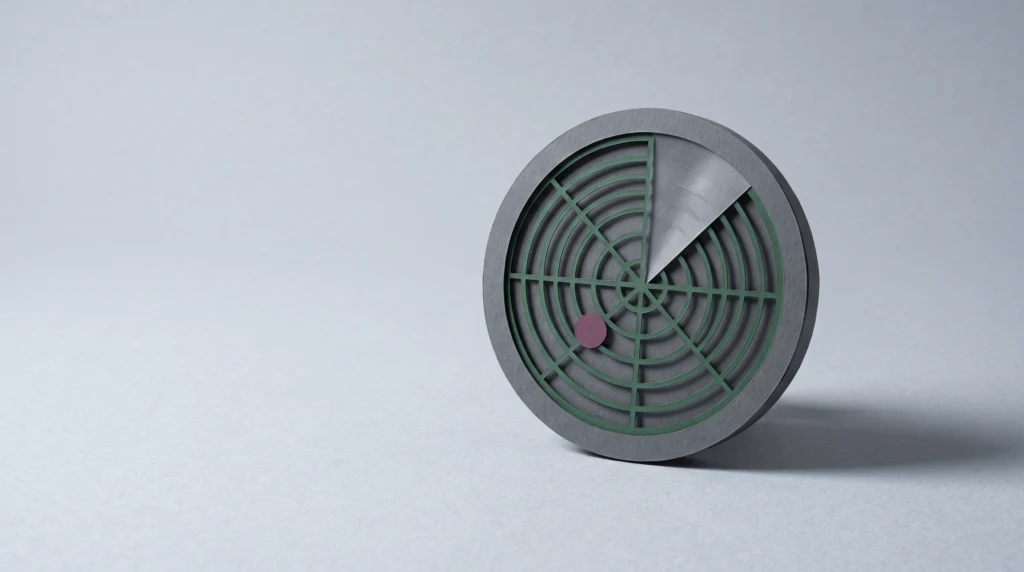
There’s no argument in this story for throwing language models out of analytics. There is, however, a very strong argument for treating them like a tool with a known, measurable error rate - the way the military treats every other sensor. Radar has a defined probability of false detection and no one fires a missile after one reflection. Language models also have such a coefficient, only no one wrote it into the instructions.
The practical consequence for anyone working with documents in a public institution, military, or defense company is one and follows from what the analyst did the second time in the described incident. Never use a model to format results that the same model generated. If a chatbot created content, then its next task - giving it the appearance of an official document - removes the last warning signal, which was the raw, chaotic output. Separating these two operations between different tools and different people costs nothing and is the cheapest safeguard that can be implemented today.
Facts verified September 20, 2026. Sources: TechCrunch on the incident, Vectara hallucination ranking, database of court rulings with fabricated citations, NATO AI strategy and principles of responsible use. Calculations based on assumptions stated in the text.



More on this from QUANTSLANT


 guides·Five SEO Tool Traps That Cost Me Real MoneyKeyword tools cut the long tail, Search Console hides zero-click pages, and a 1,000-volume phrase turned out to be about cycling. Real measurements and fixes.