Falcon Emirati: Arabic AI Model for UAE Dialect and Culture
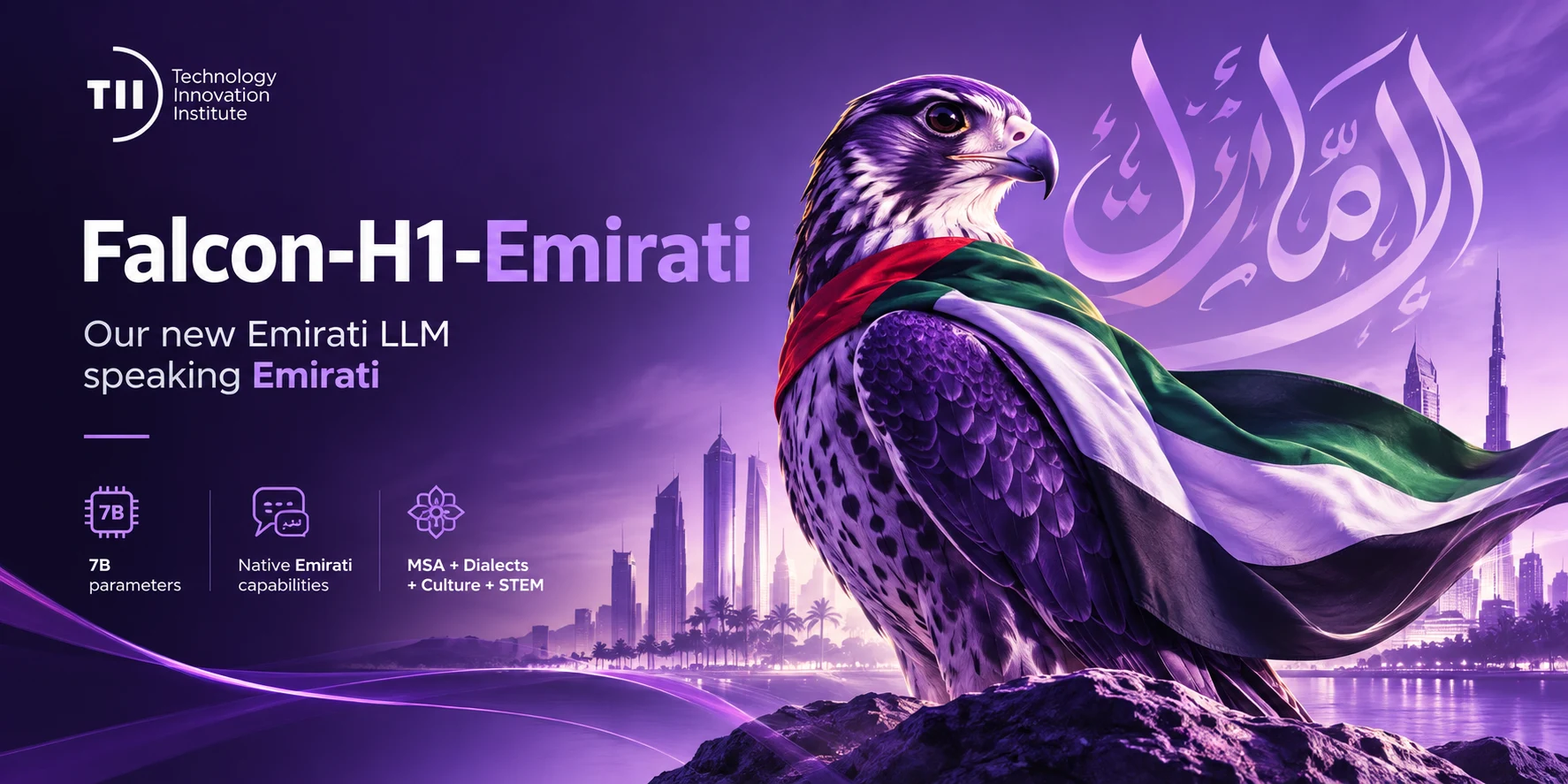
TII's Falcon Emirati is the first large language model trained specifically on Emirati Arabic dialect and UAE culture, not just Modern Standard Arabic.
👁 114 reads
When a user types an Arabic proverb known to every Abu Dhabi resident, global language models respond with polite ignorance - the paraphrase is grammatically correct but completely misses the point. This isn’t a technical error. It’s a consequence of the fact that literally none of the dominant language models were trained on Emirati Arabic as a full-fledged, distinct linguistic system. The Technology Innovation Institute (TII) in Abu Dhabi decided to solve this problem - and published the Falcon Emirati model on Hugging Face.
The Problem You Can’t See From Outside
Arabic is not one language. It’s a family of dialects, each with its own phonetics, vocabulary, idioms, and expressions rooted in local history. Emirati - the Arabic variant used in the United Arab Emirates - differs from Modern Standard Arabic roughly as much as a regional dialect differs from broadcast standard. You can communicate, but something always gets lost in translation.
The problem is particularly visible in two categories of content. First are proverbs and idioms rooted in Arabian Peninsula culture and the Bedouin history of the Emirates - expressions that sound like random word combinations to outsiders but carry specific, strongly cultural meaning for UAE speakers. Second are everyday realities: institutions, places, dishes, social practices, and historical references that are obvious to a resident of Dubai or Al-Ain but invisible to a model trained on the general Arabic-language internet corpus.
Standard large language models - including earlier models from the Falcon family - were trained primarily on Modern Standard Arabic and data from countries with the largest numbers of Arabic-writing internet users. Egypt, Morocco, Saudi Arabia. The Emirates, with a population of just over four million Emirati citizens among nine million total residents, simply didn’t generate enough data for models to learn local specifics on their own.
What Falcon Emirati Can Do
TII designed Falcon Emirati as a specialized model, not another general-purpose model with Arabic in its supported language set. The difference is fundamental. Instead of trying to serve the entire Arab world at an average level, the team focused on deep coverage of one specific linguistic variant and one specific culture.
The model understands Emirati proverbs in their original context - it can explain where a given expression comes from, in what situations it’s used, and what social connotations it carries. It handles questions about local traditions: falconry as a UNESCO-listed cultural heritage element, the specifics of Ramadan customs in the UAE, the history of the seven emirates forming a federation in 1971. It also handles questions about local institutions, procedures, and places not covered by general knowledge about the Arab world.
The key technical challenge in building such a model is data. Emirati Arabic is relatively rarely represented in open text collections - far less than Egyptian or Levantine Arabic. TII had to undertake active curatorial efforts to collect and process a corpus representative of the Emirati language variant. This data work, not the model architecture itself, is the heart of the project.
Google · Your sourcesQuantslant higher in your Google - one clickAdd to preferred sources →Why This Matters Beyond the Emirates
Falcon Emirati is another signal of a trend gaining momentum across the AI industry: moving away from the paradigm of one model for all languages and cultures. For years, the assumption dominated that a sufficiently large model trained on sufficiently large data would learn to handle all linguistic variants on its own. Practice shows this assumption works for major variants of major languages and fails for everyone else.
For the Emirates, the project has not only a technical but also a political dimension. The UAE consistently invests in digital sovereignty and local AI infrastructure - TII is precisely one of those institutions meant to guard that sovereignty. A language model that actually understands Emirati culture is a symbol that the country is not merely a recipient of technology created elsewhere but an active participant in its creation.
Falcon Emirati itself is available on Hugging Face, meaning developers - both in the UAE and beyond - can explore it, test it, and build their own tools on top of it. The project is already gathering community attention: in the first days after publication, the Hugging Face blog post recorded over a thousand views and over two hundred interest markers.
The question behind the entire project, however, is broader than the model itself. If Emirati dialect deserves its own LLM, how many such models should exist in the world? Linguists estimate that Arabic has several dozen clearly distinct dialects - and that’s just one language. Falcon Emirati doesn’t answer this question, but it asks it in a very concrete, technical way.
More on this from QUANTSLANT
 guides·Leonardo AI Pricing: Plans, Tokens & How Many Images You GetLeonardo AI offers four plans: Free with 150 daily tokens, Essential ($12), Premium ($30), and Ultimate ($60). How many images you get depends on the model.