Gemma 4 31B Local Setup: RTX 4090 Benchmarks & VRAM
Can Google's Gemma 4 31B run smoothly on a single RTX 4090? We tested Ollama speeds, VRAM limits, and non-English reasoning. Here are the benchmarks.
👁 117 reads
Google’s Gemma 4 31B is currently the most capable dense open-weights model that fits entirely on a single 24 GB GPU like the RTX 4090. We ran it locally via Ollama on our test rig: it generates around 42 tokens per second, scores an impressive 9.5 out of 10 in our multilingual non-English tests, but consumes nearly the entire 24 GB VRAM buffer and punishes slow storage drives. Here are our full benchmark results.
Current status as of October 8, 2026
- Model:
gemma4:31b-it-qaton Ollama 0.40.1 (quantization-aware trained version, 17.65 GB base file + 1.2 GB vision module). - License: Apache 2.0 - fully cleared for commercial use.
- Speed: 40.7-43.4 tok/s generation, approx. 870-1240 tok/s prompt processing.
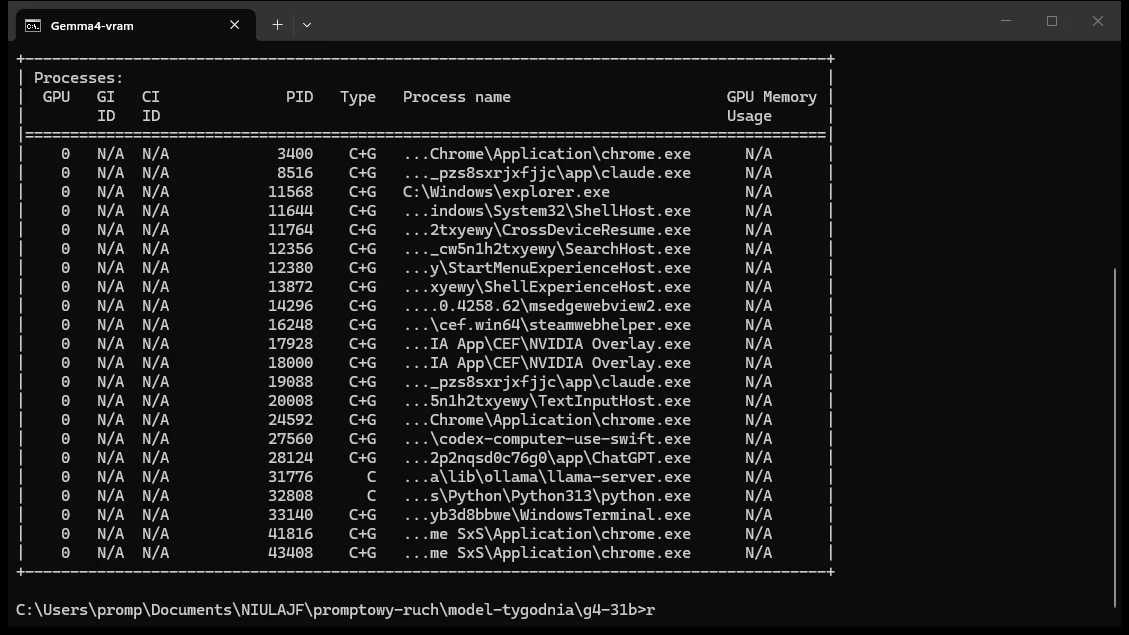
- Video memory: 19.2 GB allocated according to Ollama, peaking at 24.0 GB total system GPU usage (via nvidia-smi).
- Multilingual score (tested in Polish): 9.5/10 across 5 complex linguistic tasks.
- Download time: 40 min 41 s. Drive load time from external USB: 1 min 53 s to 14 min 33 s.
Why Gemma 4 31B fits the single-GPU sweet spot
Our goal was to find a heavy-hitting dense model capable of running completely on a single consumer flagship card (RTX 4090 24 GB, Windows 11). Most other recent candidates quickly fall out of contention:
- Ling 3.1 Flash - features 560 billion parameters with no open weights available yet (as detailed in our look at Ling 3.1 Flash).
- Mistral Small 4 - despite the “Small” label, it packs 119 billion parameters, meaning even aggressive quantization cannot squeeze it into 24 GB.
- GLM 5.3 - lacks a lightweight “Air” tier, while GLM-5.3 Flash starts at a massive 320 billion parameters.
- Hy Image 3.5 - Tencent currently offers API preview access only, with no public weights.
- Qwen 3.8 27B - already evaluated in our 7 local AI models benchmark.
Gemma 4 31B represents the largest dense configuration in the Gemma 4 family that fits onto a standard 24 GB gaming card without offloading layers to system memory.
Gemma 4 31B specs and details
| Specification | Gemma 4 31B |
|---|---|
| Developer | Google DeepMind |
| Parameter count | 30.7 billion, dense architecture (all parameters active per token) |
| Context window | Up to 256k tokens |
| Input / Output | Text and vision input; text-only output |
| Languages | 140+ in training data, ~35 supported out of the box according to Google |
| License | Apache 2.0 |
| Ollama tags | gemma4:31b-it-qat (Q4_0, 19 GB), gemma4:31b-it-q8, gemma4:31b-it-bf16 (63 GB) |
| Recommended settings | temperature 1.0, top_p 0.95, top_k 64 |
The QAT build underwent quantization-aware training targeting 4-bit precision, resulting in substantially lower perplexity loss compared to traditional post-training 4-bit quantization. On a 24 GB VRAM budget, it is the only practical option, as the Q8 variant exceeds 30 GB.
RTX 4090 performance benchmarks
| Metric | Measured result | Notes |
|---|---|---|
| Download (18.2 GB total) | 40 min 41 s | Speeds fluctuated between 4 and 29 MB/s |
| First load attempt | Failed after 5 min | Triggered “timed out waiting for llama-server to start” - see fix below |
| Cold load from USB drive | 8 min 32 s and 14 min 33 s | External D: drive over USB, ~44-66 MB/s throughput |
| Warm load from system cache | 1 min 53 s | Weights already cached in system RAM from previous run |
| Token generation speed (5 tasks) | 40.7-43.4 tok/s | Context 8192 tokens, thinking mode disabled |
| Long-form generation (1,438 tokens) | 41.3 tok/s | Approx. 800 words delivered in 35 seconds |
| Generation speed at 32k context | 42.2 tok/s | Zero speed penalty observed |
| Prompt evaluation rate | 870-1240 tok/s | First query ran slower during warmup (24 tok/s) |
| VRAM usage reported by Ollama | 19.2 GB (8k context) / 19.3 GB (32k context) | 100% layer offload to GPU |
| Total GPU memory usage (nvidia-smi) | 21.8 GB upon load, 24.0 GB at peak | Includes desktop and browser overhead (~0.8 GB baseline) |
Pumping out 41 to 43 tokens per second easily exceeds human reading speed. In comparison to our earlier local AI model benchmark, the smaller Gemma 4 12B delivered 104 tok/s using just 8 GB VRAM, while Qwen 3.8 27B took 17 GB at roughly half the 12B model’s speed. Gemma 4 31B is naturally the heaviest of the trio, but remains remarkably responsive for daily interactive tasks.
VRAM headroom warning: do not multitask on your GPU
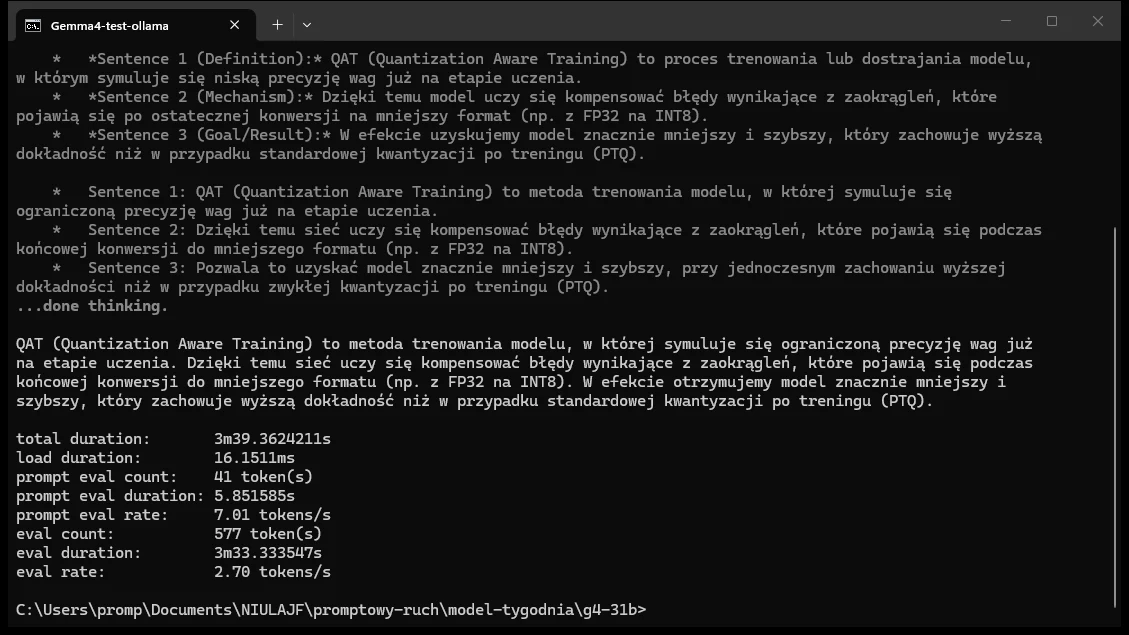
While running our tests, a background image generation batch was initiated in ComfyUI on the same GPU. VRAM instantly saturated (hitting 23.9 out of 24.0 GB), forcing Windows to page model tensors into shared system RAM. Inference speed crashed from 42 tok/s down to 2.7 tok/s, and then to 0.5 tok/s on the subsequent prompt. Gemma 4 31B leaves virtually zero margin on a 24 GB card: running an image generator alongside it is impossible, and heavy browser tabs can steal enough VRAM to degrade performance.
Multilingual evaluation: 5 non-English test tasks
To stress-test complex grammar, inflections, arithmetic, and cultural reasoning beyond basic English, we tested it in Polish across 5 standardized test prompts scored from 0 to 2 points each.
| Task | Score | Observations |
|---|---|---|
| Apology email with declensions (Brzęczyszczykiewicz, Szczebrzeszyn) | 1.5/2 | Correctly inflected town name and offered 10% discount code, but omitted the customer’s complex surname in greeting |
| Text correction (8+ grammatical and punctuation errors) | 2/2 | Spotted all spelling errors, missing letters, and 5 misplaced commas |
| Invoice calculation: 3 line items with 23% and 5% VAT | 2/2 | Calculated VAT totals and gross amounts accurately to the exact decimal |
| 5 cultural and factual questions about Poland | 2/2 | 100% accuracy on geography, literature, mountain peaks, and history |
| Idioms and contextual usage examples | 2/2 | Accurate contextual definitions paired with natural conversational sentences |
| Total score | 9.5/10 |
We noted two minor formatting quirks rather than factual flaws: the model heavily favors Markdown styling and rendered correction arrows using LaTeX formatting ($rightarrow$), which looks unparsed in basic terminal clients. Furthermore, during reasoning steps in ollama run, the internal thought chain takes place in English before synthesizing the final non-English response.
Apology email - full model response (185 tokens, 42.5 tok/s)
Prompt (tested in Polish): Napisz krótki e-mail (do 120 słów) do klienta, pana Grzegorza Brzęczyszczykiewicza ze Szczebrzeszyna, z przeprosinami za 5-dniowe opóźnienie dostawy krzesła biurowego. Zaproponuj rabat 10% na kolejne zamówienie. Ton uprzejmy, bez przesady. Użyj poprawnej odmiany nazwiska i nazwy miejscowości. (Translation: Write a short polite email apologizing for a 5-day shipping delay for an office chair, offering a 10% discount code, using correct noun declensions.)
Temat: Przeprosiny za opóźnienie w dostawie zamówienia

Szanowny Panie Grzegorzu,

chciałbym najmocniej przeprosić za 5-dniowe opóźnienie w dostawie Pana krzesła biurowego do Szczebrzeszyna. Bardzo nam przykro z powodu zaistniałej sytuacji.

W ramach rekompensaty przygotowaliśmy dla Pana kod rabatowy o wartości 10% na kolejne zamówienie w naszym sklepie: RABAT10.

Mamy nadzieję, że produkt spełni Pana oczekiwania, a ten gest pozwoli nam zachować Pana zaufanie. W razie dodatkowych pytań pozostaję do dyspozycji.

Z poważaniem,

[Twoje Imię i Nazwisko]
[Nazwa Firmy]
Text correction - full model response (306 tokens, 40.7 tok/s)
Prompt (tested in Polish): Popraw błędy w tekście i wypisz listę poprawek (każda w osobnym punkcie: było -> jest). Tekst: "Wczoraj poszłem do sklepu żeby kupić chleb, ale okazało się że był zamknięty. W poniedziałek napewno pójde jeszcze raz, bo mam nadzieje że będzie otwarte. Moja koleżanka która tam pracuje mówiła, że wogóle nie zamykają przed 18." (Translation: Correct the grammatical and punctuation errors in the text and list each fix point-by-point.)
Oto poprawiony tekst:

„Wczoraj poszedłem do sklepu, żeby kupić chleb, ale okazało się, że był zamknięty. W poniedziałek na pewno pójdę jeszcze raz, bo mam nadzieję, że będzie otwarty. Moja koleżanka, która tam pracuje, mówiła, że w ogóle nie zamykają przed 18.”

Lista poprawek:
* poszłem $rightarrow$ poszedłem (błąd fleksyjny)
* sklepu żeby $rightarrow$ sklepu, żeby (brak przecinka przed spójnikiem)
* okazało się że $rightarrow$ okazało się, że (brak przecinka przed spójnikiem)
* napewno $rightarrow$ na pewno (pisownia rozdzielna)
* pójde $rightarrow$ pójdę (brak polskiego znaku)
* nadzieje $rightarrow$ nadzieję (brak polskiego znaku)
* że będzie otwarte $rightarrow$ że będzie otwarty (błąd składniowy - sklep jest rodzaju męskiego)
* koleżanka która $rightarrow$ koleżanka, która (brak przecinka przed zdaniem podrzędnym)
* pracuje mówiła $rightarrow$ pracuje, mówiła (brak przecinka zamykającego zdanie podrzędne)
* wogóle $rightarrow$ w ogóle (pisownia rozdzielna)
Invoice calculation - full model response (176 tokens, 41.4 tok/s)
Prompt (tested in Polish): Policz fakturę. Pozycje netto: laptop 4200.00 (VAT 23%), książka 59.90 (VAT 5%), usługa szkolenia 1500.00 (VAT 23%). Podaj VAT dla każdej pozycji, sumę netto, sumę VAT i sumę brutto. Kwoty zaokrąglaj do grosza. Na końcu jedna linia: BRUTTO = … (Translation: Calculate the invoice: net prices laptop 4200.00 at 23% VAT, book 59.90 at 5% VAT, training service 1500.00 at 23% VAT. Output VAT per item, net subtotal, VAT subtotal, and grand total rounded to two decimals.)
Oto wyliczenia dla poszczególnych pozycji:

*   Laptop: netto 4200,00 $rightarrow$ VAT (23%): 966,00
*   Książka: netto 59,90 $rightarrow$ VAT (5%): 3,00
*   Usługa szkolenia: netto 1500,00 $rightarrow$ VAT (23%): 345,00

Suma netto: 5759,90
Suma VAT: 1314,00
Suma brutto: 7073,90

BRUTTO = 7073,90
Factual queries - full model response (60 tokens, 43.4 tok/s)
Prompt (tested in Polish): Odpowiedz krótko na 5 pytań, każde w jednej linii: 1) Jakie miasta są siedzibami władz województwa lubuskiego? 2) Kto napisał "Lalkę"? 3) Jak wysoki jest najwyższy szczyt Polski i jak się nazywa? 4) W którym roku odbyła się bitwa pod Grunwaldem? 5) Ile województw ma Polska? (Translation: Answer 5 factual regional trivia questions covering administrative capitals, classic literature, peak elevation, historical battles, and province count.)
1) Zielona Góra i Gorzów Wielkopolski.
2) Bolesław Prus.
3) 2499 m n.p.m., Rysy.
4) 1410.
5) 16.
Idiom comprehension - full model response (303 tokens, 42.0 tok/s)
Prompt (tested in Polish): Wyjaśnij prostym językiem znaczenie trzech polskich frazeologizmów i do każdego podaj jedno zdanie przykładowe: "wyjść jak Zabłocki na mydle", "rzucać grochem o ścianę", "mieć muchy w nosie". (Translation: Explain the meanings of three common idioms in plain terms and supply a natural example sentence for each.)
Oto wyjaśnienia tych frazeologizmów napisane prostym językiem:

1. Wyjść jak Zabłocki na mydle
*   Znaczenie: Oznacza ponieść klęskę, sromotnie przegrać lub zostać z niczym, mimo że miało być inaczej (często po tym, jak ktoś wierzył w łatwy zysk).
*   Przykład: *Kupiłem ten tani telefon przez internet, ale okazał się zepsuty i sprzedawca nie chce oddać pieniędzy - wyszedłem jak Zabłocki na mydle.*

2. Rzucać grochem o ścianę
*   Znaczenie: Mówić do kogoś, kto zupełnie nie słucha, nie rozumie lub ignoruje nasze argumenty i prośby.
*   Przykład: *Tłumaczę synowi już godzinę, że musi posprzątać pokój, ale to jak rzucanie grochem o ścianę.*

3. Mieć muchy w nosie
*   Znaczenie: Być w złym humorze bez wyraźnego powodu, być marudnym lub poirytowanym.
*   Przykład: *Nie podchodź teraz do Anny, bo od samego rana ma muchy w nosie i na wszystko się gniewa.*
Licensing: what you can build with Gemma 4
Gemma 4 is released under the permissive Apache 2.0 license. This marks an important transition from Gemma 3, which relied on Google’s custom terms of use containing restrictive use-case clauses. Under Apache 2.0:
- You can freely use the model in commercial applications and customer-facing software.
- You are permitted to fine-tune the architecture and redistribute derivative checkpoints, provided license attribution is maintained.
- There are zero API fees or licensing royalties payable to Google, leaving local electricity and compute as your only operational costs.
Step-by-step setup guide for Ollama
- Install Ollama from ollama.com (we used version 0.40.1). If your models reside on a secondary drive, configure the
OLLAMA_MODELSenvironment variable (e.g.,D:AIollama). For more setup tips, check our Ollama guide. - Pull the model file (~18 GB):
ollama pull gemma4:31b-it-qat
- Extend the loading timeout if using slower storage. By default, Ollama waits 5 minutes before timing out. Over an external USB drive, loading took 8 to 14 minutes, triggering a “timed out waiting for llama-server to start” error on our first try. In PowerShell (make sure to quit Ollama from the system tray first):
$env:OLLAMA_LOAD_TIMEOUT = "30m"
ollama serve
Pro tip: keep this model on a fast internal NVMe SSD whenever possible.
- Run and benchmark inference in a separate terminal window:
ollama run gemma4:31b-it-qat --verbose "Explain in 3 sentences how QAT quantization works."
The
--verboseflag reports the eval rate in tokens per second upon completion. To disable the internal reasoning phase, append--think=false. - Confirm hardware allocation:
ollama ps
nvidia-smi
The PROCESSOR column in
ollama psshould display “100% GPU”. If you notice split CPU/GPU offloading, reduce your context size or terminate other programs occupying VRAM. - Benchmark custom context windows via the API:
curl http://127.0.0.1:11434/api/chat -d "{"model":"gemma4:31b-it-qat","messages":[{"role":"user","content":"Hello"}],"think":false,"options":{"num_ctx":32768}}" - Unload the model when finished to free your VRAM:
ollama stop gemma4:31b-it-qat
Is Gemma 4 31B right for your setup?
- Yes, if you own a 24 GB GPU (RTX 4090, 3090, or 5090) and need top-tier reasoning and multilingual fluency without transmitting sensitive data to external cloud APIs.
- Yes, for confidential enterprise document review, copyediting, and dense summarization where 42 tok/s delivers prompt responsiveness.
- No, if your hardware has 16 GB VRAM or less. Opt for Gemma 4 12B instead; it runs 2.5 times faster while requiring just 8 GB of VRAM.
- No, if you plan to run concurrent local image or video diffusion pipelines on the same graphics card.
For a broader breakdown of text, image, and video models you can host yourself, explore our comprehensive Local AI overview, and check our hardware reference on how much VRAM you need for local LLMs.
Frequently asked questions
How much VRAM does Gemma 4 31B need?
In its QAT 4-bit configuration, Ollama reserves 19.2 GB of VRAM with an 8k context window and 19.3 GB with 32k context. Total card allocation reached 24.0 GB at peak during our tests, making a dedicated 24 GB GPU an absolute requirement.
Can an RTX 4090 run Gemma 4 31B?
Yes. The entire model fits 100% onto the GPU, delivering 40 to 43 tokens per second. However, no other GPU-intensive tasks can run simultaneously without causing severe performance throttling down to 0.5-2.7 tok/s.
How well does Gemma 4 31B handle non-English languages?
Exceptionally well. In our five-part linguistic test suite, it scored 9.5 out of 10, executing complex inflections, contextual idioms, and localized math without factual errors.
Is Gemma 4 cleared for commercial use?
Yes. Gemma 4 is published under the Apache 2.0 license, which grants commercial deployment, modification, and redistribution rights.
Why does Ollama fail to load Gemma 4 31B?
The most common culprit is a storage timeout: Ollama defaults to a 5-minute initialization window. Set OLLAMA_LOAD_TIMEOUT=30m or relocate weights to an NVMe drive. Insufficient free VRAM will also cause initialization failures.
Should you choose Gemma 4 31B or Gemma 4 12B?
On a 24 GB card, choose the 31B model for maximum comprehension and accuracy. On GPUs with 16 GB or less, or whenever pure generation speed is prioritized, choose Gemma 4 12B (which clocks in at 104 tok/s using just 8 GB VRAM).
Sources and test verification
- Gemma 4 31B Model Card on Hugging Face (license terms, architecture parameters, and recommended sampling).
- Ollama Library: gemma4 repository tags.
- Hardware test bench: Custom PC (RTX 4090 24 GB, Windows 11, Ollama 0.40.1), October 8, 2026.
More on this from QUANTSLANT

 guides·Best AI to Translate Contracts: ChatGPT vs DeepL and PrivacyWe tested AI models on legal contracts. Here is how ChatGPT and DeepL compare on accuracy, privacy, and handling confidential business agreements.