Google Labs Playground: AI Browser Games from Prompts
Google Labs launched Playground, an experimental tool that builds playable browser games from text prompts. Here is what we know about access, models, and limits.

👁 112 reads
On October 7, 2026, Google Labs launched Playground - an experimental platform where you can build browser games directly from chat prompts, with no coding required. At launch, it is only available to US residents aged 18 and older. If you try accessing it from outside the US, the site immediately redirects to a Google account login screen. Here is everything we know so far, along with what Google has yet to clarify.
As of October 9, 2026
- What it is: Playground, a Google Labs experiment to “Create custom games in minutes”.
- URL: playground.google (overview at labs.google/playground).
- Availability: US only, 18+, Google account required. Other countries are “coming soon”, with no specific dates.
- Pricing: Free to play; creation limits depend on your Google AI plan. Google has not disclosed specific prices or game caps.
- Underlying models: Gemini, Nano Banana, and Lyria - according to 9to5Google and statements from a Google spokesperson.
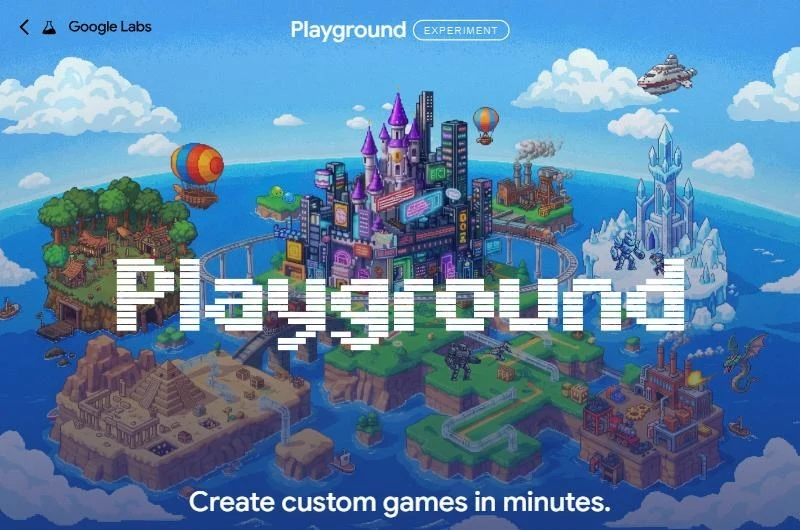
How Google Labs Playground Works
The premise is straightforward: you describe the game you want in plain text, and Playground compiles a playable version directly in your browser. From there, you can continue the chat to refine the details. According to Google’s blog post and reporting from 9to5Google, you can:
- Start from scratch or use prebuilt templates like quizzes, tower defense, or racing games;
- Choose between 2D or 3D, single-player or multiplayer modes;
- Adjust jump physics, scoring mechanics, character designs, and environments using natural language;
- Upload your own sketches, which the AI transforms into matching in-game assets;
- Keep your game private, share it via direct link, or publish it to the public Playground Explore gallery.
Games run on both smartphones and laptops, include leaderboards and player ratings, and sync achievements to Play Games profiles. Public creations undergo community guideline checks and can be reported by users.
Models and Architecture Behind Playground
Google’s official announcement does not explicitly name the underlying models. However, 9to5Google reports that it relies on a trio: Gemini (game logic and code), Nano Banana (visuals), and Lyria (music and audio) - a lineup that matches Google’s broader AI stack. Several outlets note this has not been confirmed in official documentation, so we treat it as highly probable rather than verified fact.
One major limitation: you cannot export project files to run elsewhere. Your game stays hosted inside Google’s web player. Creators looking for greater control are being pointed toward Unity Spark, an upcoming collaboration between Google and Unity featuring “professional mechanics” and full 3D authoring. A closed beta is scheduled to launch later this year.
Availability, Pricing, and Limits
| Detail | Current status |
|---|---|
| Countries | US only; additional regions promised without set dates |
| Age requirement | 18+ |
| Account | Google account required |
| Playing games | Free, directly in the browser |
| Game creation | Free tier with rate limits; higher tiers tied to Google AI plans (exact limits undisclosed) |
| Game export | None |
Early reviews have been lukewarm. TweakTown noted that game mechanics can feel clunky and users quickly run into generation limits. That is typical for an early Google Labs experiment - both Flow and Project Genie launched in a similar state.
Accessing Playground Outside the US
We tested access on October 9. The informational landing page at labs.google/playground loads normally, but visiting playground.google immediately redirects to a Google login screen. Google explicitly states that the service is restricted to the US, so logging in with an international account will likely result in an unavailability prompt. For tips on how to prepare once rollouts expand, check our guide on how to make a game in Google Playground.
Google · Your sourcesQuantslant higher in your Google - one clickAdd to preferred sources →Sources



More on this from QUANTSLANT



 state of ai·Why Truth Probes in LLMs Fail: Measurement Error, Not DeceptionA linear probe showing near-zero accuracy does not prove an LLM hid the truth. New research shows perfect aliasing can invert truth probe measurements.