GPT-Image-2.6 vs 2.5: Same Rate, Triple the Bill
OpenAI claims GPT-Image-2.6 is 50% faster at the same price as 2.5. However, API token usage tripled the actual cost per image in our launch-day tests.

👁 113 reads
OpenAI advertises GPT-Image-2.6 as being 50 percent faster at the exact same pricing rate as 2.5. The official price list confirms it: 30 USD per million output image tokens, completely unchanged. Yet for the exact same medium-quality image of a local bakery, the 2.5 Sunburst model consumed 343 tokens, whereas 2.6 Sunburst used 1,132 tokens. The resulting cost: 0.011 USD versus 0.034 USD. The rate stays identical, but the final bill per image is three times higher.
That was my most important finding on launch day, so I am highlighting it right upfront. The rest of this review covers a direct benchmark of 12 identical prompts across both model generations, followed by a sequential chain of three image edits. All tests were executed via the API on November 5. For a broader overview of the launch, check out our hub covering ChatGPT Images 2.6.
Benchmark Numbers Across 12 Prompts
| Model (Medium Quality) | Median Generation Time | Average Cost per Image |
|---|---|---|
| 2.5 Sunburst | 17.9 s | 0.011 USD |
| 2.6 Sunburst | 26.3 s | 0.035 USD |
| 2.6 Flare | 8.0 s | 0.035 USD |
The promise of being “50 percent faster” held true only for Flare. In my runs, Sunburst 2.6 proved slower than Sunburst 2.5 across all twelve tested prompts. It is possible that launch-day server congestion skewed the latency figures, so I plan to measure again later. For now, “newer and faster” does not apply to Sunburst.
Another quirk surfaced during testing: through the third-party API provider I used, whenever 16:9, 9:16, or 3:4 aspect ratios were requested, the 2.6 models consistently returned 3:2 or 2:3 outputs. In contrast, 2.5 strictly honored the requested dimensions. If you generate YouTube thumbnails or portrait-oriented assets, double-check your exported dimensions before dropping them into production.
Quality: Fewer Differences Than the Version Jump Suggests
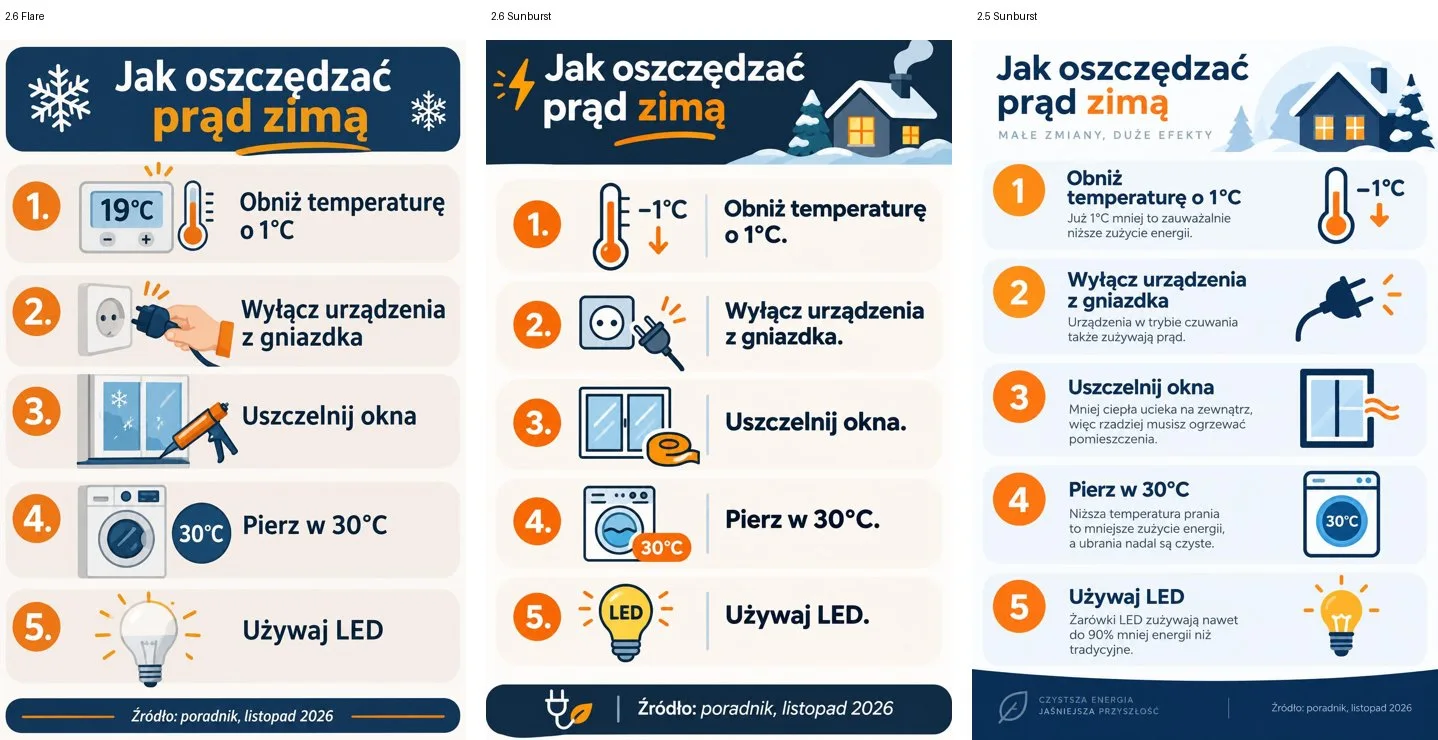
When comparing static generations side by side, 2.5 and 2.6 perform quite similarly. We tested prompts requiring Polish signage (such as a brewery named “TURTLE BREWERY”, translated from the Polish original), and both models rendered diacritics and typography cleanly without spelling errors. Both models also maintain complex layout structures for infographics and menus. Still, a few clear nuances stand out:
- 2.5 more frequently inserts sensible supplementary text and explanations on its own, such as short bullet captions inside an infographic.
- 2.6 Sunburst handles multi-condition prompts more reliably, delivering cleaner, more poster-like overall compositions.
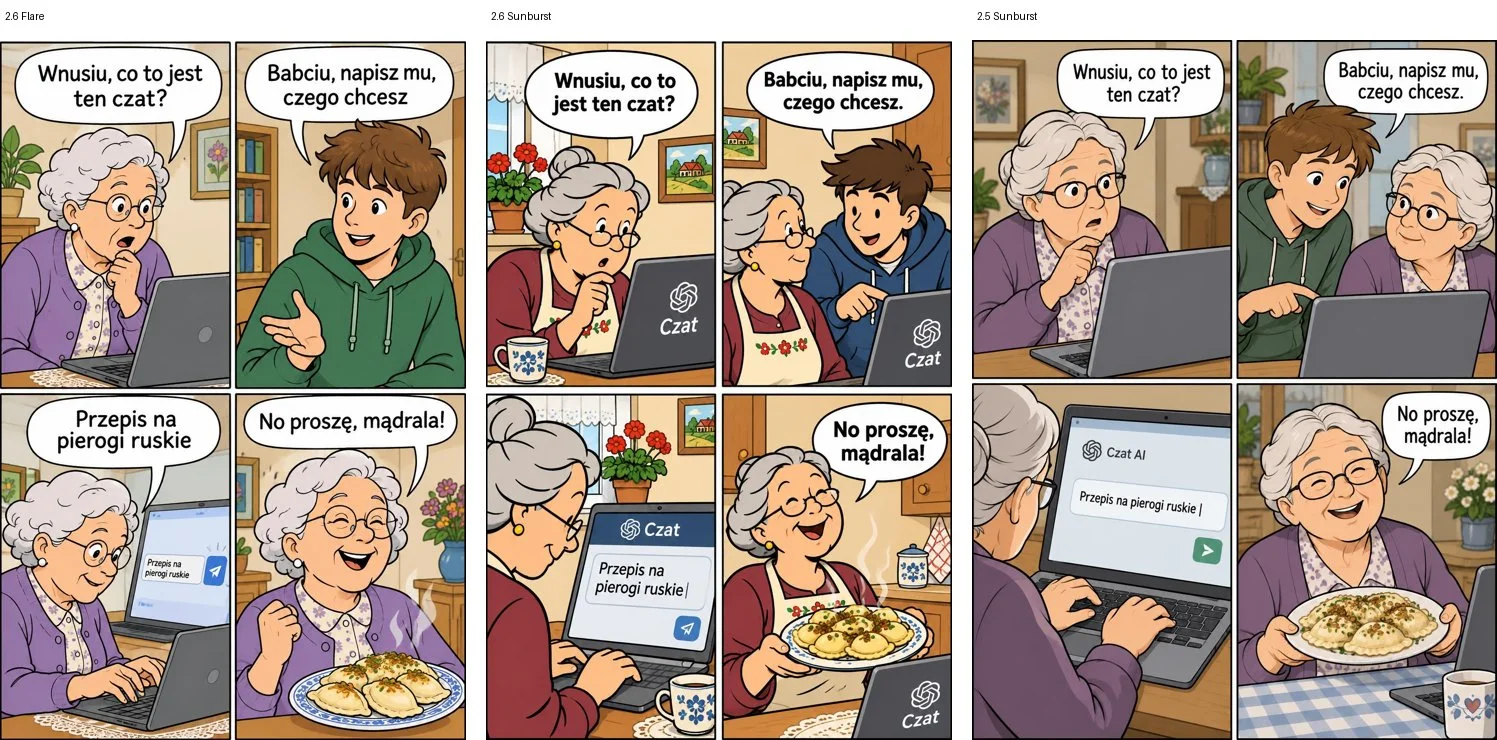
- In a comic panel test, 2.6 Sunburst hallucinated an OpenAI logo onto a grandmother’s laptop without being asked. It is a minor detail, but unprompted branding can be a real issue in client deliverables.
Chaining Three Edits in Sequence
The sequential editing test was the most revealing. Starting with a portrait of an elderly fisherman, I instructed each model to execute three sequential revisions, chaining each step directly from the previous result: place him inside a city tram, hand him a coffee cup with a subtle smile, and change the view outside the window to winter. Every prompt ended with the explicit instruction: “do not change anything else.”

Both generations maintained the subject’s facial consistency across all three modification steps, an outcome that was nearly impossible just a year ago. Model 2.6 showed stricter adherence to constraints: between steps two and three, the foreground scene remains virtually identical, modifying only the landscape outside the glass. On the other hand, 2.5 depicted the winter environment much more vividly, whereas the snow in 2.6 requires close inspection. Running the edit workflow in 2.6 cost 0.046 USD and took roughly 27 seconds, compared to 0.022 USD and 19 seconds in 2.5.
Should You Upgrade?
My takeaway: if you already run an established pipeline on 2.5 Sunburst where unit costs matter, do not migrate blindly. Run your standard production prompts through both models and inspect the usage payload in the API response. In my workload, changing a single line to the new model string tripled generation costs for comparable visual quality. The compelling reasons to move to 2.6 are Flare’s raw generation speed and newly added capabilities such as animated GIFs, native SVGs, and regional inpainting. We dive into those features in our guide to GIF generation in ChatGPT.
For an earlier comparison pitting 2.5 against Google’s stack, check out our analysis of Nano Banana 2.1 vs GPT Image 2.5.
Sources
- Independent API benchmark tests (via OpenRouter: openai/gpt-image-2.5-sunburst, openai/gpt-image-2.6-sunburst, openai/gpt-image-2.6-flare), November 5, 2026; token counts and dollar costs recorded from API usage response metadata.
- OpenAI: GPT-Image-2.6 Flare Model Documentation and Pricing
- OpenAI Developers on X: Announcement of GPT-Image-2.6
Verified: November 5, 2026.

More on this from QUANTSLANT


 benchmarks·GPT-Image-2.6: Flare vs Sunburst Speed and Quality TestFlare and Sunburst cost the exact same per image, but Flare runs three times faster. Our API benchmark reveals where Sunburst actually justifies the wait.