The art of getting lost: the history of The Legend of Zelda, 1986-2026
Forty years of Zelda in one argument: the series wins whenever it dares to let the player get lost. With sales from Nintendo reports and creator quotes.
👁 113 reads
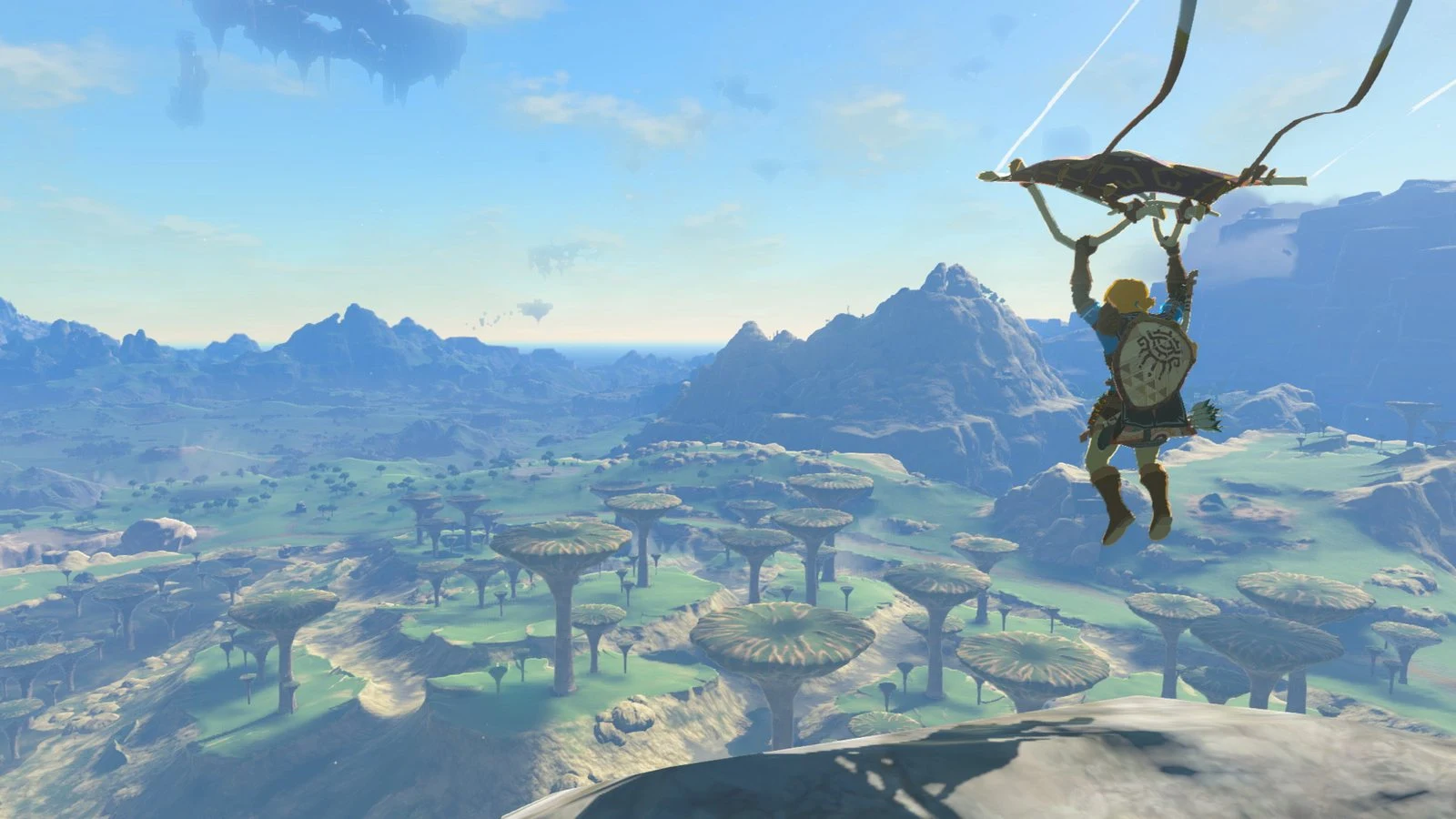
A man falls out of the sky over a land he does not know. Mountains, a forest, something that looks like ruins, and not a single arrow telling him where to go. That frame comes from a game released in 2023, but the sentence that describes it was written with a marker on a whiteboard on 1 February 1985. It said: adventure. The Legend of Zelda turned 40 this year. My argument in this piece: the series does not move in a straight line but in a circle. Every dozen years or so it becomes so good at leading the player by the hand that it loses its own point, and then someone in Kyoto remembers how it all began: in 1986 nobody told you which way to walk. Its biggest successes are not the moments when it added something. They are the moments when it dared to let people get lost again.
Release dates below are Japanese ones. Sales figures come only from Nintendo’s financial reports, review averages from Metacritic as read on 15 November 2026.
1985-1987: a whiteboard and five mountains
In 2009 Satoru Iwata, then president of Nintendo, sat the makers of the first Zelda at one table and asked them to bring their old papers. Programmer Toshihiko Nakago produced the first specification of the game, jotted down by Shigeru Miyamoto on a whiteboard that could be copied. It is dated 1 February 1985. The binder said “Adventure Mario”, because the name Zelda did not exist yet, and an enemy called “Hakkai” later became Ganon. What the papers do not contain is a world. Takashi Tezuka only remembers that it started with the dungeons.
“There were about five mountains on the screen and you’d go into the middle of them and there’d be a dungeon. That was all there was to it.”
Toshihiko Nakago, Iwata Asks, 2009
The overworld, the thing we now consider the essence of Zelda, was added partway through. Tezuka and Miyamoto drew its map together with markers on one long sheet, one taking the left half and the other the right. The game came out in Japan on 21 February 1986 for the Famicom Disk System and reached the United States on 22 August 1987. The same conversation contains a story that says a lot about the Nintendo method: Tezuka laid the dungeons out like a jigsaw puzzle to save memory, made a mistake and used only half of the space. Miyamoto said it was fine like that.
“So, using the half of the memory that was left over, we decided to create the Second Quest”
Toshihiko Nakago, Iwata Asks, 2009
A year later, on 14 January 1987, Zelda II switched combat and dungeons to a side view. The series was twelve months old and already experimenting on itself.
1991-1993: the template and the after-school club
A Link to the Past (21 November 1991) set the order that the word “Zelda” would mean for two decades: a top-down view, dungeons cleared in a fixed sequence, and in each of them an item that opens the way to the next. Tezuka later admitted the production was a challenge and that this was why he had to join partway through as director.
Two years later came a game nobody had ordered. A few programmers were testing after hours what the Game Boy could do.
“We’d do our regular work during normal work hours, and then work on it sort of like an afterschool club activity.”
Takashi Tezuka, Iwata Asks, 2009
That became Link’s Awakening (6 June 1993), with characters from Mario games walking around the island and a mood borrowed from television.
“I was talking about fashioning The Legend of Zelda: Link’s Awakening with a feel that’s somewhat like Twin Peaks. At the time, Twin Peaks was rather popular. The drama was all about a small number of characters in a small town.”
Takashi Tezuka, Iwata Asks, 2009
Eiji Aonuma, who would later take over the series, says that without this pocket-sized game in between, Ocarina of Time would have been different. One curiosity from the same years: in 1993-1994 three Zelda games appeared on the Philips CD-i, made under licence and not by Nintendo. The official 40th anniversary history on Nintendo’s Japanese site lists 20 games. Those three are not among them.
1998-2000: the third dimension
Ocarina of Time (21 November 1998) still holds a Metacritic score of 99 out of 100. It did not break the 1991 template. It translated it: the dungeons, the items and the sequence stayed, the dimension changed. Miyamoto did not pretend anyone knew how it would end.
“it was a huge project of making game in 3D polygon without knowing the final outcome from the beginning.”
Shigeru Miyamoto, Iwata Asks, 2011
Then came the opposite task: Miyamoto asked Aonuma whether a new Zelda could be made in a year using Ocarina’s models. Aonuma went to Yoshiaki Koizumi, who agreed to help if he could use Ocarina’s clock for a game in which the same moments are played over and over. The result was the Three-Day System and Majora’s Mask (27 April 2000), 17 months after Ocarina.
“I also remember telling him “We’ll definitely make this in one year!” Looking back at it now, I said something unbelievable to my boss!”
Eiji Aonuma, Iwata Asks, 2015
2001-2009: the split into two workshops
After 2000 the series divided in two, and that split explains everything that followed. Aonuma summed it up: Nintendo was making a 3D Zelda and, in parallel, a handheld game with Capcom. Tezuka had handed the top-down line to an outside studio, and Iwata remembered his own reaction.
“I vividly remember being shocked when I heard that. I almost thought it must be some kind of mistake.”
Satoru Iwata, Iwata Asks, 2009
Capcom made the two Oracle games (2001) and The Minish Cap (2004), directed by Hidemaro Fujibayashi. Remember the name. The small Zeldas then moved to the Nintendo DS and stylus control with Phantom Hourglass (2007) and Spirit Tracks (2009). The 2D line became the workshop where things could be broken. The 3D line carried the expectations. In 2000 Nintendo showed a realistic Link at its Space World show; a year later it showed a cartoon one.
“We never hesitated in our desire to make a completely new Zelda game. But we did notice the negative reaction when we announced it, so we were uneasy.”
Eiji Aonuma, Iwata Asks, 2013
The Wind Waker (13 December 2002) now stands at 96 on Metacritic. At the time Nintendo drew its conclusion and planned the next big Zelda as its opposite: Twilight Princess (2 December 2006), a launch game for Wii, which sold 5.84 million copies across Wii and GameCube. Years later Iwata noticed a pattern that may be the most accurate sentence ever said about this series.
“Every time a new Zelda title comes out, there’s no shortage of negative opinions, but a year or two later, people are revising their opinions, and its reputation goes up.”
Satoru Iwata, Iwata Asks, 2013
2011: the template hardens
Skyward Sword (23 November 2011), released for the 25th anniversary and directed by Fujibayashi, now a Nintendo employee, scored 93 with critics and sold 3.52 million copies. Next to the 5.84 million of its predecessor, on a console that sold more than 100 million units, that was a signal. The diagnosis came from the man who invented the series. In 2011 Aonuma admitted that recent Zeldas had been made easier so that everyone could reach the goal, and that his boss had a problem with it.
“But Miyamoto-san has been complaining that without anything to get stuck on, the games don’t stick with you as memories.”
Eiji Aonuma, Iwata Asks, 2011
For me that sentence is the key to the whole history. The 1991 template, translated into 3D in 1998, was polished for twenty years until the thing at its core in 1986 was gone: the possibility of getting lost.
2013-2017: the second birth
The first crack appeared where more had always been allowed, in the 2D line. A Link Between Worlds (2013) lets you rent items from a shop and take the dungeons in the order you choose.
“We made this game with the idea of rethinking the conventions of Zelda games, and we truly did take on all kinds of challenges.”
Eiji Aonuma, Iwata Asks, 2013
Four years later, on 3 March 2017, came Breath of the Wild, directed by Fujibayashi and produced by Aonuma. There is a mountain on the horizon and the question of whether you can climb it. You can. This year Fujibayashi said plainly where the idea came from.
“Even with The Legend of Zelda: Breath of the Wild, we consciously returned to the core gameplay principles of the first game in the series as we developed an experience centered on exploration and discovery across a vast world.”
Hidemaro Fujibayashi, Ask the Developer, 2026
That is why I call it a second birth rather than a revolution. Breath of the Wild dug the 1985 whiteboard out from under thirty years of conveniences, and the numbers showed what people had wanted all along.
| Game | Units sold (Nintendo reports) | Metacritic |
|---|---|---|
| Breath of the Wild (2017) | 34.28 million on Switch (30 Sep 2026) plus 1.08 million on Wii U | 97 |
| Tears of the Kingdom (2023) | 22.90 million (30 Sep 2026), of which 18.51 million in the first quarter | 96 |
| Twilight Princess (2006) | 5.84 million on Wii and GameCube | 96 (GameCube) |
| Link’s Awakening (2019) | 5.49 million (31 Mar 2021) | 87 |
| Ocarina of Time (2026) | over 5.2 million in the first four days | 95 |
| Echoes of Wisdom (2024) | 4.09 million (31 Mar 2025) | 85 |
| Skyward Sword (2011) | 3.52 million (31 Mar 2012) | 93 |
Nintendo has published per-title figures only since the fiscal year that ended in March 2007, so the table has no games from 1986-2004. Each figure is the last one Nintendo reported for that game.
2019-2026: after the revolution, and the circle closes
Tears of the Kingdom (12 May 2023) kept the same world and gave Link new hands. Fujibayashi says the idea began with playing with the previous game’s tools.
“For instance, I used spinning cog wheels as tires and attached four of them to a board to create a car.”
Hidemaro Fujibayashi, Ask the Developer, 2023
Echoes of Wisdom (26 September 2024) is the first main entry in which you play as Zelda, for a purely practical reason.
“We were initially thinking that Link would be the protagonist. But when we focused on the gameplay using echoes and had Link copying and pasting things into the game field, the sword and shield got in the way.”
Eiji Aonuma, Ask the Developer, 2024
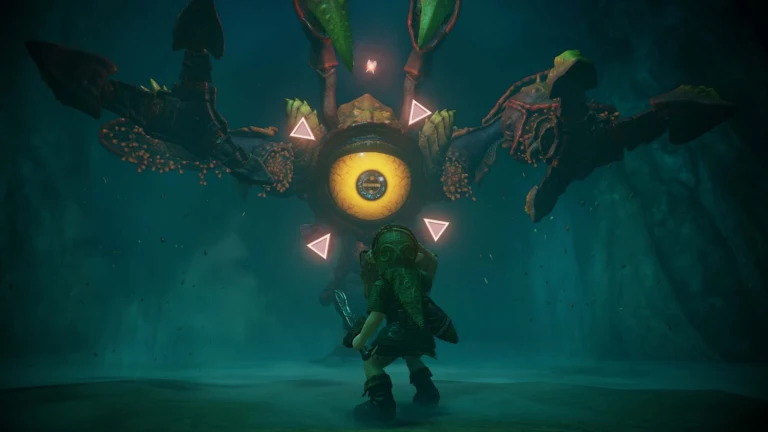
For the 40th anniversary Nintendo did not make a new Zelda. It rebuilt an old one: Ocarina of Time for Nintendo Switch 2, released on 5 November 2026, sold over 5.2 million copies in four days. Its team added fast-travel points at the producer’s request, everyone played the result, and the producer changed his mind.
“So even though I was the one who proposed adding warp points, they just weren’t working for me in the end, so I got the team to take them all back out again.”
Eiji Aonuma, Ask the Developer, 2026
Convenience was removing the journey, and the journey turned out to be the content. A live-action film, The Legend of Zelda, directed by Wes Ball and produced by Shigeru Miyamoto and Avi Arad, opens in cinemas on 30 April 2027.
What 40 years teach
Arrange these games by how much freedom they gave and you get the letter U. High in 1986: go wherever you like. Then a long slide in which every entry is more polished, prettier and slightly tighter than the last. The bottom around 2011. And a sharp return in 2017. I do not think the middle was a mistake: without the tight template there would be no Ocarina, and without twenty years of polishing it nobody at Nintendo could have built a world where freedom does not end in boredom after three hours. But for most of those 40 years “better” meant “more convenient” in Zelda, and the biggest jump in sales and scores came when someone took the conveniences away. On the whiteboard of 1 February 1985 there was no story, no princess and no Triforce. There was one word, and the series still wins whenever it takes that word seriously.
Sources
- Nintendo (Japan), series history for the 40th anniversary
- Iwata Asks: The History of Handheld The Legend of Zelda Games
- Iwata Asks: New Super Mario Bros. Wii, Volume 2
- Iwata Asks: Ocarina of Time 3D
- Iwata Asks: Majora’s Mask 3D
- Iwata Asks: The Wind Waker HD
- Iwata Asks: A Link Between Worlds
- Ask the Developer: Tears of the Kingdom
- Ask the Developer: Echoes of Wisdom
- Ask the Developer: Ocarina of Time
- Nintendo IR: software sales
- Metacritic
Image: The Legend of Zelda: Tears of the Kingdom, © Nintendo.

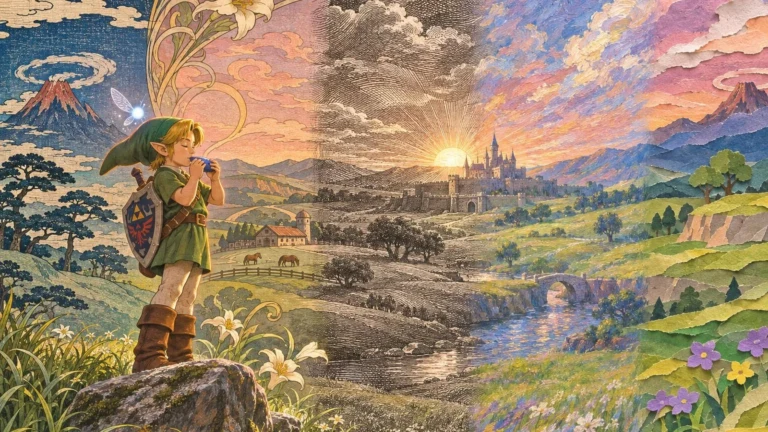
More on this from QUANTSLANT


 news·One stick: why Ocarina of Time changed 3D games, and what the Switch 2 remake could not take awayFive inventions Nintendo made in 1998 because the pad had one stick. The 2026 remake got a second one and still threw almost nothing out.