The hanger, the barrel and the table: how Shigeru Miyamoto works
The creator of Mario and Zelda has turned 74. His road from Sonobe to the top of Nintendo, told through three objects and his own words.
👁 114 reads
Shigeru Miyamoto was born on 16 November 1952, so he has just turned 74. Less than two weeks earlier, on 3 November 2026, he was awarded Japan’s Order of Culture; the ministry’s list names him as a game producer in the field of “media arts (games)”. He has worked at Nintendo since April 1977. That is 49 years at one company. He is usually described as an artist with a vision. In the dozens of conversations in which he and his colleagues explain how the games were made, I see someone else: an industrial designer who for half a century has done what he was taught at design school. He takes a constraint and looks for the shape that solves it. So I will tell this story through three objects: the hanger that got him the job, the barrel that makes Mario jump, and the table he is said to upend at Nintendo to this day.
Sonobe: a valley without a television
He grew up in Sonobe, a village in a river valley about thirty miles northwest of Kyoto. His father taught English. There was no television and hardly any toys, so he made his own out of wood and string, put on shows with homemade puppets and drew flip-books. That is how Nick Paumgarten described it in his 2010 profile for The New Yorker, which also carries the most famous story about his childhood: a boy of seven or eight finds a hole in the ground, returns the next day with a lantern and discovers a small cave with passages leading to other chambers. Paumgarten adds that Miyamoto has told variations of the cave story over the years and that it has become a misty but indispensable part of his legend.
When NPR asked him in 2015 about the origins of Zelda, he did not talk about a cave. He talked about hiking near Kobe in his upper elementary school years and about seeing a big lake near the top of a mountain.
“And I drew on that inspiration when we were working on the Legend of Zelda game and we were creating this grand outdoor adventure where you go through these narrowed confined spaces and come upon this great lake.”
Shigeru Miyamoto, NPR, 2015
Cave or lake, the mechanism is the same and it returns throughout his life: something he experienced with his own body becomes a rule of a game. Not a plot. A rule. He wanted to be a manga artist and gave up for a reason that speaks well of him.
“there were so many other manga artists who were at such a high quality that I felt I couldn’t compete with them”
Shigeru Miyamoto, NPR, 2015
The hanger: a crow, an elephant and president Yamauchi
He studied industrial design at the municipal art college in Kanazawa. After graduation his father, through a mutual friend, got him an interview with Hiroshi Yamauchi, president of Nintendo. He brought toys he had made, among them two wooden clothes hangers for children, one shaped like a crow and one like an elephant. Yamauchi hired him as an apprentice in the planning department. Nintendo’s own documents put it dryly: April 1977, joined the company. I like that hanger because the whole later Miyamoto is already in it. It is an object for use. It has to work in the hand of a child who cannot reach the wardrobe yet, and only once it works does it get a beak.
For the first years he did not make games. He designed arcade cabinets and artwork for games invented by others.
The barrel: one button
In 1981 Nintendo’s American branch was stuck with a warehouse of arcade machines nobody wanted. The game was Radar Scope; The New Yorker writes of two thousand unsold cabinets. Yamauchi told Miyamoto to come up with a game that could be put into them.
“Make games that sell more!”
Hiroshi Yamauchi, quoted by Miyamoto, Iwata Asks, 2009
He sketched ideas for five games, the first ones with Popeye, a character Nintendo held a licence for at the time. The licence fell through and he had to invent his own characters: a gorilla, a girl and a small man in a cap. The cabinet had one button. What should it do?
“But then we thought: “If you had a barrel rolling towards you, what would you do?””
Shigeru Miyamoto, Iwata Asks, 2009
Jump. The most important move in the history of games exists because the box left over from a failed shooter had one button. Mario himself is built the same way, inside a square of 16 by 16 pixels. Hair cannot be drawn in it, so he wears a cap. A mouth cannot be drawn, so he has a moustache.
“You don’t have to draw a mouth, which makes a big difference.”
Shigeru Miyamoto, Iwata Asks, 2009
Super Mario Bros. came out in Japan on 13 September 1985 and The Legend of Zelda on 21 February 1986, made in parallel by the same small team.
The third dimension: a puppet show in space
In the mid-1990s nobody knew what a jumping game should look like in 3D. Yoshiaki Koizumi remembered the moment of decision.
“He just came out one day and said, “I’m gonna direct this one.””
Yoshiaki Koizumi, Iwata Asks, 2010
In Super Mario 64 the camera is held by a character inside the game, so the camera, as Miyamoto puts it, is almost a character itself. He compared the whole thing to doing puppet shows in a 3D video game space. Two years later came Ocarina of Time, and with it the clearest sign of how little he cares about what is usually considered the heart of an adventure game.
“So even when it comes to the Ocarina of Time, I hardly ever talked about the story.”
Shigeru Miyamoto, Iwata Asks, 2011
Will Wright, creator of The Sims, put the difference between Miyamoto and the rest of the industry most briefly.
“Miyamoto starts from the kinesthetics of the controller.”
Will Wright, The New Yorker, 2010
The table: chabudai gaeshi
In a classic Japanese baseball comic and animated series there is a scene in which the father upends the low tea table during a family meal. In Japanese: chabudai gaeshi. At Nintendo the expression has its own footnote in the company’s interviews, which explains that Miyamoto’s working style has been compared to that scene because of his tendency to make last-minute suggestions that leave everyone else scrambling. He thinks it is an exaggeration.
“To me, “overturning” would mean coming out with something like: “Actually, Link was a woman all along!””
Shigeru Miyamoto, Iwata Asks, 2006
Why do people put up with it? Because behind the habit is the skill Satoru Iwata valued in him most.
“Miyamoto-san can look at his own work as if it is someone else’s and say, “It’s missing something here.””
Satoru Iwata, Iwata Asks, 2011
How does he know what is missing? Not from surveys: The New Yorker noted that Nintendo does not use focus groups. He sits someone who does not know the game in front of it and watches over their shoulder. He sometimes asks younger creators to play their own games with their hands switched, to remember how a first-timer feels.
“That may be in the game, but if Nakago-san didn’t see it, then other players might not see it either, which is the same as if it weren’t in there at all.”
Shigeru Miyamoto, quoted by Eiji Aonuma, Iwata Asks, 2009
Iwata remembered and spread Miyamoto’s definition of an idea: “something that solves multiple problems at the same time with just a single adjustment.” The jump in Donkey Kong is such an idea. So is Mario’s cap. If there is one method, it is this: do not add, find the shape that settles several things at once. Exactly what chair designers are taught.
| From life | In the game | Source |
|---|---|---|
| A barrel rolling towards you | The jump button, Donkey Kong (1981) | Miyamoto, Iwata Asks |
| 16 by 16 pixels is too few for hair and a mouth | Mario’s cap and moustache | Miyamoto, Iwata Asks |
| A lake near the top of a mountain near Kobe | The outdoor adventure of The Legend of Zelda (1986) | Miyamoto, NPR |
| Swimming after turning 40 | Mario’s swimming in Super Mario 64 (1996) | Miyamoto, NPR |
| Pottering around the garden | Pikmin (2001) | Iwata, Iwata Asks |
| Getting a dog | Nintendogs (2005), 23.96 million sold | Iwata, Iwata Asks |
| Weighing himself every day | Wii Fit (2007), 22.67 million sold | Miyamoto, Iwata Asks |
Wii: a machine for mums
He admits he was advised against all this.
“I’ve been told in the past that it’s better not to mix my hobbies with my work, or that it’s best not to try and make something I know intimately into a product”
Shigeru Miyamoto, Iwata Asks, 2007
He did not listen, and in 2006 the method got its own console. According to The New Yorker he conceived and helped design the Wii controller, and he summed up the goal as a machine that mums would want. He describes the shape of the remote in language we already know.
“Once we decided on this shape and the control became one-handed, several problems were solved at once.”
Shigeru Miyamoto, Iwata Asks, 2006
Wii sold 101.63 million units and Wii Sports 82.79 million, according to Nintendo’s reports.
The summit: Fellow
His formal career is more modest than you might expect. He joined Nintendo’s board only in June 2000, after 23 years at the company, and became senior managing director and representative director in May 2002. He has never been president. After Satoru Iwata died on 11 July 2015, Nintendo created a new position, Fellow, and he holds it to this day as Executive Fellow and Representative Director. In practice it meant moving beyond games: he presented Super Mario Run on Apple’s stage in September 2016, oversaw Super Nintendo World at Universal Studios Japan, and produces films. The Super Mario Bros. Movie (2023) took 1.36 billion dollars at the box office and The Super Mario Galaxy Movie (2026) 1.01 billion. The live-action The Legend of Zelda, which he is producing with Avi Arad, opens on 30 April 2027. He talks about films the way he talks about games.
“We do not want to set a release date first and then force the production schedule to meet it.”
Shigeru Miyamoto, Nintendo shareholders’ meeting, 27 June 2025
For the consumer, not for the boss
Takashi Tezuka, with whom he drew the map of the first Zelda, retired in June this year. Miyamoto stays, and according to president Shuntaro Furukawa he takes part in the training of new employees every year. What he tells teams, in his own words, is always the same.
“work for the consumer, not for your boss.”
Shigeru Miyamoto, Nintendo shareholders’ meeting, 27 June 2025
Back to the three objects. The hanger says where he came from: a workshop where a thing first has to work. The barrel says how he thinks: a constraint is not an obstacle but a question. The table says why his games are better than other people’s: in the last week he can look at his own work like a stranger and have the courage to take it apart. Calling him a genius is convenient, because it excuses us from thinking about what can be taken from him. And nearly everything can. The only genius in it is that he has done it consistently for 49 years.
Sources
- Nick Paumgarten, “Master of Play”, The New Yorker, 2010
- NPR, Q&A with Shigeru Miyamoto, 2015
- Iwata Asks: New Super Mario Bros. Wii
- Iwata Asks: Twilight Princess
- Iwata Asks: Nintendo DSi
- Iwata Asks: Wii Fit
- Iwata Asks: Wii Remote
- Nintendo, notice of the 2025 shareholders’ meeting
- Nintendo, Q&A of the 2025 shareholders’ meeting
- MEXT, Order of Culture 2026
- Nintendo IR: hardware and software sales
- Box Office Mojo
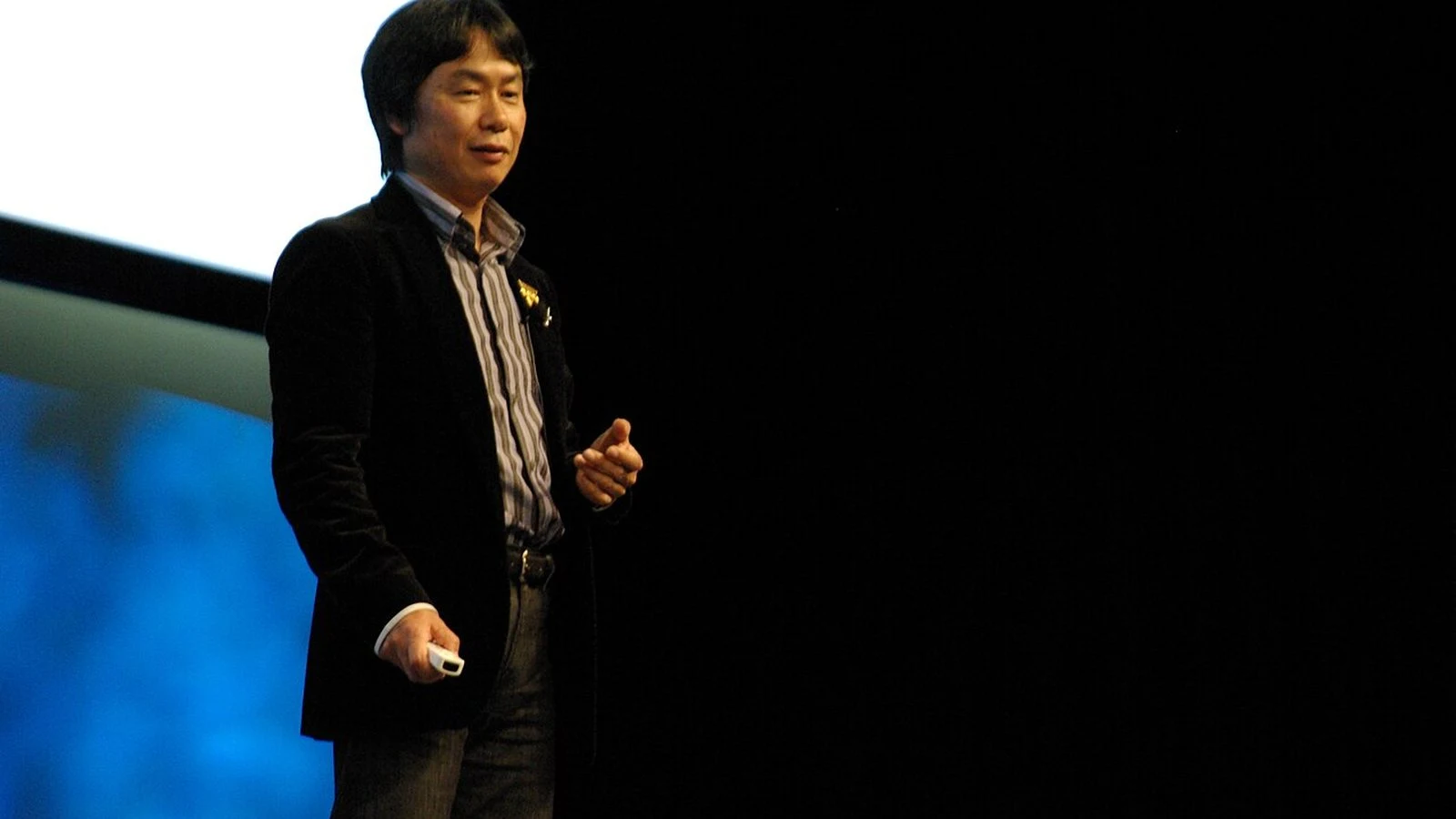
Photo: Shigeru Miyamoto, GDC 2007 - Vincent Diamante, CC BY-SA 2.0, Wikimedia Commons.

More on this from QUANTSLANT
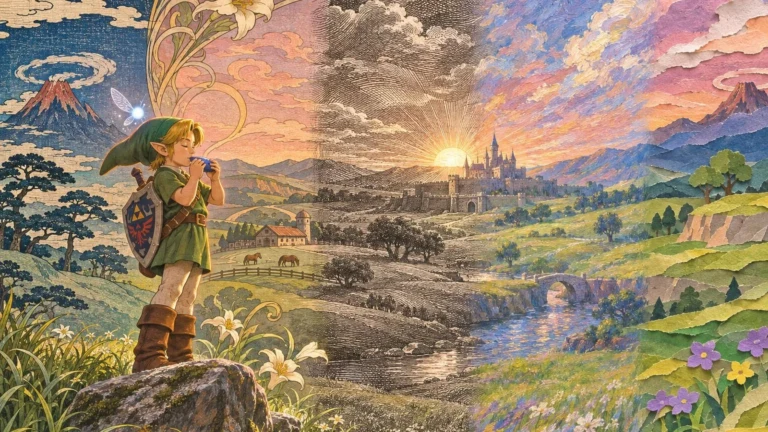



 news·The art of getting lost: the history of The Legend of Zelda, 1986-2026Forty years of Zelda in one argument: the series wins whenever it dares to let the player get lost. With sales from Nintendo reports and creator quotes.