Lip Sync AI Test: OmniHuman 2 vs Kling Avatar, H3 Max & VEED
I tested five lip sync models on the exact same portrait and speech sample: OmniHuman 2.0, H3 Max, VEED Fabric, OmniHuman 1.5, and Kling AI Avatar v2.
👁 124 reads
The same portrait, the exact same spoken sentence, and five models that turn a still image into a talking character: OmniHuman 2.0, its predecessor OmniHuman 1.5, Kling AI Avatar v2, MiniMax H3 Max Lip Sync, and VEED Fabric 1.0. On 20 October 2026, the top performers in my lip sync benchmarks were OmniHuman 2.0 and H3 Max Lip Sync (both scored 8.5/10). H3 Max was over 10 times faster and half the price, though it crops the frame to 4:3. Kling moved its mouth too subtly, while OmniHuman 1.5 bared its teeth during silent pauses.
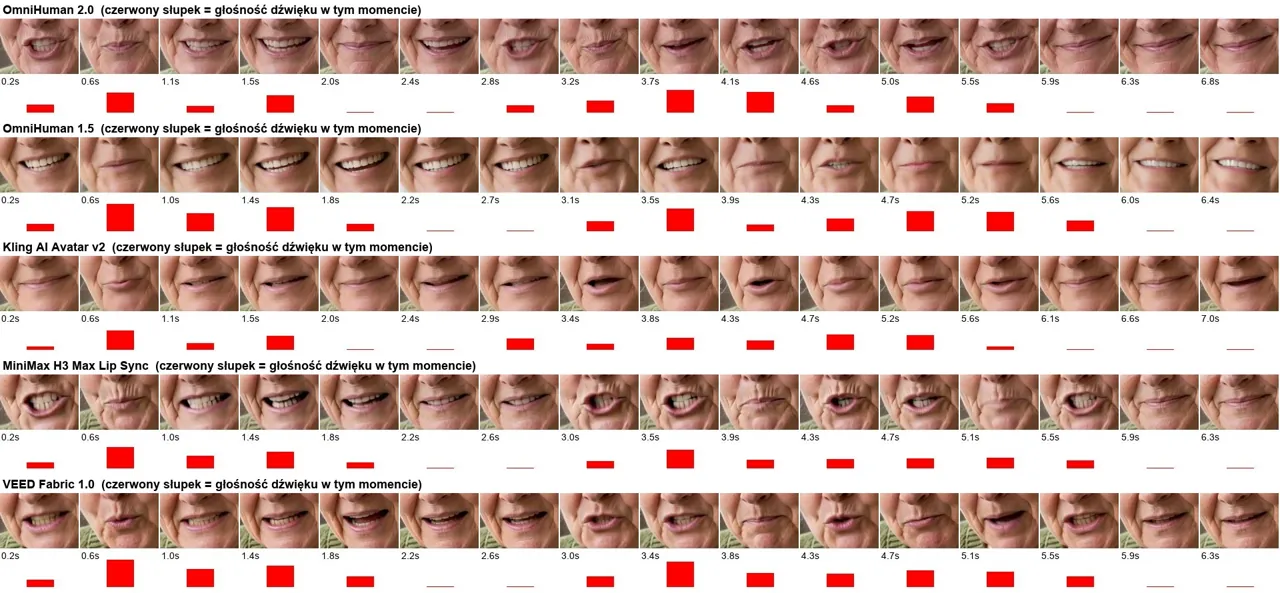
Benchmark Results: Testing 5 Lip Sync AI Models
The input for every model was identical: a portrait of a 62-year-old woman generated in FLUX 3 Image (not a real human) and a 6.5-second TTS audio clip in Polish: “Dzien dobry, jestem Halina. Dzis pokazeg wam pierogi ruskie mojej babci.” I used no extra text prompts, left all settings at default, selected the lowest resolution where choices were offered, and executed everything via the fal.ai API. More of my independent benchmark runs across image and video models are collected in the Quantslant Lab.
| Model | Score | Render Time | Clip Cost |
|---|---|---|---|
| OmniHuman 2.0 | 8.5 | 2.5-3 min* | $0.74 |
| MiniMax H3 Max Lip Sync | 8.5 | 12 s | $0.35 |
| VEED Fabric 1.0 | 7.0 | 22 s | $0.56 |
| OmniHuman 1.5 | 6.5 | 3.5 min | $1.12 |
| Kling AI Avatar v2 Standard | 6.0 | 5 min | $0.40 |
* Typical generation time for OmniHuman 2.0 across five test clips. This specific clip sat in the fal queue for over 20 minutes.
Scoring runs from 0 to 10: whether the mouth opens accurately on spoken syllables and firmly closes during pauses, whether lip or tooth artifacts appear, and whether facial expressions and head movements feel natural. A second test portrait (a young man in a tracksuit reciting the Polish tongue twister “W Szczebrzeszynie chrzaszcz brzmi w trzcinie”) yielded a similar ranking: OmniHuman 2.0 scored 8.5, H3 scored 8.5, and Kling scored 6.5.
Side-by-Side Video Clips
Key Findings from the Test
- OmniHuman 2.0 is a substantial leap over 1.5: Much tighter synchronization during silent breaks, plus a one-third price reduction on fal ($0.105 versus $0.16 per second).
- H3 Max Lip Sync delivers the best speed, price, and quality ratio: 12 seconds render time at $0.05 per second in 480P. Note that H3 Max is a variant post-trained by fal, not MiniMax’s base release. Its drawback is forced cropping: it turned my 3:2 portrait into a tight 4:3 framing and magnified the face.
- Kling AI Avatar v2 preserves the face and background without distortion, but its lip amplitude is too muted to make spoken Polish look believable.
- Non-English speech caused no failures: Every model accepted the Polish speech track and animated mouth movements to the audio cadence. The differences came down to physical precision, not language barriers.
OmniHuman 2.0 Deep Dive: 5 Characters Tested
BytePlus launched OmniHuman 2.0 (developed by ByteDance) on 15 October 2026, alongside its availability on fal. BytePlus claims the model aligns mouth movement, body language, and emotion with the rhythm and meaning of audio, supporting speech, singing, and dialogue. Single takes can scale up to five minutes. I tested OmniHuman 2.0 across five different AI-generated faces with varied Polish sentences to test phonetic boundaries (“szcz”, “chrz”, “zdzbla”, “gzegzolka”).
| Character | Spoken Line | Score | Cost |
|---|---|---|---|
| Woman 62 yo | “Dzis pokaze wam pierogi ruskie…” | 8.5 | $0.74 |
| Man in tracksuit | “W Szczebrzeszynie chrzaszcz brzmi w trzcinie.” | 8.5 | $0.66 |
| Studio presenter | “Na drogach slisko, a w Tatrach spadl pierwszy snieg.” | 8.5 | $0.69 |
| Farmer by barn | “Zdzbla wysokie, ziarno ciezkie.” | 8.0 | $0.79 |
| 3D cartoon fox | “Gzegzolka, zrebie i zaba to moi przyjaciele!” | 8.5 | $0.73 |
The average score across the five runs was 8.4/10, totaling $3.61. Lips close reliably during pauses, and characters come to a calm rest with a slight smile once the audio ends. However, render queues on fal can take 2.5 to 3 minutes, with occasional spikes over 20 minutes.
Which Lip Sync AI Should You Choose?
- For natural movement and longer speech takes (up to 5 minutes): OmniHuman 2.0 is the top choice if you want organic head motion and clean pauses.
- For fast turnarounds, cheap renders, and tight facial close-ups: MiniMax H3 Max Lip Sync via fal API is unmatched in raw render speed (12 seconds) at $0.05/s.
- Looking for end-to-end video generators that output native speech directly: Check my comparisons in the AI Video Arena.
- Full catalog overview: You can inspect the entire testing batch in my roundup of new models on fal.ai (October 2026).
How I Tested
- Conducted on 20 October 2026 via the fal.ai API using single-attempt runs per model.
- All portrait source files were generated with AI (FLUX 3 Image); no real human photos were animated.
- Audio clips were generated via Polish TTS (6.5 to 7 seconds).
- Scoring examined both full-motion clips and a 16-frame breakdown of the mouth aligned with audio amplitude extracted via MediaPipe.
- Total benchmark cost: $3.61 (OmniHuman 2.0 character series) + $3.10 (comparison set across the other 4 models).
Frequently Asked Questions
Which lip sync AI handled Polish best?
In my test, OmniHuman 2.0 and MiniMax H3 Max Lip Sync tied for first place at 8.5/10. All five models ingested the audio without technical errors.
How much does one minute of talking photo AI cost?
On fal.ai: H3 Max Lip Sync costs $3.00 (480P), Kling AI Avatar v2 Standard is $3.37, VEED Fabric is $4.80 (480p), OmniHuman 2.0 is $6.30, and OmniHuman 1.5 costs $9.60. Directly through BytePlus, OmniHuman 2.0 is listed at $0.07 per second ($4.20 per minute), with avatar lip sync entries also showing a $0.12 per second tier.
Can you animate a photograph of a real person?
Legally and ethically, only with that person’s explicit consent and clear synthetic media disclosure. I used exclusively synthetic AI portraits for all my benchmarks.
Google · Your sourcesQuantslant higher in your Google - one clickAdd to preferred sources →Sources
- Author benchmark: 11 lip sync test clips via fal.ai API on 20 October 2026.
- fal.ai model documentation and API pricing: OmniHuman v2, OmniHuman 1.5, Kling AI Avatar v2 Standard, H3 Max Lip Sync, VEED Fabric 1.0 (accessed 20 October 2026).
- BytePlus official announcement on OmniHuman 2.0 launch (15 October 2026).
- BytePlus OmniHuman product specifications and pricing sheet (checked October 2026).
- BytePlus Vision OmniHuman 2.0 API documentation (updated 15 October 2026).
More on this from QUANTSLANT

 guides·Why Available Balance Does Not Mean a Deposited Check Has Cleared