AI Detector: How It Works, Why It Fails, and What to Do
AI detectors claim to spot machine-written text, but they rely on statistics, not proof. Here's how they work, why they flag human writing, and how to respond.

👁 115 reads
Looking for a tool? Our free AI writing detector checks text paragraph by paragraph and shows specific signals instead of a single percentage. This article explains how such tools work and why you should never trust them unconditionally.
An AI detector is a tool that gives you a percentage labeled “written by artificial intelligence” after you paste in text. It sounds like a measurement, but it’s actually a probability estimate based on language statistics. This difference matters because today, such percentages determine grades in schools, publication decisions, and freelance assignments. Below: how detectors really work, why they make mistakes in both directions, what to do when one wrongly flags your text, and when they’re worth using at all.
What AI detectors actually measure
Detectors don’t “see” who wrote the text. They measure two characteristics. Perplexity: a language model checks how predictable each next word is compared to what it would expect. Text from a model is on average more predictable than human text, because the model chooses words with the highest probability. Burstiness: humans mix long sentences with short, clipped ones; models maintain an even rhythm. On top of that come surface signals: overused phrases, symmetrical three-item lists, absence of typos, and lack of concrete details.
All these characteristics are statistical, not definitive. That’s why a responsible detector gives a range, not a verdict, and why none should be the sole evidence against a student or employee.
Four situations where detectors get it wrong
Simple, formulaic text. An instruction manual, terms of service, press release, or essay following a rigid template have low variability by nature. The detector will flag “AI” even though a human wrote them.
Translated text. Machine-translated and then edited text has statistics similar to generated text. This is one of the most common causes of false positives for people who write in English and translate to other languages.
Text by language learners. Simpler vocabulary and repetitive syntax are exactly the features detectors read as machine-generated. This is a known ethical problem with such tools.
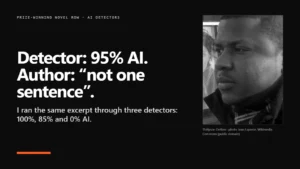
Model text that’s been rewritten. Just ask the model to “write unevenly, add a digression” or rearrange sentences yourself, and the score drops. Anyone who wants to fool a detector can do it in minutes, while someone writing honestly has no way to prove their case.
For texts in non-English languages, there’s another issue: most detectors were trained primarily on English. In practice, their readings on short non-English fragments are noticeably less stable - the same sentence can get different scores in two tools. This is an observation from editorial work, not a measured result with a sample and methodology.
What to do when a detector flags your text
- Show process, not product. Edit history in Google Docs or Word, notes, rough drafts, photos of handwritten pages. This is the only evidence a detector can’t undermine.
- Ask for a second tool. If two independent detectors give contradictory results, the result itself loses evidentiary value.
- Ask for a conversation about content. Someone who wrote the text can explain every thesis and cite sources. Someone who pasted it usually can’t.
- Ask about the rules. In school and university, what counts is what’s in the academic regulations or statute, not a tool’s reading. Formally, an accusation must be proven, not made probable.
More about how this looks from the school’s side is in the article whether teachers can detect ChatGPT, and about writing papers with AI without getting caught in AI for writing papers.
When detectors make sense
They make sense as an initial filter for large volumes of text: you order a hundred product descriptions and want to know which ones to check more carefully. They make sense as a signal for the author: if your own text gets a high score, it often means it’s boring and predictable, regardless of who wrote it. They don’t make sense as proof or as the basis for evaluating an individual person.
What to look for in a tool
A good tool gives a confidence interval instead of a single number, highlights fragments instead of rating the whole with one percentage, states plainly which languages it was trained on, and doesn’t promise 100% accuracy. A promise of “we detect AI with 99% accuracy” is itself a warning, because with an inherently probabilistic task, such a figure can’t be maintained on texts outside the test set.
See also: Pangram: a detector that shows fragments
Google · Your sourcesQuantslant higher in your Google - one clickAdd to preferred sources →Common questions
Are there AI detectors for languages other than English?
There are several interfaces in various languages, but what matters isn’t the language of the buttons, but the language the model was trained on. Before using one, check whether the tool declares support for your language, and test it on your own old text from before the chatbot era.
Can ChatGPT tell if text was written by AI?
No. Pasting text into a chat with the question “is this AI” produces a made-up answer, because the model doesn’t have access to statistics of its own generation after the fact. This is the worst possible way to check.
Can you fool a detector?
Yes, and easily: rewriting in your own words, interjections, uneven sentence length, and concrete life details lower the score. This is the main argument against treating detectors as proof.
Does Google penalize AI-written text?
Google states that it evaluates quality and usefulness, not how the text was created. What’s penalized is mass production of worthless pages, regardless of the tool.
This article describes how detectors work and editorial practice as of September 2026. I deliberately don’t give accuracy percentages for specific tools, because a proper measurement requires your own test set with labels, and I haven’t done that. All comparative assessments are my opinion.
More on this from QUANTSLANT
 magazine·OpenAI: What It Is, Who Runs It, and What It SellsOpenAI created ChatGPT and the GPT models. Here's who founded it, what it offers, where its money comes from, and the controversies surrounding it.