Liquid AI d1-ultra: Decision Index Leader and Test Results
Liquid AI's d1-ultra leads the Artificial Analysis Decision Index with 65.2 points. Here are its benchmarks, API pricing and results from our Polish-language test.
👁 113 reads
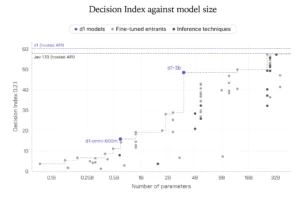
Liquid AI released d1-ultra on October 15, a decision model that selects an answer from a list and assigns a probability to each option rather than writing text. It scores 65.2 in Artificial Analysis’s Decision Index, making it the new leader among decision models, well ahead of TypeSafe’s Jev 1.13 at 57.5. I checked the AA leaderboard, the manufacturer’s website, pricing and whether the model worked from Poland. On October 19, I also ran it through my set of Polish-language customer-service requests.
At a glance (October 19, 2026)
- Decision Index (AA): d1-ultra 65.2, Jev 1.13 57.5, Jev 1.14 57.1.
- AA reports a cost of $31.8 per million tasks and 93 ms per task.
- API only: Liquid, OpenRouter and Vercel. Downloadable weights are not available.
- Price: $0.042 per million input tokens; output is free.
- My October 19 test through OpenRouter: department classification 44 out of 47, urgency 43 out of 50, tool decisions 10 out of 10.
What is d1-ultra?
d1-ultra is Liquid AI’s largest decision model. It can process text, images or both together, and answer three types of questions: yes or no, choosing from a list, and rating on a scale. The manufacturer highlights use cases such as detecting a defect in a circuit-board photo or reviewing a customer claim with an attached image. The context window is 32,768 tokens.
Liquid says the model is based on a larger open model with its own modifications, but does not identify the base model or disclose the number of parameters. d1-ultra itself is available only through an API. Only smaller models in the family, d1-3B and d1-omni-600M, have open weights, under the LFM Open License. I covered the earlier, smaller d1 model when the d1 series launched.
d1-ultra’s Decision Index score
| Model | AA Index | Cost per 1 million tasks | Time per task |
|---|---|---|---|
| d1-ultra (Liquid AI) | 65.2 | $31.8 | 93 ms |
| Jev 1.13 (TypeSafe) | 57.5 | $41.5 | 127 ms |
| Jev 1.14 (TypeSafe) | 57.1 | $41.5 | 78 ms |
| GLiDE (Fastino) | 53.9 | $119.0 | 217 ms |
| Microsoft-Decision-1 | 53.8 | $30.7 | 207 ms |
Its lead comes mainly from three of the index’s four tests. d1-ultra has the best scores among decision models in these areas:
- When2Call (whether to answer, call a tool, ask a follow-up question or refuse): 92.6, versus 83.7 for the previous leaders, Celeris-1 Decision and GLiDE.
- WildGuardTest (harmful requests and responses): 95.4, versus 95.1 for GLiDE.
- Admitting uncertainty on knowledge questions: 84.5, versus 39.8 for Microsoft-Decision-1.
It is weaker on general knowledge and reasoning. Its accuracy on knowledge questions is 31.6 (the best d1 score is 41.0), and it scores 15.0 on HLE-MultiChoice (Jev 1.13 scores 20.9). General-purpose language models still score higher in this index: Claude Haiku 5.5 in Max mode scores 68.4, but costs about $2,073 per million tasks. Liquid also says d1-ultra beat Jev 1.14 in all 112 evaluations it ran. That is the manufacturer’s result and has not yet been independently replicated.
In the other decision-model leaderboard, JevBench, d1-ultra scores 80.5 in Capability Score and ranks second among API services, behind kettei-fat at 86.3. The open Polish model basal-omni-1.0-ultra scores 82.5 there, but was not measured in the Decision Index, so the two models cannot be compared in one AA table.
Pricing and availability
- Pricing: $0.042 per million input tokens. Output is free because the model does not generate tokens. Liquid counts a 1024 x 1024 px image as 1,536 tokens.
- Where to access it: Liquid’s API (console.liquid.ai), OpenRouter as
liquid/d1-ultrausing the same/v1/systemoneformat as other decision models, and Vercel AI Gateway. - Access from Poland: It worked through OpenRouter without a separate Liquid account when I checked on October 19, 2026. Check with the provider for availability in your country.
My Polish-language test
I used the same set as for the launch of the leaderboard: 50 customer-service requests for department and urgency classification, plus 10 tool-use decisions. I set the answer key on October 13. The test was conducted in Polish; the examples and results below describe that Polish-language test, not a new English-language test.
- Department: 44 out of 47, matching the best decision models on October 13 (Microsoft-Decision-1, Decider, Mercury and Clef). Jev 1.13 scored 41, and basal-omni-1.0-mini scored 42.
- Confidence: At a confidence threshold of 0.9, it got 40 out of 42 right.
- Urgency: 43 out of 50. At a threshold of 0.5, it incorrectly marked 7 cases that could wait as urgent, so you should set a higher threshold using your own data.
- Tool decisions: 10 out of 10.
- Time and cost: Median latency was 351 ms from Poland, including network time. The full test cost $0.00075, or about $12.5 per million tasks of this kind.
I have collected the decision models, both leaderboards and my tests in the AI decision models guide.
Sources
- Liquid AI: d1-ultra, Introducing the World’s Best Decision Model (October 15, 2026)
- Liquid AI: decision model documentation
- Artificial Analysis: Decision Index (checked October 19, 2026)
- OpenRouter: liquid/d1-ultra pricing and context (October 19, 2026)
- Benchmark Heaven: JevBench API services leaderboard (October 19, 2026)
- My test: 50 customer-service requests and 10 tool decisions through OpenRouter, October 19, 2026

More on this from QUANTSLANT


 ai tools·Claude API: Pricing, API Keys and Your First RequestLearn how to get a Claude API key, understand model pricing, reduce costs with prompt caching and batch processing, and send your first request.