Genie 4 Prompts: A Framework and 8 Ready-to-Use Examples
Learn the prompt patterns in Google DeepMind’s Genie 4 examples, with a seven-part framework and eight prompts to try when the model becomes available.
👁 113 reads
Google DeepMind’s Genie 4 is not yet publicly available, but DeepMind has published more than a dozen complete prompts for it, along with an official prompt-writing guide for Project Genie. I broke the examples down into a framework. At the end, you’ll find eight ready-to-use prompts in English for the day Genie 4 becomes available in Project Genie.
A caveat: I haven’t tested these prompts on Genie 4 because I don’t have access yet. Everything below is based on DeepMind’s official examples and Google’s guide. For an overview of the model, see the Genie 4: What It Is and How It Works hub.
Two prompt styles in the official examples
Genie 4 demos show two styles.
Style 1: environment and character. This is how Project Genie works. One field describes the world (Environment), while another describes the character you control (Character). The character doesn’t have to be human. Official examples include an empty wooden boat on a pond, a watermelon on a pedestal, a pink satin ribbon and a view from a hot-air balloon basket.
Style 2: one long director-style description. These are paragraphs written like a screenplay: visual style, setting, camera, movement, sound and a list of restrictions. The most striking demos use this format, including a dragon race, a stained-glass world and a saxophonist on a lake.
A seven-part framework for Genie 4 prompts
| Block | What to include | Example from DeepMind prompts |
|---|---|---|
| 1. Visual style | Genre and medium | “16 mm documentary footage,” “1995 Hong Kong indie cinema, 35 mm” |
| 2. Setting | Terrain, surface and what appears in the frame | “A pond with lily pads and pink flowers, viewed directly from above” |
| 3. Character | Who or what it is, what it looks like and how it moves | “An empty wooden boat with three benches, stationary” |
| 4. Camera | First- or third-person view, and what the camera is attached to | “The camera is the rider’s eyes; never show the rider” |
| 5. World behavior | Wind, water, tracks and reactions | “The fabric ripples and lifts as wind gets underneath its folds” |
| 6. Sound | A separate “Audio:” line | “Wingbeats, gusts of wind, a volcano rumbling” |
| 7. Restrictions | What must not appear | “No CGI, no video-game look, no over-the-shoulder view” |
Advice from Google’s official prompt guide
The Project Genie prompt guide was created for Genie 3, but Genie 4 is also expected to come to the same app. Here are the main recommendations:
- Environment: Name the terrain (forest, city, mountains) and surface (dirt road, asphalt, calm ocean). Specify the style (realistic, game-like, cartoon). List important objects, such as temple ruins in the distance or a volcano on the horizon. Describe how the world behaves: whether the wind is blowing and whether the road gets dusty underfoot.
- Character: Say who or what the character is and what it looks like. Describe its movement: flying, moving forward and backward, jumping. Explain how it changes the world, such as leaving tire tracks or a lawn mower cutting the grass.
- Language: Use short declarative sentences. Video-game vocabulary can help describe how to control a character.
- Mood: Use sensory details, such as gloom and smoke near the ground or a step as light as a feather.
- Image: Upload a high-quality image with the character in the center of the frame.
- Preview: For a text-only prompt, Project Genie first creates a preview image in Nano Banana Pro. Refine it before entering the world.
- Gemini as an editor: Google itself recommends expanding your prompt in the Gemini app.
What DeepMind’s longer prompts can teach you
I read all the long prompts on the Genie 4 blog. Four techniques recur.
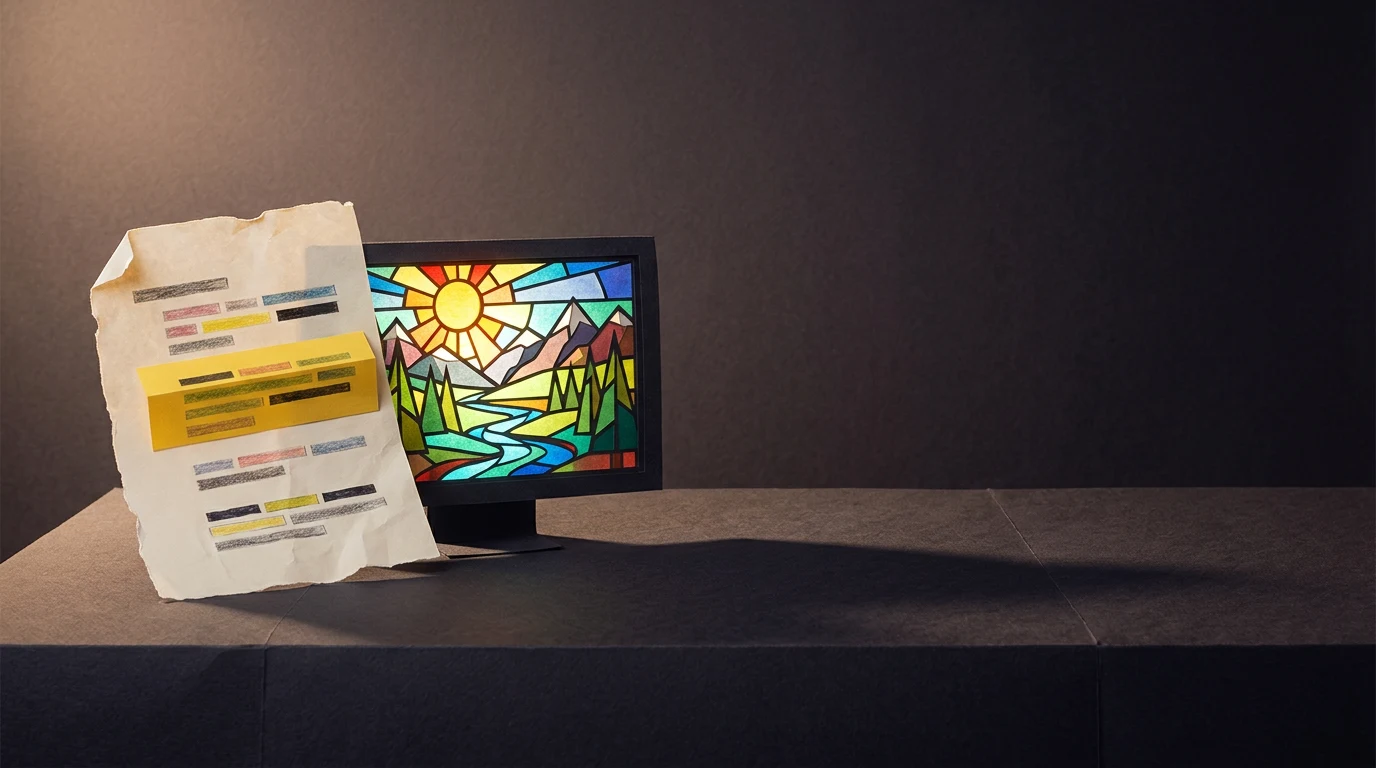
Repeat the most important rule. In the stained-glass world prompt, the sentence “Everything must be made of glass” appears three times, followed by a list: grass, water, sky, clouds, flowers, trees, mountains and sun. A world model generates frames in real time, so it can easily “drift” toward realism. The prompt closes that loophole several times.
Use numbers instead of adjectives. “Exactly two axolotls, no more,” “140 km/h” and “the 1980s.” A number gives the model a firmer anchor than a word like “several.”
Describe the camera as if writing a contract. In the dragon prompt, more than half the text is about the camera itself: where it is, what appears at the bottom of the frame and what must not be shown. This is where things can go wrong most easily in first-person mode.
Put sound on a separate line. Genie 4 generates audio, so the demos have a separate “Audio:” or “Audio description:” line naming specific sound sources. The saxophonist prompt even includes a restriction: “No music beyond the instruments present in the scene.”
In-world commands: controlling a live world
A new feature in Genie 4 is the ability to enter commands while a world is already running. DeepMind lists changes in weather, camera movement and the introduction of a new person or object. Gemini adapts the command to the scene, so short instructions should be enough. Here are examples I plan to try first:
- Start a heavy rain.
- A dog runs into the scene from the left.
- Move the camera high above the street.
- The man turns to me and asks for directions. (A dialogue test.)
- Night falls, street lamps turn on.
DeepMind warns that after several complex changes, the world may start to drift. It’s better to issue commands one at a time and wait for the result.
8 Genie 4 prompts you can try
These prompts are written in English because all the official examples are in English. I’ll check the Polish-language version after launch.
1. A village street after rain (environment and character)
Environment: A Polish village street after summer rain, wet cobblestones, wooden fences, a small chapel, puddles reflecting grey clouds. Documentary realism, natural colors. Character: First-person view of a person riding an old bicycle; tires splash water from the puddles. Audio: dripping water, distant church bell, bicycle chain.
Suggested prompt; not tested. It is intended to explore atmosphere and water under the wheels.
2. A tram at night (the character is a vehicle)
Environment: A city at night, old tenement buildings, wet asphalt, neon shop signs, light fog. Character: A yellow tram moving forward and backward along the tracks, sparks under the pantograph. Third-person camera behind the tram. Audio: tram bell, rain on metal.
3. Kayaking down a river (water physics)
Environment: A narrow forest river with fallen trees, clear water, sun rays through the leaves. Character: First-person view from a kayak, the paddle visible at the bottom edge of the frame, water drips from the paddle. Audio: paddle strokes, birds, flowing water.
4. Film-scene previsualization (director-style prompt)
Cinematic 35mm film. A small kitchen in a 1990s apartment block at dawn. A woman in a grey coat stands by the window holding a letter. Handheld camera slowly circles her. Muted colors, soft window light, fine grain. One continuous shot. Audio: a ticking clock, a kettle starting to whistle. No text, no music.
Try several takes of the same scene with different lighting and camera work, as video testers often do.
5. A game-level prototype
Environment: A floating island level made of mossy stone platforms over clouds, game-like stylized look, collectible glowing coins on the path. Character: A small fox in a red scarf that can run, jump and glide. Third-person camera.
6. An archival photo as a world (image-based)
Use the reference image as the exact first frame. Preserve the buildings, the people and the clothing of the era. Black-and-white documentary footage, natural film grain. The camera can walk slowly along the street. People continue their activities naturally. Audio: street ambience of the era, footsteps, distant voices.
Upload an old photo of your hometown. Keep in mind that DeepMind warns that real places may not be reproduced accurately.
7. Object physics (short prompt)
A macro close-up of a raindrop hitting a spider web on a garden fence at sunrise.
One sentence, like the official maple seed prompt. A short prompt can show how much the model fills in on its own.
8. Dialogue with a character
Environment: A busy market hall with fruit stalls and warm light. Character: First-person view of a customer. A friendly fruit seller in an apron greets me and answers my questions about the apples. Audio: market chatter, the seller's voice clearly audible.
A test of the biggest new feature: character speech in real time.
Common issues to watch for
- Too much at once. According to DeepMind, several characters each performing their own actions remain a weak point.
- Text in the world. If you want a sign with specific wording, include the wording in the prompt. Otherwise, the model is more likely to produce garbled text.
- A specific street. Naming a particular street in Kraków won’t produce an accurate copy. Describe the atmosphere of a place, not its address.
- Long sessions. The model holds together for a few minutes. Capture important shots early.
I’ve covered a similar approach to video prompting in my Veo guide and AI video arena test. Separating the environment from the action can also work with standard video generators.
Google · Your sourcesQuantslant higher in your Google - one clickAdd to preferred sources →Sources
- Google DeepMind: Genie 4, example prompts, October 27, 2026
- Google DeepMind: Genie 4 model page
- Google DeepMind: How to Create Effective Prompts with Genie
Last checked: October 28, 2026.



More on this from QUANTSLANT


 ai tools·Claude Design: Features, Pricing and How It WorksClaude Design turns chat prompts into prototypes, slides and website mockups. See how it works, what it costs, where it falls short and how to export projects.