I tested Kling 4.0 on 10 clips
Ten clips reveal strong Polish speech and useful character continuity, alongside an incomplete camera orbit and stubborn reference props.
👁 119 reads
I tested Kling 4.0 on 10 clips covering camera movement, Polish speech, lettering, water, character continuity, and reference-heavy scenes. As of October 21, 2026, the strongest results came from speech and simple character references, while precise camera instructions and unwanted props remained weak spots.
In short
- The 10 clips averaged 8.45/10 in this editorial assessment.
- All three Polish spoken passages were transcribed without word errors; English and French speech were not tested.
- The motorcycle orbit scored 7/10 because it covered roughly half the requested angle.
- Reference images preserved characters well, but also carried unwanted boxing gloves into new scenes.
What the test actually covered
I generated the clips manually in the kling.ai interface using Kling 4.0 and its Omni reference mode. Every clip used 720p. Most were landscape scenes; the coach-and-dachshund clip used a vertical frame. All human characters were fictional, so the continuity checks concern designed characters rather than likenesses of real people.
The set combines short technical challenges with a bakery sequence that increases the number of image references. It also includes a longer multi-shot scene and a vertical comedy clip. That makes it useful for spotting practical failures, but it is not a controlled benchmark with repeated runs for every condition. The scores are judgments about these particular outputs.
The ten generations used 585 credits in total. The observed 720p rate was 9 credits per second after the displayed discount. These figures describe this session, not a guaranteed price for every account or a dollar conversion. For the wider feature overview, see the Kling 4.0 hub.
The scorecard: all 10 clips
| Scene | Requested length | Score /10 | Main observation |
|---|---|---|---|
| Motorcycle orbit | 5 s | 7.0 | Smooth motion, incomplete orbit |
| Polish speech | 5 s | 9.5 | Accurate words and matching mouth movement |
| Chalk lettering | 5 s | 9.0 | Polish accents preserved |
| Overflowing water | 5 s | 8.0 | Correct sequence, abrupt puddle |
| Character after a cut | 5 s | 8.5 | Appearance stayed consistent |
| Baker, one reference | 5 s | 9.0 | Strong face and clothing match |
| Bakery, three references | 5 s | 8.5 | Recognizable cast, unwanted gloves |
| Bakery, ten references | 5 s | 8.0 | All elements present, weaker mustache |
| Multi-shot baker | 15 s | 8.5 | Requested cuts and coherent character |
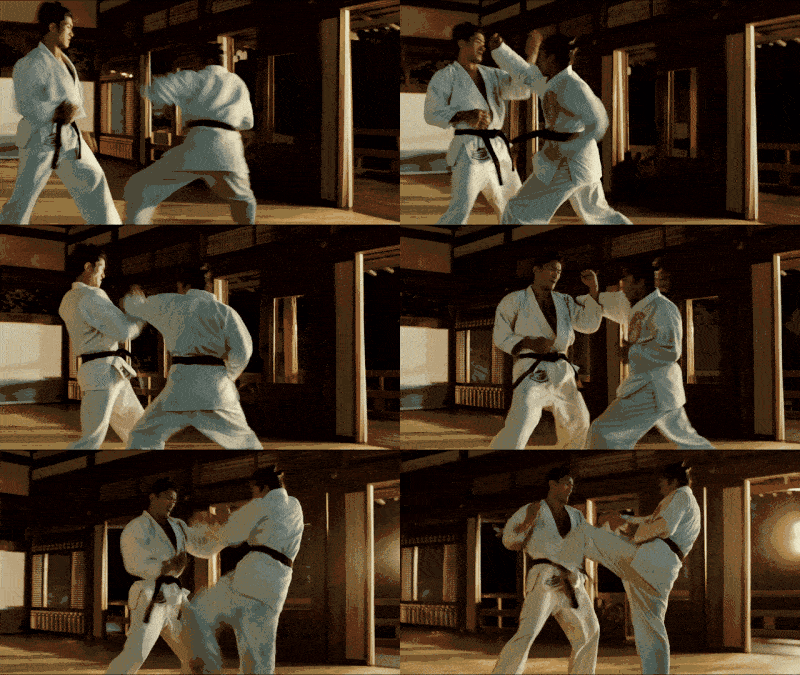
| Coach and dachshund | 10 s | 8.5 | Effective comedy, wrong hand equipment |
The average is encouraging, but the differences matter more than the headline number. A recognizable cast does not automatically mean every small facial feature survives. Likewise, attractive camera movement can still fail a precise framing instruction. Review the output against the brief before treating a high score as permission to use it.
Polish speech was the clearest surprise
The dedicated speech clip included a Polish tongue twister followed by a price. Whisper large-v3 recovered the intended words, with a word error rate of zero after normalizing the written number into words. The visual review also found mouth movement consistent with the speech. This is stronger evidence than merely hearing something that sounds approximately Polish.
The baker’s longer scene and the coach’s shouted instructions also produced accurate Polish transcripts. Across these three passages, the test therefore supports a narrow but useful conclusion: Kling 4.0 can deliver correct Polish speech in the situations tried here. It does not establish reliability across every sentence, speaker, or recording style.
For a creator working on multilingual content, that is a reason to run a language-specific pilot. It is not evidence that English or French dialogue passed this test, because neither was tested. Pronunciation, voice suitability, timing, and the actual wording should all be checked in the intended language before a clip reaches an audience.
The lettering result was another positive sign: the chalkboard rendered “ŻÓŁTA ŁÓDŹ” with its diacritics intact. Correct Polish text in one shot is useful evidence of character handling, although it cannot guarantee clean typography throughout a longer sequence or across every writing system.
Where motion and continuity held up
The motorcycle remained stable, without visible deformation, and its reflections looked sound. The weakness was instruction following: the requested orbit was 180 degrees, while the result covered approximately 90 degrees. That explains the 7/10 score. If the final edit needs a particular reveal, smooth movement alone will not satisfy the brief.
The water scene followed the expected sequence: pouring, bubbles, rising level, overflow, then a puddle. The puddle arrived rather suddenly near the end and looked slightly yellow. The result communicated the action, but the transition into the spill still deserved close inspection.
Character continuity was more convincing. After a hard cut, the short red hair, glasses, yellow jacket, and backpack remained consistent. The character was small in the wide shot, which limits how much facial detail that example can prove. In the longer baker clip, the requested kitchen, oven-detail, and counter shots appeared with cuts, although the mustache weakened in the opening shot.
What to change in a practical workflow
The recurring reference problem was unusually concrete: boxing gloves traveled with the coach even when the scene called for something else. They appeared in the bakery and replaced the intended training pads in the vertical clip. The image was influencing the action as well as the character’s appearance.
- Prepare character references without equipment that should disappear between scenes.
- Describe cuts explicitly with shot labels and “Hard cut” when the sequence requires them.
- Check small identity details after cuts, especially in crowded scenes.
- Review dialogue separately from image quality, in the language actually generated.
- Verify camera endpoints instead of judging only whether the movement looks smooth.
The interface allowed up to 10 image references and a duration range of 3-30 seconds. It offered 720p and 1080p, while 4K was marked “Coming Soon.” Only 720p was generated in this test. The observed concurrency limit was three jobs; adding more work required waiting for a slot rather than assuming an unlimited queue.
A sensible next step is a short scene with a clear acceptance criterion: correct words, a specific cut, or a recognizable character. Readers ready to reproduce that kind of check can use this referral link to Kling. The evidence here favors deliberate iteration over assuming that a detailed prompt controls every visible object.
FAQ
Did Kling 4.0 speak Polish correctly?
Yes, in all three Polish passages included in this test. The transcripts contained no word errors, with number normalization applied to the dedicated speech check. That remains a small sample.
Was English or French speech tested?
No. The multilingual takeaway is that Polish worked in these examples. English and French need their own checks, including listening by someone fluent in the target language.
Can Kling 4.0 make several shots in one clip?
Yes. The 15-second baker clip followed three described shots and cuts. In the tested interface, the instructions went into the prompt rather than a separate multi-shot switch.
Sources
- My own test in kling.ai, October 21, 2026: ten clips generated with Kling 4.0, scored by me; Polish speech transcribed with Whisper large-v3.
- Kling 4.0 release notes - official background; the interface observations above are dated October 21, 2026.


More on this from QUANTSLANT

 ai tools·DeepSeek V4.1 Flash 1017: API Pricing, Search API and My TestThe October checkpoint, official peak and off-peak prices, Search and Fetch billing, and a clearly scoped test in Polish.