MAGI-2 Preview: Sand.ai Open Video Model Benchmarks and Hardware Specs
Sand.ai released MAGI-2 Preview: an open-weights 114B MoE video generator with audio under Apache-2.0. Leaderboard rank, hardware demands, and pricing.
👁 124 reads
Regularly updated. Status as of October 11, 2026.
MAGI-2 Preview is an open-weights video generation model from Beijing-based Sand.ai: 114 billion parameters (with roughly 6B active per token), 10-second 1080p clips with synchronized audio, and an Apache-2.0 license. On the Artificial Analysis image-to-video leaderboard, it ranks 10th (1093 Elo points), making it the second highest-ranking public-weights model behind MiniMax H3. The catch: running it locally demands eight 80 GB NVIDIA Hopper GPUs, and no public API pricing is available yet.
Status as of October 11, 2026
- Release: August 5, 2026; see the Sand.ai technical report. Weights available on Hugging Face since August 3-5.
- State: “Preview.” The developers describe it as an intermediate research release. No new commits have been made to the code repository since August 6.
- Leaderboard: 10th place on AA-Video-I2V v1.0 (1093 Elo, 95% CI 1086-1100, 11,895 comparisons). On text-to-video, only the unreleased “0912” checkpoint is listed: 21st place, 960 Elo.
- License: Apache-2.0, permitting commercial use without territorial restrictions.
- Hardware: 8x Hopper GPUs (80 GB each), ~307 GB of model weights. Will not run on an RTX 4090 or standard consumer PCs.
- API: Artificial Analysis notes “Coming soon.” Unavailable on fal.ai, Replicate, WaveSpeedAI, or OpenRouter.
- Hands-on test: Not tested locally due to the 8x 80 GB GPU cluster requirement, and no live API pricing exists yet.
What is MAGI-2 and who is behind it?
Sand.ai is a Beijing-based AI startup founded by Yue Cao. Cao co-authored the Swin Transformer architecture (recipient of the Marr Prize), previously worked as a Principal Researcher at Microsoft Research Asia, and led a research lab at BAAI. The company has several notable releases:
- MAGI-1 (2025) - an autoregressive video model that generated video sequentially and supported infinite extension. It remains accessible via several third-party API providers.
- GAGA-1 - an audio-video model focused on talking avatars.
- VidMuse - an AI music video app; Sand.ai’s homepage claims it reached $10 million in annual recurring revenue (ARR) within two months.
- MAGI-2 Preview (August 5, 2026) - their latest open-weights foundation model.
Funding: according to 36kr (June 29, 2026), Sand.ai raised over $100 million across two rounds from investors including Matrix Partners China, Sinovation, IDG, and Baidu Ventures. On September 29, Wangsu Science & Technology announced the acquisition of a 4.4% stake for 300 million RMB, valuing the startup at roughly $1 billion. Regulatory filings from that deal revealed modest revenues alongside steep operating losses, as covered in Sand.ai valued at $1 billion.
Architecturally, MAGI-2 marks a major departure from MAGI-1. Instead of autoregressive chunking, it uses a single unified diffusion transformer operating across text, image, and audio in one sequence. Its high parameter count stems from a mixture-of-experts (MoE) design: 40 layers in total, including 36 sparse MoE layers with 12 routing heads each, where each head activates 6 out of 256 experts. This brings total parameters to 114 billion while routing only ~6 billion per token. Sand.ai explicitly labels this in its technical paper as an “intermediate research release.”
MAGI-2 Preview: The Open-Source 100B+ Ultra-Fine-Grained MoE Video Generation Model
- Sand.ai (@SandAI_HQ) August 14, 2026
Artificial Analysis leaderboard rankings
Artificial Analysis (AA) computes rankings using blind head-to-head human evaluations: evaluators choose the superior output between two models given the identical prompt. Checking both tables on October 11, 2026, MAGI-2 Preview ranks 10th in image-to-video with an Elo of 1093. Its 95% confidence interval (1086-1100) overlaps with Grok Imagine 1.5 and HappyHorse 1.0, effectively putting ranks 9 through 11 in a statistical tie. However, it trails the top of the table significantly: category leader MiniMax H3 Max sits 102 points ahead.
| I2V Rank | Model | Elo | 95% CI | USD / min (AA) | Open weights |
|---|---|---|---|---|---|
| 1 | MiniMax H3 Max | 1195 | 1186-1204 | 4.80 | No |
| 2 | MiniMax H3 | 1181 | 1173-1189 | 7.80 | Yes (excl. EU) |
| 7 | Wan 3.0 | 1164 | 1156-1172 | 12.00 | No |
| 8 | HappyHorse 1.1 | 1104 | 1097-1111 | 9.90 | No |
| 9 | Grok Imagine Video 1.5 | 1098 | 1090-1106 | 8.40 | No |
| 10 | MAGI-2 Preview | 1093 | 1086-1100 | N/A | Yes, Apache-2.0 |
| 11 | HappyHorse 1.0 | 1083 | 1076-1090 | 13.20 | No |
| 23 | LTX-2.5 Fast | 1038 | 1029-1047 | 7.80 | Yes |
Source data: AA-Video-I2V v1.0, recorded October 11, 2026. Open weights classification matches AA’s directory.
Chart scale starts at 1000 Elo (100% bar = 1200) to highlight differences.
The 0912 version on the Text-to-Video leaderboard
In the text-to-video rankings (AA-Video-T2V v2.0, evaluated at 1080p with audio, launched September 30), an entry titled “MAGI-2 Preview (0912)” appears with a September 12, 2026 date stamp. It sits at 21st place with 960 Elo (95% CI 950-970 across 3,674 comparisons). This is not a publicly downloadable checkpoint: AA provides no weight repository link, and the official GitHub repository has seen no code updates since August 6. It appears to be an unreleased checkpoint submitted directly to AA for evaluation. The publicly released August weights do not appear on the T2V v2.0 board.
MAGI-2 Preview technical specifications
| Feature | MAGI-2 Preview specification |
|---|---|
| Parameters | 114B total, ~6B active per token (MoE) |
| Architecture | Single-stream diffusion transformer, 40 layers (36 MoE + 4 dense), Top-6 out of 256 experts per head |
| Modes | Text-to-video (T2V) and Image-to-video (I2V, image conditioned as first frame) |
| Clip duration | 10 seconds - the only supported output length |
| Resolution | Two-stage pipeline: preview at 512 x 896, refiner up to 1088 x 1920, optional rescale to 1080 x 1920 |
| Audio | Native generation synchronized with visual frames (dialogue, sound effects, music); audio VAE derived from Stable Audio Open 1.0 |
| Prompt control | Structured timeline prompting (temporal segment ranges, timestamped audio events, dialogue scripts) |
| Inference steps | 100 preview diffusion steps + 5 refiner steps (undistilled base model) |
| Text encoder | Qwen3.5-27B |
| Video VAE | From Wan2.2-TI2V-5B, paired with a distilled turbo decoder |
| Framerate | Unspecified in README (config files specify 25 fps) |
Sources: GitHub README and Sand.ai research paper (verified October 11, 2026). MAGI-2 lacks the iterative video extension and “infinite duration” features found in MAGI-1.
Timeline prompting is the model’s most notable feature. Official examples format a 10-second clip into temporal segments (such as “00:00.0-00:05.0” and “00:05.0-00:10.0”), detailing camera motion, character behavior, timed audio cues, and dialogue lines inside each segment. Because the model was trained on long, structured descriptions, the README advises using an LLM to expand concise user prompts. Sample prompt setups from the repository are reviewed in MAGI-2 in practice: prompt examples.
Availability and pricing
Commercial accessibility remains MAGI-2’s biggest bottleneck. While the weights are fully open, no managed on-demand service with transparent retail pricing exists for general users. Status check as of October 11:
| Platform | MAGI-2 status | Pricing |
|---|---|---|
| Hugging Face (Weights) | Available | $0, but requires dedicated compute |
| platform.sand.ai (Sand.ai API) | Unconfirmed | Credit tiers locked behind login; documentation currently covers MAGI-1 endpoints |
| magi.sand.ai (Web App) | Unconfirmed | Subscription plans and free credits invisible without creating an account |
| Artificial Analysis | - | “API Pricing: Coming soon” |
| fal.ai | No | Hosts MAGI-1 extend-video: $0.80 for 4s + $0.20 per additional second |
| WaveSpeedAI | No | Hosts MAGI-1 24B: $0.08/s; daVinci-MagiHuman: $0.02-$0.06/s (256p-1080p) |
| Replicate, OpenRouter | No | - |
Sand.ai claims target generation costs will reach “1/10 the cost” of leading proprietary competitors, but provides no concrete per-second rate. A rumored cost of 0.5 RMB per clip originating from third-party blogs refers to a planned distilled variant, not the current release. Comparative generation rates across competing platforms are tracked in How much does AI video cost per second?.
Open weights: files and hardware requirements
The primary reason MAGI-2 has attracted developer interest is its licensing. The full checkpoint weights reside on Hugging Face under Apache-2.0: free to download, fine-tune, modify, and deploy commercially without revenue thresholds or geographic exclusions. By comparison, MiniMax H3’s open license excludes the European Union, and LTX-2.5 requires commercial licensing once annual revenues hit $10 million.
| Directory | Size | Contents |
|---|---|---|
| preview | 228 GB | Preview stage transformer (56 safetensors files) |
| text_encoder | 56 GB | Qwen3.5-27B text encoder weights |
| refiner | 14 GB | 1088×1920 refiner transformer |
| stable-audio-open-1.0 | 5 GB | Audio VAE checkpoint |
| vae | 3 GB | Wan2.2 video VAE |
| turbo_vae | 2 GB | Distilled turbo decoder (default) |
| Total | ~307 GB |
Official README requirements:
- 8x NVIDIA Hopper GPUs (H100 or H200 with 80 GB VRAM). The README notes that at 1080p, neither the preview transformer nor the refiner can co-exist on a single 80 GB card alongside the other’s activations, requiring staging between steps.
- Python 3.12, recent CUDA drivers, and ffmpeg (mandatory; video outputs render silent if omitted).
- Docker image:
sandai/magi-2-preview- ~12.7 GB uncompressed on Docker Hub (tagged August 5). - Offload profiles: Encoder, preview, refiner, and VAE components support
cpu,gpu, androundtripoffloading.
What is missing from the repository:
- Distilled checkpoints - still flagged as “Coming soon” in the README, intended to cut diffusion step requirements.
- Official quantizations (no FP8 or GGUF builds provided).
- ComfyUI nodes - ComfyUI Wiki noted their absence on August 5, and the official repo still contains no workflow wrappers.
Compute time and generation costs: Sand.ai provides no official benchmark times. Independent analysis from mushroom.cv (August 7, 2026) estimates 15 to 30 minutes of generation time per 10-second clip on an 8x H100 cluster, working out to roughly $25 to $42 per clip when renting AWS p5 instances. By comparison, running MiniMax H3 Max via commercial API costs $4.80 per minute of finished footage ($0.80 per 10s clip).
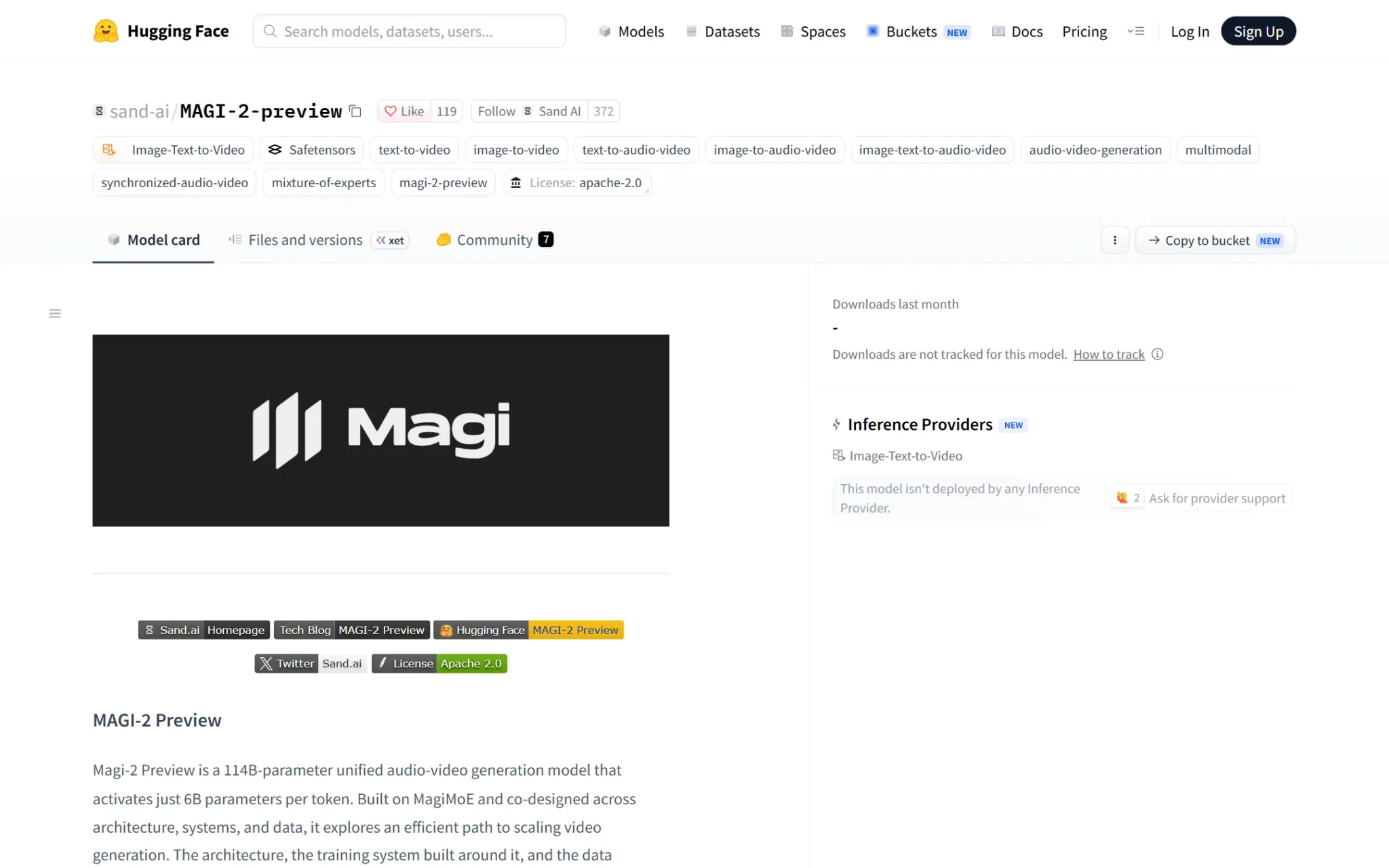
MAGI-2 cannot run on an RTX 4090 or standard home workstations. The base preview transformer alone requires 228 GB of disk and far exceeds 24 GB of VRAM; consumer multi-GPU setups will not bridge the gap. Exercise caution when browsing Hugging Face and GitHub: third-party repositories mimicking MAGI-2 have appeared, but the only official trees are SandAI-org/MAGI-2-preview and sand-ai/MAGI-2-preview.
Consumer alternatives: If you operate a single 24 GB GPU, Wan 2.2 is a practical local alternative. The TI2V-5B model (Apache-2.0) generates 720p footage at 24 fps on an RTX 4090, completing a 5-second video in under 9 minutes. LTX-2.5 provides official ComfyUI workflows, INT8 and NVFP4 checkpoints, and FP8 modes with CPU offloading for lower VRAM thresholds. For an overview of models suitable for consumer hardware, see Running AI locally.
How to run MAGI-2: step-by-step setup
Without an open API endpoint, deploying MAGI-2 requires provisioning an 8x Hopper node. The steps below reflect the official setup instructions documented in the project README:
- Provision infrastructure: Rent a node equipped with 8x NVIDIA H100 or H200 (80 GB) GPUs and sufficient NVMe storage to hold the ~307 GB weights plus Docker container.
- Download checkpoints: Clone files into a local
ckpt/directory using the Hugging Face CLI:pip install huggingface_hubfollowed byhf download sand-ai/MAGI-2-preview --local-dir ckpt. Directory paths map automatically to the default configs. To store weights elsewhere, specify theMAGI2_CKPT_ROOTenvironment variable. - Launch Docker: Pull the container via
docker pull sandai/magi-2-preview:latest, then rundocker run --gpus all -it -v /path/to/ckpt:/workspace/ckpt sandai/magi-2-preview:latest. Pinning a specific release tag is recommended overlatestto avoid upstream pipeline shifts. - Run the reference demo: Execute
bash scripts/run_demo.shto render a 1080p test video at seed 42 using the reference prompts inassets/demo_samples.json. Output renders tosample_000.mp4. - Run custom inference: Generate outputs via
torchrun --nproc_per_node=8 inference/pipeline/entry.py --prompt "a red fox in snow" --output output/. For image-to-video, append--image; for exact aspect adjustments, pass--output-widthand--output-height. - Prompt enhancement (optional): Configure
inference/prompt_enhancement/enhancer.pyby supplying anAPI_KEYfor an OpenAI-compatible endpoint. Leaving this unconfigured passes your raw prompt directly to the encoder.
While native bare-metal installation is possible (pip install -r requirements.txt alongside custom builds for MagiAttention and MagiCompiler), using the preconfigured Docker image avoids dependency compilation issues.
Model comparison: open-weights vs. proprietary leaders
| Model | I2V Elo | T2V Elo | AA USD / min (I2V / T2V) | Weights |
|---|---|---|---|---|
| MAGI-2 Preview | 1093 | 960 (0912 only) | Unlisted | Open (Apache-2.0) |
| Wan 3.0 | 1164 | 1156 | $12.00 / $12.00 | Proprietary (Wan 2.2 is open) |
| MiniMax H3 | 1181 | 1137 (768p) | $7.80 / $4.80 | Open weights, restricted license (excludes EU, US, UK, KR) |
| LTX-2.5 Fast | 1038 | 946 | $7.80 / $7.80 | Open weights (LTX-2.x Community License) |
| HappyHorse 1.1 | 1104 | 1042 | $9.90 / $10.80 | Proprietary |
| Grok Imagine Video 1.5 | 1098 | 1045 | $8.40 / $15.00 | Proprietary |
Elo ratings and API pricing reflect AA leaderboards on October 11, 2026. Licensing terms verified via Hugging Face. For an in-depth hardware and architecture breakdown, see MAGI-2 vs. Wan vs. LTX-2.5 vs. MiniMax H3.
Summary: In visual fidelity, MAGI-2 Preview performs on par with mid-tier proprietary models like Grok Imagine 1.5 and HappyHorse while decisively outperforming LTX-2.5. It lags MiniMax H3 by 88 Elo points; however, MiniMax H3’s custom license restricts commercial use in jurisdictions such as the EU, US, and UK, whereas MAGI-2 provides unrestricted global Apache-2.0 licensing.
Who should consider MAGI-2?
- AI research labs: Teams with dedicated multi-node H100 clusters looking to explore large-scale MoE architectures for video and native audio diffusion.
- Enterprise teams with strict on-premises requirements: Organizations subject to data privacy or legal constraints that mandate self-hosted pipelines under an Apache-2.0 license.
- Studios building proprietary fine-tunes: Studios seeking a base foundation model to adapt to custom cinematic styles without royalty obligations.
- Not suited for solo creators on desktop hardware: The model cannot run on consumer GPUs, and no cost-effective API exists yet. Cloud APIs like MiniMax H3 Max or self-hosting Wan 2.2 are practical alternatives.
- Not suited for high-volume production: At an estimated compute cost of $25-$42 per clip on rented nodes, commercial video generation APIs remain significantly cheaper.
For a broader market overview, consult Which AI video generator should you choose? and our AI video generator rankings.
Frequently asked questions
Is MAGI-2 free to use?
The model weights and code are free under the Apache-2.0 license. However, operational costs are substantial: you must provision a cluster of eight 80 GB Hopper GPUs. No turnkey free web demo is currently available.
Can I run MAGI-2 on an NVIDIA RTX 4090?
No. The preview model files alone consume 228 GB, and full execution requires roughly 307 GB across an 8x Hopper GPU node. No official distilled or quantized versions (such as FP8 or GGUF) have been published.
How much does the MAGI-2 API cost?
Public API pricing has not been disclosed. Artificial Analysis lists pricing as “Coming soon.” While Sand.ai operates an API dashboard, pricing details remain behind authentication and focus primarily on MAGI-1 endpoints. It is not hosted on fal.ai, Replicate, or WaveSpeedAI (as of October 11, 2026).
Does MAGI-2 support ComfyUI?
There are no official ComfyUI nodes. Third-party repositories claiming ComfyUI support should be approached with caution, as unverified packages may contain broken code or security risks.
How does MAGI-2 differ from MAGI-1?
MAGI-1 was an autoregressive model that built videos in sequence and allowed arbitrary clip extensions. MAGI-2 is a unified MoE diffusion transformer that generates 10-second segments with integrated audio in a single pass, dropping support for continuous iterative extensions.
What is MAGI-2 Preview (0912)?
This is a checkpoint dated September 12 that appears exclusively on the Artificial Analysis text-to-video leaderboard (ranking 21st, 960 Elo). Sand.ai has not released weights or documentation for this build.
Does MAGI-2 generate foreign-language dialogue?
The developers have not provided an official list of supported languages; reference timeline configurations use English dialogue scripts. Non-English voice rendering has not been tested independently due to the hardware requirements needed to run generation tasks.
Are MAGI-2 generations cleared for commercial use?
Yes. The Apache-2.0 license covers commercial deployment without gross-revenue limitations or geographic boundaries. Users remain legally responsible for ensuring generated content complies with local copyright and safety laws.
Related articles
- MAGI-2 in practice: timeline prompts and video outputs
- Open video models in 2026: MAGI-2 vs. Wan vs. LTX-2.5 vs. MiniMax H3
- Sand.ai hits $1B valuation after Wangsu strategic investment
- Agnes Video 2.5 and HiDream-O1-Video - new releases from the latest leaderboard benchmark cycle
Sources and review dates
- Hugging Face: sand-ai/MAGI-2-preview - licensing, model weights (October 11, 2026)
- GitHub: SandAI-org/MAGI-2-preview - repository README, technical specifications (October 11, 2026)
- Sand.ai: MAGI-2 Preview: Scaling Video Generation Models Efficiently (August 5, 2026)
- sand.ai - homepage showcase videos (October 11, 2026)
- Docker Hub: sandai/magi-2-preview (October 11, 2026)
- Artificial Analysis: Image-to-Video and Text-to-Video leaderboards (October 11, 2026)
- 36kr on Sand.ai funding (June 29, 2026)
- China AI Dispatch on Wangsu investment (September 29, 2026)
- Sand.ai: About us (October 11, 2026)
- mushroom.cv - performance and cloud compute cost analysis (August 7, 2026)
- ComfyUI Wiki on MAGI-2 status (August 5, 2026)
- fal.ai MAGI-1, WaveSpeedAI MAGI-1 24B, WaveSpeedAI daVinci-MagiHuman (October 11, 2026)
- MiniMax H3 License, LTX-2.5 model card, Wan2.2-TI2V-5B model card (October 11, 2026)