The silent layoff: what happens to people AI quietly puts out of work
AI doesn't fire people with a bang. It fires them with silence, and that silence is the most important story of this revolution.

👁 118 reads
Picture a translator who spent fifteen years making a living from manuals, product descriptions and contracts. Not literature, ordinary, dull, repetitive work. The kind that pays the bills. She never got a redundancy notice, because she was never on staff. One quarter the assignments dried up a little. The next quarter, a little more. The agency that gave her the most volume stopped replying. Nobody fired her. She simply stopped being needed. And that is the strangest thing about this whole revolution: AI doesn’t lay people off with a bang. It lays them off with silence.
When the mines closed, there were cameras, banners and politicians at the gates. When factories moved to Asia, journalists wrote about dying towns. Those were events. They had a date, a face and a culprit. The disappearance of work through artificial intelligence has none of those things. There is no day on which it happened. There is no gate to stand in front of. There is only a graph of incoming orders sliding slowly downward, and a person who refreshes their inbox more and more often.

Why the statistics don’t show it
Economists offer reassurance: unemployment isn’t rising, so there’s no cause for alarm. And they’re right about the number, except that the number is measuring the wrong thing. Unemployment counts people who lost a salaried job and are looking for a new one. It doesn’t count the freelancer whose pipeline of work has dried up. It doesn’t count the illustrator who hasn’t gone bankrupt but whose monthly income has fallen by two-thirds, and who now tutors on the side. It doesn’t count the copywriter who still technically has work but is now doing what three people used to do, at the same rate as one.
That is the central trap of this revolution. It isn’t producing an army of unemployed people. It is producing a quiet impoverishment, a slow slide down from the middle class, with no single moment that could be photographed. Income falls, hours rise, self-worth cracks, but officially you are still “working”. The statistic sees an employed person. Life sees someone who is losing, in silence.
On top of that, there is a phenomenon I’d call the last-order effect. Professions don’t die all at once; they drag out the agony over years. There is always someone who needs a “real human”, for proofreading, for a tricky case, for something the model can’t handle. That residual demand acts like an anaesthetic. It lets you believe nothing is happening, because the phone still rings occasionally. Meanwhile the market isn’t so much shrinking as it is getting thinner: fewer and fewer people are catching smaller and smaller crumbs.
Who benefits from the silence
The silence around this subject is not accidental. It has its beneficiaries, and they are worth naming.
The first is the technology companies. For them, the narrative of “AI as your assistant, your superpower, your second brain” is worth billions. Nobody buys a tool sold under the tagline “we’ll replace you and stop paying you”. So the language has been polished to a shine. AI “helps” you, “supports” you, “takes the load off”, “boosts your productivity”. It never “eliminates” you. And if someone does fall out of the market, it’s because they “didn’t keep up”, “didn’t adapt”, “didn’t retrain”. The blame is elegantly transferred from the technology to the victim.
The greatest trick of this revolution is not that machines learned to write and draw. The greatest trick is convincing the people it displaced that they only have themselves to blame for learning too slowly.
The second beneficiary is employers. A company that cuts costs through AI has no interest in saying so out loud. Why would it? Better to say they are “optimising processes” or “undergoing digital transformation”. The client doesn’t need to know that the text they’re reading was written by a model, and that the writer who used to produce it has just lost half their income. In fact, the company wants the client to believe they are still paying for human quality.
The third beneficiary, and the most painful one, is the people directly affected. Because shame is at work here. In a culture that measures a person’s worth by their usefulness, admitting “I was replaced by software” sounds like admitting to being inferior to a machine. It is easier to say “I decided to change industries”, “I’m looking around for something”, “I’m taking a breath”. People draw the curtain over their own disappearance themselves, because the alternative is a public confession of failure. And so the circle closes: nobody speaks, so everyone thinks they’re going through it alone.
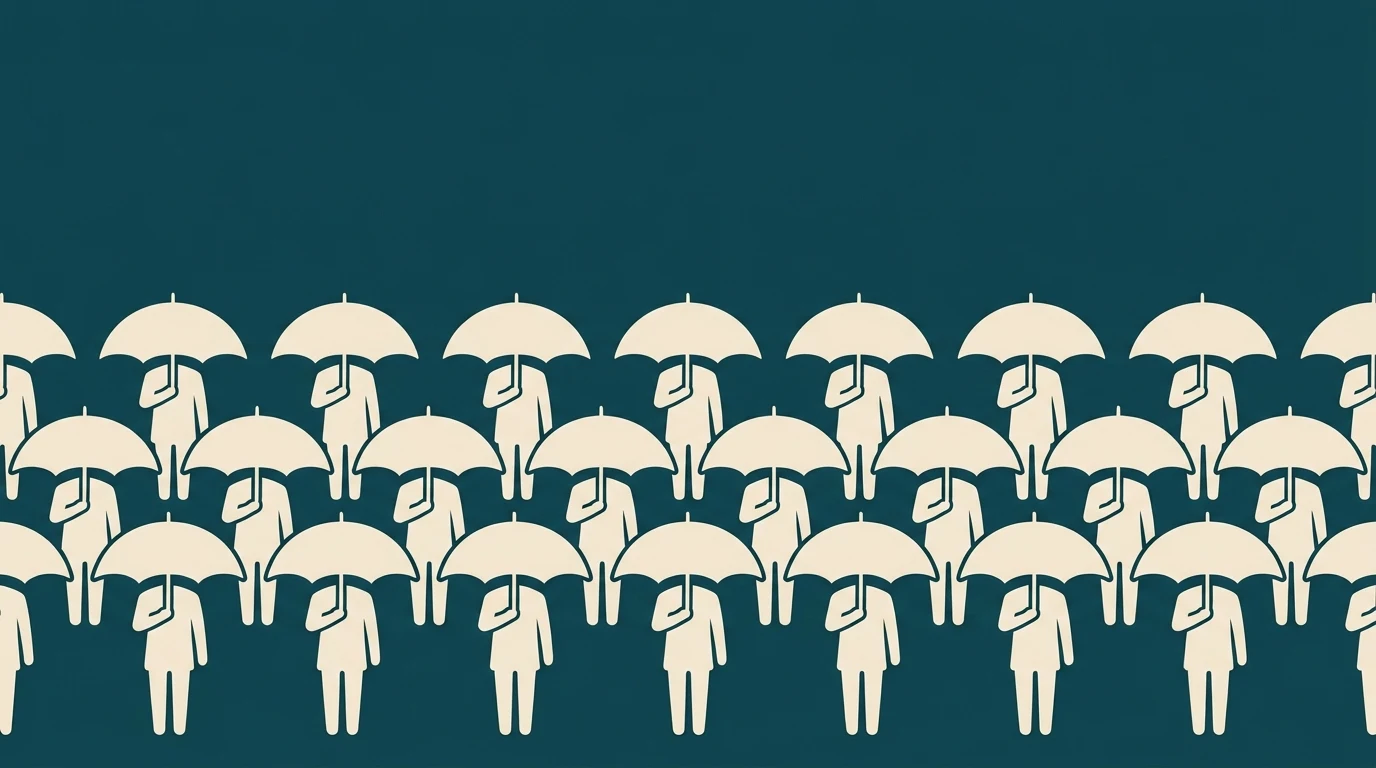
The false comfort of “new jobs”
Whenever this subject comes up, the counter-argument follows immediately: “Every technological revolution destroyed some jobs and created new ones. There were blacksmiths, now there are mechanics. It’ll be fine.” That sentence sounds wise and historically grounded. It is, in practice, lazy.
First, “it’ll be fine” for the system does not mean “it’ll be fine” for a specific person. True, the economy as a whole usually adjusts, over decades and generations. But a person does not live on the scale of generations. A forty-five-year-old specialist whose profession has evaporated does not have thirty years for “the market to adjust”. She has a mortgage, a child at university and a specific Tuesday on which she needs to eat. The sentence “new jobs will emerge” is statistically true and individually cruel.
Second, the pace. Previous revolutions unfolded over decades. People had time to retrain, and often it was only their children who stepped into the new order. The current change is happening in quarters. A skill that was your foundation can lose most of its market value in less time than a single mortgage cycle. The human brain and the human biography are not built for that.
Third, and this is the crux that the optimists refuse to see: new jobs appear higher up, and disappear lower down. Yes, we need people who design, train and oversee AI systems. But those are positions for people with a specific kind of capital: education, access, flexibility, often age. A translator of instruction manuals will not become a prompt engineer simply because that fits the narrative of progress. The net balance may even add up, and still entire groups of people are left on the wrong side of the exchange. Aggregate optimism is always cheap, because it is paid for with other people’s lives.
What we actually lose when these jobs disappear
It is easy to assume that because the work was repetitive, there is nothing to mourn. That a model doing the same thing for less is simply better. But that calculation leaves out something no spreadsheet can price.
Work is not only income. It is structure, a sense of agency, a network, an identity. When someone says “I’m a translator”, “I’m a graphic designer”, “I write”, they are not describing a revenue stream; they are describing themselves. Taking someone’s work away through the quiet disappearance of commissions strips them not only of money but of an answer to the question “who am I”. And that question does not leave with the last invoice. It stays, growing louder, in an apartment where the phone no longer rings.
We also lose a certain kind of knowledge. A professional who spent years translating, editing and drawing carried a feel for the work that no model possesses, because a model has statistics, not experience. When these people disappear from the market, so does the layer of people capable of judging whether the machine did it well. In ten years we may wake up in a world where vast quantities of things are produced cheaply and quickly, but almost nobody can say whether they are any good. The loss of the masters is quieter than the loss of jobs, but it lasts longer.
Why this is everyone’s problem, not the private failure of the left behind
The biggest lie in this whole story is: “That’s their problem.” The idea that if your job hasn’t disappeared yet, you can sleep soundly. You can’t, and not for moral reasons but purely practical ones.
The wave will not stop at translators, copywriters and illustrators just because they happened to be first. They were first because their work was the easiest to digitise: it took place on screens, in text, in pixels. But the logic is identical for anyone whose work can be broken down into repeatable patterns. Lawyers handling standard contracts, analysts, some programmers, customer service, accounting. The order is a technical matter, not a principle. Those who say today “this doesn’t affect me” generally mean “this doesn’t affect me yet”.
That is why the silence around the first wave is so dangerous. Because in that silence a precedent is being set, a template for how society responds when technology drains people out of the market. And today that template sounds roughly like this: don’t notice, don’t name it, blame the people involved for not retraining fast enough. If we allow the first groups to be treated that way, that is exactly how we will be treated when our turn comes. Silence is not neutral. Silence is an investment in ensuring that our own disappearance will also be met with silence.
Google · Your sourcesQuantslant higher in your Google - one clickAdd to preferred sources →Break the silence before it becomes the norm
I’m not going to tell you that AI is evil and must be stopped, because that is both naïve and untrue. I use it every day and I see what it makes possible. The problem is not the technology; it is that as a society we have chosen not to look at its cost. Progress without a named price tag looks free. It is not free. Someone pays for it, only they pay in silence, alone, in their own home, convinced that what happened to them is a personal failure.
The first step is not a government programme or a tax on robots, though those conversations are necessary too. The first step is stripping this phenomenon of its right to be invisible. Naming it. Saying plainly: not “he didn’t keep up”, but “he was replaced”. Not “career change”, but “the job ceased to exist”. As long as we speak about this in the language of individual blame, every person who goes through it will go through it alone and in silence.
The translator at the start of this piece is fictional. Her situation is not. You know people like her. You may be starting to become one yourself. And the only thing we can do for them, and perhaps for ourselves, starting right now, is stop pretending they aren’t there. Because revolutions that are allowed to stay invisible are the ones that do the most damage.


More on this from QUANTSLANT
 premium·AI Video Isn’t the Next Step After the Image. It’s a Different SpeciesSora and Veo 3 are not an improved Midjourney.