Whisper: Polish Transcription, Models, Setup & Test (2026)
Whisper is OpenAI's open speech-to-text model you can run locally for free. We tested it in Polish on RTX 4090: large-v3 achieved 2.4% word error rate.
👁 126 reads
Whisper is OpenAI’s open speech-to-text model that you can run for free on your own computer, with no limits and no need to send recordings to the cloud. It handles Polish well: in our test on an RTX 4090 card, the large-v3 model transcribed 22 minutes of narrated audio with 2.4% word error rate in 3 minutes 14 seconds, but only after changing one setting. With default settings, the same model fell into repetition loops, and the faster large-v3-turbo skipped two paragraphs.
Status as of October 3, 2026
- Latest models: large-v3 (November 2023) and large-v3-turbo (October 2024). OpenAI has not released a “Whisper v4” model, despite the name circulating in comparison sites.
- License: MIT for both code and model weights, including commercial use.
- OpenAI API: whisper-1 marked as legacy ($0.006 per minute), OpenAI recommends gpt-transcribe for new projects ($0.0045 per minute according to pricing tables).
- Fastest local option: faster-whisper (CTranslate2), up to 4x faster than the original at the same accuracy; on Macs, whisper.cpp.
- Our test: 5 models, 4 recordings, RTX 4090. Best result: large-v3 with 2.4% word error rate after changing one setting.
What is Whisper
Whisper is a speech recognition model that OpenAI released in September 2022 along with code and weights. The first versions were trained on 680,000 hours of internet audio, and large-v3 on over 5 million hours (mostly with automatically generated captions), which is why it handles accents, noise, and specialized vocabulary better than older systems. It supports 99 languages, including Polish, and can:
- transcribe a recording in the original language,
- translate speech directly to English (all models except turbo),
- detect the language of a recording,
- provide timestamps for each sentence, and in some tools for each word, which is sufficient for SRT subtitles.
Whisper does not recognize speakers. With a conversation between multiple people, you get continuous text without separation. For that, you need extensions like WhisperX, or services with speaker recognition. A shorter introduction to Whisper is in the article Whisper: speech-to-text transcription in Polish.
Models and Requirements
| Model | Parameters | GPU Memory (OpenAI) | Relative Speed | When to Use |
|---|---|---|---|---|
| tiny | 39M | ~1 GB | ~10x | testing, weak computers |
| base | 74M | ~1 GB | ~7x | quick content preview |
| small | 244M | ~2 GB | ~4x | laptop without powerful GPU |
| medium | 769M | ~5 GB | ~2x | good compromise |
| large-v3 | 1550M | ~10 GB | 1x | highest accuracy |
| large-v3-turbo | 809M | ~6 GB | ~8x | nearly large quality, much faster |
Memory requirements refer to OpenAI’s original implementation. faster-whisper in float16 or int8 mode needs significantly less, so large-v3 will fit on a card with 6-8 GB of memory. Without a GPU, Whisper still works, just slower.
Getting Started: Whisper on Windows Step by Step
The simplest path without programming is a ready-made program with a GUI:
- Buzz - free program for Windows, Mac, and Linux: you select a file, model, and language, and get text or subtitles.
- Subtitle Edit - free subtitle editor for Windows with built-in Whisper, convenient when you want to edit subtitles for a video right away.
- MacWhisper - Mac application, free in the basic version.
We use faster-whisper in Python because we process many files at once. Here’s how to set it up:
- Install Python 3.12 from python.org (check “Add to PATH”).
- In the command line, type:
pip install faster-whisper. - For NVIDIA cards, install CUDA libraries:
pip install nvidia-cublas-cu12 nvidia-cudnn-cu12. In our case, the missing cublas64_12.dll file was in thetorch/libdirectory of the installed PyTorch, so it was enough to add that directory to the path before import. - Save the script
transcription.py(below) and run:python transcription.py recording.mp3. - On first run, the model will download automatically (large-v3 is ~3 GB), then it works offline.
Script with settings that gave the best result in our test (works with MP3, WAV, M4A, and video files, as it decodes them with built-in PyAV):
import sys
from faster_whisper import WhisperModel

model = WhisperModel("large-v3", device="cuda", compute_type="float16")
# without GPU: WhisperModel("large-v3-turbo", device="cpu", compute_type="int8")
segments, info = model.transcribe(sys.argv[1], language="pl", beam_size=5, vad_filter=True,
                                  condition_on_previous_text=False)
with open(sys.argv[1] + ".txt", "w", encoding="utf-8") as f:
    for s in segments:
        f.write(s.text.strip() + "n")
print("Done:", round(info.duration), "s recording")
Four settings that make a difference for Polish:
language="pl"- without this, Whisper guesses the language from the first 30 seconds and with an English intro can translate the entire recording to English.vad_filter=True- cuts silence before transcription. Reduces the risk of hallucinated sentences in pauses.condition_on_previous_text=False- most important for recordings longer than a few minutes. In our test, it reduced large-v3 errors from 4.9-5.5% to 2.4% and eliminated repetition loops.initial_prompt="Names: Kowalczyk, Brzęczyszczykiewicz. Company: Quantslant."- hint with proper names the model should recognize.
Our Test: Whisper in Polish on RTX 4090
On October 3, 2026, we ran five Whisper models (faster-whisper 1.2.1, float16 on RTX 4090, beam 5, VAD enabled, Polish language) on four recordings we tested in Polish:
- The Waistcoat by Bolesław Prus from Wolne Lektury, narrated by Jan Peszek: 22 minutes 22 seconds, ~2900 words of 19th-century prose. The text is in the public domain, so we have an exact reference.
- Synthetic male voice (Microsoft Marek): 60 seconds, 146 words with idioms, amounts, percentages, date, and time.
- Synthetic female voice (Microsoft Zofia): same text, 65 seconds.
- Male voice with noise: same recording with added pink noise, speech only ~4 dB louder than noise.
The metric is WER, the percentage of incorrect words (substituted, omitted, and added) after normalizing capitalization, punctuation, and number notation. For synthetic recordings, the reference is the text in spoken form (“2026 roku”, not “2026 r.”).
| Model | The Waistcoat (narrator, 22 min) | Time for 22 min | Male Voice | Female Voice | Voice with Noise |
|---|---|---|---|---|---|
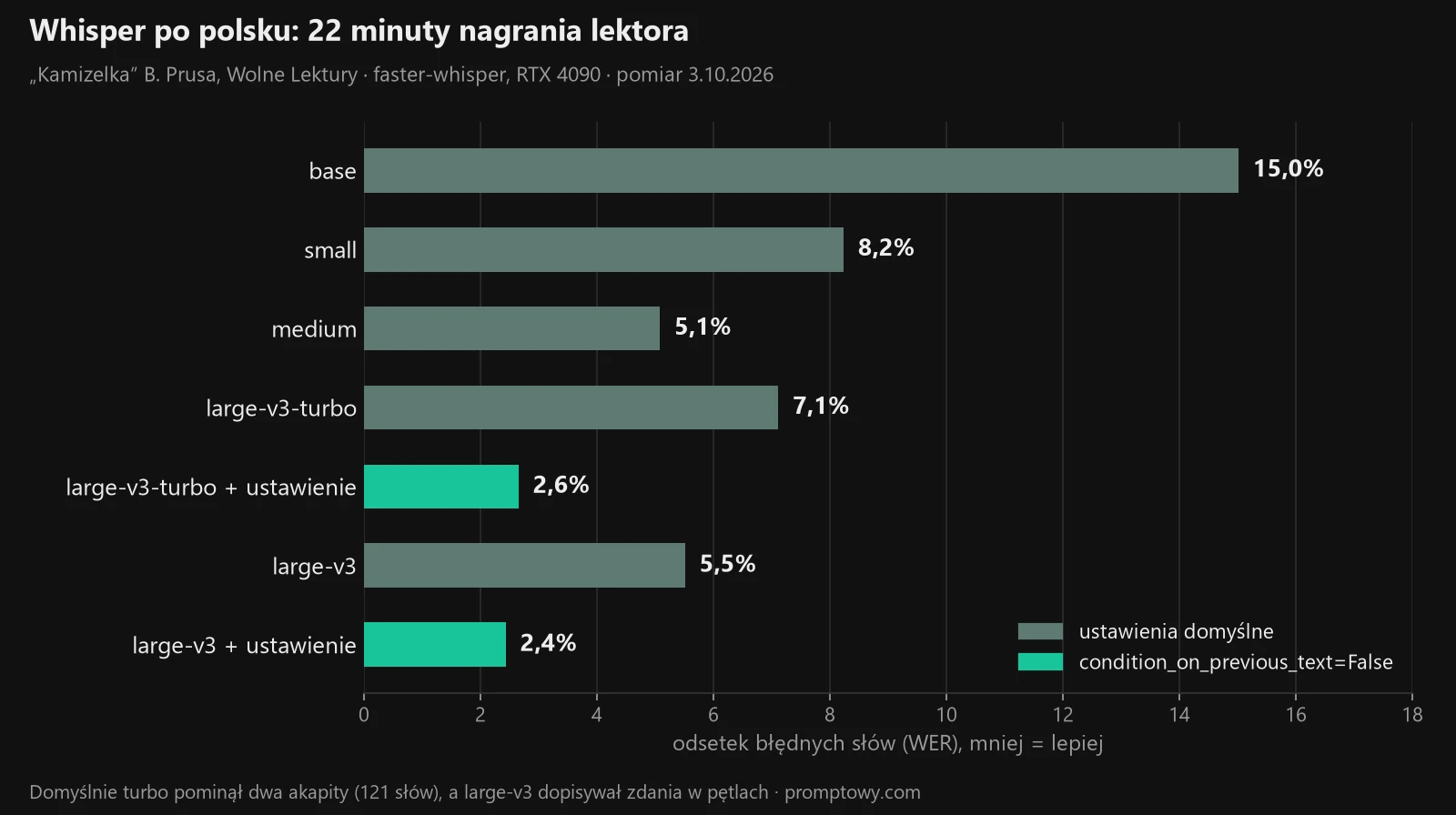
| base | 15.0% | 48 s | 16.4% | 15.8% | 32.9% |
| small | 8.2% | 87 s | 4.8% | 5.5% | 12.3% |
| medium | 5.1% | 160 s | 0.7% | 4.1% | 7.5% |
| large-v3-turbo | 7.1% (default), 2.6% after setting change | 54 s, after change 43 s | 2.1% | 2.7%* | 6.2% |
| large-v3 | 4.9-5.5% (default), 2.4% after setting change | 228 s, after change 194 s | 0.0% | 2.7% | 2.1% |
* This result includes two hallucinated words appended at the end of the recording (“Zjedenska Zjedenski”). “After setting change” means condition_on_previous_text=False, described below. Times are the better of two measurements: the card was shared with other tasks, so individual runs varied even several-fold (turbo once 54 s, once 252 s). Model loading time from disk is not included.
What This Means
- One setting changes everything. By default, Whisper feeds the previous segment as context to the next. With long recordings, an error once made snowballs: large-v3 repeated entire sentences several times (“niech pan sam powie, co to jest wart, a ja się zgodzę“) and added “nie nie nie nie nie nie”, and turbo silently skipped two paragraphs (121 words). With
condition_on_previous_text=False, both models transcribed everything without loops and without gaps, and the error count dropped by half or more. - Disabling VAD doesn’t help, it actually hurts. Without silence removal, large-v3 added 112 words in loops (7.7% errors), and turbo still skipped the same paragraphs.
- Best quality-to-time ratio goes to large-v3-turbo: 22 minutes in 43 seconds, 31 times faster than real-time, at 2.6% errors.
- Noise filters out small models. When speech was only ~4 dB louder than noise, large-v3 made 3 errors out of 146 words, medium 11, small 18, and base 48.
- Base and tiny are not suitable for Polish. 15% word error rate means correcting every seventh word.
- Some “errors” are stylization. Prus writes characters’ speech in dialect (“jake kamyzelkie”, “doktór”), and Whisper transcribes it in correct Polish. This raises the score for all models by a similar amount.
For comparison: in a separate test of the ElevenLabs Scribe service on an interview full of names, Scribe made no errors, while Whisper large-v3 confused two names. Cloud wins with proper names and speaker recognition, Whisper with privacy and no limits.
Whisper via OpenAI API
If you don’t want to install anything, you can use Whisper and its successors through the OpenAI API. According to OpenAI documentation, they recommend gpt-transcribe (files) and gpt-live-transcribe (live) for new projects, and mark whisper-1 and gpt-4o-transcribe models as legacy. Prices per minute of recording according to October 2026 pricing tables:
| Model | Price per Minute | Notes |
|---|---|---|
| gpt-transcribe | $0.0045 | recommended for files, word and language hints |
| gpt-4o-mini-transcribe | $0.003 | cheapest |
| gpt-4o-transcribe-diarize | $0.006 | recognizes speakers |
| whisper-1 | $0.006 | only one with word-level timestamps and SRT/VTT export |
One hour of recording through gpt-transcribe costs ~$0.27. Locally on your own card, you only pay for electricity. How much it costs to run on your own hardware compared to API, we calculated in the article Local Model or API.
Whisper Compared to Other Tools
| Tool | Polish | Speakers | Privacy | Price |
|---|---|---|---|---|
| Whisper locally | good, better in large models | no (WhisperX yes) | recording stays with you | $0 |
| OpenAI gpt-transcribe | good | in diarize variant | OpenAI cloud | $0.0045 per minute |
| ElevenLabs Scribe | very good with names and numbers | yes, up to 32 | cloud | free plan, API from $0.22 per hour |
| TurboScribe | like Whisper (based on it) | yes | cloud | 3 files daily free |
| Otter.ai | does not support Polish | yes | cloud | - |
We collected free methods with minute limits in the article Free Polish Transcription, and the entire process from recording to corrected text in the guide Recording Transcription. If you’re making subtitles from transcription, check out the article AI for Subtitles.
Who is Whisper For
- Yes: journalists, lawyers, doctors, and researchers with recordings that cannot leave the computer; podcast and video creators with dozens of hours of material; developers building transcription into their own tools.
- Probably not: multi-person meetings where speaker separation matters; people without patience for installation (then TurboScribe or Scribe); recordings full of names that must be error-free without corrections.
Frequently Asked Questions
Is Whisper free?
Yes. The code and model weights are under MIT license, so you run it locally without fees and limits, including commercially. Only the OpenAI API is paid, billed per minute of recording.
How well does Whisper understand Polish?
Well with clear speech from one person. In our test on a 22-minute narrator recording, large-v3 had 2.4% word error rate (after disabling condition_on_previous_text), and the smallest tested model base had 15%. With strong noise, the error count grows several-fold.
Which Whisper model to choose for Polish?
With a GPU of 8 GB or more: large-v3 or large-v3-turbo. On a laptop without a GPU: large-v3-turbo in int8 mode or small. We don’t recommend tiny and base models for Polish, they confuse over ten percent of words.
Is there a Whisper v4?
No. As of October 3, 2026, the latest open models are large-v3 and large-v3-turbo. Sites describing “Whisper v4” usually refer to large-v3 or to newer, closed OpenAI models available only through API.
Does Whisper work without internet?
Yes. After the first model download, it works completely offline, and the recording does not leave the computer.
How long does it take to transcribe an hour of recording?
On RTX 4090 with the large-v3 model, we got ~9 minutes per hour of recording, and with large-v3-turbo under 2 minutes. On a CPU without a GPU, expect time close to or longer than the recording length.
Why does Whisper add sentences that weren’t there?
These are so-called hallucinations, most often in silence at the end of a recording or with noise. In our test, the turbo model appended the words “Zjedenska Zjedenski” at the end of a clean recording. Enabling VAD (vad_filter=True), setting condition_on_previous_text=False, and trimming silence at the end of the file helps.
Does Whisper recognize speakers?
No. For speaker separation, you need an extension like WhisperX (with the pyannote model) or a service like ElevenLabs Scribe or gpt-4o-transcribe-diarize in the OpenAI API.
Google · Your sourcesQuantslant higher in your Google - one clickAdd to preferred sources →Sources and Verification Date
Data and measurement from October 3, 2026. Test recording: Bolesław Prus, “The Waistcoat,” narrated by Jan Peszek, Wolne Lektury (work in public domain, recording under Wolne Lektury license).
- OpenAI Whisper - repository, models, and license
- faster-whisper - repository
- OpenAI - transcription API guide
- OpenAI transcription pricing table (October 2026)
- Wolne Lektury - The Waistcoat
- Otter.ai - supported languages
 Whisper AI: Speech-to-Text Transcription ReviewAI Tools
 Audio to Text Transcription: Free Tools & When They FailGuides
 Open WebUI with Ollama: Local ChatGPT Install and TestGuides
The link to ElevenLabs is a partner link: if you buy through it, QUANTSLANT earns a commission and you pay the same price. It has no influence on the content, including where the coverage is critical.
More on this from QUANTSLANT



 guides·Waking Up App: Practical Uses for Stress, Sleep & FocusHow Waking Up fits into everyday situations: before important conversations, after stressful workdays, when you can't fall asleep, or when you catch yourself scrolling.