AI Image Generator Ranking: 8 Models Tested Side-by-Side
We tested 8 paid AI image generators with identical prompts: scores 0-10, costs from $0.03 to $0.13 per image, speed tests, and non-English text rendering.
👁 132 reads
We ranked AI image generators the same way we test locally: identical prompts, one attempt each, no cherry-picking prettier versions. On September 27, 2026, we ran five prompts from our Z-Image Turbo test through eight paid models available via OpenRouter’s API, from Nano Banana Pro to Recraft V4.1. We measured time and cost for each image, then scored all 40 images at full resolution and zoomed in. We also show results from two free models running on our graphics card.
Summary
Nano Banana Pro delivered the best images (average 9.0/10), but it’s also the most expensive: $0.13 per image. The best quality-to-price ratio goes to GPT Image 2 in “medium” quality: 8.7/10 for $0.033. Close behind are Nano Banana 2 and Grok Imagine 2.0 (both 8.6) and Seedream 5.0 Pro (8.5). We tested non-English text rendering with a bakery sign reading “PIEKARNIA ŻÓŁĆ” (Polish for “Bakery Bile”) - 6 out of 8 API models spelled it correctly. FLUX.2 Pro and Recraft V4.1 made mistakes, as did both local models. Fastest was Recraft (7 s), slowest was Grok (72 s). The entire test cost $2.25.
How We Tested
We called all models through OpenRouter’s image API (/api/v1/images) with 16:9 aspect ratio and “1K” resolution where the model accepts it. Where possible, we set the same seed as in our local test (FLUX.2, Seedream, Qwen-Image). GPT Image 2 received “medium” quality, and Grok Imagine got the highest available in this API, also “medium”. We measured time from sending the request to receiving the file, and copied cost from the usage.cost field in the response. Prompts are in English, word-for-word identical to those in our local test from September 26.
Our test budget was $2.50. One prompt across eight models cost $0.45, so instead of eight prompts we ran the five most demanding:
- Market - reportage: elderly woman selling tomatoes, cucumbers and dill at a market, morning side light.
- Sign - bakery with painted sign reading “PIEKARNIA ŻÓŁĆ” (Polish for “Bakery Bile”), warm evening light.
- Illustration - flat magazine-style illustration: person at laptop late evening, llama beside them, navy and orange palette, no text.
- Portrait - 40-year-old with freckles and gray beard holding steaming coffee with both hands.
- Pierogi - overhead shot: pierogi with onion and sour cream on wooden table.
We scored each image 0-10 for: prompt adherence, realism, hands, text accuracy, and absence of text where the prompt forbade it. These scores are our opinion, but under each panel we explain what lost points.
Results: Prices, Times and Scores
Prices are actual amounts charged by OpenRouter for one image, excluding VAT. Time is the average of five images.
| Model | Price per image | Average time | Resolution | Average score |
|---|---|---|---|---|
| Nano Banana Pro (Google) | $0.134 | 18.6 s | 1376×768 | 9.0 |
| GPT Image 2, medium (OpenAI) | $0.033 | 29.7 s | 1536×864 | 8.7 |
| Nano Banana 2 (Google) | $0.067 | 12.2 s | 1376×768 | 8.6 |
| Grok Imagine 2.0 (xAI) | $0.06 | 71.5 s | 1280×720 | 8.6 |
| Seedream 5.0 Pro (ByteDance) | $0.045 | 45.6 s | 1280×720 | 8.5 |
| FLUX.2 Pro (Black Forest Labs) | $0.045 | 13.0 s | 1824×1024 | 7.6 |
| Qwen-Image 3 (Alibaba) | $0.03 | 67.0 s | 1024×576 | 7.6 |
| Recraft V4.1 | $0.035 | 7.2 s | 1344×768 | 6.5 |
| Qwen-Image 2.1 (local, RTX 4090) | ~$0.002 electricity | 6.5 s | 1344×768 | 6.9 |
| Z-Image Turbo (local, RTX 4090) | ~$0.001 electricity | 4.2 s | 1344×768 | 5.7 |
Three things in the table aren’t obvious. FLUX.2 Pro charges per megapixel and without a specified size returned a 1824×1024 image, so we paid $0.045 instead of $0.03. Qwen-Image 3 in “1K” mode only gave 1024×576, and according to OpenRouter’s pricing the 2K version costs the same $0.03. GPT Image 2 in “high” quality is several times more expensive: OpenRouter’s documentation shows a 16:9 image for $0.13.
Gallery: Same Prompt, Ten Models
Each panel shows eight API models and two local models from our RTX 4090 card (last two tiles). We ran the writing tasks in Polish, a heavily inflected language with diacritics, making this a useful test of non-English text rendering.
1. Market Reportage
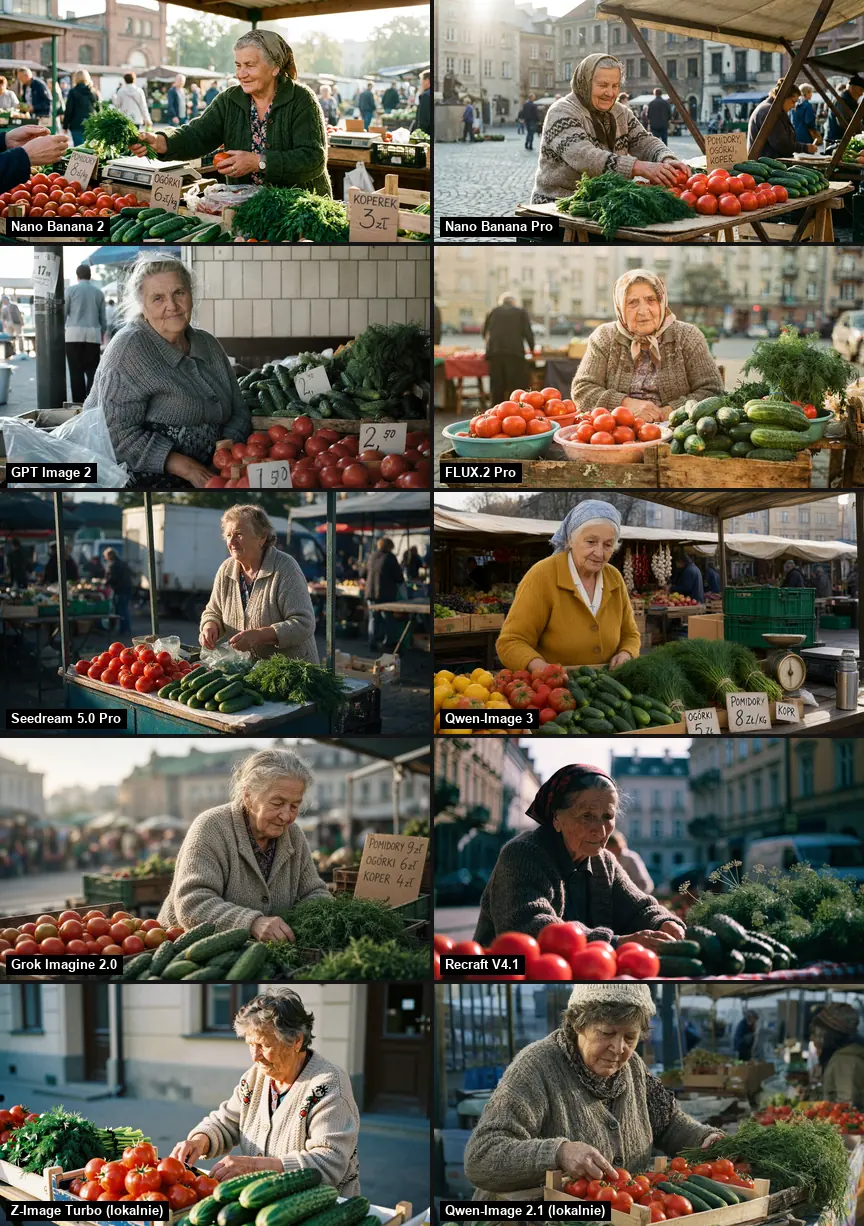
Four API models added signs in Polish, though the prompt didn’t ask for them: Nano Banana 2, Nano Banana Pro, Qwen-Image 3 and Grok Imagine. All were spelled correctly, including “OGÓRKI” (Cucumbers) and price tags, while GPT Image 2 put just prices in “2.50” format. Seedream 5.0 Pro (8.5) gave the most reportage-like frame: side light, shallow depth of field, ordinary sweater instead of stock-photo costume.
2. Non-English Text: Bakery Sign
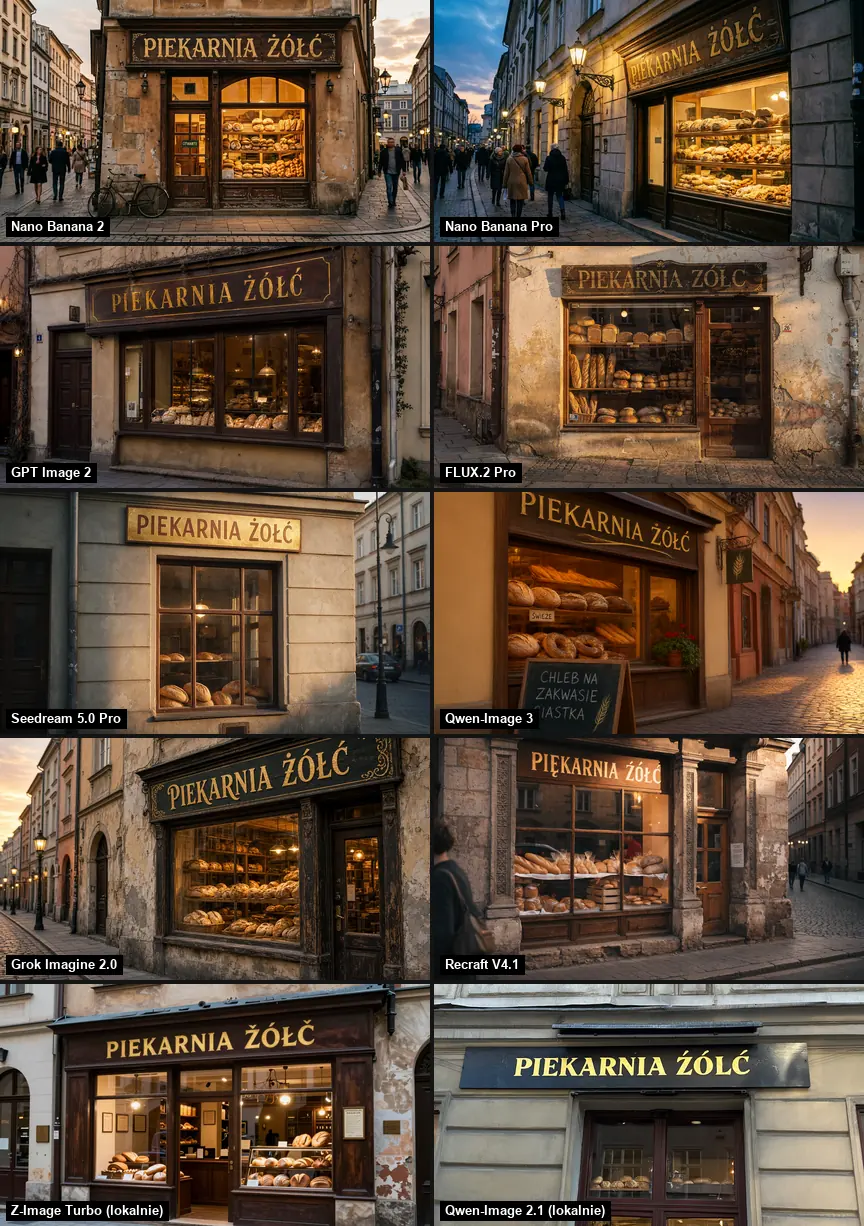
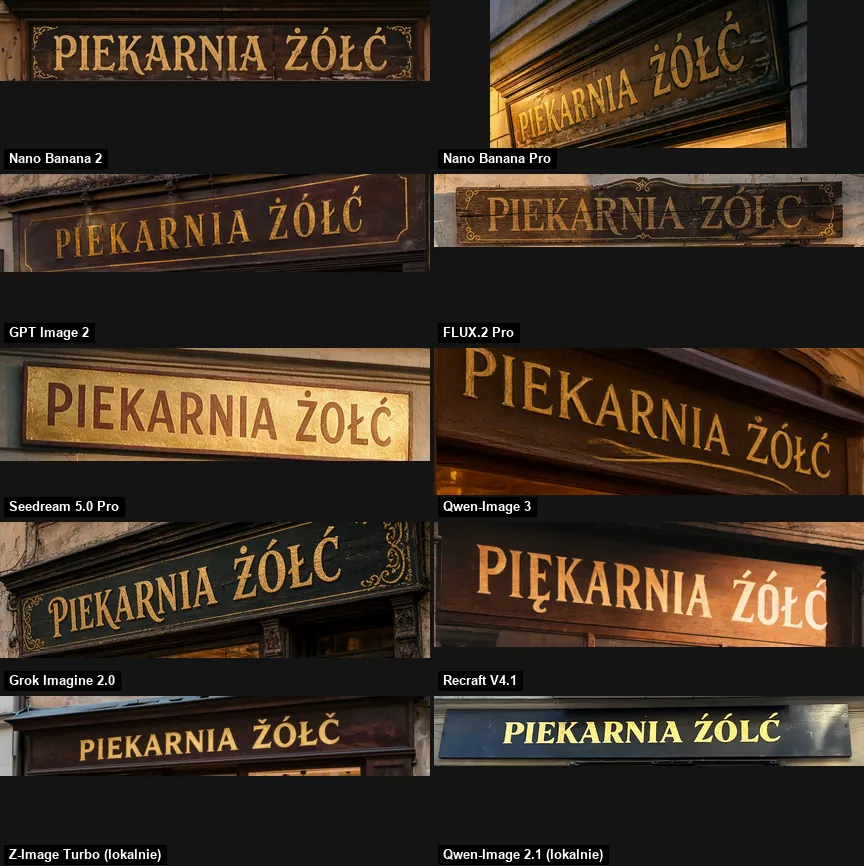
This is where the ranking diverged most. FLUX.2 Pro lost the dot over Z and the accent over C - two of four diacritics (5/10). Recraft added an ogonek to “PIEKARNIA” and put an acute accent instead of a dot over Z, with a lighter patch visible under the text (4/10). Qwen-Image 3 not only spelled the sign correctly but drew a “CHLEB NA ZAKWASIE” (Sourdough Bread) board and “FRESH” card, also error-free. This matches our August diacritics test, where FLUX.2 Pro also confused accents.
3. Illustration Without Text
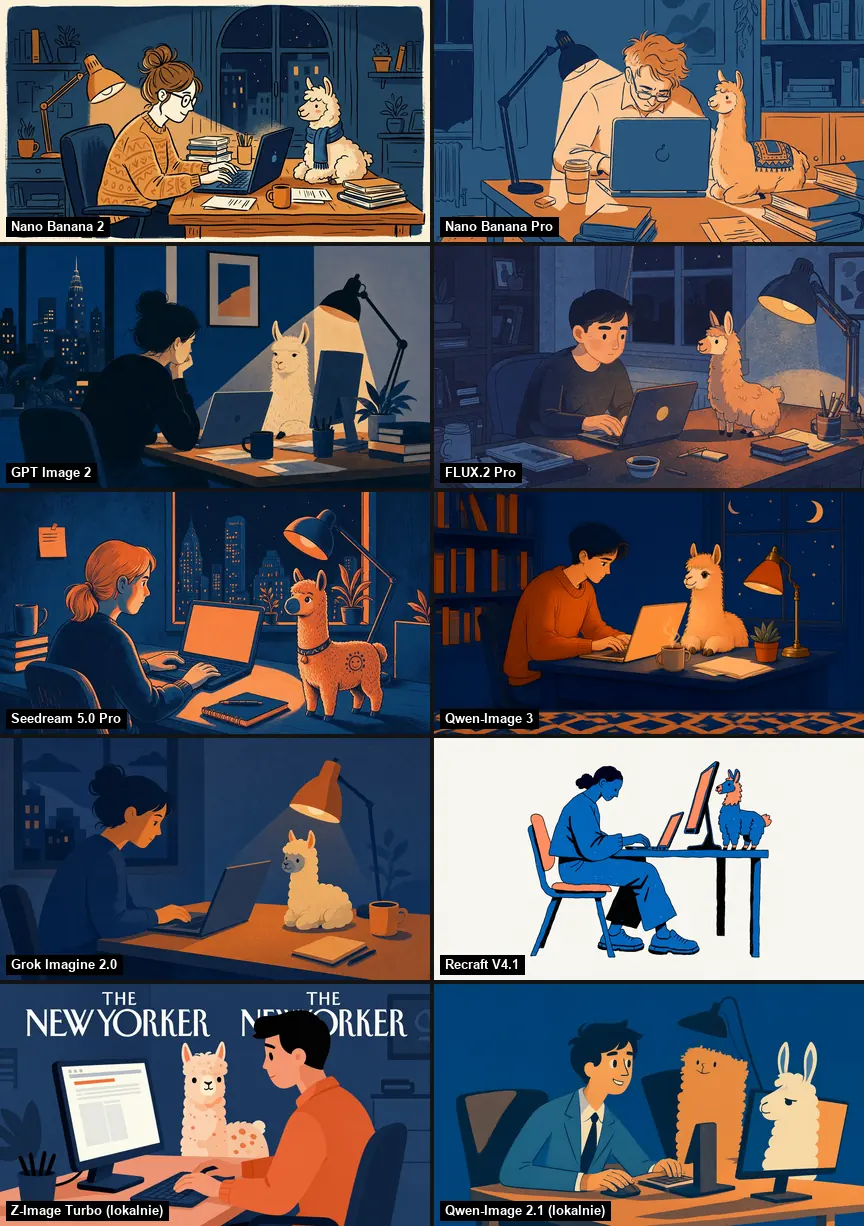
In our local test, Z-Image Turbo twice inserted “THE NEW YORKER” vignette into this image (3/10). All API models treated the magazine name as a style description, not text to draw. Recraft (7.5) made the most “magazine-like” linework, but on white background, so it lost the “late evening” from the prompt.
4. Portrait With Hands
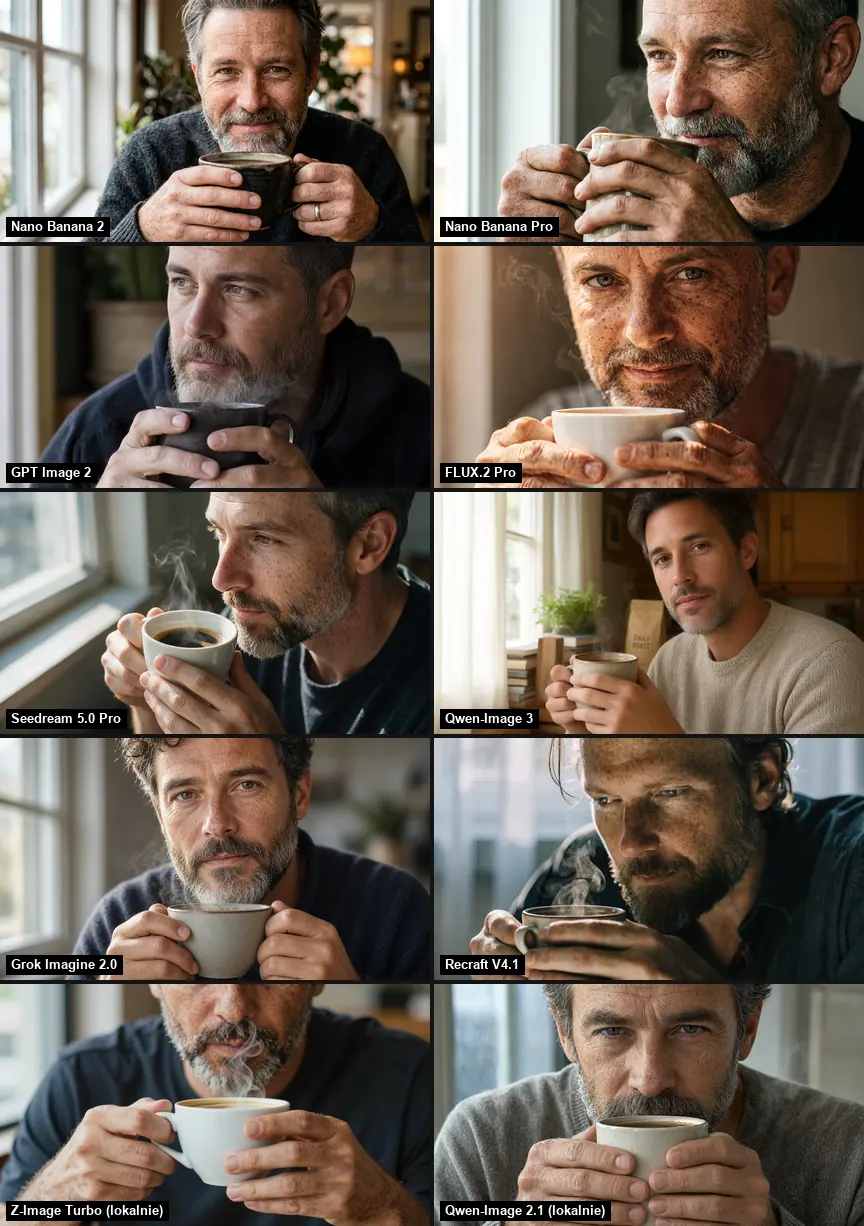
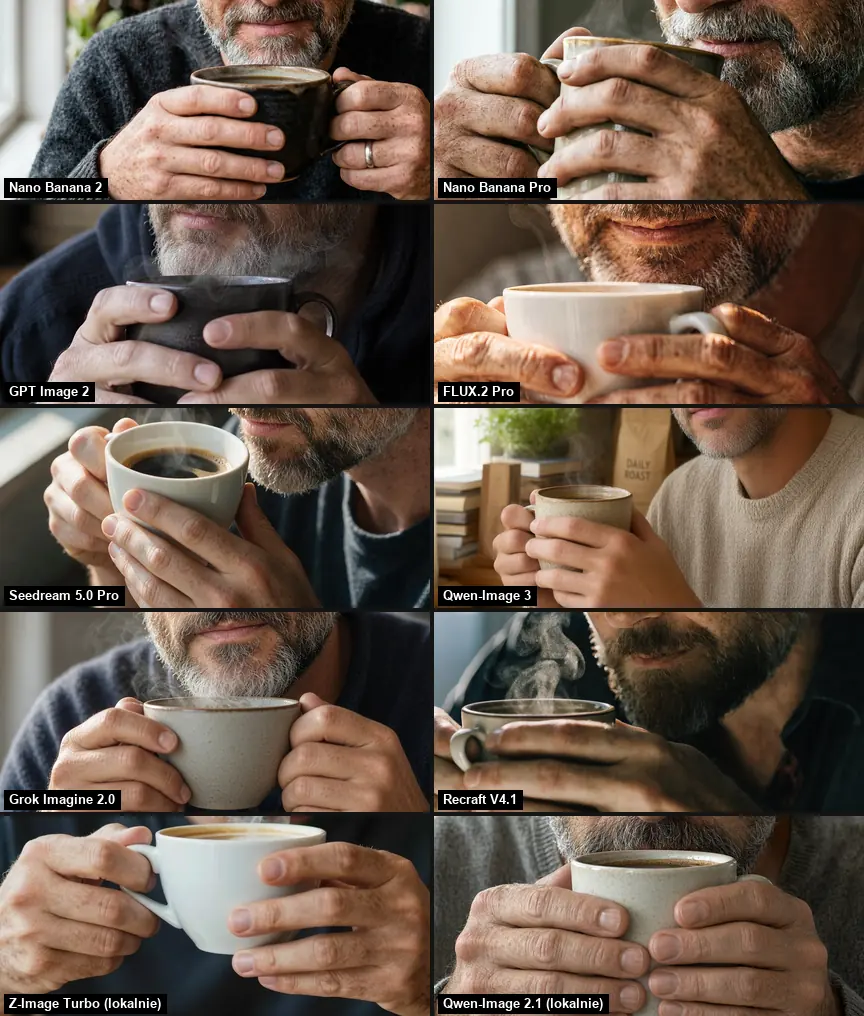
Hands stopped being a problem: all ten models drew five fingers per hand. Differences are in prompt details. GPT Image 2 (8) omitted freckles, Nano Banana 2 (8) the steam over the mug, and Recraft (7) gave a red beard instead of gray.
5. Pierogi From Above
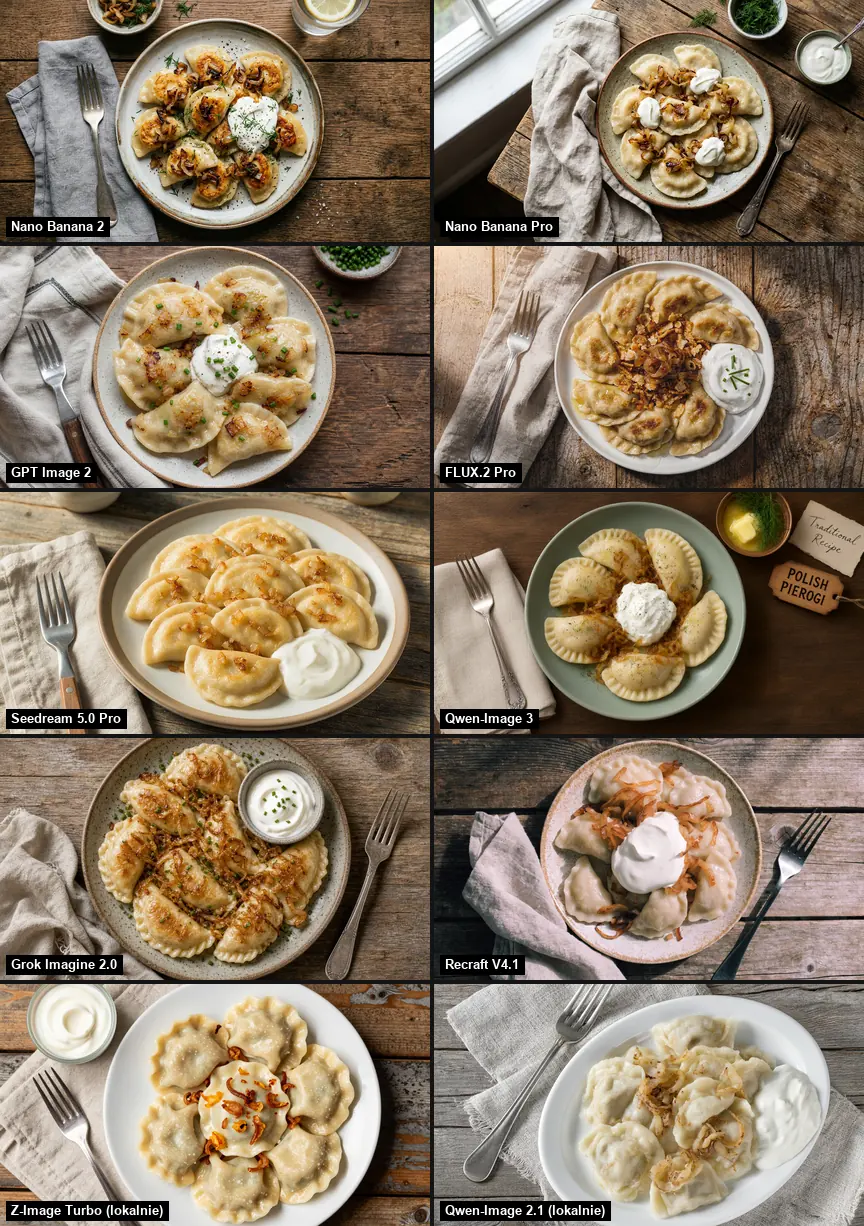
Pierogi are a good test of knowledge about Central European cuisine. Nano Banana 2 (7.5) made pan-fried dumplings folded like Asian gyoza, and Recraft (7) bunched them together like uszka (small dumplings). Seedream (8) gave nice pierogi, but from an angle, though the prompt said “overhead.”
Scores for Each Prompt
| Model | Market | Sign | Illustration | Portrait | Pierogi | Average |
|---|---|---|---|---|---|---|
| Nano Banana Pro | 9 | 9.5 | 8.5 | 9 | 9 | 9.0 |
| GPT Image 2 | 8 | 9.5 | 9 | 8 | 9 | 8.7 |
| Nano Banana 2 | 9 | 10 | 8.5 | 8 | 7.5 | 8.6 |
| Grok Imagine 2.0 | 8.5 | 9.5 | 8 | 8.5 | 8.5 | 8.6 |
| Seedream 5.0 Pro | 8.5 | 8.5 | 8.5 | 9 | 8 | 8.5 |
| FLUX.2 Pro | 7.5 | 5 | 8.5 | 8.5 | 8.5 | 7.6 |
| Qwen-Image 3 | 8.5 | 9 | 8.5 | 5.5 | 6.5 | 7.6 |
| Recraft V4.1 | 7 | 4 | 7.5 | 7 | 7 | 6.5 |
| Qwen-Image 2.1 (local) | 8 | 5 | 5.5 | 8 | 8 | 6.9 |
| Z-Image Turbo (local) | 8 | 5 | 3 | 6.5 | 6 | 5.7 |
Conclusions: Which Generator for What
- Highest quality without compromise: Nano Banana Pro. It tied for first place in three of five prompts, and in the other two lost to the winner by half a point. You pay four times more than GPT Image 2 for this. A guide to both Google models is in our article about Nano Banana.
- Most quality per dollar: GPT Image 2 in “medium” quality. 8.7/10 for $0.033, you just have to wait about 30 seconds.
- Fast and cheap, with non-English text: Nano Banana 2. 12 seconds, no errors in diacritics, weaker only with pierogi.
- Portraits and reportage: Seedream 5.0 Pro. Most natural light in the test, but time ranged from 24 to 87 seconds.
- Non-English text on graphics: any from the top five. Avoid FLUX.2 Pro and Recraft V4.1 or check every letter.
- Free on your own card: Qwen-Image 2.1 and Z-Image Turbo performed worse than paid models, mainly because of text. For photos without text they got 8/10 for the market, the same level as GPT Image 2. More about them in our article about local AI.
This is our opinion: at today’s prices, the difference between $0.033 and $0.13 per image only matters when you’re generating hundreds of graphics monthly. For individual images we’d go by quality, and for serial production we’d choose GPT Image 2 or Nano Banana 2. Full subscription pricing, including Midjourney which couldn’t be tested here, is in our guide to AI image generators.
What This Test Doesn’t Tell You
This is one attempt per prompt, so with a different seed each model could have scored a point better or worse. We didn’t test photo editing, character consistency, or images from reference. Midjourney and Ideogram aren’t in the ranking because they’re not in OpenRouter’s API, and Midjourney’s terms prohibit generation through automated tools. We covered them separately: Midjourney and Ideogram. Details about the tested models are in our FLUX and Seedream guides.
Frequently Asked Questions
Which AI image generator is best in 2026?
In our test on September 27, 2026, the highest average (9.0/10) went to Nano Banana Pro from Google. Behind it were GPT Image 2 (8.7), Nano Banana 2 and Grok Imagine 2.0 (both 8.6), and Seedream 5.0 Pro (8.5).
Which generator renders diacritics correctly?
The sign “PIEKARNIA ŻÓŁĆ“ was spelled without errors by Nano Banana Pro, Nano Banana 2, GPT Image 2, Seedream 5.0 Pro, Qwen-Image 3 and Grok Imagine 2.0. FLUX.2 Pro and Recraft V4.1 each made two errors.
How much does one AI image cost through API?
In our test, from $0.03 for Qwen-Image 3 to $0.134 for Nano Banana Pro, excluding VAT. GPT Image 2 in “medium” quality cost $0.033.
Which image generator is fastest?
Recraft V4.1 returned images in an average of 7.2 s, Nano Banana 2 in 12.2 s, and FLUX.2 Pro in 13 s. Grok Imagine 2.0 and Qwen-Image 3 needed over a minute. Locally, Z-Image Turbo makes an image in 4.2 s on RTX 4090.
Does AI still mess up hands?
Not in this test. All ten models drew the correct number of fingers on hands holding a mug. Errors concerned age, freckles and beard color instead.
Sources and Date Checked
- Our own test through OpenRouter API (
/api/v1/images) - 16:9
- “1K”
- one attempt
- seed 20260926 where the model accepts it
- cost from
usage.costfield. Local models: test from September 26 - 2026 on RTX 4090
- described in our article about Z-Image Turbo. Pricing: OpenRouter image models
- OpenRouter image API documentation. Checked September 27
- 2026
More on this from QUANTSLANT
 benchmarks·AI Video Generator Ranking: 6 Models, Same PromptsWe tested Veo 3.1, Kling 3.0, Seedance 2.0, Hailuo 2.3, Grok and Wan 3.0 with identical prompts. Videos, costs, speed and scores compared.