AI World Models Explained: Genie, Odyssey, Cosmos & V-JEPA
What are AI world models, how do they differ from video generators, and which ones can you test right now? Here is our breakdown and hands-on test.
👁 118 reads
A world model is an AI that does not just write text or generate a static video clip - it predicts how the world changes following an action. This allows you to walk through a generated environment like a video game, or lets a robot rehearse a task before executing it in physical reality. In this guide, we break down the most prominent world models - Genie, Odyssey, Cosmos, V-JEPA, and Atlas - including how they work, access availability, and our hands-on test results.
Status as of October 9, 2026
- Latest release: Odyssey-3 (October 8, 2026) - free browser preview, no account required.
- Most prominent: Google DeepMind Genie 3, available as Project Genie on the Google AI Ultra plan.
- Open weights: NVIDIA Cosmos and Meta V-JEPA 2 - downloadable for self-hosting.
- Our test: Generating regional landscapes in Odyssey-3 - results detailed below.
What is an AI world model?
A large language model predicts the next word. A world model predicts the next state of the world: the next video frame, object positions, and camera movement. Control input is the decisive factor here. The model receives a command such as “player steps forward” or “robotic arm closes gripper” and must compute the resulting environment state.
Key differences compared to AI video generators like Veo:
- A video generator renders an entire clip at once, which you can only watch passively.
- A world model generates frames step by step in real time, responding directly to your control inputs.
- A world model needs to remember what it has already rendered - if you turn around and walk back, a building should remain in the exact same spot (currently still its weakest point).
For more on why researchers view world models as the critical step beyond LLMs, see our analysis: world models - AI that understands physics.
How world models work under the hood
Most visual world models follow a shared architectural pattern:
- Video training: Models train on millions of hours of footage, often from video games and dashcams, paired with telemetry and control data (keystrokes, steering angles, robotic joint movements).
- Autoregressive prediction: Based on preceding frames and user control signals, the system predicts the next frame sequentially, similar to an LLM predicting tokens.
- Diffusion decoding: Each new frame is generated via denoising steps. To enable real-time interaction, teams distill these models down to run in just a few denoising steps per frame.
- Context memory: The model maintains a finite memory window of previous frames. Once an object drops out of this context window, the model must re-imagine it from scratch, leading to shifting geometry and vanishing landmarks.
Meta’s V-JEPA takes an alternative route: instead of predicting raw pixels, it predicts representations in an abstract feature space. You cannot walk through it visually, but it is dramatically cheaper to run computationally and much better suited for robotic trajectory planning.
Current limitations vendors rarely highlight
- Object permanence: Rotating the camera frequently reshuffles the scene. In our Odyssey-3 testing, geometry shifted within 10 seconds.
- Short session lengths: Free browser demos run for only a few minutes, while Google DeepMind reports Genie 3 maintains coherent worlds for several minutes.
- Output resolution: Typically capped at 480p to 720p, far behind modern 4K AI video generators.
- Narrow geographical training: World models render generic representations (such as a generic European town) rather than authentic local architecture.
- Vendor-reported benchmarks: Independent audits remain scarce, and vendors routinely publish variations of benchmarks that show their models in the best light.
Real-world applications
- Robotics and autonomous vehicles: Training agents in synthetic simulations instead of racking up thousands of costly, risky real-world test hours. This is the core focus for NVIDIA and Odyssey.
- AI agents: Generating endless diverse virtual environments for reinforcement learning.
- Gaming and film: Rapid visual prototyping, location ideation, and interactive world sketches.
- Physics understanding: Measuring whether artificial intelligence truly grasps intuitive real-world dynamics via benchmarks like Physics-IQ.
Top AI world models compared (October 2026)
| Model | Developer | Primary Function | Availability | Weights |
|---|---|---|---|---|
| Odyssey-3 / Pro | Odyssey | Real-time interactive worlds from text prompts, 832×480 / 1280×720, 1st and 3rd person views | Free web preview without account; API via inquiry | No |
| Genie 3 (Project Genie) | Google DeepMind | Explorable world from text or image prompts, 720p at 24 fps | Google AI Ultra tier, 18+ | No |
| Cosmos (incl. Cosmos 3 and Cosmos 3 Edge) | NVIDIA | World foundation models for robotics and autonomous driving, synthetic data generation | Publicly downloadable | Yes (NVIDIA license) |
| V-JEPA 2 | Meta | Feature-space video prediction without pixel rendering; robotic planning | Publicly downloadable | Yes |
| Atlas and Marble | World Labs | 3D scenes and video from a single photo, 3D Gaussian splat export | Marble web preview; Atlas announced | No |
Genie 3 and Project Genie
Google DeepMind introduced Genie 3 in August 2025. It generates explorable environments in 720p at 24 frames per second. In January 2026, Google rolled it out inside Labs as Project Genie, initially restricted to Google AI Ultra subscribers in the US. By May 2026, access expanded to select international Ultra subscribers, though Google has not published an exhaustive regional availability list. Project Genie pairs Genie 3 with Nano Banana and Gemini. For details on how Genie fits into the competitive landscape, read our overview: world models - the next AI frontier after LLMs.
Odyssey-3
Palo Alto-based Odyssey launched Odyssey-3 on October 8, 2026. It is an autoregressive diffusion transformer that denoises successive frames conditioned on past context and user inputs. Distilled to run in just a handful of steps per frame, it achieves real-time interactive playback. Odyssey aims to use the same underlying architecture to train autonomous agents, drones, and robots. Check out our deep dive: Odyssey-3 hands-on test.
NVIDIA Cosmos
Cosmos is NVIDIA’s open-weights family of foundation models targeted at physical AI. Its primary role is generating rich synthetic sensor data for autonomous cars and industrial robotics. The Edge variant is optimized to execute locally on physical devices without relying on cloud infrastructure. See our deployment walk-through in NVIDIA Cosmos 3 guide and our breakdown of the Cosmos 3 Edge architecture.
V-JEPA 2 and Yann LeCun
Meta released V-JEPA 2 in June 2025. Diverging from image-generating competitors, it predicts future dynamics within an abstract conceptual representation space. This paradigm has been championed by Yann LeCun, who argues that generating individual pixels wastes compute when teaching machines how physical reality functions. The weights are open source. LeCun has since departed Meta to expand on this direction via his own venture; read more in our profile: Yann LeCun and AMI Labs.
World Labs: Marble and Atlas
Founded by Fei-Fei Li, World Labs focuses on spatial intelligence. Marble constructs explorable 3D environments, while Atlas, unveiled on September 1, 2026, generates up to one minute of 1440p video from a single reference still, complete with precise virtual camera control and 3D point cloud export capabilities. Learn more in our piece on World Labs Atlas.
Physics-IQ benchmark performance
The Physics-IQ benchmark tests whether a model’s predicted video continuations respect intuitive physics: gravity, rigid-body collisions, and fluid dynamics. Below are the verified scores published by Odyssey at launch. Because rival developers test against varying benchmark subsets, we present only directly comparable vendor-verified data.
Hands-on test: regional landmarks in Odyssey-3
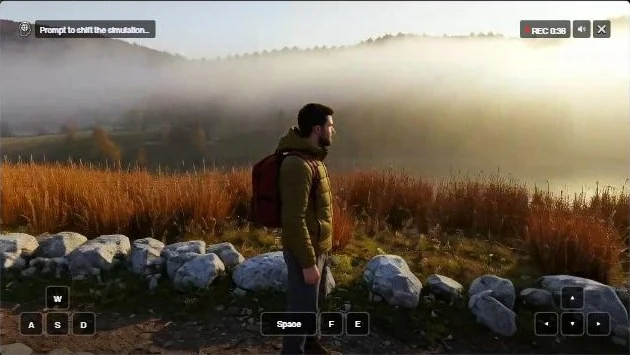
Odyssey-3 was the only major world model open to instant browser testing without requiring an account or fee. We put its spatial comprehension to the test using specific regional prompts: the wild mountain meadows of the Bieszczady range (połonina w Bieszczadach), tested in both English and Polish, alongside Krakow’s historic Main Market Square during winter.
| Test Criterion | Result |
|---|---|
| Non-English prompt handling (tested in Polish) | Understood without issues |
| Atmospheric fidelity (fog, tall grasses, rolling ridges) | Convincing aesthetic |
| Specific architectural heritage (Lemko wooden church, Cloth Hall) | Failed - rendered generic Central European buildings |
| Camera movement and panning responsiveness | Smooth and playable |
| Object permanence after a 360-degree turn | Poor - building geometry morphed completely |
Our verdict: the model captures lighting and atmospheric tone remarkably well, but lacks specific local architectural training and struggles with persistent object geometry. It is suitable for rapid mood boarding, but not for accurate location reconstruction.
How to get started with world models
- Free web access: Visit experience.odyssey.systems, enter an environmental prompt, and navigate using standard WASD and arrow keys.
- Via Google subscription: Access Project Genie through Google AI Ultra - check Google Labs to confirm availability for your account.
- Local self-hosting: Clone NVIDIA Cosmos or Meta’s V-JEPA 2 from Hugging Face. You will need a high-end NVIDIA GPU and a functioning Python development setup.
World models vs AI game generators
It is easy to conflate world models with automated game-building tools. Google Labs Playground structures complete interactive games complete with gameplay mechanics, scoring systems, and leaderboards. By contrast, a world model generates only navigable physical space without embedded game rules. See our guide on getting started with Google Playground.
Frequently asked questions
How does a world model differ from an AI video generator?
A video generator renders a fixed, non-interactive clip. A world model generates continuous frames on the fly in direct response to user or agent control commands, while attempting to retain spatial memory.
Are any world models free to use?
Yes. Odyssey-3 offers a free web-based interactive preview, while NVIDIA Cosmos and Meta V-JEPA 2 provide open weights for local execution.
Where is Genie 3 available?
Project Genie is included with the Google AI Ultra plan via Google Labs. Availability is expanding internationally, but Google has not published an exhaustive list of supported countries.
Do world models truly understand physics?
Only partially. Leading scores on the Physics-IQ benchmark sit around 66 points, indicating significant room for improvement. Basic visual physics like walking cadence, lighting changes, and atmospheric fog look plausible, but complex mechanical interactions remain unreliable.
Can you run a world model locally on your own computer?
NVIDIA Cosmos and Meta V-JEPA 2 can be self-hosted if you have a powerful NVIDIA GPU with sufficient VRAM. Odyssey-3 and Google Genie 3 are cloud-only proprietary services.
How can creative professionals use world models today?
They serve as quick interactive sketchpads for virtual location scouting, environmental mood boards, and conceptual game prototypes. They are not yet reliable enough for finished production assets.
Google · Your sourcesQuantslant higher in your Google - one clickAdd to preferred sources →Sources and verification
- Odyssey - Meet Odyssey-3
- Google - Project Genie
- 9to5Google on Project Genie
- Wikipedia - Genie (world model)
- Editorial hands-on testing of Odyssey-3, conducted October 9, 2026. All data verified as of October 9, 2026.
More on this from QUANTSLANT



 state of ai·ROAR: Smarter Retrieval for Zero-Shot Time Series ForecastingROAR introduces opportunity-aware refinement for zero-shot time series, selectively weighting retrieved data to achieve the lowest average MSE.