Odyssey-3 Review: Testing the Interactive AI World Model
Odyssey-3 generates real-time interactive 3D worlds from a single text prompt. We tested the free browser demo on consistency, physics, and world memory.

👁 134 reads
On October 8, 2026, Palo Alto startup Odyssey launched Odyssey-3, a foundational world model that generates an interactive 3D environment from a single sentence and lets you walk through it in real time. A free browser preview is accessible without logging in, so we put it straight to the test on complex terrain: the Bieszczady mountain pastures in southeastern Poland. The autumn mist looked striking, but structural consistency fell apart as soon as we turned the camera around. For a broader look at this technology, see our guide on world models and how they work.
As of October 9, 2026
- Models: Odyssey-3 (832×480) and Odyssey-3 Pro (1280×720), developed by Odyssey in Palo Alto.
- Architecture: Foundational world model, autoregressive diffusion transformer.
- Preview: experience.odyssey.systems, free, no login required - featuring a queue and roughly 5-minute session timer.
- API: Waitlist via contact form only, no public pricing.
- Weights: Closed model, no public weights.
- Multilingual support: Understands non-English prompts, but lacks accurate knowledge of specific regional landmarks.
What Odyssey-3 Actually Does
Odyssey-3 is a foundational world model. Unlike standard AI video generators that output a pre-rendered, fixed clip, a world model predicts subsequent frames on the fly based on previous frames and input signals from a human or robotic agent. This architecture allows you to navigate the generated environment using standard WASD keys and pan the camera with arrow keys while the scene renders dynamically.
According to Odyssey, the same trained core serves three distinct purposes:
- Interactive simulation, allowing humans to explore generated worlds directly;
- Embodied AI and robotics control, demonstrated across a robotic arm, humanoid robot, autonomous car, and drone;
- Training AI agents inside synthetic environments, including video games.
The company claims an autonomous driving policy trained on just 20 hours of simulated data successfully navigated closed tracks in India. They also claim agent behaviors transferred across titles like GTA V, Red Dead Redemption 2, and Sleeping Dogs. These remain vendor claims rather than independent third-party evaluations.
Benchmark Scores and Physics Performance
The headline metric from the launch is Odyssey-3’s score on Physics-IQ Verified, a benchmark assessing whether generated video adheres to physical laws.
| Benchmark | Odyssey-3 Pro | Comparison |
|---|---|---|
| Physics-IQ Verified, video-to-video | 66.1 | FLUX 3: 64.35 (per Odyssey) |
| Physics-IQ Verified, image-to-video | 54.7 | - |
| WorldMark | 1st place in 3 of 4 categories | Lower score only in “first-person, real-world environment” |
To be clear: these numbers come directly from the company. AI newsletter AlphaSignal also highlighted a compute-budget caveat regarding the physics benchmark score. Independent verification has not yet been published.
Hands-On Test: Exploring Navigable Worlds
We accessed experience.odyssey.systems through a standard desktop browser. There was no registration wall or terms modal. We entered a brief queue (“You’re 8th in line”) and gained access after roughly one minute, with a session countdown starting at around 4:30. We ran three separate test scenarios.
Scenario 1: Prompt in English
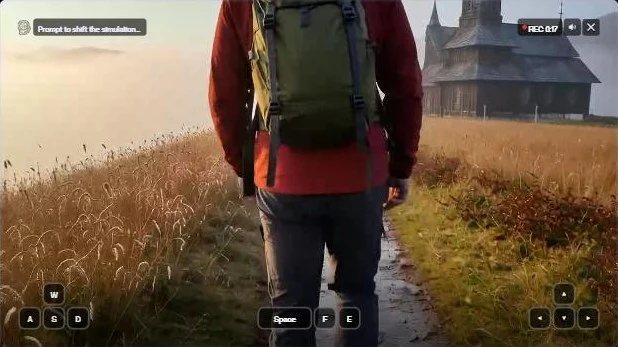
We entered an English prompt describing an autumn mountain ridge in the Bieszczady mountains with a wooden church, dawn fog, and a first-person perspective. The model defaulted to a third-person view behind a backpacker, which appears to be its preset mode. The russet grasses, damp trail, and morning mist looked remarkably convincing. However, the wooden church resembled a Scandinavian stave church rather than the specific Eastern European wooden architecture we asked for.
Scenario 2: Prompt in Polish
For the second run, we tested it in Polish: “Widok z pierwszej osoby: połonina w Bieszczadach jesienią, drewniana cerkiew łemkowska, mgła o świcie, rude trawy, buczyna w dolinie“ (“First-person view: mountain pasture in the Bieszczady mountains in autumn, wooden Lemko church, dawn mist, russet grasses, beech forest in the valley”). The model understood the Polish text without issue, generating rolling hills shrouded in fog, brown grasses, and a rustic timber cabin behind a post-and-rail fence. It again ignored the first-person view command.
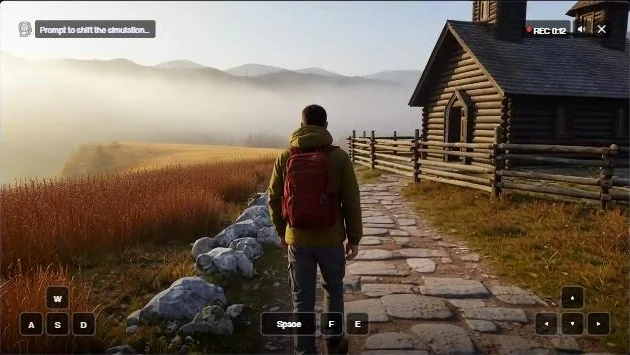
We then walked forward for several seconds and panned the camera left. The movement was responsive and smooth, and the valley filled with morning fog provided the most visually impressive frame of the entire session.
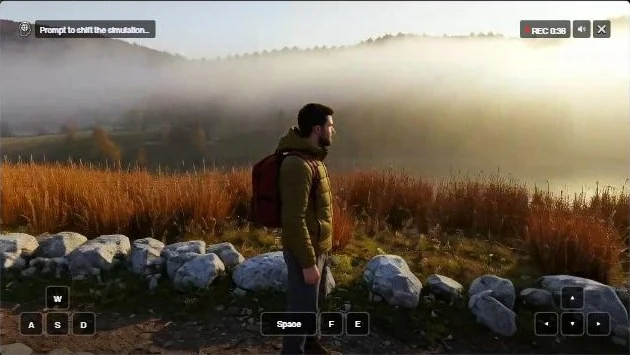
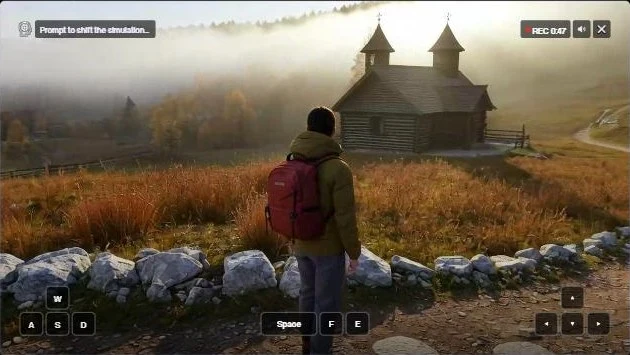
The critical flaw appeared when we turned the camera back to the right. The log cabin and the wooden fence had vanished entirely. In their place stood an entirely different wooden structure with two cross-topped spires, situated further down the hill. Ironically, it looked closer to an authentic Eastern European chapel than the original cabin, but the model had completely failed to remember the geometry it generated ten seconds earlier.
Scenario 3: Landmark Test
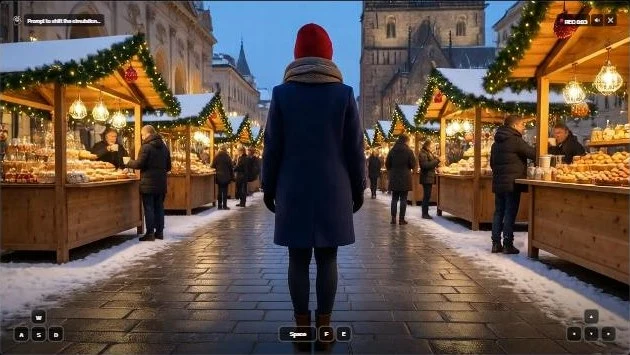
Finally, we tested landmark recognition with another non-English prompt: “Rynek Główny w Krakowie zimą o zmierzchu, Sukiennice i Kościół Mariacki, pada śnieg, jarmark bożonarodzeniowy“ (“Main Market Square in Krakow in winter at dusk, Cloth Hall and St. Mary’s Basilica, falling snow, Christmas market”). The result was an appealing, generic European Christmas market. The famous Cloth Hall was absent, and the gothic church in the background featured only a single tower rather than the iconic twin towers of St. Mary’s.
Test Summary and Technical Findings
| Test Area | Result | Notes |
|---|---|---|
| Terrain fidelity | Partial | Mist, grasses, and rolling ridgelines looked authentic; regional buildings were inaccurate |
| Multilingual prompts | Functional | Descriptions were understood accurately, though specific foreign landmarks were not recognized |
| Latency and fluidity | Good | Camera navigation and movement felt responsive with minimal latency |
| Physics rendering | Solid on basic effects | Walking, lighting shifts, and volumetric fog behaved naturally; no collision glitches observed |
| World persistence | Poor | Panning away and back caused buildings to shift positions and change appearance entirely |
| First-person view | Failed via prompt | Requires manual toggle before generation; our toggle was unresponsive during the test |
A technical note: during our browser session, the web app triggered a write action to the system clipboard. While harmless in this context, it is worth clearing your clipboard after testing.
Availability and Access
- Browser Preview: Globally accessible at experience.odyssey.systems without an account or payment, subject to a queue and short timed sessions.
- API: Accessible strictly through a business contact form for robotics and autonomous vehicle teams. No self-serve API keys or public pricing tables are available.
- Model Weights: Fully proprietary. Odyssey has not published weights or disclosed parameter counts.
Who Is Odyssey-3 Built For?
- AI enthusiasts: A compelling 5-minute showcase demonstrating where generative AI is heading beyond passive video generation.
- Game designers and concept artists: Useful for rapid 3D mood boards and environmental concepting, though unsuitable for production-ready asset generation.
- Robotics and autonomous systems teams: The primary target audience for Odyssey’s commercial API and simulation pipelines.
Further Reading
- World Models Explained: Genie, Odyssey, Cosmos, and V-JEPA
- World Models: The Next AI Frontier After LLMs
- World Labs Unveils Atlas: Spatial Intelligence in Focus
Sources
- Odyssey - Meet Odyssey-3 (October 8, 2026)
- Odyssey on X - Launch Announcement
- AlphaSignal on Odyssey-3
- The Next Web on Odyssey-3
- Independent browser evaluation conducted via experience.odyssey.systems on October 9, 2026.



More on this from QUANTSLANT



 ai tools·Google Labs Playground: AI Browser Games from PromptsGoogle Labs launched Playground, an experimental tool that builds playable browser games from text prompts. Here is what we know about access, models, and limits.