HappyHorse 1.1 examples: 7 test clips, prompts and scores
Seven HappyHorse 1.1 clips with prompts, scores and costs: camera movement, English speech and image-to-video shine, while lettering and Polish speech struggle.
👁 114 reads
This test contains 7 HappyHorse 1.1 clips generated through OpenRouter, each lasting 5 seconds at 720p and costing 0.494 USD. Three scored particularly well at 8.5/10: character consistency across a cut, English dialogue, and an image-to-video shot of a mug. Two struggled: Polish lettering on a chalkboard (3/10) and Polish speech (4.5/10). Below are the clips, prompts and scores. This is an English adaptation of the test conducted on October 11, 2026, not a new test run. Where the original prompt included Polish text, an explicitly labeled translation is provided. For rankings, pricing and availability, see the HappyHorse 1.1.
Quick verdict (October 11, 2026)
- Strengths: camera movement, character consistency, image-to-video generation and English speech.
- Weaknesses: text within the frame, Polish diacritics, Polish speech and liquid physics.
- Average across 4 Video Arena scenes, excluding speech: 6.1/10. Wan 3.0 scored 9.1.
- Test cost: 3.46 USD for 7 clips, plus 0.03 USD for the starting image.
How the test was conducted
All clips were generated on October 11, 2026 through the OpenRouter API (alibaba/happyhorse-1.1), at 720p, in a 16:9 aspect ratio, with a duration of 5 seconds and the same seed, 20261008. Generation took 96-112 seconds per clip. Every file is 1280×720 at 24 frames per second and includes an audio track. The first five scenes use exactly the same prompts as the Video Arena comparison from October 8, allowing comparison with six other models. The scoring method is also the same: four sampled frames at 8, 35, 62 and 92% of the duration, plus the complete clip, scored on a 0-10 scale. Speech is transcribed with faster-whisper large-v3 and assessed using WER, or word error rate.
| Example | Use case | Score | Best result in the October 8 Arena |
|---|---|---|---|
| 1. Camera orbit around a motorcycle | product shots and advertising | 8 | Wan 3.0 and Kling 3.0: 8.5 |
| 2. Polish speech | short videos with Polish dialogue | 4.5 | MiniMax H3 Max: 9 |
| 3. Chalkboard lettering | title cards, signs and logos | 3 | Wan 3.0 and H3 Max: 10 |
| 4. Pouring water | food and drink videos | 5 | Wan 3.0: 9 |
| 5. One character across 2 shots | short stories and episodic videos | 8.5 | Wan 3.0: 9 |
| 6. English speech | English-language short videos | 8.5 | additional scene outside the Arena |
| 7. Image-to-video | animating product photographs | 8.5 | additional scene outside the Arena |
A full bar represents 10 points.
The seven test clips
1. Camera orbit around a motorcycle
Use case: showing a product from multiple angles, opening an advertisement or adding a cutaway to a music video.
A smooth 180-degree camera orbit around a vintage red motorcycle parked on a wet cobblestone street in an old European town at blue hour. The camera circles steadily from the front of the motorcycle to its back at a constant speed. Street lamps reflect in the puddles, light drizzle. The motorcycle keeps its exact shape and details. Realistic cinematic footage, real-time motion, no text, no logos.
The prompt asks for a smooth 180-degree orbit around a red motorcycle on wet cobblestones at blue hour, with street lamps reflected in puddles.
Score: 8/10. The camera moves from a front three-quarter view to a rear three-quarter view, completing the requested half-orbit. The motorcycle retains its shape and details, while the puddles and reflected lamps look convincing. This matches MiniMax H3 Max (8) and falls just behind Wan 3.0 (8.5). In the same scene, Seedance 2.5 added a black sheet over the seat, while Veo 3.1 Lite barely moved the camera.
2. A woman speaking Polish
Use case: short videos with Polish dialogue or an advertisement with an on-screen speaker.
Adapted prompt: the quoted dialogue below is an English translation of the Polish sentence used in the actual test.

Medium close-up of a woman in her thirties sitting at a kitchen table, looking straight into the camera. She says clearly and calmly in Polish: [English translation: In Szczebrzeszyn, a beetle buzzes in the reeds, and I pay thirty-two Polish currency units.] Natural daylight from a window, static camera, realistic, no subtitles, no on-screen text, no music.
The original test asked a woman at a kitchen table to look at the camera and deliver a Polish tongue twister followed by a sentence about a payment. The translated wording above is for readers; it was not used to generate a new English clip.
Score: 4.5/10. The image is acceptable, the lips move and the voice sounds natural. However, Whisper’s transcript contained errors in 6 of the 12 words, giving a WER of 0.5. For comparison, MiniMax H3 Max achieved a WER of 0 in this scene, Wan 3.0 scored 0.167, and Seedance 2.5 scored 0.583. See the detailed HappyHorse 1.1 Polish speech test.
3. Chalk lettering on a board
Use case: title cards, signs and product names within a scene.
Adapted prompt: the two requested inscriptions are translated from the Polish originals; the clip tests Polish lettering.

Close-up of a green school chalkboard in a sunlit classroom. A hand finishes writing with white chalk. The chalkboard clearly shows exactly two lines of text in capital letters: first line [English translation: VIDEO ARENA 2026], second line [English translation: YELLOW BOAT]. Static camera, realistic, chalk dust in the light, no other text.
The hand was asked to finish two uppercase lines on a green chalkboard. Translated into English, these read VIDEO ARENA 2026 and YELLOW BOAT. The original Polish wording was deliberately chosen to test diacritics.
Score: 3/10. The hand writes naturally, with attractive light and chalk dust. The lettering is unreliable, though: the heading for 2026 loses a letter, and the second line contains incorrect diacritics and letter substitutions. Only Wan 3.0 and MiniMax H3 Max rendered both original lines correctly in the Arena. This result makes HappyHorse 1.1 a poor choice when exact lettering matters. Add the text during editing instead.
4. Pouring water until the glass overflows
Use case: drink advertisements, food videos and product shots involving liquids.
Static close-up on a wooden kitchen table in daylight. Water is poured from a glass pitcher into an empty clear drinking glass. The stream splashes, bubbles rise, the water level rises steadily until the glass overflows and water spills onto the table and spreads into a puddle. Real-time speed, no slow motion, realistic physics, no text.
The prompt asks for water to pour into an empty glass, rise steadily and eventually overflow onto the table.
Score: 5/10. The stream and bubbles look good, but the sequence of events is wrong: a puddle appears on the table in the 2nd second, before the glass is full. Veo 3.1 Lite made the same mistake in the Arena and also scored 5. Wan 3.0 scored 9 because the water rose consistently and overflowed at the right moment.
5. The same character across two shots
Use case: short stories, AI-generated series and advertisements following one character.
Two shots separated by one hard cut. Shot 1: wide shot of a young woman with short red hair, round black glasses, a yellow raincoat and a black backpack walking along a rainy city street at night with neon reflections on the wet pavement. Hard cut. Shot 2: close-up of the same woman with the same short red hair, the same round black glasses and the same yellow raincoat as she stops under a shop awning and looks up at the rain. Realistic, cinematic, no text.
The prompt specifies two shots separated by a hard cut: a woman in a yellow raincoat walking through a rainy street at night, followed by a close-up of the same woman under an awning.
Score: 8.5/10. The cut occurs at the right point. The face, glasses, yellow raincoat and backpack straps remain consistent afterward. The only difference is slightly longer hair in the close-up. This is better than MiniMax H3 Max (7.5), which changed the hairstyle to a bob with bangs, and Seedance 2.5 (6), which hid the hair under a hood. Only Wan 3.0 scored higher, at 9.
6. A fisherman speaking English
Use case: English-language short videos and advertisements, or footage styled as a handheld documentary.
Medium shot of an elderly fisherman with a grey beard sitting on a wooden pier at sunrise, mending a net. He looks up at the camera, smiles and says in English: "The sea gives you exactly what you have patience for." Gentle waves, seagulls in the distance, warm golden light, handheld documentary style, realistic, no subtitles, no text.
The scene shows an elderly fisherman with a gray beard repairing a net at sunrise. He looks up and delivers the English sentence about patience and the sea.
Score: 8.5/10. Whisper transcribed the sentence without an error (WER 0), and the lip movements match the audio. The deduction is for an unrequested edit: the clip begins with a brief close-up of the hands before switching to the medium shot. The same model misrendered half the words in the Polish example. These two samples therefore show a language-dependent difference, rather than an inability to generate speech at all.
7. Image-to-video: a mug and coffee
Use case: animating product photographs, creating e-commerce videos and adding cutaways.
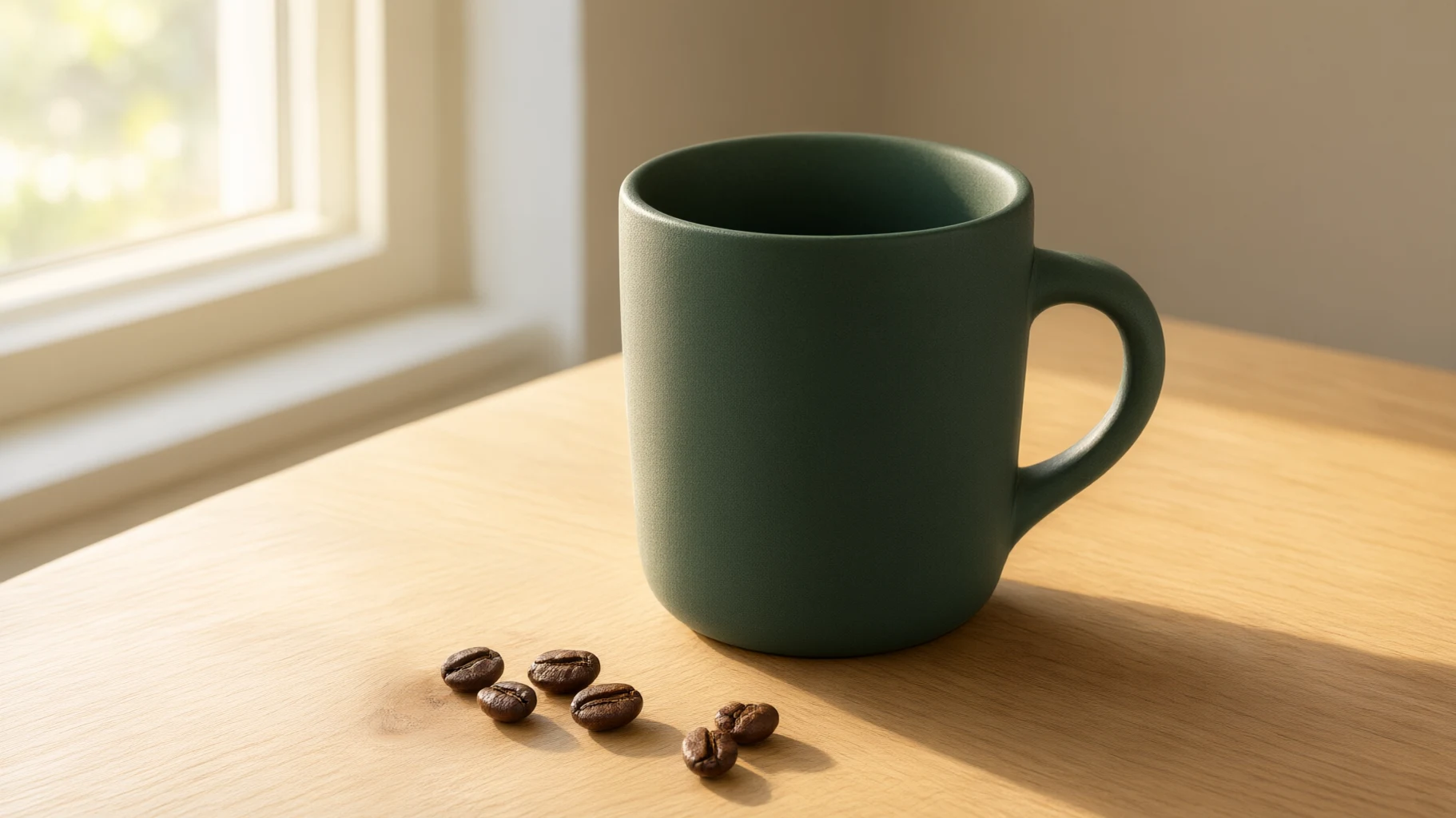
The starting frame, a green mug on an oak table, was generated with Qwen-Image 3 through OpenRouter for 0.03 USD:
Slow camera push-in on the green ceramic mug. Hot black coffee is poured into the mug from above in a thin stream, steam rises and curls in the sunlight, dust particles float in the window light. Sound of pouring coffee and a quiet morning kitchen. Realistic, no text, no logo.
The prompt asks for a slow push-in toward the green mug as black coffee pours from above, steam rises and the sound of pouring fills a quiet kitchen.
Score: 8.5/10. The push-in is smooth, the mug retains the starting image’s shape and color, the coffee pours in a thin stream, and steam rises. Coffee beans near the edge leave the frame as the camera moves closer, but that is a natural consequence of the camera movement. This was one of the strongest results in the test and helps explain the model’s stronger position in image-to-video rankings than in text-to-video rankings.
Official prompts to try
At the time of the source review, Alibaba did not provide downloadable video examples paired with prompts; its blog showed a GIF without the prompt. The examples below come from documentation and campaign materials. They were not generated for this test, so no test results are shown.
A cardboard town (text-to-video documentation)
A miniature city built from cardboard and bottle caps comes to life at night. A cardboard train slowly passes through, with small lights dotting the scene and illuminating the way ahead.
This prompt describes a miniature cardboard city coming to life at night, with a train and small lights illuminating its route. Source: Alibaba Cloud documentation.
A dance with a change of style (Alibaba Cloud campaign)
A girl is dancing gracefully. As she spins around in a full turn, the entire scene seamlessly transforms from a cartoon style into a realistic live-action setting.
During the dancer’s full turn, the scene changes from animation to realistic live action. Source: HappyHorse campaign page.
A dance battle between two characters (fal.ai references)
A dance battle between character1 and character2, cinematic lighting, smooth camera movement.
This prompt uses uploaded reference images for a dance battle with cinematic lighting and smooth camera movement. The reference mode was not tested in this review; character1 and character2 refer to the uploaded images.
Community gallery
The gallery at happyhorse.com contains user templates, including a puppy in a bee costume across three shots, a stuffed toy in a 15-second clip with second-by-second directions, and an 80s-style horror scene using five references. The full prompts make these useful examples to inspect. They are not embedded here because they were created by users and no reuse license was stated. The featured video, Are You Happy - HappyHorse 1.1 Is Now Available (2:21, June 23, 2026), can be watched on the site.
Practical takeaways
- Write prompts and dialogue in English when that fits your project. The Polish speech sample contained substantial errors.
- Do not rely on precise lettering within the scene. Add it during editing.
- Start from an imagewhere practical. Image-to-video produced one of the cleanest results in this test.
- Specify shots and cuts explicitly using instructions such as Shot 1, Hard cut and Shot 2. The model followed that structure in this example.
For HappyHorse 1.1 against Wan 3.0, Seedance and MiniMax on the same scenes, see the four-model comparison. Further test results are available in the Video Arena and the video generator ranking.
Sources and review dates
- Test clips: OpenRouter, model alibaba/happyhorse-1.1, October 11, 2026; comparative scores from the Video Arena (8.10.2026)
- Alibaba Cloud documentation (11.10.2026)
- Alibaba Cloud HappyHorse campaign (11.10.2026)
- happyhorse.com, template gallery (October 11, 2026)