GPT-Image-2.6 vs Nano Banana 2.1, FLUX 3, Seedream, Qwen
We benchmarked GPT-Image-2.6 against Nano Banana 2.1, FLUX 3, Seedream 5 Pro, and Qwen Image 3 Pro across speed, generation cost, and rendering typography.
👁 148 reads
On launch day for GPT-Image-2.6, I ran the exact same 12 prompts across five flagship image models: OpenAI’s new Sunburst, Google’s Nano Banana 2.1, Black Forest Labs’ FLUX 3, ByteDance’s Seedream 5 Pro, and Alibaba’s Qwen Image 3 Pro. Every test was routed through the exact same API, running each prompt once with no cherry-picking or rerolls. Most prompts tested complex typography with diacritics and non-English scripts, which remains the fastest way to expose weak image generators.
For a complete breakdown of OpenAI’s release, head over to the ChatGPT Images 2.6 overview, or check our generation-over-generation test in 2.6 vs 2.5.
Generation speed and API cost
| Model | Latency (median) | Cost per image (average) |
|---|---|---|
| GPT-Image-2.6 Sunburst (medium) | 26 s | $0.035 |
| GPT-Image-2.6 Flare (medium) | 8 s | $0.035 |
| Nano Banana 2.1 | 16 s | $0.038 |
| FLUX 3 | 25 s | $0.048 |
| Qwen Image 3 Pro | 67 s | $0.040 |
| Seedream 5 Pro | 63 s | $0.079 |
Pricing is relatively tightly grouped across the board, with the exception of Seedream, which costs more than double the rest. Generation speed tells a completely different story: Flare completes a full generation before Qwen or Seedream even start outputting.
Rendering complex typography: Polish milk bar menu
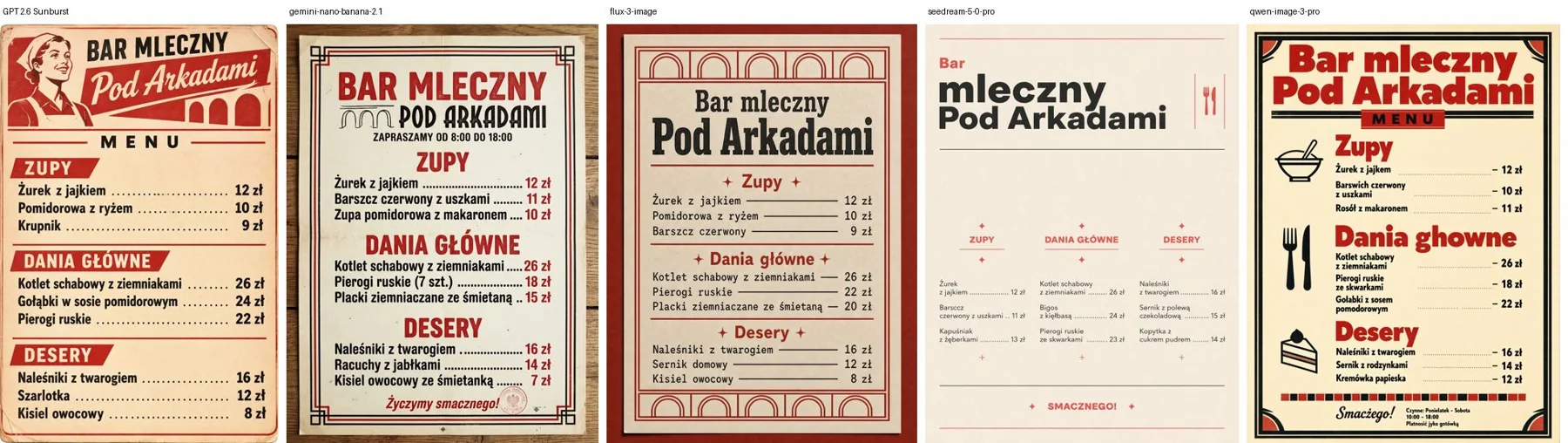
GPT, Nano Banana, and FLUX nailed every single word and diacritic without error. Seedream generated accurate spelling, but scaled the text down so aggressively that the layout turned into an empty decorative poster rather than a readable menu. Qwen completely fell apart on Polish diacritics, spitting out scrambled strings like “[corrupted lettering in the original Polish test]”, “[corrupted lettering in the original Polish test]”, and “[corrupted lettering in the original Polish test]”. For real-world production assets, errors like that require manual cleanup in graphic editing software.
Four-panel comic strip with dialogue
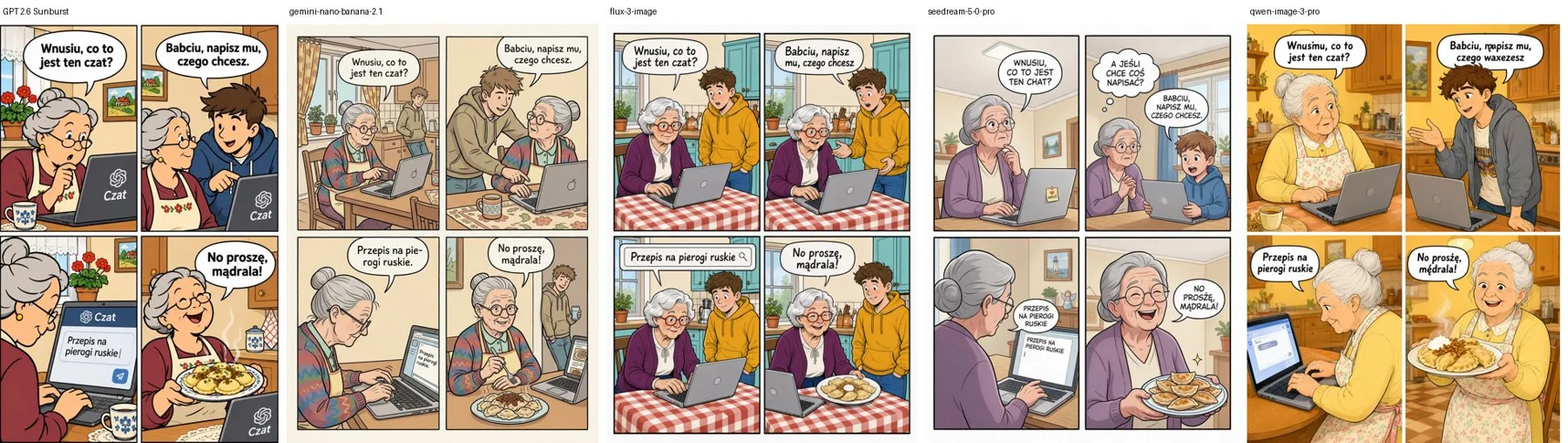
The brief required four distinct panels with four speech bubbles containing exact verbatim dialogue. GPT and Nano Banana reproduced the dialogue down to the comma. FLUX produced striking illustrations, but the grandson character froze in the identical pose across all four panels, looking copy-pasted. Seedream hallucinated an extra thought bubble that was never in the script, while Qwen mangled multiple words. One minor gripe with GPT: it inserted an unprompted OpenAI logo onto the laptop lid.
Illustrated coastal map

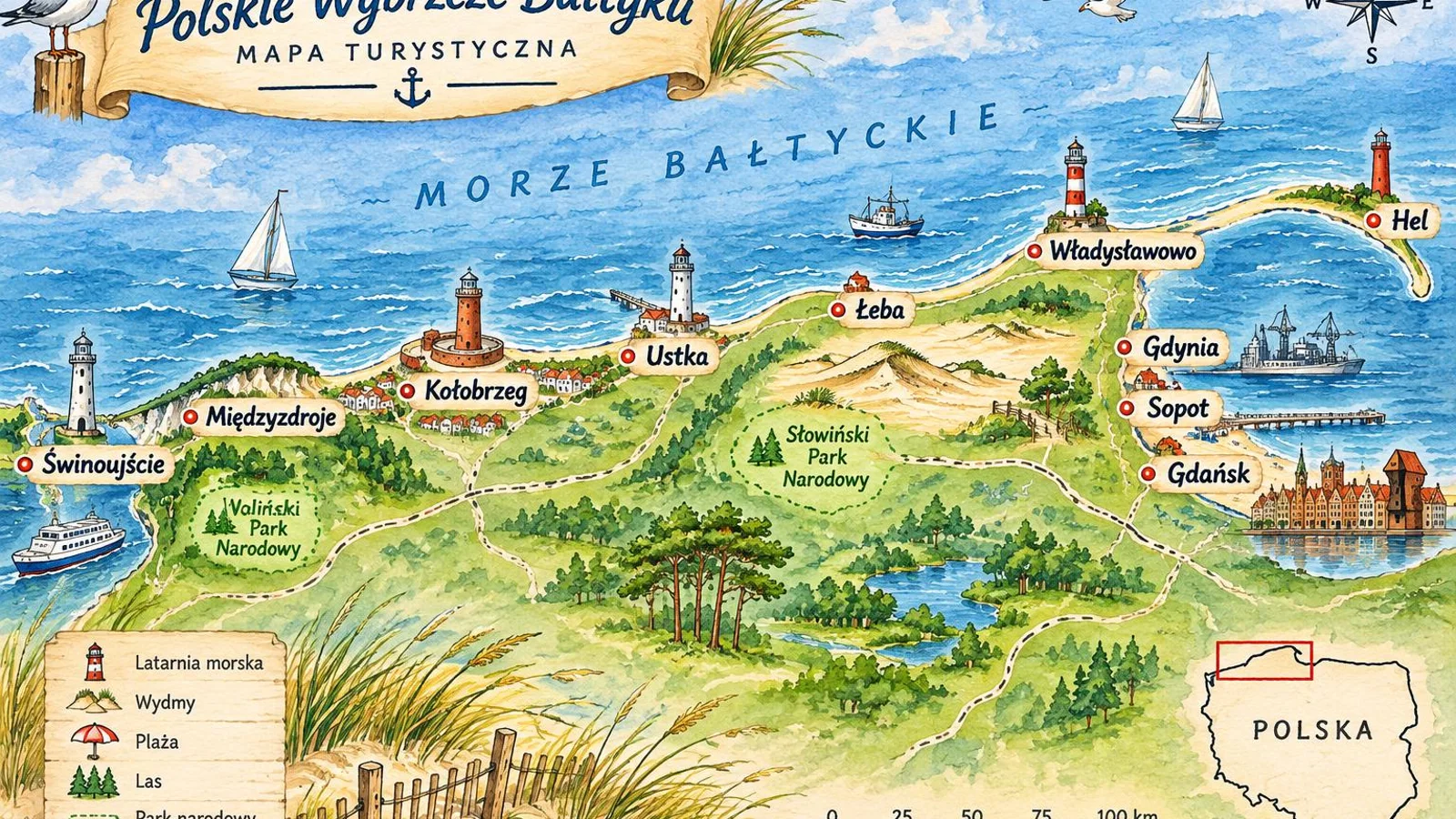
GPT took the win here, with Nano Banana a close second: both maps plotted all ten requested towns in correct geographic order, featured accurate local labels, and captured realistic coastal geography. FLUX generated a pretty watercolor illustration, but accidentally duplicated the town of Wladyslawowo. Seedream and Qwen rendered English titles because the system prompt was in English, which is a fair interpretation, though not ideal if you need localized regional travel assets.
Portraits and brand identity
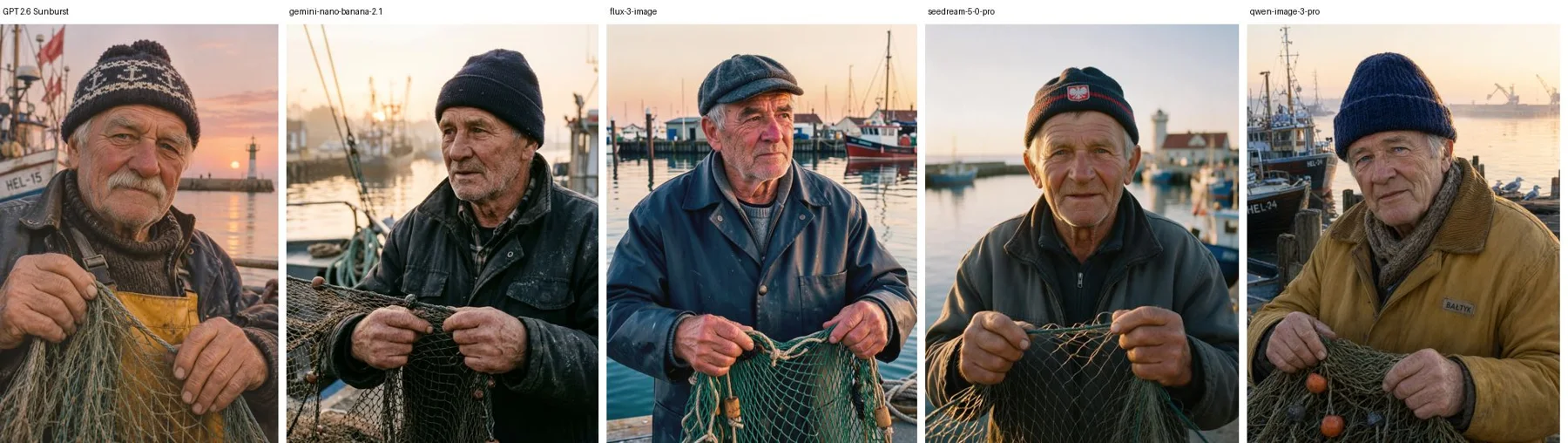
Photorealism is where differences narrow down to personal aesthetic preference. Every tested model rendered clean hands and anatomical details, which used to be the main failure point in earlier generations. GPT delivered the most cinematic directional lighting, Nano Banana produced the most believable skin texture, and Seedream added an unprompted eagle insignia to the cap.

When tasked with generating a logo sheet for “TURTLE BREWERY” (translated from the Polish original), every model spelled the accented characters correctly, preserving both the dot over the Z and the slash through the L. GPT, Nano Banana, and Seedream were the only three to deliver a fully structured brand sheet containing all three labeled logo variants.
Which model should you choose?
My takeaway from this benchmark: when you need complex typography or foreign diacritics embedded directly into imagery, it comes down to a dead heat between GPT-Image-2.6 and Nano Banana 2.1. GPT holds a clear lead in throughput thanks to Flare’s 8-second generation time, while Nano Banana excels at natural photographic texture. FLUX 3 remains fantastic for artwork and text-free scenes, but stumbles more frequently on multi-element compositions. Qwen Image 3 Pro still struggles with Latin diacritics, and Seedream 5 Pro is simply too slow and overpriced to justify against this competition.
Explore individual model evaluations: Nano Banana 2.1, FLUX 3 Max, Seedream, and Qwen Image vs closed models.
Sources
- Author’s benchmarks via the OpenRouter API, 5 Nov 2026: openai/gpt-image-2.6-sunburst, openai/gpt-image-2.6-flare, google/gemini-nano-banana-2.1, black-forest-labs/flux-3-image, bytedance-seed/seedream-5-0-pro, and qwen/qwen-image-3-pro. Usage field costs recorded.
- OpenRouter: GPT Image 2.6 Flare
Verified: 5 Nov 2026.
More on this from QUANTSLANT
 guides·ChatGPT GIF Maker: How to Animate Images and API LimitsChatGPT Images 2.6 lets you generate animated GIFs directly from prompts. Here is how it works in the app and the API limits you need to know.