Nano Banana 2.1: Price, Tests and How to Use It in Gemini for Free
Google launched Nano Banana 2.1: half the API price, 8:1 panoramas, and better inpainting. We tested consistency, text rendering, and sequential editing.
👁 120 reads
Nano Banana refers to Google’s suite of image generation and editing models integrated into Gemini. Starting October 6, 2026, the latest release is Nano Banana 2.1: its API costs half as much as Nano Banana 2 ($0.0336 per 1K image), handles targeted image edits more effectively, and supports ultra-wide 8:1 panoramas. Inside the Gemini web and mobile apps, you can still use it for free, subject to daily usage quotas.
Status as of October 7, 2026
- Latest release: Nano Banana 2.1, launched October 6, 2026, available via API as
gemini-nano-banana-2.1. - Access: Gemini app, Google AI Studio, Search AI Mode, Flow, Stitch, Google Ads; third-party API via OpenRouter and fal.ai.
- API pricing: $0.0336 / $0.0504 / $0.113 per 1K / 2K / 4K image (Nano Banana 2: $0.067 / $0.101 / $0.151).
- Arena (text-to-image, Oct 6): 5th place, 1,328 points; GPT Image 2.5 Sunburst leads with 1,425 points.
- Benchmark tests: 13/13 Polish diacritics rendered, 9.0/10 in masked editing, but severe color drift in repeated editing sequences (SSIM 0.41 after 8 steps).
- October 7 update tests: rendered data charts with bar height errors of just 0.14 percentage points and 19/19 correct numeric values; 4-panel comic delivered 10/12 dialogue bubbles verbatim (detailed results).
- Nano Banana 2 (
gemini-3.1-flash-image) is marked as deprecated.
This overview covers what remains effective from previous iterations (free consumer access, prompting workflows, invisible watermarking) while evaluating version 2.1 through direct hands-on testing. The initial announcement details are documented separately in our report on what Google announced for Nano Banana 2.1.
What is Nano Banana?
Nano Banana originated as a playful internal code name under which a Google model anonymously dominated blind image generation leaderboards. Today, it serves as the official branding for the Gemini image generation ecosystem. The model processes multimodal instructions, synthesizes images from scratch, and excels at editing uploaded source photographs while preserving facial likeness, clothing, and scene structure.
The lineup as of October 2026:
- Nano Banana 2.1: The primary update to Nano Banana 2, engineered for execution speed and low unit costs, delivering improved localized editing and subject consistency. Released October 6, 2026.
- Nano Banana 2 (Gemini 3.1 Flash Image): The preceding baseline, now marked for deprecation in the API.
- Nano Banana Pro (Gemini 3 Pro Image): The higher-tier model with extended reasoning capabilities, tailored for complex typography and miniature text.
- Nano Banana 2 Lite: The entry-level variant, reviewed in our Nano Banana 2 Lite guide.
What is new in Nano Banana 2.1
Google’s API changelog highlights “significant improvements in visual quality, prompt following, multi-turn character consistency, text rendering, and panoramic aspect ratio generation.” The official announcement on X outlined four core upgrades: visual design fidelity, masked inpainting, object and character persistence, and photorealistic rendering.
- 50% lower API cost: Output image generation drops from $60 to $30 per million tokens.
- Panoramas: Native support for aspect ratios including 1:4, 4:1, 1:8, and 8:1 at 1K, 2K, or 4K resolutions.
- Up to 14 reference images: Maintains consistency across up to 4 characters and up to 10 distinct objects within a single composition.
- Three reasoning levels: minimal, medium (default), and high.
- Input flexibility: Accepts text, images, video, and PDF up to 131,072 context tokens; leverages Google Search (including Google Images) for factual grounding.
- Masked editing: Operates semantically; the API lacks a dedicated binary mask parameter, meaning target regions are defined through natural language descriptions or an accompanying visual guide image.
How to get started step by step
- Go to gemini.google.com or open the Gemini app on mobile and sign in with your Google account (age 18+ required).
- Select image creation (banana icon or “Create image”) or simply upload an existing picture and describe your modifications.
- Provide clear, explicit instructions specifying what to keep, what to alter, and your desired aspect ratio. Restrictive phrases like “only change this” and “leave everything else untouched” improve instruction following.
- For panoramas and manual 4K rendering, switch to Google AI Studio, where model variants, aspect ratios, and resolutions can be adjusted directly.
- To integrate into software workflows, generate a developer key (see our Gemini API key guide) or route requests via OpenRouter under the model ID
google/gemini-nano-banana-2.1.
Pricing: free access, subscriptions, and API rates
Within the consumer Gemini web interface and mobile apps, Nano Banana is accessible on the free tier under dynamic usage caps governed by server load. Higher limits are allocated to Google AI subscription tiers. The API tier does not offer a free tier; costs are billed per generated asset:
| Model (Gemini API, standard) | 1K | 2K | 4K | Output image cost |
|---|---|---|---|---|
Nano Banana 2.1 (gemini-nano-banana-2.1) |
$0.0336 | $0.0504 | $0.113 | $30 / 1M tokens |
Nano Banana 2 (gemini-3.1-flash-image) |
$0.067 | $0.101 | $0.151 | $60 / 1M tokens |
Nano Banana Pro (gemini-3-pro-image) |
$0.134 | $0.134 | $0.24 | $120 / 1M tokens |
Batch mode processing (with completion within 24 hours) cuts all standard rates by 50%. In practical tests through OpenRouter including reasoning tokens, effective costs reached $0.035-$0.048 for a 1K image, approximately $0.054 for 2K, and $0.117 for 4K. Input text tokens in version 2.1 increased in price ($1.50 per million tokens versus $0.50 previously), an adjustment primarily relevant when sending complex system prompts or multiple high-resolution reference images.
Complex typography and diacritics test
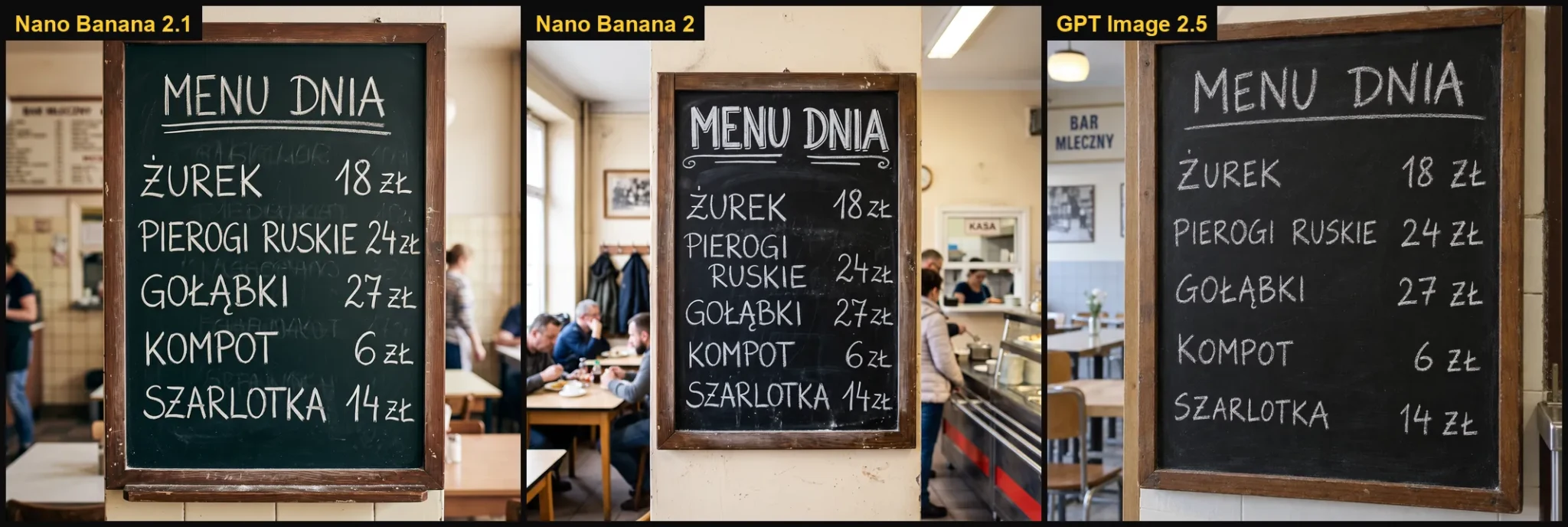
Natural language prompts are processed cleanly across various languages. To stress-test font rasterization and rare diacritics, we tested the model using Polish phrases containing complex accents. Nano Banana 2.1 rendered them without errors: across four graphics featuring diacritics (an event poster, a traditional milk bar menu board, a book cover titled with the Polish words translated as “A Blade of Grass and Bile”, and a dumpling package), it reproduced 13 out of 13 phrases accurately. The only minor deviation: the currency abbreviation in the original Polish test appeared in lowercase instead of the requested uppercase form, replicating behavior also seen in Nano Banana 2 and GPT Image 2.5. On the packaging design, the model added unprompted but contextually coherent brand slogans.
Benchmark results across 8 test suites
Every newly deployed image model is benchmarked across standardized evaluation suites, with direct comparisons aggregated into our AI Image Generator Arena. Nano Banana 2.1 was evaluated on release day via the OpenRouter API using default reasoning settings.
| Test (identical prompt suites) | Nano Banana 2.1 | Nano Banana 2 | Nano Banana Pro | GPT Image 2.5 Sunburst | Arena Leader |
|---|---|---|---|---|---|
| Diacritics & complex text (13 phrases across 4 graphics) | 13/13 | 13/13 | 13/13 | 13/13 | 4-way tie |
| Bounding box object placement (mean IoU, 16 objects) | 0.44 (7/16) | - | 0.48 (7/16) | 0.54 (11/16) | FLUX 3: 0.89 (16/16) |
| Sequential editing drift - SSIM after Step 8 (1.0 = baseline) | 0.41 | 0.61 | 0.60 | 0.48 | Ideogram 4.5: 0.95 |
| 4K fine detail - effective optical resolution | 4.2 Mpx (out of 16.9) | 4.2 Mpx | 4.2 Mpx | 4.1 Mpx | FLUX 3: 16.8 Mpx |
| Micro-typography on 4K renders (8 targets) | 5/8 | 3/8 | 7/8 | 5/8 | Nano Banana Pro: 7/8 |
Key takeaways:
- Typography: Matches the strong performance of its predecessor, remaining near the top tier for text accuracy.
- Bounding box layout: Average. A complex kitchen layout failed (mean IoU 0.19), whereas a beverage commercial setup placed reliably (0.67). For deterministic bounding box layouts, FLUX 3 remains the superior model, as detailed in our FLUX 3 bounding box benchmark.
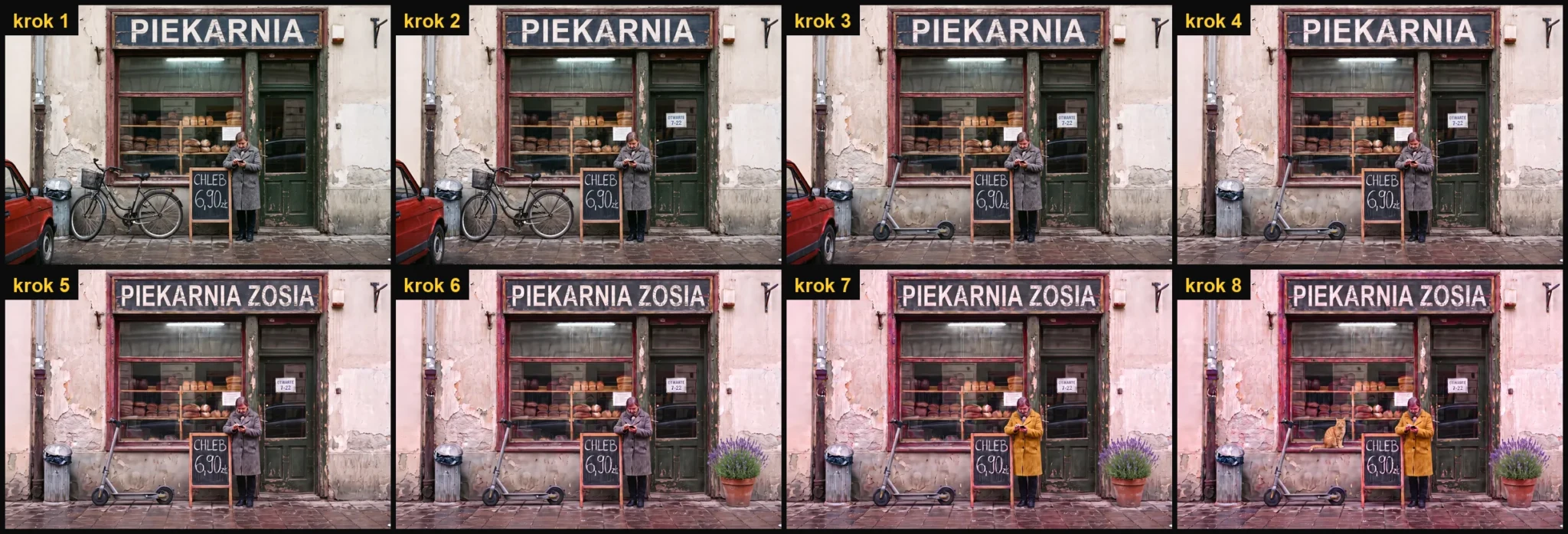
- Sequential editing: The model followed every consecutive instruction (green door, hours sticker, scooter, storefront banner, lavender pots, yellow trench coat, cat). However, the overall frame shifted slightly and developed an aggressive magenta tint. By step 8, average color deviation reached ΔE 18.9, compared to 15.5 for Nano Banana 2.
- 4K outputs: While canvas dimensions measure 5504 × 3072 px, effective resolving detail tops out near 4.2 megapixels, identical to Nano Banana 2 and Pro. The output represents an upsampled structure rather than native optical 4K.
Masked inpainting evaluation
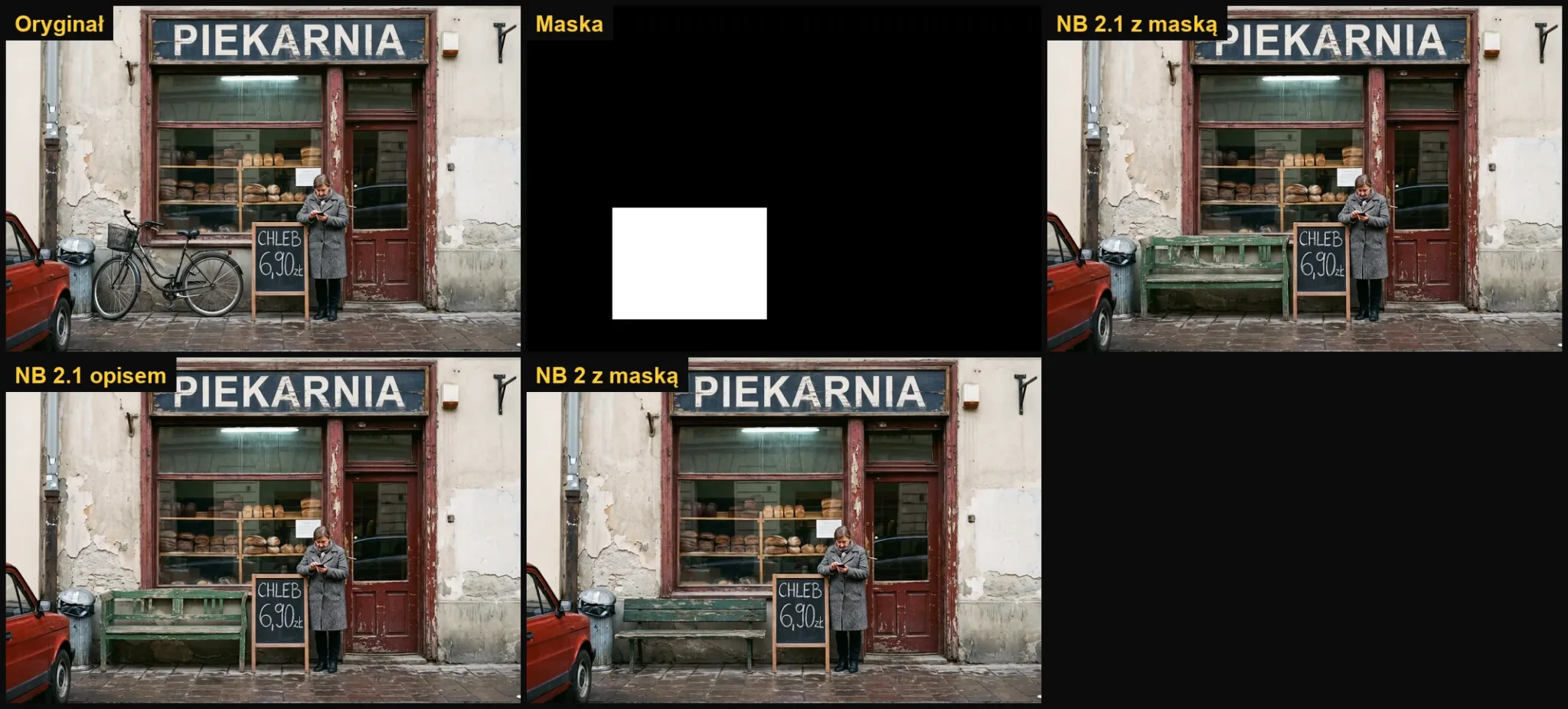
Using a bakery exterior photograph, three editing tasks were assigned: replacing window bread with cakes, swapping a parked bicycle for a bench, and adding a street address plaque to the wall. Edits were performed twice: first pairing the image with a black-and-white mask, then relying strictly on descriptive text prompts. Evaluations were scored via Gemini 3.8 Flash vision analysis. Nano Banana 2.1 scored 9.0/10 with an explicit mask, versus 7.3/10 for Nano Banana 2. Without a mask, version 2.1 dropped to 7.7/10, confirming that spatial masks significantly improve results. Keep in mind that masks act as soft guidance rather than rigid bounding borders: both versions placed the plaque slightly above the designated mask boundary, and surrounding regions were subtly regenerated (outside-mask SSIM hovered around 0.80 for both models).
Character consistency
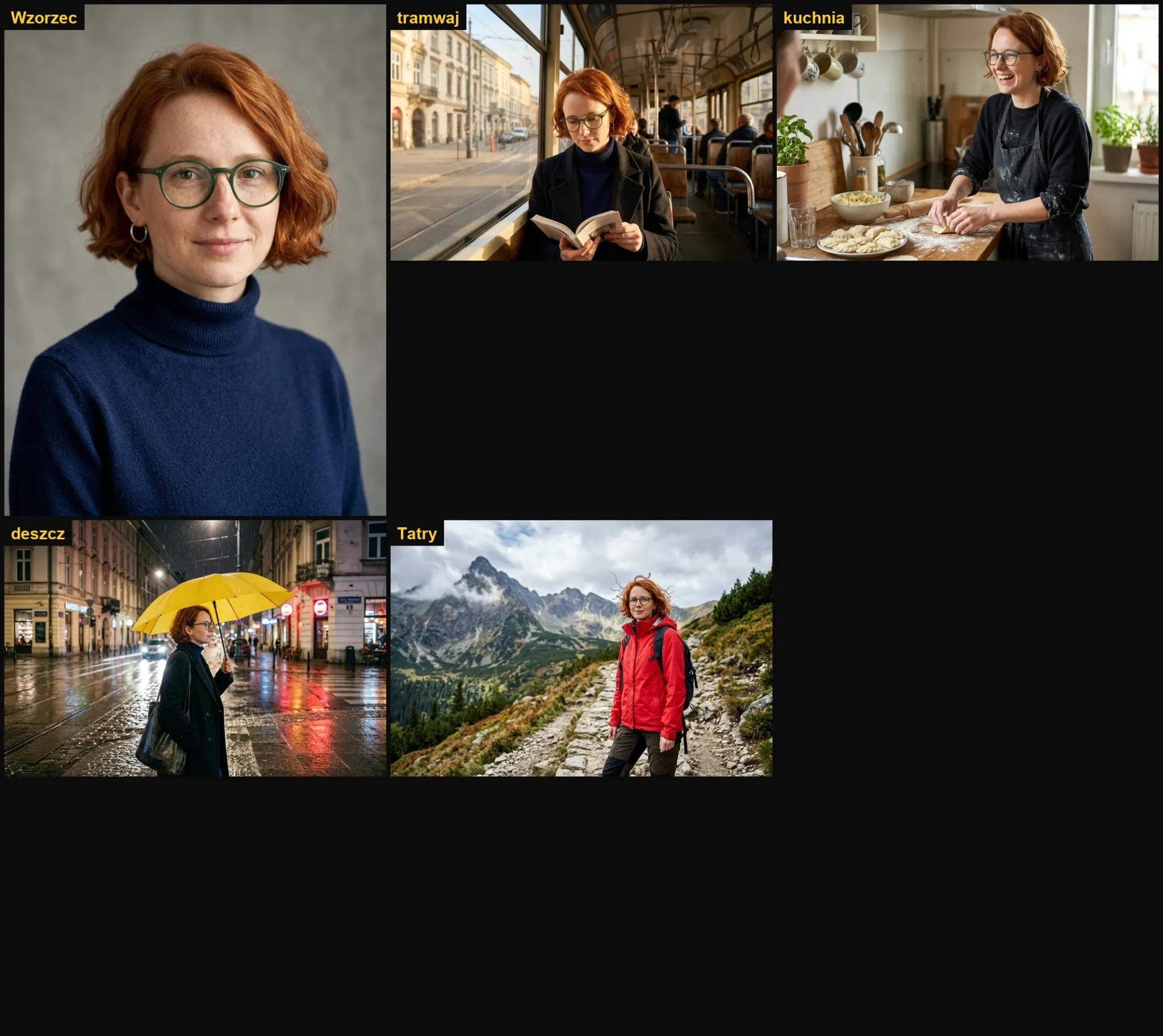
We created a character anchor named “Hanka” (short red hair, freckles, round green glasses, single silver earring) and requested four distinct narrative frames: a city tram interior, hand-making dumplings, a rainy urban street, and an alpine hiking trail. Likeness recognition scored 9.25/10 with 15 of 16 signature facial features preserved, matching Nano Banana 2. The primary improvement is commercial: cost per generated scene dropped from $0.068 to $0.038. Further methodology is covered in our 10 models, one character benchmark.
| Feature Benchmark | Nano Banana 2.1 | Nano Banana 2 |
|---|---|---|
| Masked editing - tasks completed (3 tests) | 3/3 | 3/3 |
| Masked editing - quality score (avg. 1-10) | 9.0 | 7.3 |
| Identical edit via text prompt only (avg. 1-10) | 7.7 | - |
| Character persistence - recognition (avg. 0-10, 4 scenes) | 9.25 | 9.25 |
| Character persistence - preserved traits (hair, freckles, glasses, earring) | 15/16 | 15/16 |
| Measured cost per 1K scene | $0.038 | $0.068 |
A direct head-to-head comparison with the current leaderboard leader is available in our Nano Banana 2.1 vs. GPT Image 2.5 analysis, and sample prompts are cataloged in our Nano Banana 2.1 prompt showcase.
Data visualizations and multi-panel comics
We expanded testing to include two challenging edge cases: programmatic bar charts derived from real-world telemetry (browser share, mountain elevations), measuring individual bar heights down to the pixel, and a 4-panel comic strip evaluating dialogue speech bubbles. Each task contained three test setups run across three models. Note that the original test suite was executed in Polish to evaluate complex non-English character rendering.
| Advanced Test | Nano Banana 2.1 | Nano Banana 2 | GPT Image 2.5 Sunburst |
|---|---|---|---|
| Bar charts - mean height error (19 bars) | 0.14 pp | 0.41 pp | 0.16 pp |
| Chart data labels exact match | 19/19 | 13/19 | 13/19 |
| Chart title accuracy without typos | 2/3 | 3/3 | 3/3 |
| Comic speech bubbles rendered verbatim (12 total) | 10/12 | 12/12 | 12/12 |
| Character consistency across 4 panels (score 0-10) | 9.3 | 9.7 | 9.3 |
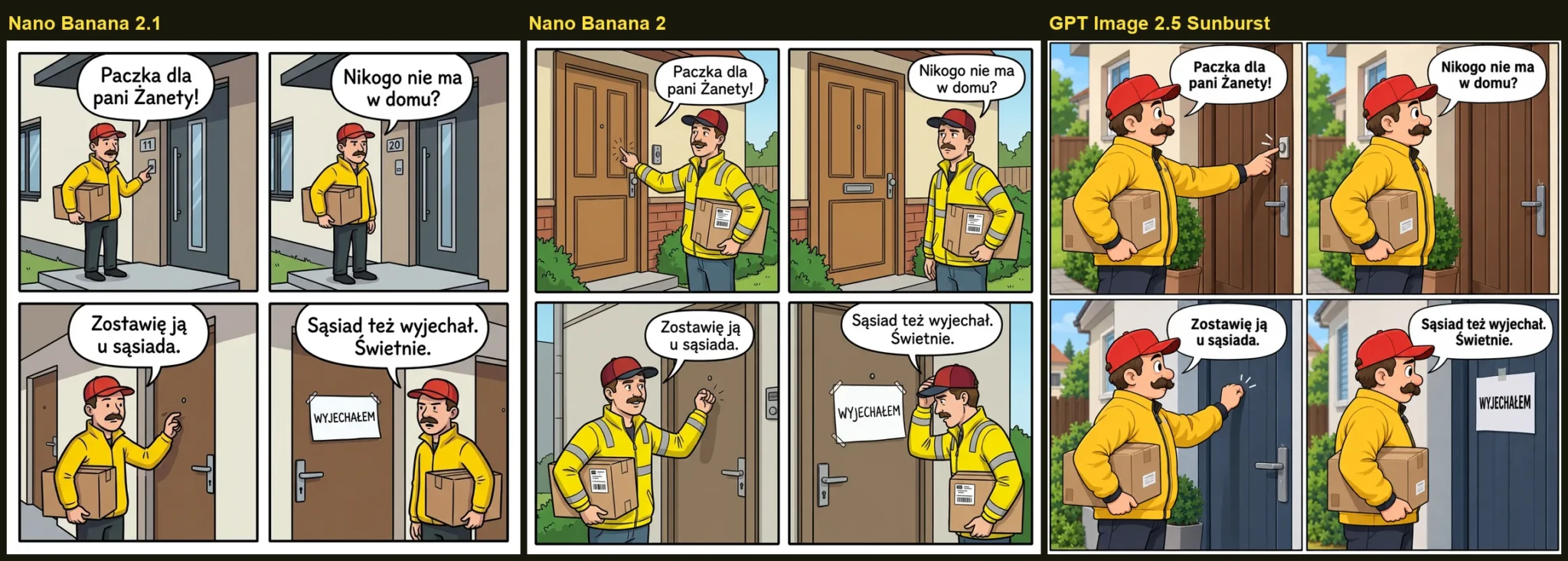
Comprehensive measurement overlays, comic renders, and raw data are published in our Nano Banana 2.1 data infographics and comic breakdown.
Model maturity rating
We have mapped the findings across a three-stage maturity scale: unripe indicates experimental shortcomings, ripe denotes dependable production readiness, and spotted highlights degradation during prolonged editing cycles.
- Bounding box positioning: IoU 0.44, only 7 of 16 targets placed correctly
- 4K rendering: 16.9 Mpx output files resolve only 4.2 Mpx of actual optical detail
- Complex typography: 13/13 test words rendered correctly
- Masked inpainting: 9.0/10 quality (up from 7.3 on Nano Banana 2)
- Character consistency: 9.25/10 stability at $0.038 per scene
- Data infographics: bar height error limited to 0.14 pp, 19/19 labels matched
- Comics: 12 panel bubbles rendered cleanly across test dialogues
- Multi-pass editing: SSIM degraded to 0.41 after 8 sequential steps
- Color shifts toward magenta, mean ΔE of 18.9 (compared to 15.5 for Nano Banana 2)
- Comic layout: 2 of 12 bubbles produced duplicate punctuation (“??” and “!!”)
- Infographics: extraneous accent mark introduced in 1 of 3 chart headings
Competitive comparison
| Model | Text-to-Image Arena (Oct 6) | API Cost per Image | Benchmark Strengths |
|---|---|---|---|
| GPT Image 2.5 Sunburst | Rank 1, 1425 pts | $0.0086-$0.13 (16:9, quality dependent) | Spatial layout, typography, overall visual quality |
| GPT Image 2 (medium) | Rank 3, 1383 pts | - | - |
| MAI Image 2.6 (Microsoft) | Rank 4, 1333 pts | - | Untested |
| Nano Banana 2.1 | Rank 5, 1328 pts | $0.0336-$0.113 | Typography, masked edits, competitive cost |
| FLUX 3 Image | - | - | Bounding box precision, native optical 4K |
| Ideogram 4.5 | - | - | Multi-turn editing without color drift |
Explore detailed breakdowns for alternative models in our guides for GPT Image, Ideogram, FLUX, and Qwen-Image-2.1, or review our consolidated AI image model rankings.
Who should use Nano Banana 2.1?
- Consumers modifying personal images in Gemini: Free access, easy prompting, and reliable facial retention.
- E-commerce and marketing workflows: Clean typographic rendering on packaging, mockups, and campaign variants; API cost is cut in half at scale.
- Comic creators and storyboard artists: Consistent character identities matching Nano Banana 2 at reduced operating cost.
- Avoid for long iterative editing chains on a single frame (magenta color drift) and large-scale architectural print media (4K output is upscaled). Ideogram 4.5 and FLUX 3 are better suited for those demands.
Three prompts to try
For editing your own photograph (adapted from tested patterns): “Preserve the face, body structure, and clothing of the person in the reference photo completely unchanged. Only change the background to a sunlit morning cafe interior, soft window light coming from the left, natural color grading, no skin retouching.”
For generating a graphic from scratch: “A 3:4 vertical poster for a board game night, featuring a single large wooden pawn on an off-white cream background, heading BOARD GAME NIGHT at the top, event date at the bottom, no additional text.”
For localized inpainting: “On this photo, change only the color of the jacket to dark green. Keep everything else untouched.” In version 2.1, you can include a black-and-white mask image and instruct: “Edit only the white area defined in the mask.”
For additional templates, see our guides on 10 practical Nano Banana prompts, conceptual logo design, YouTube thumbnail workflows, and rendering legible in-image text.
Watermarking and known limitations
Every file generated through Nano Banana embeds imperceptible SynthID digital watermarking alongside C2PA provenance metadata; read our analysis on SynthID and C2PA implementations. System guardrails reject non-consensual depictions of public figures and NSFW content. Google explicitly acknowledges that version 2.1 can struggle with dense miniature text, full paragraph generation, and occasional character symmetry errors, such as the earring swapping ears in our multi-scene test.
Related guide: Google Gemini Guide: Plans, API Pricing, Features, and Benchmarks
Frequently Asked Questions
Is Nano Banana 2.1 free to use?
Yes, inside the Gemini web interface and mobile applications, subject to dynamic daily usage limits. The API does not have a free tier: costs run $0.0336 for 1K, $0.0504 for 2K, and $0.113 for 4K images.
How do you enable Nano Banana 2.1 in Gemini?
No configuration is necessary. Google deploys the updated model across consumer web and mobile apps automatically. In Google AI Studio, select it manually from the model drop-down list.
What is the difference between Nano Banana 2.1 and Nano Banana 2?
Version 2.1 cuts API pricing by 50%, adds aspect ratios up to 8:1, introduces three reasoning levels, and improves masked inpainting (scoring 9.0 vs. 7.3 out of 10 in our benchmark). Text accuracy and character consistency remain equally strong, though version 2.1 degrades faster over repeated sequential edits.
Nano Banana 2.1 vs. GPT Image 2.5: Which is better?
GPT Image 2.5 Sunburst leads the text-to-image Arena (1,425 vs. 1,328 points) and demonstrates superior bounding box adherence. Nano Banana 2.1 offers cheaper API pricing and convenient consumer integration within Gemini. Compare their outputs side by side in our direct benchmark review.
What is the API model name for Nano Banana 2.1?
In the official Gemini API, call gemini-nano-banana-2.1. On OpenRouter, use google/gemini-nano-banana-2.1. On fal.ai, routes are designated as google/nano-banana-2.1 and google/nano-banana-2.1/edit.
Does Nano Banana 2.1 produce true optical 4K?
The output canvas measures 5504 × 3072 pixels, but effective resolving detail aligns with roughly 4.2 megapixels. It is suitable for digital displays, but lacks the native detail required for large-format fine-art printing.
Can you use Nano Banana images commercially?
Google’s commercial terms permit business usage, though users remain responsible for third-party intellectual property, trademarks, and source reference rights. SynthID watermarking remains embedded in exported files.
When will Nano Banana 2 be turned off?
In the API changelog, the gemini-3.1-flash-image model identifier is listed as deprecated. While third-party reports suggested an October 29, 2026 cutoff date, official documentation reviewed on October 7 had not confirmed a hard deadline. Production pipelines should migrate to 2.1 promptly.
Sources and verification
- Documentation verified October 7
- 2026: Gemini API Changelog
- Gemini API Pricing
- Model Card: gemini-nano-banana-2.1
- Announcement by @NanoBanana (Oct 6)
- LMSYS Arena Text-to-Image Leaderboard
- OpenRouter and fal.ai model directories
- and original benchmarks conducted via OpenRouter API.
More on this from QUANTSLANT

 news·World Labs Unveils Atlas: Fei-Fei Li’s 3D World ModelFei-Fei Li's World Labs introduces Atlas, a multimodal 3D world model generating 1440p video and spatial assets with precise camera control from single images.